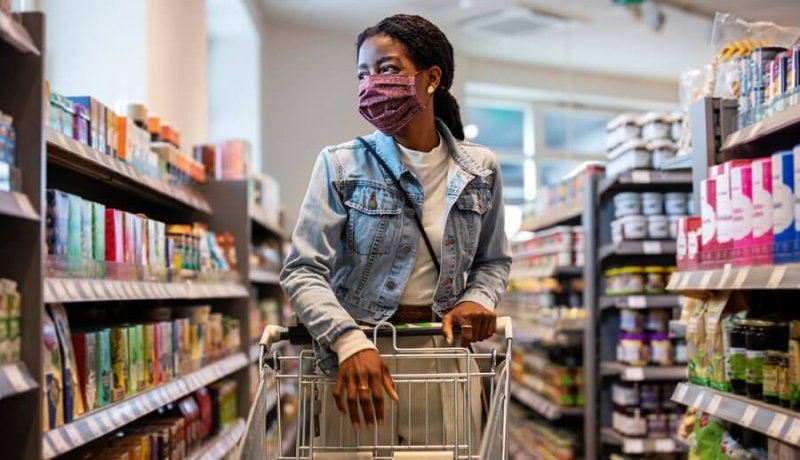
‘Post-coronavirus trauma’: Why a growing group of ‘perma-maskers’ say they won’t forgo face coverings anytime soon

Credit: AARP
Credit: AARP

Last year, protesters staged rallies against official requirements to wear masks, built pyres to burn them in protest and touched off wild screaming matches when confronted about not wearing them inside supermarkets.

But as more Americans become vaccinated and virus restrictions loosen, masks are at the center of a second round in the country’s culture brawl. This time, people who choose to continue to cover their faces have become targets of public ire.

For a number of so-called perma-maskers, the decision is informed by trauma: They endured the coronavirus or witnessed loved ones die, and they say taking off their mask makes them feel terrifyingly vulnerable.


Mis- and disinformation are distorting science and public policy. Subscribe to our Daily and Weekly Digests for incisive coverage of ‘disruptive’ innovations in AI, agricultural biotechnology, food, chemicals, nuclear energy, vaccines, and other disruptive innovations.

Post-coronavirus trauma appears to be common: A survey of nearly 400 Covid patients by doctors at Agostino Gemelli hospital in Italy showed 30 percent developed post-traumatic stress disorder after a severe illness.

“There is an element of precaution that is brought on by the emotional and psychological impact with what I went through,” [COVID survivor Joe] Glickman said of his masking. “I don’t think it is necessarily unjustified. I think it is somewhere in the middle.”


Read the original post

Related Articles

Infographic: Global regulatory and health research agencies on whether glyphosate causes cancer

Infographic: Global regulatory and health research agencies on whether glyphosate causes cancer

Does glyphosate—the world's most heavily-used herbicide—pose serious harm to humans? Is it carcinogenic? Those issues are of both legal and ...

Most Popular

Screenshot-2026-09-16-at-2.26.42-PM
Viewpoint: How to ecologically damage America’s forests: Ban glyphosate
Screenshot-2026-09-20-at-9.03.54-AM
From Malaysia to the world: A pioneering science communicator reimagines global science communication for a digital age
Screenshot-2026-09-20-at-4.31.28-PM
White House drafting executive order to control what OMB Director Vought claims are “woke” NIH science grants
ChatGPT-Image-Sep-17-2026-12_28_43-PM
Vitamin D, omega-3 fish oil and glucosamine supplements could cause brain damage 
ChatGPT-Image-Mar-10-2026-01_39_01-PM
Viewpoint—“Miracle molecule” debunked: Why acemannan supplements don’t work
ChatGPT-Image-Sep-20-2026-04_22_32-PM
What’s Trump’s ‘AI Force’? Administration rushes to announce ill-defined watchdog agency and czar amid criticism of its resistance to curb AI acceleration
ChatGPT-Image-Sep-18-2026-10_49_24-AM
‘Symptom borrowing’: Young people are copying health problems they see on TikTok
Screenshot-2026-08-12-at-11.31.46-AM
AI is helping develop new vaccines
ChatGPT-Image-Sep-11-2026-01_53_42-PM
Should doctors engage in social media to counter misinformation?
Screenshot-2026-09-14-at-4.31.14-PM
Viewpoint: What’s the likely impact when the EPA loosens rules limiting methane pollution from oil and gas wells?
Screenshot-2026-08-19-at-6.19.42-PM
Facts & Fallacies podcast: 'Regenerative farming'? RFK Jr.’s federal push romanticizes the past and risks food security
Screenshot-2026-09-10-at-12.20.19-PM
'Jet fuel didn't melt the steel': 9/11 conspiracy theories debunked
glp menu logo outlined

Get news on human & agricultural genetics and biotechnology delivered to your inbox.