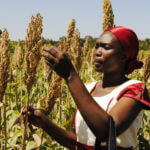
Ghanian farmers press for locally-developed pest-resistant genetically modified cowpea

Credit: Undark
Credit: Undark

More than 200 Ghanaian farmers have expressed their readiness to plant Bt cowpea, Ghana’s first genetically modified food crop as soon as possible.

The crop, which was developed by Ghanaian scientists, has been genetically modified (GM) to resist the destructive pod-borer insect pest. As a result, farmers will be able to significantly reduce the use of pesticides and subsequent increases in yield and income. The crop is also expected to support the nation’s economic development and food security while improving farmers’ livelihoods.

Farmers from the Atebubu-Amantin Municipality of the Bono East Region of Ghana very positive about the technology and say it is good for them. They asked the scientists at CSIR to ensure farmers get the pod borer resistant (PBR) cowpea (GM) Cowpea seeds as soon as possible.

Mis- and disinformation are distorting science and public policy. Subscribe to our Daily and Weekly Digests for incisive coverage of ‘disruptive’ innovations in AI, agricultural biotechnology, food, chemicals, nuclear energy, vaccines, and other disruptive innovations.

[Dr. Daniel Osei Ofosu from the National Coordinator Program for Biosafety Systems] predicted that farmers will be receptive to GM cowpea because it reduces pesticide use and increases yields. “Once the farmer starts to use the technology, the consumer will not feel bad about using it,” he added. “So, to me, it’s a win–win.”

This is an excerpt. Read the original post here.

Related Articles

Infographic: Global regulatory and health research agencies on whether glyphosate causes cancer

Infographic: Global regulatory and health research agencies on whether glyphosate causes cancer

Does glyphosate—the world's most heavily-used herbicide—pose serious harm to humans? Is it carcinogenic? Those issues are of both legal and ...

Most Popular

ChatGPT-Image-Mar-10-2026-01_39_01-PM
Viewpoint—“Miracle molecule” debunked: Why acemannan supplements don’t work
ChatGPT-Image-Sep-10-2026-10_36_07-AM
Viewpoint: Even lousy scientific articles can shield authors when they hype dubious health claims and products
sorghum farmers in kenya FARMERS TREND
Here are all the ways CRISPR gene editing is transforming Africa’s staple crops—and there’s a lot more innovation to come
Screenshot-2026-10-01-at-11.21.27-AM
Vaccine hesitancy, like malaria, surges globally, topping 35% in some countries
ChatGPT-Image-Sep-30-2026-01_11_07-PM
How U.S. teamed with Russia to block global human AI weapons oversight
ChatGPT-Image-Sep-30-2026-01_25_34-PM
Blood tests for Alzheimer’s? The latest grifter, social media scam.
ChatGPT-Image-Sep-21-2026-03_15_09-PM
Viewpoint: Chipotle-inspired lesson: 10,000 sick customers suggest that processed foods can be safer than fresh ones
ChatGPT-Image-Sep-30-2026-01_38_36-PM
Viewpoint: Died “with measles” vs. died “from measles”: RFK, Jr.’s dangerously subversive word games
Screenshot-2026-09-28-at-1.16.38-PM
Defying public perceptions, U.S. cancer deaths plunged 35% since 1991
ChatGPT-Image-Sep-29-2026-12_16_42-PM
Social media influencers are driving food misinformation across Europe
glp menu logo outlined

Get news on human & agricultural genetics and biotechnology delivered to your inbox.