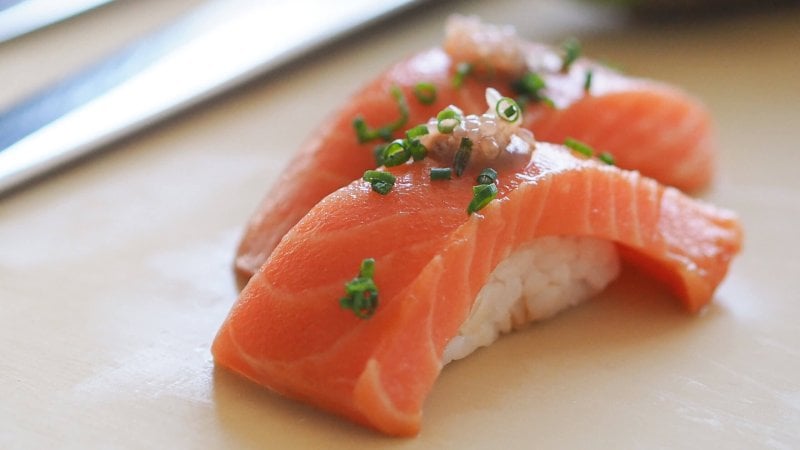
Lab-grown seafood: Here’s a taste test and roadmap of its path to approval

Credit: Wildtype
Credit: Wildtype

Wildtype, a cell-cultured meat company pioneering the field of cellular agriculture to grow cuts of seafood, without fishing or fish farming, invited me to a private tasting at a sushi bar in the East Village of Manhattan to try its sushi-grade salmon. As the first and only cell-cultured seafood brand to raise $100 million in Series B funding, and with high-profile investors like Leonardo DiCaprio, Robert Downing Jr., and Jeff Bezos, I had high expectations; I was not disappointed. In fact, it tasted exactly like conventional sushi-grade salmon (which arguably isn’t the case with many plant-based alternatives), and as a bonus, didn’t have any of the common contaminants such as mercury, microplastics, antibiotics, or pesticides.

Follow the latest news and policy debates on sustainable agriculture, biomedicine, and other ‘disruptive’ innovations. Subscribe to our newsletter.

And then there’s the question of when this product will be available for consumers. It’s currently illegal to sell cell-cultured seafood in the United States, as the U.S. Food and Drug Administration (FDA) hasn’t granted the nascent industry regulatory approval.

“The FDA has been a trusted partner throughout our multi-year consultation process, and we look forward to continuing our work with them […] We understand people have questions about this technology and we believe transparency is absolutely critical in the important work ahead of building trust with our future customers. As a result, we plan to partner with the FDA to make a significant portion of our pre-market safety assessment available to the public.” [says co-founder Justin Kolbeck]


This is an excerpt. Read the original post here

{{ reviewsTotal }}{{ options.labels.singularReviewCountLabel }}
{{ reviewsTotal }}{{ options.labels.pluralReviewCountLabel }}
{{ options.labels.noReviewsLabel }}
{{ options.labels.newReviewButton }}
{{ userData.canReview.message }}

Related Articles

Infographic: Global regulatory and health research agencies on whether glyphosate causes cancer

Infographic: Global regulatory and health research agencies on whether glyphosate causes cancer

Does glyphosate—the world's most heavily-used herbicide—pose serious harm to humans? Is it carcinogenic? Those issues are of both legal and ...

Most Popular

ChatGPT-Image-Jul-22-2026-09_13_07-AM
Viewpoint—The Strategic Litigation boom: Understanding the tightening coalition among NGOs, foundations, journalists, and tort lawyers
How to Include More Strawberries in Your Diet
Strawberries are berries—and 35 other surprising food and drink myths
close up arabica coffee farmer s hands picking beans plant his farm colombia
Viewpoint: Why do so many ‘mainstream’ and ‘respected’ media outlets exaggerate climate change threats?
diversity
We are entering a new era of personalized medicine—if you’re white
Screenshot-2026-07-07-at-12.55.44-PM
Viewpoint: Yes, we can adapt to a changing climate without devastating the environment and the economy
ChatGPT-Image-Mar-10-2026-01_39_01-PM
Viewpoint—“Miracle molecule” debunked: Why acemannan supplements don’t work
ChatGPT-Image-May-22-2026-10_26_09-AM
Trump-RFK, Jr. National Science Board firings: Accountability vs. partisan meddling
organic scaled
Facts & Fallacies podcast: Organic food cuts pesticide exposure? A response to Dr. Rhonda Patrick
Screenshot 2026-07-22 at 10.25
Science brain drain escalates as Trump purge extends to USDA
ChatGPT-Image-Jul-6-2026-02_25_26-PM
40 million Americans take glucosamine. If you have memory loss, it could accelerate cognitive decline.
ChatGPT-Image-Jun-25-2026-12_23_17-PM
No, Bill Gates did not secretly engineer ticks to promote veganism
using genetics to reverse aging
Is the longevity obsession a new form of ageism?
Screenshot-2026-07-01-at-2.49.48-PM
Dr. TikTok and male fertility: Viral claims tout GLP-1 drugs as fertility boosters. What does the science say?

Sorry. No data so far.

glp menu logo outlined

Get news on human & agricultural genetics and biotechnology delivered to your inbox.