A single kilo of saffron is worth up to $10,000. Here’s the genetic history of the world’s most expensive spice

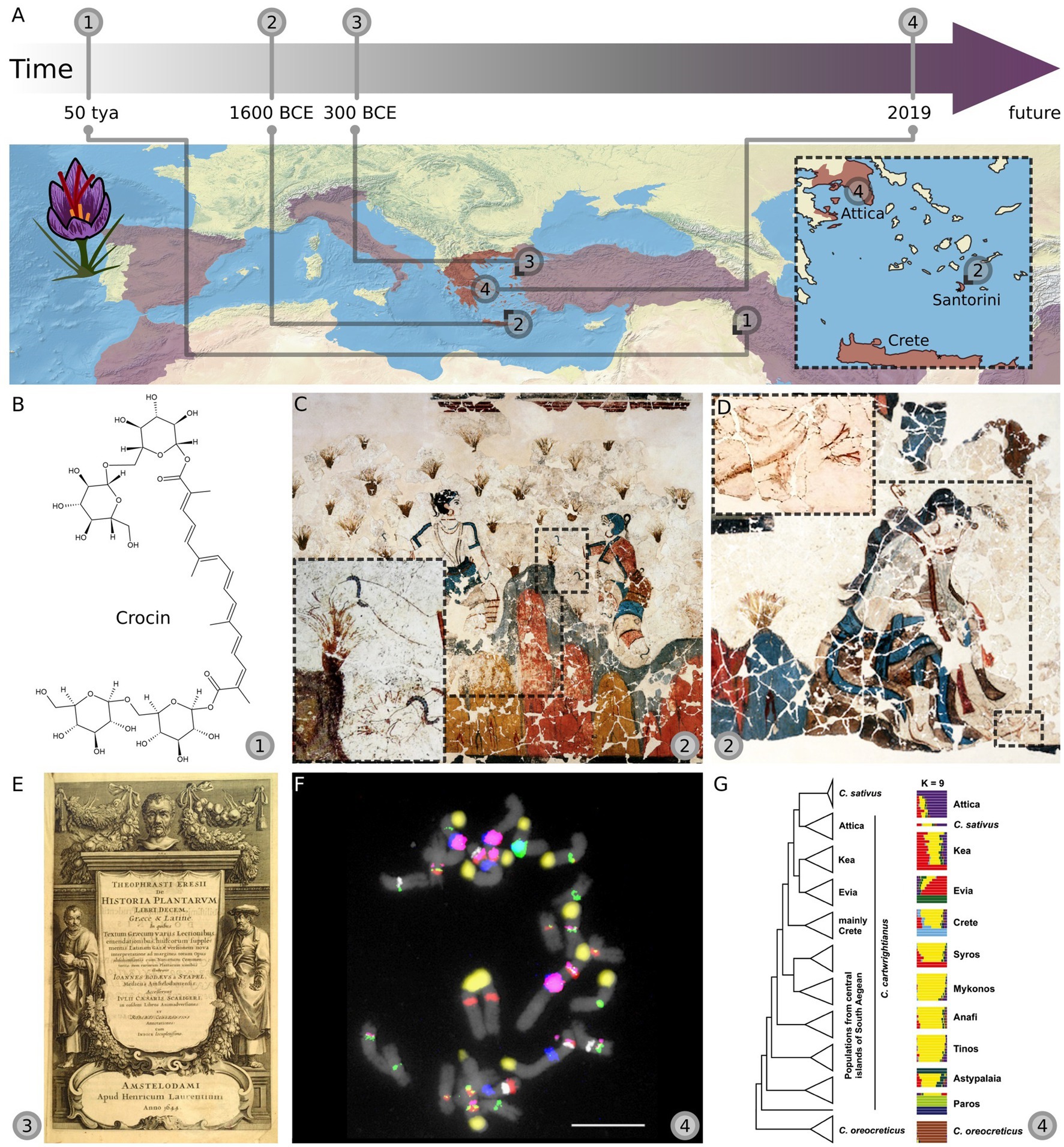
A detail of the "Saffron Gatherers" fresco from the "Xeste 3" building. The fresco is one of many dealing with saffron that were found at the ancient Minoan settlement of Akrotiri, Santorini. Credit: Frescoes

Saffron, the world’s most expensive spice, is extracted from the flowers of the saffron crocus, Crocus sativus. It has been grown for thousands of years in the Mediterranean region. But when and where was saffron first domesticated by our ancestors? In a review in Frontiers in Plant Science, researchers conclude that lines of evidence from ancient art and genetics converge on the same region.

“Both ancient artworks and genetics point to Bronze Age Greece, in approximately 1700 BCE or earlier, as the origin of saffron’s domestication,” said Ludwig Mann, one of the leading authors and a PhD student at Technische Universität Dresden, Germany.

Mis- and disinformation are distorting science and public policy. Subscribe to our Daily and Weekly Digests for incisive coverage of ‘disruptive’ innovations in AI, agricultural biotechnology, food, chemicals, nuclear energy, vaccines, and other disruptive innovations.

The authors argue that artworks from the Minoan civilization of ancient Greece are likely the oldest to depict domesticated saffron. For example, the dense patches of crocus flowers on the fresco ‘The Saffron Gatherers’ from the island of Santorini (approximately 1600 BCE) suggest cultivation. Another fresco on the same island, ‘The Adorants’, shows flowers with long, dark-red stigmas which overtop dark violet petals, typical of domesticated saffron.

An origin in Bronze Age Greece agrees with results from genetic studies from 2019, which showed that C. cartwrightianus, which only occurs in mainland Greece and Crete, is saffron’s closest wild relative.


This is an excerpt. Read the original post here

Related Articles

Infographic: Global regulatory and health research agencies on whether glyphosate causes cancer

Infographic: Global regulatory and health research agencies on whether glyphosate causes cancer

Does glyphosate—the world's most heavily-used herbicide—pose serious harm to humans? Is it carcinogenic? Those issues are of both legal and ...

Most Popular

Screenshot-2026-09-16-at-2.26.42-PM
Viewpoint: How to ecologically damage America’s forests: Ban glyphosate
Screenshot-2026-09-20-at-9.03.54-AM
From Malaysia to the world: A pioneering science communicator reimagines global science communication for a digital age
ChatGPT-Image-Mar-10-2026-01_39_01-PM
Viewpoint—“Miracle molecule” debunked: Why acemannan supplements don’t work
Screenshot-2026-09-20-at-4.31.28-PM
White House drafting executive order to control what OMB Director Vought claims are “woke” NIH science grants
ChatGPT-Image-Sep-17-2026-12_28_43-PM
Vitamin D, omega-3 fish oil and glucosamine supplements could cause brain damage 
ChatGPT-Image-Sep-20-2026-04_22_32-PM
What’s Trump’s ‘AI Force’? Administration rushes to announce ill-defined watchdog agency and czar amid criticism of its resistance to curb AI acceleration
ChatGPT-Image-Sep-18-2026-10_49_24-AM
‘Symptom borrowing’: Young people are copying health problems they see on TikTok
ChatGPT-Image-Sep-11-2026-01_53_42-PM
Should doctors engage in social media to counter misinformation?
Screenshot-2026-08-12-at-11.31.46-AM
AI is helping develop new vaccines
Screenshot-2026-09-10-at-12.20.19-PM
'Jet fuel didn't melt the steel': 9/11 conspiracy theories debunked
Screenshot-2026-09-14-at-4.31.14-PM
Viewpoint: What’s the likely impact when the EPA loosens rules limiting methane pollution from oil and gas wells?
Screenshot-2026-08-19-at-6.19.42-PM
Facts & Fallacies podcast: 'Regenerative farming'? RFK Jr.’s federal push romanticizes the past and risks food security
Screenshot-2026-09-17-at-10.24.54-AM
Viewpoint: Dubious environmental fears: Why the AI buildout is critical to America’s ecological future
glp menu logo outlined

Get news on human & agricultural genetics and biotechnology delivered to your inbox.