A.L. 288-1, better known as Lucy, was unearthed 50 years ago. Here is how a pile of bones reshaped our knowledge of human evolution

messages

In 1974, researchers unearthed fossil AL 288-1, more commonly known as “Lucy”, in a 3.2-million-year-old deposit in the Hadar region of Ethiopia. In the fifty years since this monumental discovery, paleoanthropologists around the world have spent countless hours analyzing one the most complete fossil hominins ever discovered.
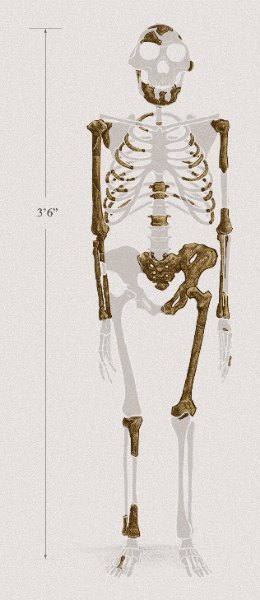
Just as hominins evolved over time, so has our understanding of Lucy and where she fits in the tangled tree of human evolution. Over the last half-century, Lucy has taught us about her own species, Australopithecus afarensis, and related species of australopiths and other hominins. Her skeleton has become a critical part of paleoanthropology and has shaped how we study ancient hominins.

Mis- and disinformation are distorting science and public policy. Subscribe to our Daily and Weekly Digests for incisive coverage of ‘disruptive’ innovations in AI, agricultural biotechnology, food, chemicals, nuclear energy, vaccines, and other disruptive innovations.

While the fossils paleoanthropologists study are millions of years old, our understanding of the species that came before us is constantly changing with new discoveries and new advances in science. New perspectives in the field lead to researchers asking new questions about old fossils, which leads to a better understanding of the fossils we already have and those we have yet to find. And there’s still more to learn from Lucy even fifty years after she was first unearthed in Ethiopia.


This is an excerpt. Read the original post here

Related Articles

Infographic: Global regulatory and health research agencies on whether glyphosate causes cancer

Infographic: Global regulatory and health research agencies on whether glyphosate causes cancer

Does glyphosate—the world's most heavily-used herbicide—pose serious harm to humans? Is it carcinogenic? Those issues are of both legal and ...

Most Popular

Crumbling MAHA Stage Portrait
Cataloging the RFK Jr.-MAHA crushing midterm collapse
Reaching Through the Woven Sky
Challenging genetic modification rejectionists: Our evolving food system has relied on science for thousands of years
Microscopic IVF Egg Injection
With technical barriers to human embryo editing falling, ethical concerns escalate
Smiling-Woman-Over-Teal-Abstract-Shapes
Viewpoint: RFK Jr.’s latest foray into junk science: Even Kennedy’s hand-picked NIH director balks at appointment of crackpot mental health director
Picture1
Viewpoint: How badly is the U.S. food-safety net fraying? FDA’s bungled handling of the tainted lettuce crisis deepens concerns over cuts to disease tracking and response
Bayer Crop Circle in Golden Wheat
Making fertilizer from thin air: Bayer’s gene-editing innovation could dramatically cut chemical fertilizer use in growing food
Screenshot-2026-10-29-at-11.18.34-AM
Viewpoint: ‘Just the flu’: Skipping your child’s flu shot could be a fatal mistake
ChatGPT-Image-Mar-10-2026-01_39_01-PM
Viewpoint—“Miracle molecule” debunked: Why acemannan supplements don’t work
Screenshot-2026-11-02-at-11.34.28-AM
Farmers are collateral damage in the PFAS “forever chemicals” crossfire. Here’s what they need to know.
Blue Checklist in Centered Hand
Viewpoint: From Medicaid cuts to MAHA-backed anti-vaccine and chemical hysteria, voters reject Republicans’ science-skeptical agenda
Neon Genome_ Fetal Dreamscape
The race to genetically engineer babies
Hipster eugenics: better babies for billionaires
Viewpoint: “Positive eugenics”: Reviving a movement reviled and condemned for a century
Screenshot-2026-11-03-at-12.31.18-PM
Gene editing once viewed with suspicion by UK  farmers, upwards of 90% now open to their sustainability benefits
Screenshot 2026-11-04 at 12.02
Ever wonder why AI can so easily be duped into manufacturing health misinformation?    
Screenshot-2026-10-28-at-3.00.44-PM
Viewpoint: Activist attacks on corporations increasingly depend on "attribution" science to target oil companies for global climate change
glp menu logo outlined

Get news on human & agricultural genetics and biotechnology delivered to your inbox.