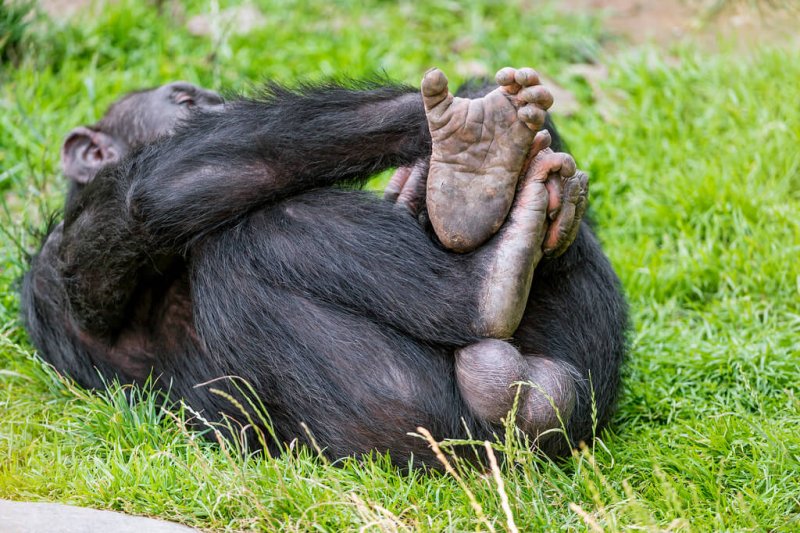
The human body is a machine whose many parts – from the microscopic details of our cells to our limbs, eyes, liver and brain – have been assembled in fits and starts over the 4 billion years of our history.
But scientists are still puzzling over why we evolved into this particular form. Why do humans uniquely have a chin, for example? And why, relative to body weight, is a human testicle triple the size of a gorilla’s but a fifth of that of a chimpanzee? As I show in my new book, The Tree of Life, we are still searching for the answers to many of these “why” questions. But we are starting to find answers to some of them.
The story of evolution tells us how, starting from simple beginnings, each species was built – when each of the components that make a living creature was added to its blueprint. If we climb the evolutionary tree of life, we can follow a twisting path that visits the increasingly specialised branches that a species belongs to. We humans, for example, were animals before we became vertebrates; mammals before evolving into primates and so on.
The groups of species we share each of these branches with reveal the order our body parts appeared in. A body and a gut (inventions of the animal branch) must have come before backbone and limbs (vertebrate branch); milk and hair (mammals) came before fingernails (primates).
There is a way we can study the separate problem of just why we evolved each of these body parts, but it only works if the feature in question has evolved more than once on separate branches of the tree of life. This repeated evolution is called convergence. It can be a source of frustration for biologists because it confuses us as to how species are related. Swallows and swifts, for example, were once classified as sister species. We now know from both DNA and comparisons of their skeletons that swallows are really closer relatives of owls than swifts.
Size matters when it comes to evolution
But convergent evolution becomes something useful when we think of it as a kind of natural experiment. The size of primate testicles gives us a classic example. Abyssinian black and white colobus monkey and bonnet macaque adult males are roughly the same size. But, like chimps, humans and gorillas, these similar monkeys have vastly dissimilar testicles. Colobus testicles weigh just three grams. The testicles of the macaques, in contrast, are a whopping 48 grams.
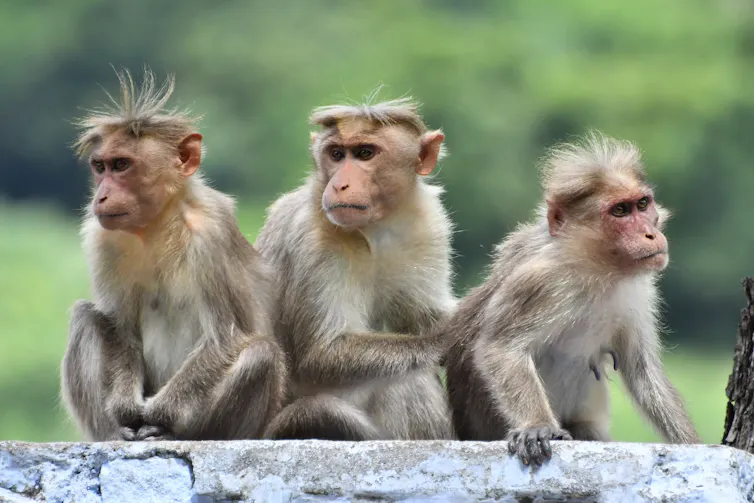
You could come up with several believable explanations for their different testicle sizes. Large testicles might be the equivalent of the peacock’s tail, not useful per se but attractive to females. But perhaps the most plausible explanation relates to the way they mate. A male colobus monkey competes ferociously for access to a harem of females who will mate exclusively with him. Macaques, on the other hand live in peaceful mixed troops of about 30 monkeys and have a different approach to love where everyone mates with everyone else: males with multiple females (polygamy) and females with multiple males (polyandry).
The colobus with his harem can get away with producing a bare minimum of sperm – if a droplet is enough to produce a baby, then why make more? For a male macaque the competition to reproduce happens in a battle between his sperm and the sperm of other males who mated before or after. A male macaque with large testicles should make more sperm, giving him a higher chance of passing on his genes. It’s a sensible explanation for their different testicle sizes, but is it true? This is where convergent evolution helps.
If we look across the whole of the mammal branch of the tree of life we find there are many groups of mammals that have evolved testicles of all different sizes. In almost all these separate cases, larger testicles are consistently found in promiscuous species and smaller in monogamous.



A small-testicled, silverback male gorilla has sole access to a harem. Big-testicled chimps and bonobos are indeed highly promiscuous. Dolphins, meanwhile, may have the biggest mammalian testicles of all, making up as much as 4% of their body weight (equivalent to human testicles weighing roughly 3 kilos). Although wild dolphin sex lives are naturally hard to study, spinner dolphins at least fit our expectations, engaging in mass mating events called wuzzles.
It was thanks to the multiple observations provided by convergent evolution that we were able to discover this consistent correlation between testicle size and sex life right across the mammals. And as for humans, we have testicle size somewhere in the middle, you can make of this what you want!
But what of the human chin?
The human chin has been fertile ground for arguments between scientists over its purpose. As with testicles, there are half a dozen plausible ideas to explain the evolution of the human chin. It could have evolved to strengthen the jaw of a battling caveman. Maybe the chin evolved to exaggerate the magnificence of a manly beard. It might even be a by-product of the invention of cooking and the softer food it produced – a functionless facial promontory left behind by the receding tide of a weakening jaw.
Intriguingly, however, a chin can be found in no other mammal, not even our closest cousins the Neanderthals. Thanks to the uniqueness of the Homo sapiens chin, while we have a rich set of possible explanations for its evolutionary purpose, in the absence of convergent evolution, we have no sensible way of testing them.
Some parts of human nature may be destined to remain a mystery.
Max Telford is Jodrell Professor of Zoology and Comparative Anatomy at University College London. Follow Max on Blue Sky.
A version of this article was originally posted at Conversation and has been reposted here with permission. Any reposting should credit the original author and provide links to both the GLP and the original article. Find Conversation on X @ConversationUS