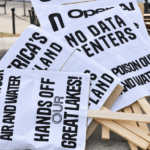
Midterms delivered a jolt to the AI industry: candidates promising to freeze data-center development won statehouses in Texas, Georgia, Ohio and Michigan, four of the country’s biggest data-center markets. Now tech giants are scrambling to adjust, as The Wall Street Journal’s Meghan Bobrowsky and Maxwell Zeff report.
At OpenAI, CEO Sam Altman fielded employee questions the next day, acknowledging concerns over water use and musing that the company might build in the desert. Senior leaders weighed whether to reset expectations for next year’s computing capacity, while staff traded notes on courting newly elected Democrats.
Tech investor Brad Gerstner said on the “All-In” podcast that as much as 35% of U.S. data-center construction planned for next year is now at risk, with moratoriums, tighter environmental rules and longer reviews looming.
Dina Powell McCormick, president of Meta Platforms, said at least one incoming governor who campaigned on the issue already wants to talk: “As soon as we get past the inauguration, let’s meet, because we don’t want to lose this investment in our town.” Still, she expects new U.S. builds from scratch to be “very challenging,” and said companies are increasingly eyeing sites abroad or expanding existing facilities where communities have already seen jobs and tax revenue.




Her prescription is better messaging. “I think we have to double and triple down on telling the story,” she said. OpenAI President Greg Brockman agreed: “We need to do a better job of really communicating to local communities about why data centers are something that can be beneficial to them.”
OpenAI followed up with a pledge to stop requiring officials to sign nondisclosure agreements and to publish the energy, water and noise impacts of its projects. Anthropic, meanwhile, flagged moratoriums as a risk in an S-1 filing for its planned IPO, noting it is pursuing projects in “non-U.S. jurisdictions” to reduce concentration risk, alongside roughly $895 billion in computing and infrastructure commitments through 2045.