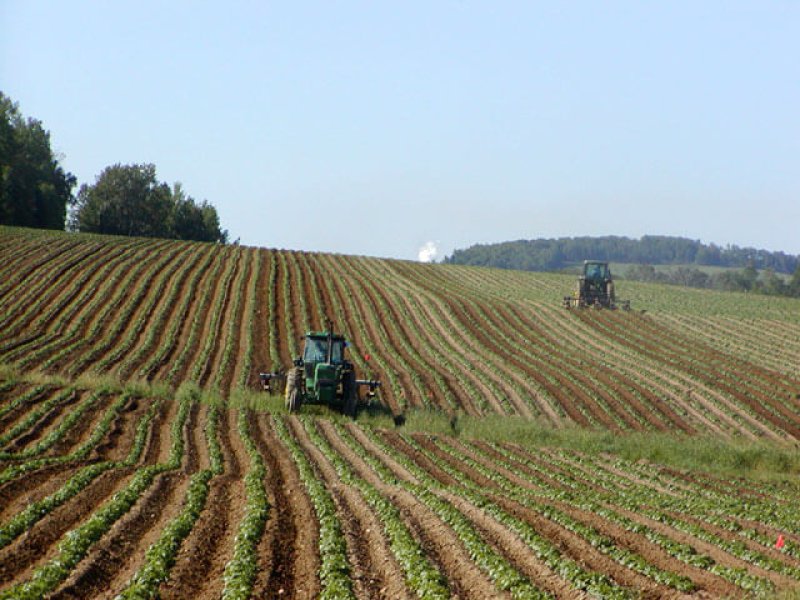
Do GMO crops “foster monoculture?” This is a frequent criticism of modern agriculture. [It’s a favorite claim of foodie and anti-GMO activist Michael Pollan. “I still feel that the great evil of American agriculture is monoculture,” he has written, laying the blame firmly at the feet of genetic engineering.] I have three problems with it:
- “Monoculture” isn’t the right term to use to describe the relevant issues – its really about a limited crop rotation
- History and economics are the drivers behind this phenomenon, not crop biotechnology
- The solutions – to the extent that they are needed – are not what most critics seem to imagine
The Corn Belt of the Midwestern U.S., is a multi-million acre farming region almost entirely dominated by just two crops – corn and soybeans. This phenomenon is often termed “monoculture,” but monoculture is merely the practical approach of growing a single crop in a given field. The opposite of monoculture is “polyculture” and it is entirely impractical for even minimally mechanized farming.
The Corn Belt is more accurately described as an example of a “limited crop rotation.” The typical pattern is an alternation between corn and soybeans in each field. There are also some fields where the growers plant continuous corn or continuous soybeans. There are many reasons that a more “diverse crop rotation” could be a good idea. Mixing up crop types over time can help build soil quality because of different rooting patterns or residue characteristics. Some plant pests can be more easily managed if their life cycles are disrupted by cropping changes. All of this is well known, but for a variety of reasons that I’ll discuss below, the less diverse rotation persists.
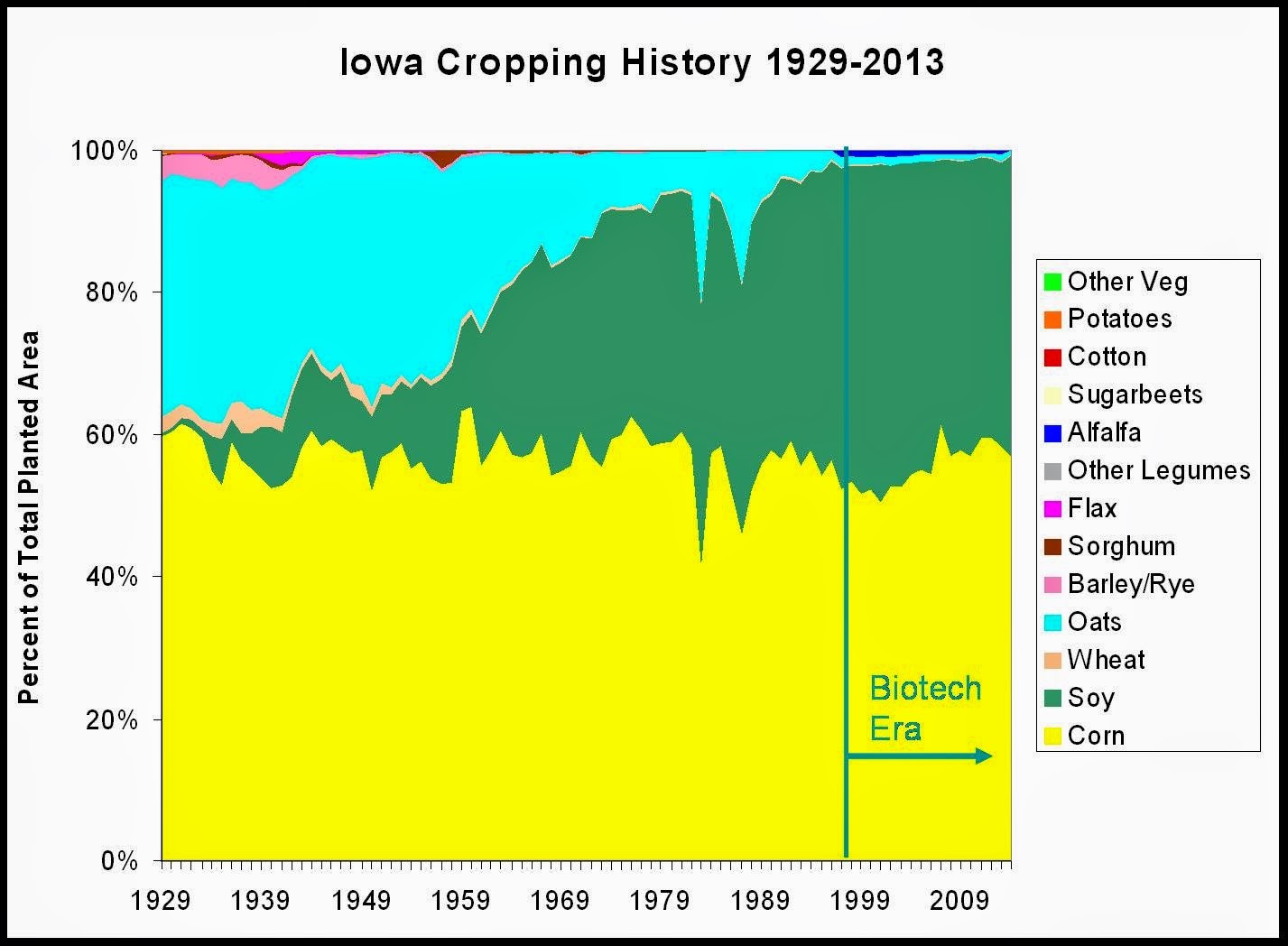
Let’s start by looking at Iowa, which sits in the very heart of the “Corn Belt.” As you can see from the graph above, corn has been the dominant Iowa crop for a very long time, because Iowa is just about the ideal place to grow that crop. Most farmland in that part of the Midwest is “rain-fed” rather than irrigated. The amount of rain that typically falls in Iowa is sufficient to produce a good corn crop without limiting yield by the number of cloudy days.
Corn is heavily planted because it typically returns the highest net profit with the least risk. The income potential from corn is what drives the cost of land for purchase or rent. As the farming population shrank and farm size increased over the last century, the remaining growers have expanded somewhat through land purchases, and more commonly through rentals. For a farmer to keep up with a mortgage or lease typically requires growing a lot of corn.
Back in the 1930s, the main crop that was rotated with corn was oats – ironically much of that to be used as a “transportation biofuel” for horses. Starting in the 1940s, soybeans began to evolve into the favored rotational crop — mostly as an animal feed with a co-product of oil for human consumption. Soybeans have much lower yield than corn, but they are able to generate their own nitrogen fertilizer (with microbial help) and don’t require many other inputs. Thus, soy has also been a reliable way to generate enough profit to cover land and operating costs. All other crops have only ever had niche status in Iowa. When biotech crops arrived they were simply sold into that pre-existing market.


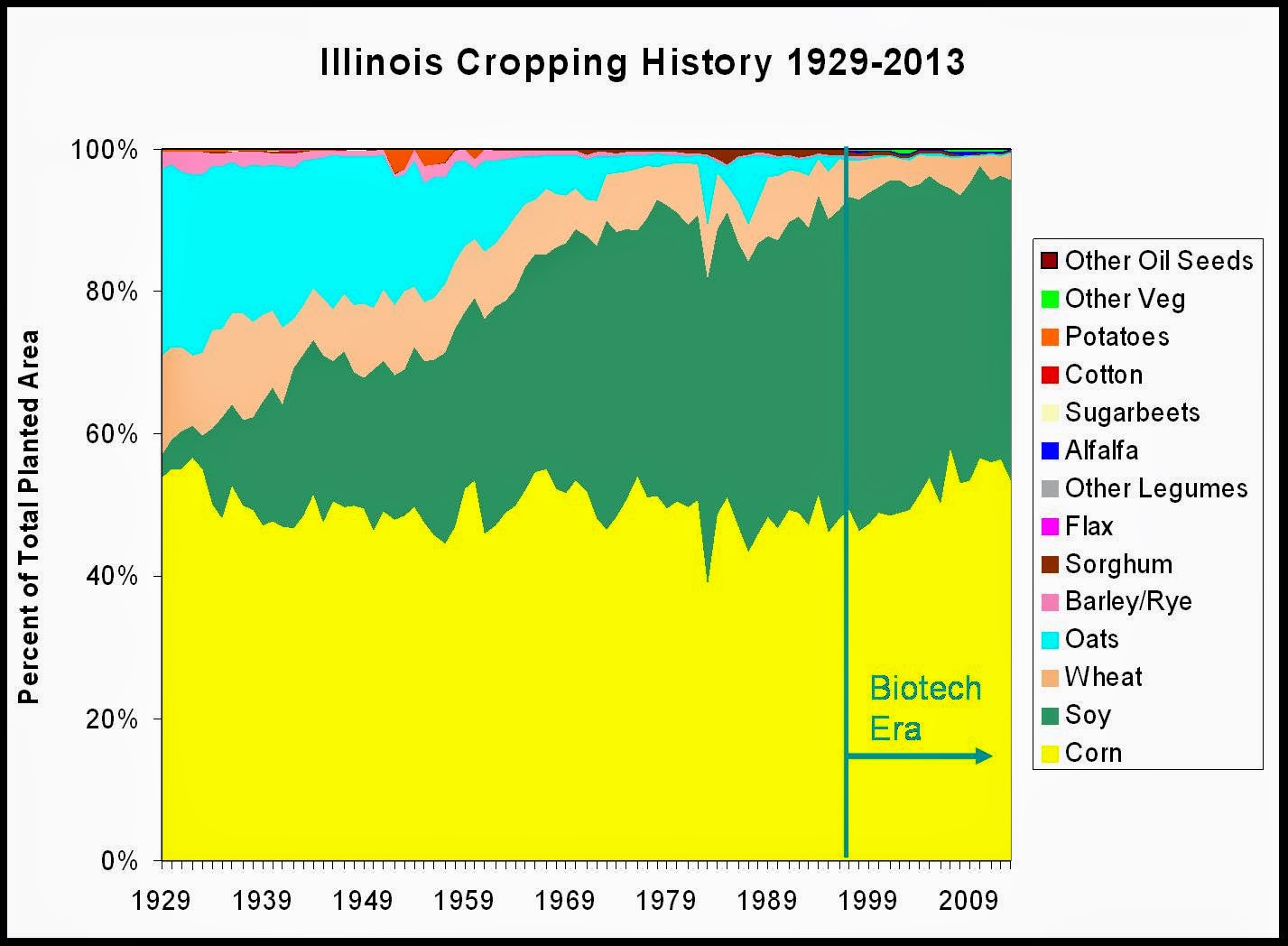
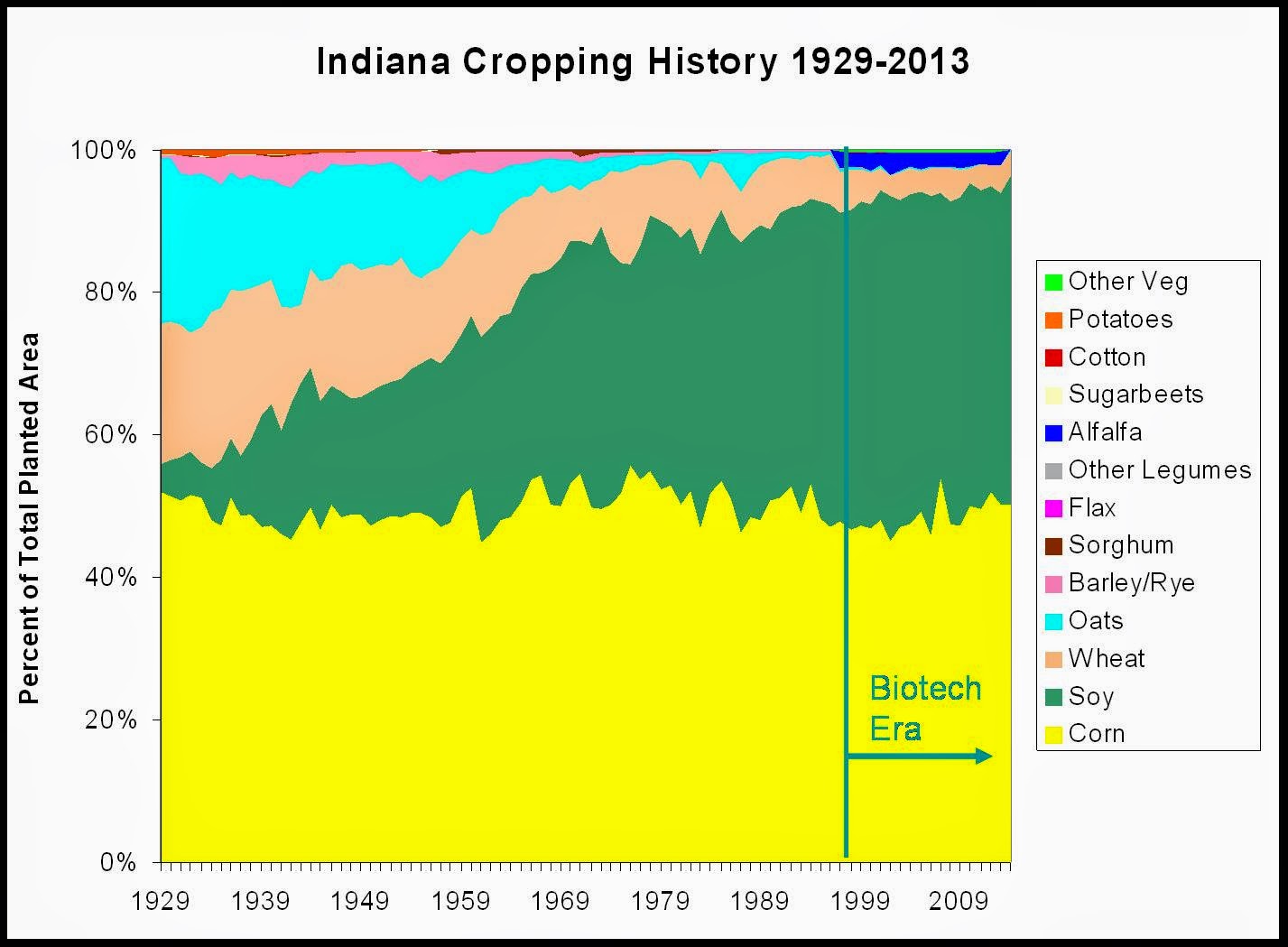
Illinois and Indiana have also been mostly two crop states ever since soybeans filled in for declining oat demand in the 50s and 60s. There has always been a small, but significant wheat sector in both of these states, part of a “double cropping” system in which corn is followed by winter wheat and then soy, producing three cash crop harvests in two years. Indiana now has a small alfalfa segment – a case of crop diversification “fostered by a GMO crop.”
There is a disease of wheat and barley called Fusarium Head Blight, which has been an increasing issue in all five of these states since the 1980s (and again in 2014). Corn, and particularly the crop residue in no-till corn, serves as a source of spores which can then infect the wheat or barley during their bloom period. Head blight is difficult to control and it can lead to significant yield losses. Infection can also lead to contamination of the grain with a mycotoxin called DON– or more colorfully, “vomitoxin.” Throughout the Midwest, wheat does not tend to have as much profit potential as corn or soy even in good years, but the risk of severe yield or quality loss from Head Blight is really what makes wheat much less attractive. Biotech had the potential to help wheat keep a place in the Corn Belt rotation, but that solution was thwarted by anti-GMO campaigning.
Read the full, original article: Do GMO crops foster monoculture?
Additional Resources:
- The problem with Monoculture, Andrew Kniss
- Union of Concerned Scientists blames GMOs for ‘superweeds’ but issue more complex, Genetic Literacy Project
- UK Ecologist: GMOs produce ‘monopoly’ and ‘monoculture’, Ecologist