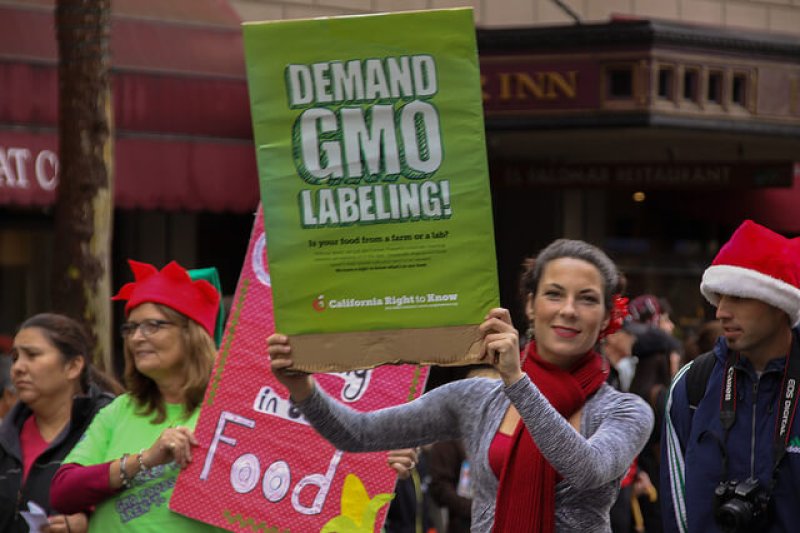
Despite current losses in Oregon and Colorado, GM opponents are determined to escalate their battle, promising to push for mandatory labeling on food state-by-state or from Congress. Many activists, such as Professor Elizabeth Glass Geltman, a City University of New York environmental professor, justify their position in part by claiming that more than 60 countries currently require GMO labeling.
How will science and the political establishment respond?
In an article this week in The Hill, Bruce Chassy, professor emeritus, Department of Food Science and Human Nutrition at the University of Illinois, says it’s important that scientists push back against against the distortions he believes anti-GMO activists have used to fuel their campaign. Chassy points out that in every case, the restrictions in place in Europe and elsewhere were put in place by politicians over the objections of the science establishment in those countries.
“The agricultural outputs of those same countries are suffering the ill effects of their decision to stigmatize GMOs and discourage the use of this new tool of modern agriculture.” Chassy add. “Unfortunately, many of these countries allowed their food labeling policies to be based on politics rather than sound science.”
Moreover, the tide in Europe appears to be slowly shifting in favor of embracing modern crop technology.
Just recently, more than twenty of Europe’s leading plant scientists signed a joint letter warning that Europe will never meet agricultural targets unless it starts allowing GM crops. In addition, Owen Patterson, the UK’s former Secretary of State for Environment, Food and Rural Affairs, cautioned earlier this year that “Europe risks becoming the museum of world farming as innovative companies make decisions to invest and develop new technologies in other markets.”
Mandatory labeling in the US could be problematic -for American agriculture and for consumers. “Technologies and products rapidly change; tomorrow’s products may not be captured by yesterday’s unscientific laws,” Chassy writes.
The prospect of mandatory labeling is considered unnecessary and misleading by many scientists, do, particularly those with expertise in crop and animal biotechnology. But if the anti-GMO movement is successful in escalating political pressure, and labeling is seriously on the table, there could be a better solution than state-by-state imposition of GMO labeling regulations.


The state-based approach could result in a confusing patchwork of different laws around the country, driving up the cost of food as much as $500 to every American family’s annual food bill as manufacturers struggle to ensure that their product conforms to varying requirements. State laws may not even end up being legal, as courts might decide they trespass on interstate trade – a power reserved for the federal government.
“The differing state and local labeling standards could require separate supply chains to be developed for various states and municipalities – potentially crippling interstate commerce throughout the food supply and distribution chain,” Chassy notes.
A national voluntary labeling might circumvent many of those concerns. It would likely be less of a problem for food companies, as all regulations could be standardized country-wide. Consumers, too, would not need to worry that a “GMO” label in one state would not mean the same thing as a label in another state. A bill roughly along those lines, as been introduced, the “Safe and Accurate Food Labeling Act,” It would prohibit any mandatory labeling of genetically engineered food and would also prohibit initiatives for labeling genetically engineered food at the state level.
Anti-GMO activists and even less strident consumers are not on board for a voluntary approach, however. Public skepticism about GMOs remains high.
Emily Sutherlin is a science journalist focusing on education and communication issues surrounding crop and animal biotechnology. Follow her @kimberlyvmonet.
Additional Resources:
- End States’ Attempts at Labeling our Food, Des Moines Herald
- New Federal Bill Aims to Squash State GMO-Labeling Efforts, Food Safety News
- GMO Labeling: How to End the Fight, Forbes