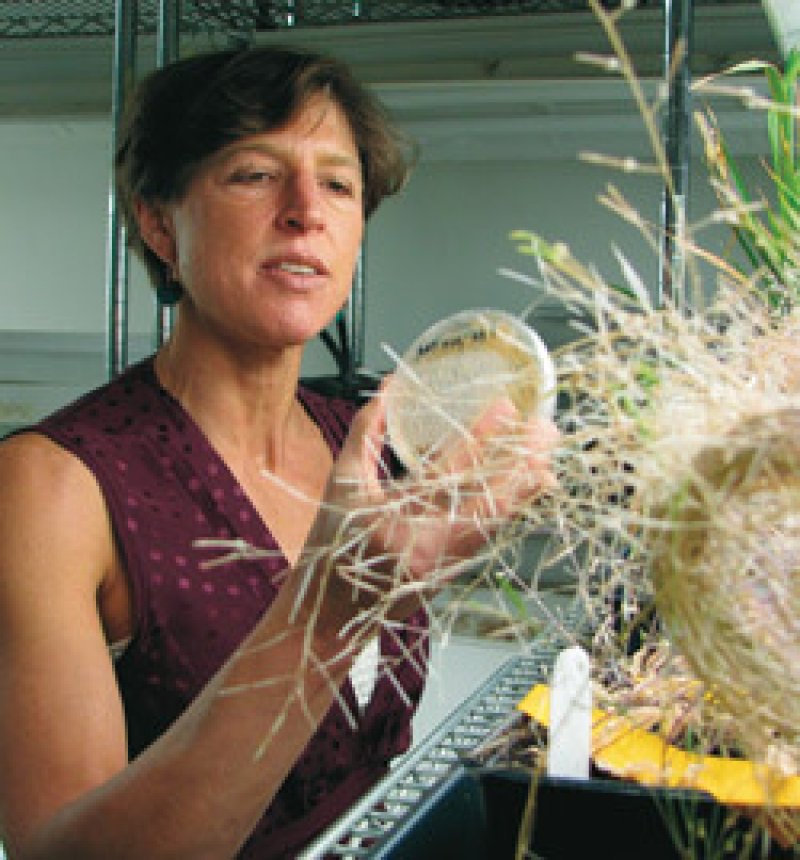
Pamela Ronald at TED: Prejudices of rich denying poor, vulnerable benefits of biotechnology

Pamela Ronald

Pamela Ronald is at the global TED conference to talk about her work as a plant geneticist, about her quest to “study genes that make plants resistant to disease and tolerant of stress.”

Genetic improvement of plants isn’t new, she says. Ancient corn had a case so hard that it couldn’t be chewed; the ancient banana was full of large seeds; ancient brussels sprouts weren’t actually individual objects. “To create these crops, breeders used many kinds of genetic techniques,” says Ronald. “Today breeders have even more the options choose from. Some of them are extraordinarily precise.”

“A lot of people don’t mind genetic modification when it involves moving rice genes around,” says Ronald, “but when it comes to taking genes from viruses and bacteria and putting them into plants, people say ‘Yuck! Why would scientists do that?’”

Ronald’s answer: “Because sometimes it is the safest, cheapest and most effective technology to advance sustainable agriculture and enhance food security.”

In the 1950s, the papaya crop on the island of Oahu in Hawaii was threatened by a ringspot pam-ronaldvirus. “Many people thought the Hawaiian papaya was doomed,” says Ronald.


A local Hawaian plant pathologist named Dennis Gonsalves had an idea. He spliced a snippet of the DNA of the virus into the papaya genome — and it worked. It made the papaya resistant to the virus. “His pioneering work is credited with rescuing the papaya industry,” says Ronald. “Twenty years later, no other method is as effective.” 80% of all Hawaiian papaya is now engineered in this way.

Genetic engineering has been used commercially for 40 years in wines, cheeses and much more. And in that time, there hasn’t been a case of harm to human health or the environment, she points out. “Look, I’m not asking you to believe me. Science is not a belief system. My opinion does not matter.  Let’s look at the evidence. After 20 years of careful study and rigorous peer review by thousands of independent scientists, every major scientific organization in the world has concluded that the process of genetic engineering is as safe or safer as older methods of genetic modification.”

She ends: “What scares me most about the loud arguments and misinformation about plant genetics is that the poorest people, the people who most need the technology, may be denied access because of the fears and prejudices of those who have enough to eat.”

Read full, original article: How genetic engineering creates food security: Pamela Ronald speaks at TED2015

Related Articles

Infographic: Global regulatory and health research agencies on whether glyphosate causes cancer

Infographic: Global regulatory and health research agencies on whether glyphosate causes cancer

Does glyphosate—the world's most heavily-used herbicide—pose serious harm to humans? Is it carcinogenic? Those issues are of both legal and ...

Most Popular

Bayer Crop Circle in Golden Wheat
Making fertilizer from thin air: Bayer’s gene-editing innovation could dramatically cut chemical fertilizer use in growing food
Glossy Plastic Bag of Tokens and Labels
Viewpoint: How CNN got played by environmental activists pushing a plastics scare and litigation agenda
Picture1
Viewpoint: How badly is the U.S. food-safety net fraying? FDA’s bungled handling of the tainted lettuce crisis deepens concerns over cuts to disease tracking and response
Screenshot-2026-10-30-at-10.55.54-AM
Longevity scandal: The huckster who validates the ‘oldest people in the world’ claims
Screenshot-2026-10-28-at-3.00.44-PM
Viewpoint: Activist attacks on corporations increasingly depend on "attribution" science to target oil companies for global climate change
Red and Green Embroidered Campaign Caps
Viewpoint: The fragile (and often bizarre) MAHA-MAGA-far left health-and-chemicals coalition is fracturing. Here’s why
Screenshot-2026-10-21-at-11.30.51-AM
Viewpoint: Yes, our food system stinks, but the attack of ultra-processed foods is often misplaced
Screenshot-2026-11-03-at-3.16.18-PM
Trump is “terminating” Biden-era rule aimed at cutting climate-warming methane emissions from oil and gas drilling
ChatGPT-Image-Mar-10-2026-01_39_01-PM
Viewpoint—“Miracle molecule” debunked: Why acemannan supplements don’t work
Reaching Through the Woven Sky
Challenging genetic modification rejectionists: Our evolving food system has relied on science for thousands of years
Screenshot-2026-10-30-at-11.36.40-AM
An Earth-saving benefit of global warming?: How fossil fuel-burning humans stopped the looming Ice Age
Robots in a Futuristic Conference Meeting
Helpful until we’re helpless? Researchers warn AI is gradually eroding human control
Screenshot 2026-07-29 at 10.40
The COVID vaccine turbo cancer scare is back. Science still proves it’s wrong.
Patriotic Flag in a Glass Flask
Viewpoint: America Last: From the Pentagon to universities, Trump’s corruption of science could inflict lasting, irreversible damage on U.S. research
glp menu logo outlined

Get news on human & agricultural genetics and biotechnology delivered to your inbox.