


Ancestry & Evolution

‘Every time you sit down in the subway, you are likely commuting with an entirely new species’: 12,000 new bacteria and viruses discovered in 6 continent study
About 12,000 bacteria and viruses collected in a sampling from public transit systems and hospitals around the world from 2015 ...
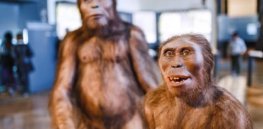
Homo sapiens reevaluated: Why the definition of ‘modern human’ is undergoing a revamp
One definition of a species is: "Groups of interbreeding natural populations that are reproductively isolated from other such groups," according ...

Viewpoint: Why the Wuhan lab escape theory explaining the origin of the global pandemic isn’t going away anytime soon
The COVID-19 pandemic has disrupted lives the world over for more than a year. Its death toll will soon reach ...
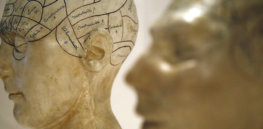
Viewpoint: Zombie pseudoscience — Evolution and intelligence studies are still shadowed by a focus on brain size
Phrenology is the detailed study of cranial sizes and shapes as a proxy for brain size and shape... Phrenology has ...

‘It’s out-competing other viruses’: Killer Indian COVID strain spreads dark cloud over growing global recovery
India [has] set another coronavirus milestone. [On May 19th], authorities announced the country had recorded more than 4,500 deaths from ...

Hairy oddballs: Why are humans the only animal to grow hair on our heads but almost none on our bodies?
Fur keeps animals warm when it's cold at night and protects them from the sun during the day. Human ancestors ...
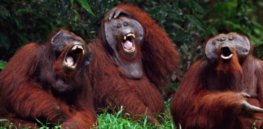
Podcast: Is laughter unique to humans? No, other animals evolved the same play behavior. Here are some examples
[HOST MICHAEL MARTIN:] It's true, we all laugh. But is laughter, uniquely human? It turns out, not really. Plenty of ...
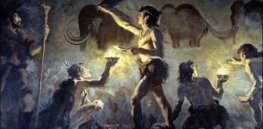
Evolution of creativity: An emerging theory of why Neanderthals succumbed to more ‘advanced’ Homo sapiens
Theories regarding the extinction of the Neanderthals range from climate change or the homo sapiens outpacing them in terms of ...

Fact checking ancient Greek history: Teeth recovered from military gravesites contradict historical beliefs that no mercenaries were deployed in battles
Ancient historians loved to write about warfare and famous battles. While these millennia-old stories still feed modern imaginations – Homer’s ...
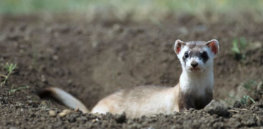
Ecological engineering: We could save endangered wildlife and fight pest-spreading diseases using cloning and gene editing. Should we?
[Endangered black-footed ferrets] are especially susceptible to plague. While many of us have not given much thought to plague since ...
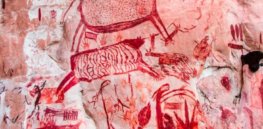
9 archaeological finds that have reshaped our views of human evolution
Here are nine of the most revealing discoveries that have changed our understanding of our early ancestors—and ourselves. ... 2 ...

Did ‘global cooling’ push multiple lines of early humans into extinction, paving way for Homo sapiens?
Modern humans, called Homo sapiens, are part of the genus Homo, which has existed for at least 2.8 million years ...
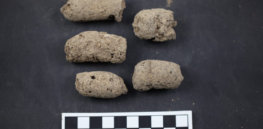
Ancient poop could save lives: ‘Exquisitely preserved’ lost microbes discovered in 2,000-year old feces could help battle chronic illnesses
Previous research has made a connection between preindustrial diets, greater diversity in the gut microbiome and lower rates of chronic ...

Science Facts and Fallacies Podcast: COVID’s mysterious origins; Why some anti-vaxxers got their shots; Unwise J&J ‘pause’?
Where did SARS-COV-2 come from? For most of the last year a natural origin story was the predominant view among ...
Is the clock ticking for the human race?
At a recent lecture to Harvard alumni I was asked how long I expect our technological civilization to survive. My ...

Are human brains the evolved pinnacle of problem-solving evolution? The reality may be more mundane
People often assume that evolution has progressed in an upward trajectory, from simple organisms to more complex ones. Because humans ...

‘Gene Conservation Units’ may be key to preserving rare species — and maintaining evolutionary processes to help them adapt to environmental change
UK landowners and conservationists welcome wider-spread use of Gene Conservation Units (GCUs) to help protect some of the rarest plants ...
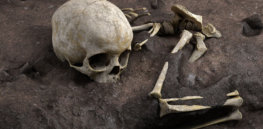
‘Humans developed complex belief systems around death’: 78,000-year old gravesite marks oldest human burial in Africa
Archaeologists have identified the oldest known human burial in Africa during field work that uncovered the remains of a child ...

What might happen if viruses jump from pet dogs to humans? That worrisome future is already here
[S]cientists are reporting that they have discovered what may be the latest coronavirus to jump from animals into people. And ...

Rapidly-spreading COVID-19 variant currently ravaging India makes first appearance in the US — in children with no recent travel history
Scientists [at the University of Texas Southwestern Medical Center found] two cases of the variant first detected in India using ...
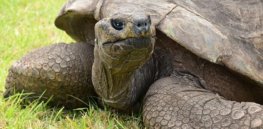
Why do some animals live extraordinarily long lives — and can humans benefit from studying them?
Life, for most of us, ends far too soon — hence the effort by biomedical researchers to find ways to ...

Were self awareness and the ability to plan what set us apart from Neanderthals?
We bear a trace of Neandertal legacy in our genome, a bequest from ancestral interbreeding. But some experts argue that, ...
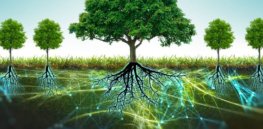
Are trees social beings? They exchange nutrients, help one another, and communicate about pests and other environmental threats
Previous ecologists had focused on what happens aboveground, but [Suzanne] Simard used radioactive isotopes of carbon to trace how trees ...
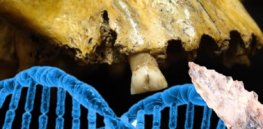
In research breakthrough, ancient human remains can now be preserved and analyzed without destroying genetic material
An Austrian-American research team (University of Vienna, Department Evolutionary Anthropology and Harvard Medical School, Department of Genetics), in collaboration with ...

Plants respond to injuries in fascinating ways. Can they feel pain?
Lacking the brain and nervous system needed to conjure consciousness (not to mention nociceptors, the animalian cells that react to ...
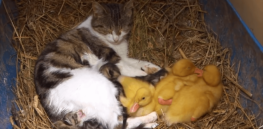
Altruism in animals: Why do animals sometimes adopt other species’ unrelated orphans?
Animals don’t have reason or moral accountability but there is abundant evidence that mammals and birds have feelings. And feelings ...
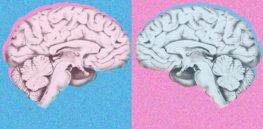
Viewpoint: ‘Dump Dimorphism’ — Challenging orthodoxy, neuroscientists claim 30 years of studies show ‘no meaningful male-female brain differences’
Everyone knows the difference between male and female brains. One is chatty and a little nervous, but never forgets and takes ...
