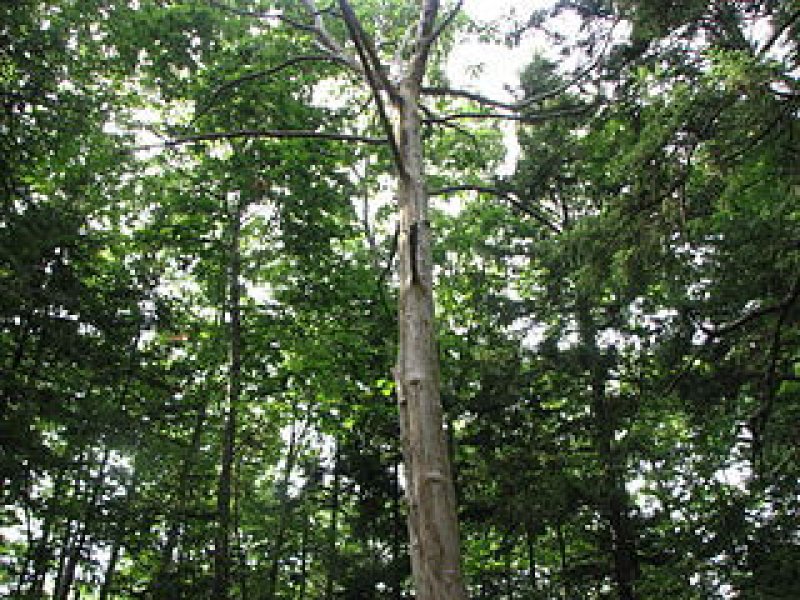
The American Chestnut tree used to grow in vast numbers across most of the eastern United States. Today, however, it has all but vanished from its natural region. The Chestnut blight, which is believed to have been brought to America from China at the start of the 20th century, has laid waste to more than four billion of the once mighty trees. Advances in genetic modification, however, could be used to save this important species and restore its numbers.
A team of researchers at the State University of New York City College of Environmental Science and Forestry (SUNY-ESF) is engineering a gene borrowed from wheat that allows the tree to disarm the adverse effects caused by the Chestnut blight.
First identified in 1904, the blight led, in part, to the discovery of the germ theory of disease, which links pathologies to microorganisms. Shortly thereafter, researchers noticed that the blight was less threatening to Chinese chestnut trees. They soon discovered that the American Chestnut could be cross-bred with the Chinese chestnut in order to produce a hybrid that holds most of the characteristics of the American Chestnut but without the vulnerability to the blight.
Organizations such as the American Chestnut Foundation have been using this crossbreeding method for decades in an effort to help find a cure for the blight. While these projects have been moderately successfully, they have not been able to give the trees full resistance to the blight, inhibiting the prospect of restoring the chestnut population that once covered much of the eastern half of the United States.
By using genetic modification, however, scientists have been able to grow much stronger trees that are resistant to the blight and might allow their numbers to grow. While the SUNY-ESF program has been working on genetic engineering to restore the tree for more than 20 years, they have made significant progress only in the last decade.
In the mid-2000s, the SUNY-ESF team first genetically engineered a chestnut embryo, a feat that had long eluded scientists. The team published its paper on this accomplishment in 2006, the same year this GM seed was first successfully planted outside of the lab. This progress led them to the development of a line of chestnuts they called the Darling 4, which is much more resistant to the blight than traditional American chestnuts, though still not as as resistant as the Chinese variety.


Still not satisfied, the team continued its research and recently produced a line of transgenic chestnuts more resistant to the blight than even the Chinese tree. The team published its results in Transgenic Research magazine in March and just two months later, planted these trees at its Lafayette Road Experiment Station. This staggering accomplishment marked the first time in history that blight-resistant American chestnut trees have grown on Earth.
The SUNY-ESF team plans to crossbreed its new line of chestnuts with the few surviving wild trees in order to build a diverse population that carry the wheat gene. Once the trees gain approval from the USDA, EPA and FDA, the team hopes to begin repopulating the tree in forests across the eastern US, where it once thrived.
While these results are still preliminary, they offer real hope for the restoration of the American chestnut, which used to grow in towering forests across nearly half of the country. Additionally, the success of the SUNY-ESF team has given further proof that scientists are able to successfully use genetic modification to solve real-world problems.
Additional Resources: