Is cancer a byproduct of modernity?

If there’s one claim that irritates me that various proponents of alternative medicine like to make, it’s that cancer is a “modern” disease, that it was rare (or even didn’t exist) before the rise of modern societies, particularly the industrial revolution. This viewpoint bubbled up when a commentary in Nature Reviews Cancer that argued strongly that cancer was almost unknown (or at least very rare) in the ancient world based on the lack of finding it in mummies in Egypt and South America. They also looked at ancient texts and literature from Egypt and Greece, and say that there’s little sign that cancer was a common ailment. After all, cancer is mainly a disease of the elderly, with three-quarters of cases being diagnosed in people over 60 and more than a third of cases diagnosed in people 75 or older. Life expectancy was much shorter in ancient times; so relatively few people made it to cancer-prone ages. Most probably didn’t make it past age 40.

It turns out that the apparently low incidence of cancer in mummies, skeletons, and other ancient remains might be an illusion. For example, investigators from the United Kingdom reported on the case of 3,000 year old skeleton found in Sudan of a man who appeared to have had metastatic prostate cancer, which they published in PLoS One by Michaela Binder and colleagues. It was the oldest complete example of a skeleton of an ancient human with cancer.
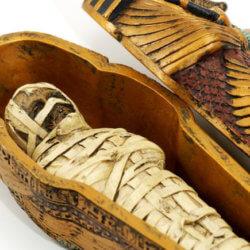
Read full, original article: Ancient cancer

{{ reviewsTotal }}{{ options.labels.singularReviewCountLabel }}
{{ reviewsTotal }}{{ options.labels.pluralReviewCountLabel }}
{{ options.labels.newReviewButton }}
{{ userData.canReview.message }}

Related Articles

Infographic: Global regulatory and health research agencies on whether glyphosate causes cancer

Infographic: Global regulatory and health research agencies on whether glyphosate causes cancer

Does glyphosate—the world's most heavily-used herbicide—pose serious harm to humans? Is it carcinogenic? Those issues are of both legal and ...

Most Popular

ChatGPT-Image-May-26-2026-07_51_21-AM-2
Viewpoint: There are more than 1,000 chemicals in a cup of coffee—including many substances that can cause cancer. Why isn’t it banned?
Screenshot-2026-04-30-at-11.33.46-AM
Anti-seed-oil to anti-vax pipeline: MAHA movement spreads to teen influencers
ChatGPT-Image-May-28-2026-02_12_17-PM
Can ‘Social Stress Indicators’ help contain social media misfluencers?
Screenshot 2025-07-30 at 10.48
Can gene editing eliminate Down syndrome? Scientists have done it in lab-grown cells
Screenshot-2026-05-29-at-1.23.52-PM
Viewpoint: Scientists recently revised downward the likelihood of catastrophic global warming. Reassured? You shouldn't be.
the magic of mRNA
Viewpoint: Anti-vax fake ‘turbo cancer’ claims threaten cancer treatment breakthroughs
ChatGPT Image May 28, 2026, 08_16_38 PM
Viewpoint: Why the EPA mismeasures cancer risk of chemicals and what should be done to fix it
ChatGPT-Image-May-22-2026-10_56_42-AM-2
‘It’s not super useful’: As wariness about AI grows, Trump proposes rollback of healthcare safeguards
Screenshot 2026-05-29 at 2.47
Psychological inoculation: With a vaccine to prevent HIV on the horizon, misinformation is soaring. What can be done.
Screenshot-2026-04-14-at-11.11.06-AM
‘Turbo cancer’ or mRNA cancer cure? Strategies to counter misinformation
downsyndrome_compilation_MID_1
CRISPR breakthrough that can remove the chromosome responsible for Down syndrome raises ethical questions
ChatGPT-Image-Mar-10-2026-01_39_01-PM
Viewpoint—“Miracle molecule” debunked: Why acemannan supplements don’t work
Screenshot-2026-05-27-at-10.51.25-AM
Viewpoint: ‘Monsanto’ blues—Planned Netflix movie promises yet another round of anti-glyphosate disinformation
glp menu logo outlined

Get news on human & agricultural genetics and biotechnology delivered to your inbox.