The team, based at the University of Bern, wanted to know if a protein called human leukocyte antigen, or HLA, is important to attraction-by-scent. HLA, which helps the immune system detect foreign invaders, also influences our personal scent and captures genetic differences between us.
The reason for focusing on HLA is to do with finding a mate that is different from us. A study from 2016 found that attraction and desire to mate was heightened between people whose cells, or genes, were different from their own. That makes sense: mating with someone genetically different from ourselves is advantageous in terms of survival. Because HLA encapsulates such genetic differences, it makes sense to ask whether the scents we find attractive are somehow tied to HLA.
…
The results add to the mystery of attraction. The researchers found that the scents men found appealing were completely unrelated to HLA. The men were definitely attracted to certain body odors and not others, but their preferences showed no tie to HLA. Meaning? Maybe finding women who are genetically different isn’t that important for men.
As the total global population continues to rise and economic growth drives a transition towards more resource-intensive diets, a growing number of consumers are concerned with how to reduce the environmental impact of their dietary choices. Consumers often see organic food as an effective way to reduce their impact: surveys reveal that regardless of geographic location, the primary motivations for organic food purchases are health1 and environmental concerns.2Furthermore, consumers are often willing to pay more for organic products – some studies indicate a willingness-to-pay of up to 100 percent above standard prices.3 But is this a wise choice? Is going organic really the best way to reduce the environmental impact of our diets?
Before we explore the relative impacts of organic vs. conventional agriculture, it is worth clarifying their definitions. Organic agriculture refers to the farming of crops or livestock without the use of synthetic inputs, including synthetic fertilizers, pesticides, plant growth regulators, nanomaterials and genetically-modified organisms (GMOs).4 Note that organic does not necessitate ‘chemical-free’ or ‘pesticide-free’; chemicals are often used in organic farming, however these cannot be synthetically manufactured, with the exception of a small number which have been approved by the National Organic Standards Board.5 Conventional (sometimes termed ‘intensive’) farming is therefore any agricultural system which uses one or more of the above synthetic inputs. Although not required for regulatory approval, organic farming often also places greater emphasis on planting techniques such as low-tillage agriculture and crop rotation.
In arable farming (which concerns the production of crops), nutrients can be added to the soil in the form of organic matter, such as green compost, animal manure (human sewage sludge is typically prohibited), or bone meal. For livestock, organic methods mean animals must be fed organically-certified feed (or graze on land with no synthetic chemical inputs), and antibiotics cannot be used throughout their lifetime (except in emergency cases such as disease or infection outbreak). In conventional livestock production, there are no constraints on feed certification and antibiotics or growth hormones are often used. Animal welfare standards for organic certification can vary by country, however for many, livestock must be raised with access to the outdoors (i.e. caged hens are not permitted). Conventional livestock farming covers a range of production methods: they can be produced in either ‘free range’ or ‘caged’ conditions. These are typically monitored and labelled as such on product packaging.
In this post, we present the empirical evidence comparing organic to conventional agriculture in terms of environmental impact. Despite strong public perception of organic agriculture producing better environmental outcomes, we show that conventional agriculture often performs better on environmental measures including land use, greenhouse gas emissions, and pollution of water bodies. There are, however, some contexts where organic agriculture may be considered appropriate.
Organic vs. conventional: what are the relative impacts?
When aiming to provide a comparison of the relative impacts of organic and conventional agriculture, it can often be misleading and misrepresentative to rely on the results of a single comparative study: there will always be single, localised examples where the environmental impacts of a conventional farm are lower than that of a proximate organic farm, and vice versa.6 In order to provide a global and cross-cutting overview of this comparison, Clark and Tilman (2017) published a meta-analysis of results of published organic-conventional comparisons across 742 agricultural systems over 90 unique foods.7
Their analysis reviewed relative impacts across the range of food types – cereals, pulses and oilcrops, fruits, vegetables, dairy and eggs, and meat – and across a range of environmental impact categories – greenhouse gas emissions, land use, acidification potential, eutrophication potential, and energy use. ‘Eutrophication’ refers to the over-enrichment or pollution of surface waters with nutrients such as nitrogen & phosphorous. Although eutrophication can also occur naturally, the runoff of fertilizer and manure from agricultural land is a dominant source of nutrients.8 This disaggregation of food types and environmental impacts is important: there is no reason to suggest that the optimal agricultural system for cereal production is the same as for fruits; and there are often trade-offs in terms of environmental impact – one system can prove better in terms of greenhouse gas emissions but higher in land use, for example.
Food systems are made up of many phases – ranging from pre-farm activities, crop production, animal feed production, and harvesting, to transportation, distribution, and cooking. To fully and consistently account for the various stages of production, a process called life-cycle analysis (LCA) is used. LCAs attempt to quantify the combined impacts across several stages of production by considering all inputs and outputs in the complete process. The key in comparing LCAs between products is ensuring that the same number of stages of the supply chain are included in all analyses. For this meta-analysis, Clark & Tilman (2017) compared 164 LCAs which account for inputs pre-farm and on-farm (up until the food leaves the farm).
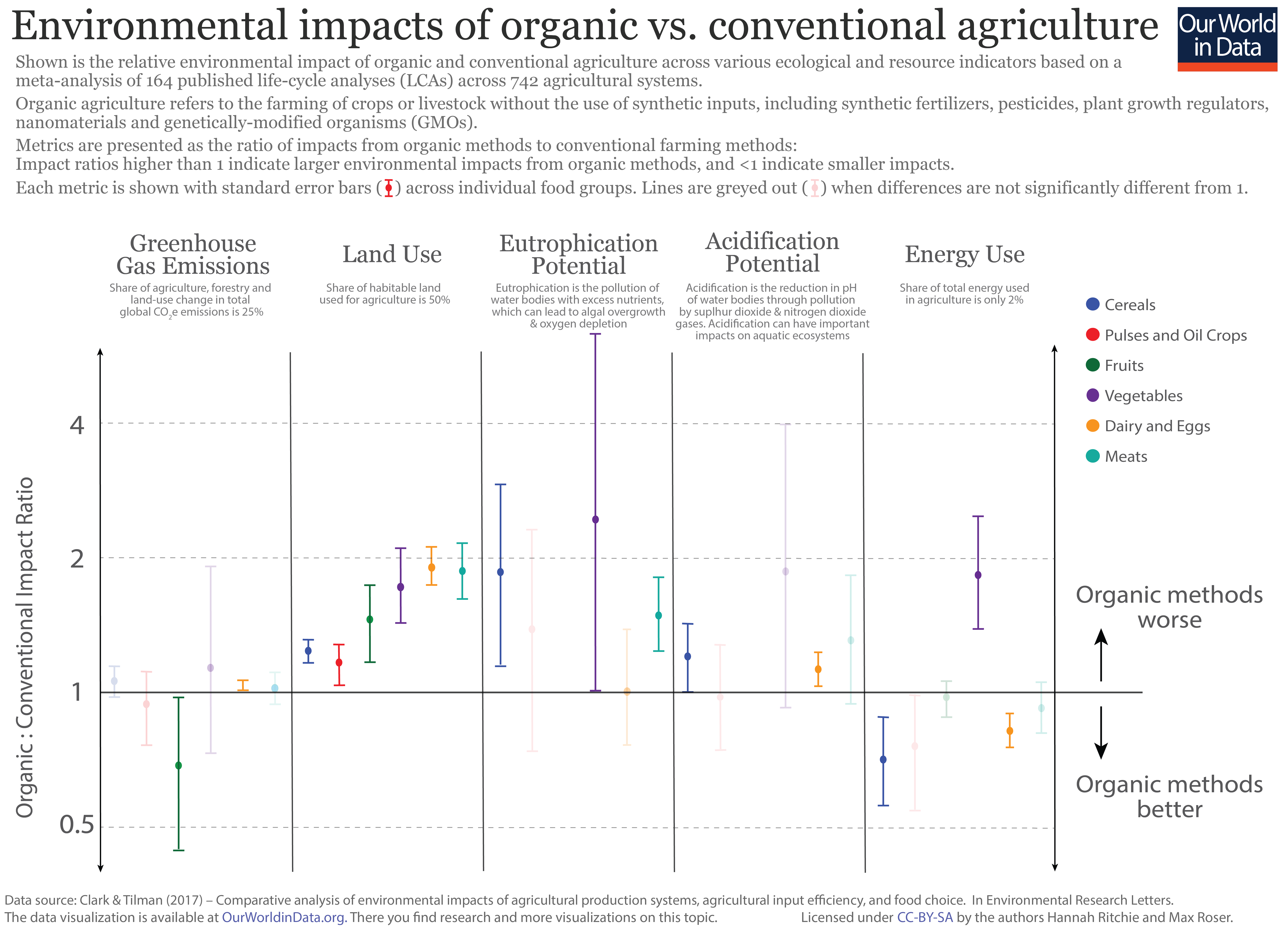
The aggregated results of Clark & Tilman’s study is shown in the chart below. This comparison measures the relative impact ratio of organic to conventional agriculture, whereby a value of 1.0 means the impact of both systems are the same; values greater than 1.0 mean the impacts of organic systems are higher (worse) (for example, a value of 2.0 would mean organic impacts were twice as high as conventional); and values less than 1.0 mean conventional systems are worse (a value of 0.5 means conventional impacts are twice as high). We see these relative impacts measured by food type across our range of environmental impacts with averages and standard error ranges shown.
We see large differences in impact patterns across environmental categories and food types. For some impacts, one system is consistently better than the alternative; whilst for others, results are mixed depending on crop type and the local agricultural context. The clearest results are for land and energy use. Organic systems consistently perform worse in terms of land use, regardless of food type. As we explore in detail in our entry on Yield and Land Use in Agriculture, the world has achieved large gains in productivity and gains in yield over the past half-century in particular, largely as a result of the availability and intensification of inputs such as fertilizer and pesticides. As a result, the majority of conventional systems achieve a significantly higher yield as compared to organic systems. Therefore, to produce the same quantity of food, organic systems require a larger land area.
This produces the inverse result for energy use. The industrial production of chemical inputs such as fertilizers and pesticides is an energy-intensive process. The absence of synthetic chemical inputs in organic systems therefore means that their energy use is predominantly lower than in intensive conventional agriculture. The exception to this result is vegetables, for which energy use in organic systems tends to be higher. Some of this additional energy use is explained by the use of alternative methods of weed and pest control in organic vegetable farming; a technique widely applied as an alternative to synthetic pesticide application is the use of ‘propane-fueled flame weeding’.9 The process of propane production and machinery used in its application can add energy costs – especially for vegetable crops.
Acidification and eutrophication potential are more mixed, but tend to be higher in organic systems; average values across all food types are higher for organic, although there are likely to be some exceptions in particular contexts. Why are organic systems typically worse in these measures? The supply of nutrients in conventional and organic systems are very different; nitrogen supply in conventional agriculture is supplied with the application of synthetic fertilizers, whereas organic farms source their nitrogen from manure application. The timing of nutrient release in these systems is different: fertilizers release nutrients in response to crop demands, meaning nitrogen is released when required by the crops, whereas nitrogen released from manure is more dependent on environmental conditions, such as weather conditions, soil moisture and temperature.
Nutrient-release from manure is therefore not always matched with crop requirements – excess nutrients which are released but not taken up by crops can run off farmland into waterways such as rivers and lakes. As a consequence, the pollution of ecosystems with nutrients from organic farms are often higher than conventional farms, leading to higher eutrophication and acidification potential.
Across all food types, there is no clear winner when it comes to greenhouse gas emissions. Results vary strongly depending on food type, although most lie close a ratio of one (where differences in impact between the systems are relatively small). Based on average values, we might conclude that to reduce greenhouse gas emissions, we should buy organic pulses and fruits, and conventional cereals, vegetables, and animal products. In general, the greenhouse gas emission sources of organic and conventional systems tend to cancel each other out. Conventional systems produce greenhouse gases through synthetic fertilizer production and application, which is largely balanced by the higher emissions of nitrous oxide (a strong greenhouse gas) from manure application.10
Should we treat environmental impacts equally?
Organic agriculture proves better for some environmental impacts, and conventional agriculture for others. These trade-offs can make it difficult to decide which we should be choosing. But should we be considering all environmental impacts equally? Should some have higher importance than others?
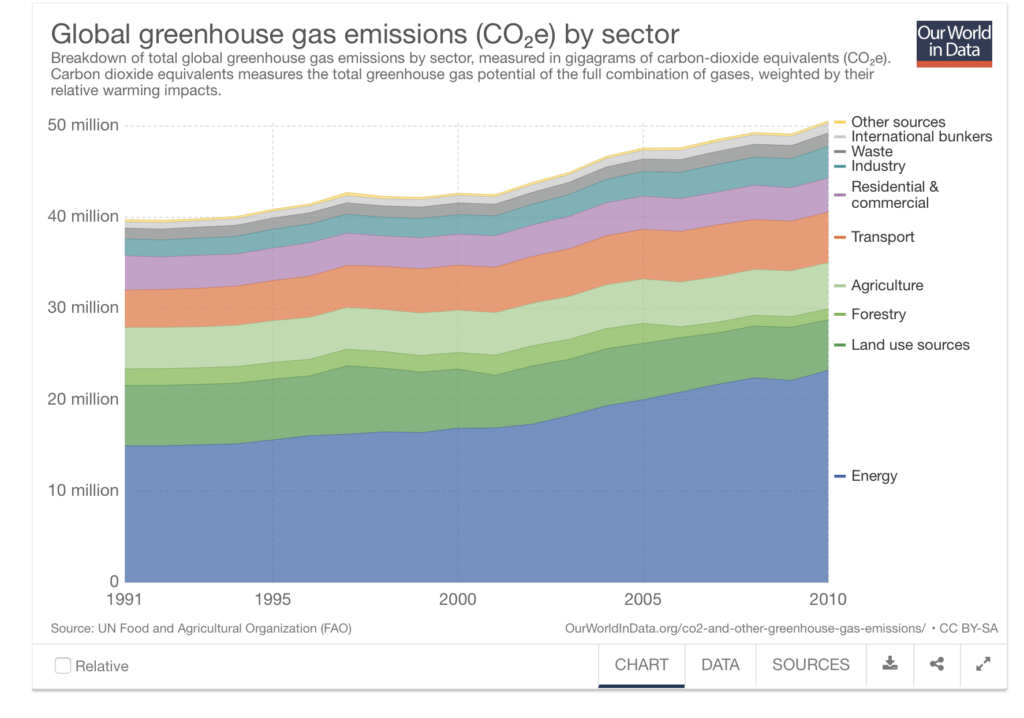
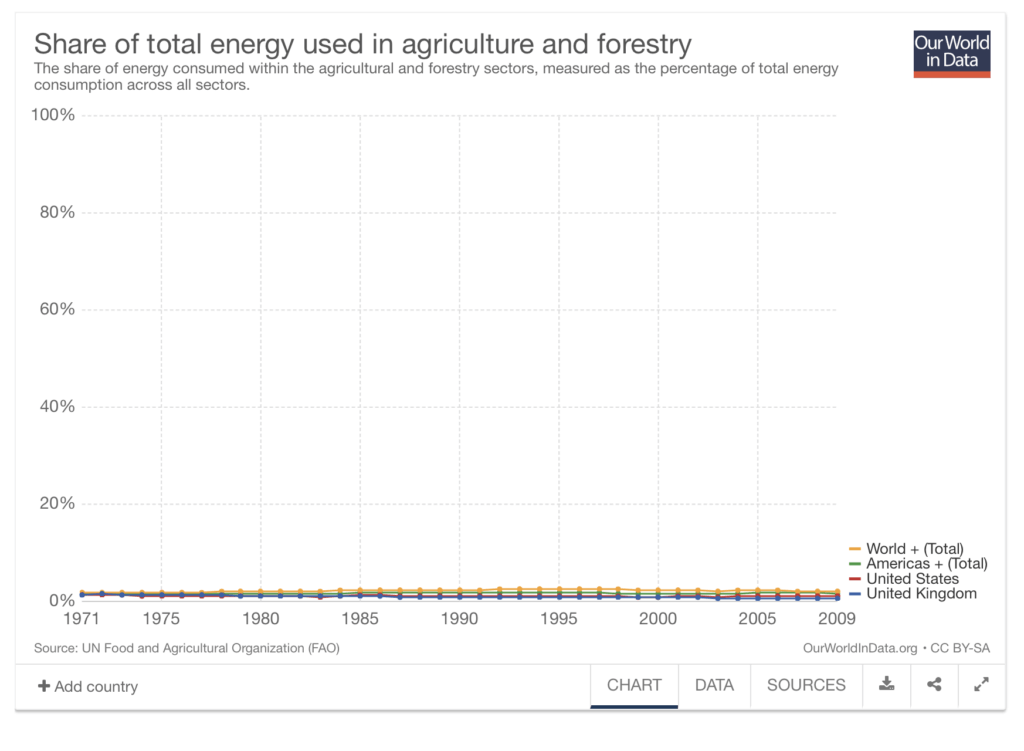
To evaluate these trade-offs we have to consider a key question: how important is agriculture’s contribution to global greenhouse gas emissions, land use, acidification and eutrophication potential, and energy use? Agriculture’s role in land use, greenhouse gas emissions, and energy use is summarised in the three charts below:
The first chart shows that agriculture, forestry and other land use (AFOLU) is the dominant land user, consuming half of the world’s habitable land;
The second chart shows that it accounts for approximately one-quarter of greenhouse gas emissions;
The third chart shows that it accounts for only two percent of energy use;
The contribution of AFOLU to acidification and eutrophication is more difficult to quantify, however it is widely considered to be the dominant source of nutrient input to aquatic ecosystems.
We might therefore conclude that energy use – the only category in which organic agriculture has a clear advantage – is comparatively substantially less important than other impacts.
Is more intensive agriculture always the answer?
If we are most concerned with areas of environmental change for which agriculture has the largest impact – namely land use, water pollution, and greenhouse gas emissions – for which conventional agriculture tends to be advantaged, is the answer to make global farming as intensive as possible? Not necessarily. There are several reasons why this view is too simplistic.
The impacts quantified here fail to capture another important ecological pressure: biodiversity. Conclusive comparisons of the relative impacts of agricultural systems on biodiversity are still lacking. Biodiversity is affected by a number of agricultural impacts, including pesticide application (which can be toxic to some species), soil erosion, and disruption from land tillage methods, and either habitat destruction or fragmentation.11 Intensive agriculture undoubtedly has severe impacts on local biodiversity.12 A recent study by Hallmann et al. (2017) reports a greater than 75 percent decline in insect populations over the last 27 years; although unclear as to the primary cause of this decline, it’s suggested that pesticide use may be a key contributing factor.13 Organic farming systems also impact biodiversity, but perhaps less dramatically per unit area, due to lower fertilizer and pesticide use. However, as our land-use metrics show: organic agriculture requires far more land than conventional agriculture. This creates a divide in opinion of how best to preserve biodiversity: should we farm intensively over a smaller area (with understanding that biodiversity will be severely affected over this area), or should we farm organically, impacting biodiversity (perhaps less severely) over a much larger area.14There is no clear consensus on how best to approach this issue.
Another point to consider is that conventional agriculture is not necessarily better across all food types. Context, both in terms of the food commodity and the local environment, can be important. For example, if greenhouse gas reduction is our main focus, we might be best off eating organic pulses and fruits, and conventional cereals, vegetables, and animal products, based on the results presented above.
This leads us to three key conclusions in the organic-conventional farming debate:
The common perception that organic food is by default better, or is an ideal way to reduce environmental impact is a clear misconception. Across several metrics, organic agriculture actually proves to be more harmful for the world’s environment than conventional agriculture.
The debate between organic and intensive agriculture advocates is often needlessly polarized. There are scenarios where one system proves better than the other, and vice versa. If I were to advise on where and when to choose one or the other, I’d advise trying to choose organic pulses and fruits, but sticking with non-organic for all other food products (cereals, vegetables, dairy and eggs, and meat).
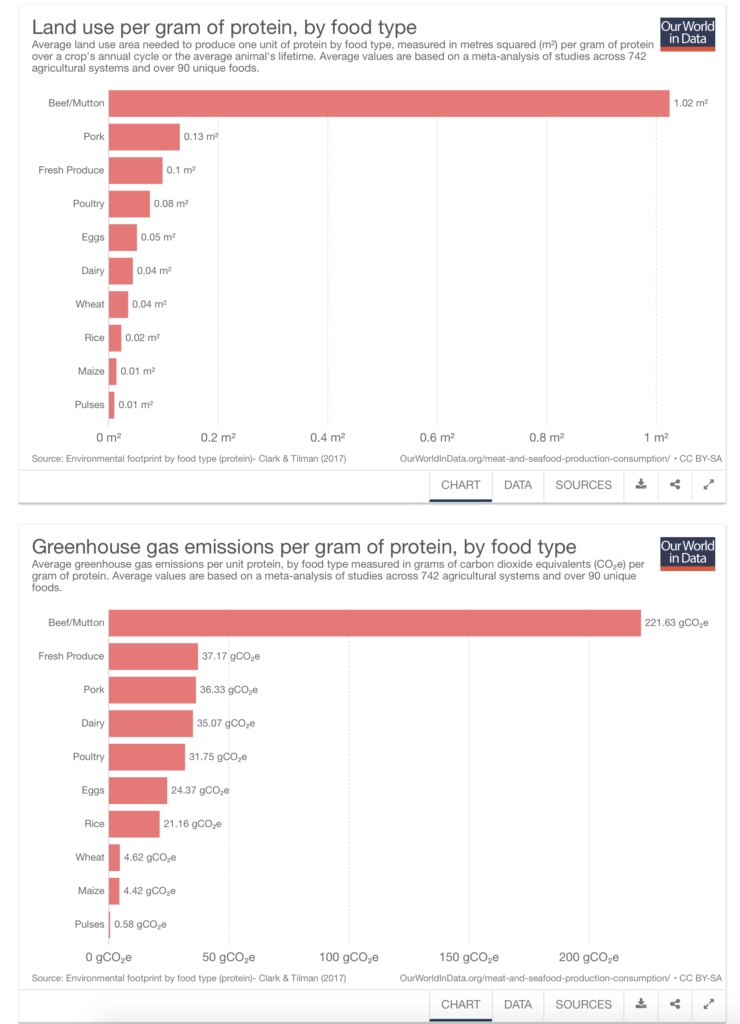
The organic-conventional debate often detracts from other aspects of dietary choices which have greater impact. If looking to reduce the environmental impact of your diet, what you eat can be much more influential than how it is produced. The relative difference in land use and greenhouse gas impacts between organic and conventional systems is typically less than a multiple of two. Compare this to the relative differences in impacts between food types where, as shown in the charts below, the difference in land use and greenhouse gas emissions per unit protein between high-impact meats and low-impact crop types can be more than 100-fold. If your primary concern is whether the potato accompanying your steak is conventionally or organically produced, then your focus is arguably misplaced from the decisions which could have the greatest impact.
Sub-note on health and food safety with regards to organic and conventional produce:
From a health point-of-view, many consumers consider organic food to be safer due to lower exposure to pesticides.15Is organic food healthier and safer in this regard? Clark & Tilman (2017) note that their study did not extend to potential health benefits of organic food. However, they do note that there is evidence that organic foods typically record lower concentrations of pesticide residues.16 In a study across three investigations in the United States – conducted by the the Pesticide Data Program of the USDA, the Marketplace Surveillance Program of the California Department of Pesticide Regulation, and private tests by the Consumers Union – organic foods were found to have around one-third of the pesticide residues of conventionally grown produce.17
This is perhaps not a surprising result, considering the use of pesticides is typically higher in conventional agriculture. However, the important question is: should we be concerned about the health impacts of pesticide residues? The World Health Organization (WHO) have established a Joint FAO/WHO Meeting on Pesticide Residues (JMPR) which establishes ‘safe’ intake levels of individual pesticide inputs, where ‘acceptable daily intakes’ are set at levels for which exposure would have no carcinogenic effects on human health. Governments and food governance bodies then use acceptable intake levels to establish Maximum Residue Limits (MRLs). These are enforced by national governing bodies to ensure that consumer food has residue levels which are below such MRLs.
Evidence suggests that residue standards and limits are strongly enforced. A US-based study investigated the ten most frequently identified pesticide residues across twelve commodity groups from the United States Department of Agriculture (USDA) Pesticide Data Program (PDP) database.18 The authors searched USDA database results for nationwide residue assessments from 2000 to 2008. All pesticide exposure estimates were found to be well below the defined ‘chronic reference doses’ (RfDs). Only one product had a residue level greater than 1% of the RfDs (and only just, measured in at 2% of RfDs). The majority (75 percent) of commodities measured below 0.01 percent of RfD limits. For context, this means residue levels were one million times lower than the threshold for which there are observable effects to exposure.
When was the last time you were shopping for an over-the-counter drug and found yourself looking at two versions of the same drug – one for women and one for men?
We’ve gotten accustomed to seeing so many different versions of these drugs: AM/PM versions, ‘Children’s’ versions, sugar-free versions, etc. Many of these can serve valuable purposes, though many just additional choices to steer consumer behavior and build sales. But one thing you don’t typically see are formulations divided by gender. But it would be a smart idea if more manufacturers did this.
Pro tip: Males and females are not identical
Besides the obvious anatomical differences, and in some cases because of them, the physiological processing of certain medications is markedly different between males and females. You may have seen that certain brands, such as Midol, are marketed specifically for women (in that case, for premenstrual cramps), but the formulation is simply a fever reducer or anti-inflammatory (different formulations are available, but one is for example, 200 mg ibuprofen), and doesn’t take into account a female-specific degradation of the tablet. Similarly, you may even have a multivitamin at home ‘formulated’ for men or for women; again this is almost entirely marketing-driven, because while the recommended daily intake (RDI) of vitamins and minerals is different for men and women, the addition of ‘male-specific’ or ‘female-specific’ herbs and other supplements in these multivitamin formulations have no good scientific backing that’s been approved by FDA.
What does have scientific backing, including studies here, here and here is the fact that males and females metabolize drugs differently. In some cases, it’s the excipients added to the tablet or capsules to stabilize it or improve digestibility, and in other cases, it’s the actual drug itself whose metabolism is dramatically different. For this reason, most drugs should really be stratified in an evidence-based manner to ensure that males and females are being exposed to the appropriate dose for their metabolism, physiology, and body mass.
Typically, in the lifecycle of drug development, many hundreds or thousands of participants are given the drug treatment, with and without food, and are measured with repetitive blood testing to identify plasma concentrations of the drug over time – how long did it take to peak? How high did it peak? How long did it stay in circulation? How quickly was it cleared? All of these questions are summarily answered within the clinical trials testing. But typically the formulation results are aggregated and not separated according to gender to look for specific effects and optimum dosing guidelines. This averaging does a fine job of meeting a guideline for an ‘averaged’ person who is half male/half female (roughly), with a body mass of about 68 kgs, of mixed population genetics. But it will more often than not lead to overdosing (even if slightly) in most women, and likely underdosing in most males. Caveat – this does not constitute medical advice to manually hypothesize a dose you think you should take. But it does indeed mean that there needs to be a significant overhaul with how dosing guidelines are approached in the drug industry, which is something that I’m now involved in.
Details on metabolism
What’s been found is that excipients such as polyethylene glycol 400 are handled differently in male versus female subjects (the presence of PEG 400 increased bioavailability of the target drug in males, but not in females). Additional interference has been found between the androgen hormone testosterone and anti-inflammatory drugs such as ibuprofen, naproxen, and aspirin. What is already known is that testosterone reduces the synthesis of leukotrienes, which are compounds produced by immune cells when they detect a potential invader. Because of this, females typically have greater levels of circulating leukotrienes than males.
What’s interesting with respect to the drug treatment in this case was that the anti-inflammatory MK886 was almost 800% more effective at reducing leukotrienes in blood samples from females as compared to males. This particular drug (MK886) was not approved for use, because during clinical trials in the 1980s and 1990s it was found to be no more effective than placebo. But what was also noted in a retrospective analysis of the studies was that women were underrepresented in the clinical trials – so even the ‘averaged’ person (who I invented above) is a calculated parameter based on all those individuals in the clinical trial, and was more heavily-weighted to being male than female in the trials, and this drug has now shown to be less effective in males in a small sample.
What’s next?
All of this suggests that the “therapeutic power” of many drugs isn’t maximized as they’re currently designed by considering males and females distinctly in the experimental trial designs. I would also go a step further and suggest that these rigorous design separations also occur by demographics to see if we can maximize healthcare treatment outcomes in all different races and ethnic groups of the population. This may turn out to be less of a factor than the gender discrepancy in metabolism, but we won’t know until we systematically trial it and collect data. It’s also likely that this won’t happen in large part because drug trials are extraordinarily expensive and time-consuming for drug companies to conduct, and to have dozens of separate, thoroughly-powered, clinical trials running concurrently would be prohibitive – especially in an era of increased pressure, scrutiny, and argument over drug prices.
Ben Locwin is a behavioral neuroscientist and astrophysicist with a masters in business, and a researcher on the genetics of human disease. BIO. Follow him on Twitter @BenLocwin.
[Editor’s note: Carrie Dennett, MPH, RDN, CD, is the nutrition columnist for The Seattle Times and speaks frequently on nutrition-related topics]
Nutrigenomics and nutrigenetics fall under the umbrella of nutritional genomics—so what’s the difference between the two? Both study how individual genetic makeup contributes to observed differences in response to diet and how that gene-diet interaction contributes to predisposition to disease. Nutrigenomics goes deeper, using molecular tools to identify how nutrients and bioactive food compounds alter the DNA transcription and translation process, affecting the expression of genes that regulate critical metabolic pathways, which may ultimately affect health outcomes.
…
CVD, type 2 diabetes, and obesity are major public health focus areas. Accordingly, they’re also points of focus for nutrigenomic research. Many cellular functions related to energy balance are regulated by gene expression and gene-environment interactions. Genetic variation may affect appetite, calorie intake, and macronutrient preference as well as insulin signaling, inflammation, adipogenesis (the formation of fat cells), and lipid metabolism This means that the individual variation seen in body weight and composition likely is influenced by genetic makeup as well as diet and activity patterns.
…
As technology improves, large meta-analyses are making it possible to examine the interactions between millions of SNPs, dietary factors, and specific phenotypes
The GLP aggregated and excerpted this article to reflect the diversity of news, opinion and analysis. Read full, original post: The Future of Nutrigenomics
A major agribusiness company sued Arkansas regulators … for banning its version of an herbicide that’s drawn complaints from farmers across several states who say the weed killer has drifted onto their crops and caused widespread damage.
Monsanto asked a state judge to block the Arkansas Plant Board from enforcing a rule it adopted last year that prevents its dicamba product from being used each year from April 15 through September 15.
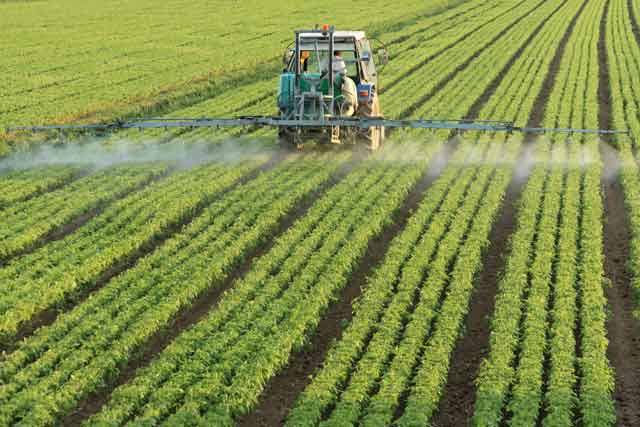
Dicamba has been around for decades, but problems arose over the past couple of years as farmers began to use it on soybean and cotton fields where they planted new seeds engineered to be resistant to the herbicide. Because it can easily evaporate after being applied, the chemical sometimes settles on neighboring fields.
The panel approved the restriction on Monsanto’s XtendiMax herbicide in November, and several months later the state adopted a wider temporary ban that included other dicamba weed killers in response to farmer complaints. The plant board last month rejected a petition from the company to allow its herbicide to be used.
In March 2015, the International Agency for Research on Cancer, or IARC, issued a report labeling the weed killer glyphosate a “probable carcinogen.” This ruling caused consternation in the scientific and agricultural communities. Glyphosate, which is manufactured by Monsanto and is the active ingredient in the company’s popular Roundup, is one of the most widely-used herbicides worldwide. It is cheap, effective, and has low toxicity. IARC’s ruling goes against the assessment of every other agency that has evaluated the compound, including the U.S. Environmental Protection Agency, the European Food Safety Authority, and the World Health Organization, of which IARC is a part.
IARC, which is based in Lyon, France, makes its assessments by convening a panel of experts to consider all the available evidence from human, animal, and mechanistic studies regarding a potential cancer threat. The agency then classifies a given substance as carcinogenic (Group 1), probably carcinogenic (Group 2A), possibly carcinogenic (Group 2B), or not classifiable as to carcinogenicity. For its glyphosate evaluation IARC formed a Working Group of 16 experts who reviewed the evidence for nearly a year before issuing its report in March 2015. The Working Group was subdivided into subgroups to assess the human evidence, the animal studies, and the mechanistic/laboratory studies. At the end of the review process, the panel designated glyphosate as a “probable carcinogen” based on the animal evidence, which was judged to be “sufficient.” We will come back to this point later.
[Editor’s note: Read the GLP’s profile of the IARC here.]
What is not widely known is that the agency’s classification of a substance does not take into account the degree of exposure to that substance in the general population. Rather, in IARC’s terminology, it evaluates “hazard” – the possibility that a substance could cause cancer under some possible condition – as opposed to “risk,” which refers to the likelihood that actual exposure in the real world might cause cancer. Needless to say, when headlines trumpet the latest IARC assessment, the public and the media assume that classification of an agent as “probably carcinogenic” must have some direct relevance to human health, even when actual human exposures are at levels too low to cause adverse health effects.
Over the past few years, when scientists have questioned the agency’s process and some of its recent classifications, rather than addressing specific criticisms, IARC officials have argued that their methods are sound and not in need of improvement, and have implied that their critics have conflicts-of-interest.
In the past year, however, as IARC’s glyphosate report has been subjected to scrutiny by scientists and investigative journalists, a number of increasingly disturbing questions have come to light. Three major, independent pieces of the “back-story” on IARC’s glyphosate assessment are presented below.
Reanalysis of the animal and epidemiologic evidence
In August 2016, Robert Tarone published a commentary entitled “On the International Agency for Research on Cancer classification of glyphosate as a probable human carcinogen” in the European Journal of Cancer Prevention. Tarone, who is a statistician who spent most of his career at the National Cancer Institute, re-examined the animal studies cited by IARC. In such studies, typically a strain of rodents is divided into one or more “treatment” groups and a control group – and the former is exposed to a test substance at increasing dose levels – in this case, glyphosate – while the control group is unexposed to the test substance. As animals die they are examined, and at the end of the study the remaining animals are sacrificed and their organs are examined for benign and malignant changes.
What is crucial is to determine whether the treatment group shows robust evidence of a greater “tumor yield” compared to controls. In relatively small animal experiments there will likely be ups-and-down, but one is looking for a consistent excess of tumors in the treated group. Most persuasive would be evidence of a dose-response relationship – that is, the more of the substance that the test animals are given, the greater the tumor yield. Furthermore, one might expect to see consistency in male and female animals, if the substance is carcinogenic.
What Tarone found is that the IARC panel highlighted certain positive results from the rodent studies they relied upon in the deliberations, and, glaringly, ignored contradictory negative results from the same studies. He also found that an inappropriate statistical test was used, making the data look more impressive than they actually were. Tarone concluded, “When all relevant data from the rodent carcinogenicity studies of glyphosate relied on by the Working Group are evaluated together, it is clear that the conclusion that there is sufficient evidence that glyphosate is an animal carcinogen is not supported empirically. Even a conclusion that there is limited evidence of animal carcinogenicity would be difficult to support…”
In reviewing the human (i.e., epidemiologic) studies, Tarone found that IARC’s case for glyphosate’s association with non-Hodgkin’s lymphoma also resulted from favoring certain study results, rather than considering the totality of the evidence.
In the past week, two new insights into the agency’s glyphosate assessment have emerged, coalescing into a full-blown scandal.
Revelations from a deposition in a lawsuit against Monsanto
Christopher Portier
A blogger, Davis Zaruk, who uses the pen-name Risk-Monger, examined the transcripts, posted on the Internet, of a deposition related to cases against Monsanto involving the scientist Christopher Portier. Portier, an American statistician who worked for the federal government for over thirty years, was the special advisor to the IARC panel that issued the report declaring glyphosate to be “probably carcinogenic.” The transcripts show that during the same week in March 2015 in which IARC published its glyphosate opinion, Portier signed a lucrative contract to act as a litigation consultant for two law firms that were preparing to sue Monsanto on behalf of glyphosate cancer victims. His contract contained a confidentiality clause barring Portier from disclosing his employment to other parties. Portier’s financial conflict-of-interest has been confirmed by the UK newspaper The Times.
It turns out that it was Portier himself, who as chair of an IARC committee in 2014 had proposed that the agency undertake a review of glyphosate in the first place. He then went on to play a key role in the deliberations resulting in the IARC conclusion that glyphosate is probably carcinogenic. In view of the new revelations, it appears that, rather than being the objective scientist he has portrayed himself to be, he may have had a preconceived plan to use the IARC ruling, which he played a major role in shaping, to cash in on the ensuing litigation campaign. In the years following the IARC glyphosate decision, Portier has frequently claimed that he had no conflicts-of-interest and that he has never taken a cent for his glyphosate work. At the same time, he and IARC generally have portrayed any scientist who questioned the evidence of glyphosate’s carcinogenicity as being motivated by pro-industry bias. This has proved an effective tactic for suppressing substantive arguments based on the scientific evidence.
IARC’s editorial process in the glyphosate report
On the heels of Risk-Monger’s exposé, three days ago, Kate Kelland, a journalist for Reuters, who has been investigating IARC’s recent assessments, published findings indicating that the glyphosate document underwent significant editing to remove null results and to strengthen positive conclusions. Kelland obtained a draft of the key chapter of the report devoted to animal studies, which became available as part of the lawsuits against Monsanto, and she compared the draft with the final, published report. She found 10 significant instances in which “a negative conclusion about glyphosate leading to tumors was either deleted or replaced with a neutral or positive one.” Kelland’s findings indicate that the original draft found little animal evidence that glyphosate was a carcinogen. Her textual analysis provides confirmation of Tarone’s independent re-analysis of the original studies. Furthermore, Portier admits in his deposition that the interim report produced by the animal subgroup during the Working Group meeting also concluded that there was “limited evidence of animal carcinogenicity.” He proclaims ignorance of when or how the conclusion was upgraded to “sufficient evidence of animal carcinogenicity” during the deliberations of the entire Working Group. It is crucial to repeat that the classification of glyphosate as probably carcinogenic to humans relied entirely upon the conclusion that there was sufficient evidence of animal carcinogenicity (because the epidemiologic evidence was not strong).
All of this points to a trusted agency redacting the evidence to suit its predetermined and preferred story-line.
What is at stake
In addition to providing the basis for litigation by US law firms, IARC’s 2015 opinion on glyphosate provided powerful ammunition to environmental activists, anti-GMO groups, NGO’s, and organic foods industry lobbyists on both sides of the Atlantic in their campaign to ban glyphosate. For the past two years, the European Union has been trying to reauthorize the weed killer but has been opposed by politicians in Member States who have been swayed by the anti-glyphosate crusade. A decision to ban or to phase out use of glyphosate will hurt both farmers and consumers by decreasing crop yields, increasing the costs of produce, and requiring substitution of herbicides about which less is known and which may pose a greater health risk. A final decision is expected next month.
The revelations about IARC’s glyphosate determination carry crucial lessons regarding relations among scientific evidence, policy, and public opinion. Decisions about the safety of chemical residues in the environment are challenging and require critical evaluation of the available evidence by experts in the relevant disciplines. These can only be achieved through a hashing out of the relevant evidence in a forum in which qualified scientists with no professional or political stake in the question at hand have an important role in order to keep the proceedings honest.
In the highly-charged and polarized climate surrounding questions involving public health and the environment, it is only too easy for advocates to gain support for their cause by appealing to public concern. Often this concern relates to trace levels of a chemical in our food, water, or environment. But the two sides in the debate are not equal. Evidence, no matter how weak or questionable, of a positive association is readily accepted as pointing to a serious threat. In contrast, even when there is superior evidence that calls into question the existence of threat, this simply does not have the same power to persuade concerned citizens.
A closely related point is that the prevailing view of conflicts-of-interest is one-sided and naïve and represents a major obstacle to achieving rationality in the public discussion of hotly contested questions like glyphosate. To be sure, industry has its clear interests, and, of course, these should be taken into account. In fact, the awareness of industry interests is, by now, built into our thinking. Things are quite different when it comes to seeing the interests at work on the other side. Given that deliberations on these matters involve human beings, we need to take it as axiomatic that all parties may be influenced by financial considerations – or equally importantly — by ideological and professional agendas. We delude ourselves if we think that environmental activists and allied scientists (including academic and government researchers) engaged in these questions are free of their own interests.
The recent revelations regarding IARC’s glyphosate assessment throw these issues into stark relief. Scientists and agencies need to be transparent. It’s not acceptable for an agency to argue that “we are impartial authorities, trust us.” Rather, we should follow the rule, “Trust but verify” – or rather, “Distrust but verify.” These revelations make it clear that, where high-stakes issues involve powerful beliefs, substantial financial rewards, and opportunities for advancement, neither individuals nor authoritative agencies can be assumed to be free of conflicts-of-interest.
It can’t be good when America’s most famous cardiologist, one with 114,000 Twitter followers, posts to social media that your product’s value is exactly “0.” Nor it is a great thing when comedian Stephen Colbert makes your industry a laughingstock on late-night TV, calling it “total bullshit.”
That’s what happened this month to Helix, the high-profile spinout of gene-sequencing giant Illumina, which created the first online DNA test store where anyone can shop for genomic insights by submitting a saliva sample.
The problem isn’t the tests that tell you about your ancestry or whether you’re a carrier of beta thalassemia. Those are based in solid science. What’s drawing critics is how scrolling through Helix.com has quickly become a little like visiting the Sharper Image of DNA. But instead of air purifiers, bacon toasters, and other electronic gadgets that no one really needs, people with money to burn can spend $149 on a scarf whose pattern is personalized using their genes, DNA diet apps, or even genetically influenced wine recommendations.
…
“We are keeping our eye on what is going on,” says Carolyn Hann, an attorney specializing in health marketing in the agency’s advertising practices division. “We recognize that in the [direct-to-consumer] market the science is evolving, and we don’t want to impede innovation, either.”
Researchers from Oxford University have taken an important step in a long-term project aimed at improving photosynthesis in rice.
In their study, the team introduced a single maize gene to the plant to make it more efficient at photosynthesis.
Rice normally uses a photosynthetic pathway called C3, which in hot and dry environments is much less efficient than the C4 pathway using by other plants.
But if rice could be ‘switched’ to use C4 photosynthesis, it could increase productivity by 50 percent.
…
Despite only being used by three per cent of plant species, the C4 pathway accounts for around a quarter of productivity on Earth.
…
In this study, the researchers were able to complete the first of three steps to convert rice to C4 photosynthesis.
To do this, the team introduced a single maize gene called GOLDEN2-LIKE to the rice plant.
This increased the volume of chloroplasts (structures where photosynthesis takes place) and mitochondria (structures that provide energy) in the sheath cells surrounding leaf veins.
Climate change could spell disaster for coffee, a crop that requires specific temperatures to flourish and that is highly sensitive to a range of pests. So scientists are racing to develop more tenacious strains of one of the world’s most beloved beverages.
…
[Eight] new hybrid varieties are gradually trickling onto the market. And this summer, World Coffee Research — an industry-funded nonprofit group — kicked off field tests of 46 new varieties that it says will change coffee-growing as the world knows it.
…
[C]offee is particularly vulnerable, scientists say, because it has an unusually shallow gene pool. Only two species of coffee, arabica and robusta, are currently grown for human consumption. And farmers traditionally haven’t selected for diversity when breeding either plant— instead, essentially, they’ve been marrying generations of coffee with its close cousins.
As a result, there are precious few varieties of arabica that can grow in warmer or wetter conditions. In addition, diseases and pests that might be exacerbated under climate change could knock out entire fields of plants.
The GLP aggregated and excerpted this article to reflect the diversity of news, opinion and analysis. Read full, original post: The race to save coffee
The itchy, red and cracked skin typical of atopic dermatitis, otherwise known as eczema, is an inflammatory condition which affects up to one in five children, many of whom continue to suffer into adulthood.
…
Olaf Rotzschke and his team at the A*STAR Singapore Immunology Network have uncovered a common genetic mutation which increases the risk of atopic dermatitis. As part of a large study aimed at identifying drug targets for allergies and other immune conditions, Rotzschke’s team collected blood samples and clinical data from 600 Singaporean residents.
…
[T]he researchers discovered that the activity of the gene VSTM1, which encodes a protein called SIRL-1, was heavily dependent on a specific SNP. This mutation, analysis revealed, lowered SIRL-1 levels on a subset of immune cells called monocytes and increased the risk of atopic dermatitis by 30 percent.
SIRL-1 is a molecule found on the surface of monocytes, and other immune cells, and functions to regulate the defense against invading pathogens. It is not currently known which molecule, or ligand, naturally docks to SIRL-1 inside the human body, but identifying such a molecule could result in new intervention strategies for eczema.
The government plans to incentivise farmers to produce more genetically modified (GM) brinjal [eggplant]….
[Eggplant, also known as brinjal and aubergine] is one of the staple vegetables in Bangladesh and across South Asia.
According to the plan, the Ministry of Agriculture will provide seeds and fertilisers among 2001 farmers in 64 districts to cultivate Bt brinjal on 2001 bighas (667 acres) of land next season.
As an incentive, each farmer will receive 20 grams of seed and 15 kilograms of DAP and MoP fertilisers, at a total cost to the government of Tk1,630,800.
The decision came from the ministry’s September 10 meeting, presided over by Agriculture Minister Matia Chowdhury.
The meeting report said a maximum of 90 farmers from Chittagong would come under the incentive programme, in addition to 75 farmers from Comilla, Cox’s Bazar, Noakhali and Bogra.
…
According to BARI [Bangladesh Agriculture Research Institute], it developed the Bt brinjal varieties – Bt Uttara, Bt Kajla, Bt Noyontara and Bt ISD 006 – from local varieties by inserting the Bt gene into them.
Women’s reproductive organs are home to plenty of microorganisms, and identifying them may help us improve women’s health.
Scientists have long known that the vagina is home to trillions of bacteria, but much less is known about the community of organisms inhabiting the rest of women’s reproductive tracts — from the uterus to the ovaries. In a study published in Nature Communications, researchers in China identified the microorganisms found in six parts of the reproductive tracts of 110 women. The research can help scientists figure out what microbes and bacteria are found in healthy women, and which ones are associated with certain diseases.
…
[R]esearchers found that certain parts of the vagina were dominated by Lactobacillus bacteria, the same family of friendly bacteria found in fermented foods like yogurt.
…
They also found that certain bacteria were associated with certain diseases. For instance, women with benign tumors in the uterus had more of the bacterium Lactobacillus iners in their cervical mucus than women who didn’t have the tumor.
…
[N]ext steps include determining how they interact with their host environment. Previous research into the microbiome in other areas of the body suggests the interactions between a person and their local bacteria can help regulate some bodily functions — and now it’s time to see if that’s true here, too.
Most of us don’t yet realize that we have to understand genetics and DNA better. When I first started writing my book, “The Family Gene,” I didn’t love memoir. I didn’t really get it. I never loved reading it, and I didn’t find my life all that exciting. But as I started diving into the science of genetics and the history of medical genetics, I realized how much I DIDN’T know. How much most of us don’t know.
…
My father, as I understood it in my early 20’s, hadn’t learned much about genetics in medical school when he went in the 1970’s. It was already a science, but mostly not a medical science. But, although the Human Genome Project (HGP) began in 1990, right around the time my father first started showing symptoms [of a genetic disease], it wasn’t published until April of 2003.
…
Things have moved so far with our case that my father, whose disappointment in medicine’s inability to help him in 1996, would be blown away to see how it might potentially help me in 2017.
…
I think a lot of people think that we know more than we do about our genetic information. But I wouldn’t underestimate the rate at which we are learning ever more – it is happening quickly now that it has begun.
Benson Hill Biosystems, an agricultural technology company, reports the launch of Edit, which is powered by CropOS™, a computational platform which, the company claims, is the only predictive engine targeted at the food and ag value chain to identify what sequence within the plant genome to edit.
According to Matt Crisp, CEO and co-founder of Benson Hill Biosystems, Edit is the first complete genome editing system made accessible to partners for the development of improved crops.
…
The Edit system combines CropOS with a portfolio of CRISPR 3.0 genome editing nucleases to create a genome editing system. Edit has been designed to optimize plant characteristics such as flavor profiles, nutrient-density, and environmental sustainability with greater speed and precision than previously possible, say company officials.
…
For decades, high R&D costs limited advanced genomic innovation to just a handful of multinational ag input companies focused squarely on high acre crops like corn and soy and almost exclusively on defensive traits like herbicide tolerance and insect resistance that appeal to farmers, said Crisp, who added that “this approach was successful in improving the yield and the efficiency of those select crops, but it created gaps and unmet opportunity that we can’t afford to continue in a modern food system.”
Today, the technical ability to produce a robot that truly looks and moves and speaks like a human remains well beyond our reach.
…
[Android creator Hiroshi] Ishiguro believes that since we’re hardwired to interact with and place our faith in humans, the more humanlike we can make a robot appear, the more open we’ll be to sharing our lives with it.
…
“If a robot behaves as though it has feelings, can we reasonably argue that it does not? If a robot’s artificial emotions prompt it to say things such as ‘I love you,’ surely we should be willing to accept these statements at face value … Why, if a robot that we know to be emotionally intelligent, says, ‘I love you’ or ‘I want to make love to you,’ should we doubt it?” Human emotions, [AI expert David Levy] argues, are no less “programmed” than those of an intelligent machine: “We have hormones, we have neurons, and we are ‘wired’ in a way that creates our emotions.”
…
Hiroshi [says] “We want to have some ideal partner, and the android can be a very strong mirror to reflect your own idea.” In this way, a relationship with an android is like having a partner who is, literally, an extension of yourself.
The GLP aggregated and excerpted this blog/article to reflect the diversity of news, opinion, and analysis. Read full, original post: Are We Ready for Intimacy With Androids?
Ban household use now, agricultural use by end 2022
Risk assessments by the EU Commission must be made public
EU countries to vote on renewing glyphosate licence on Wednesday
Parliament opposes the European Commission’s proposal to renew the controversial herbicide licence for 10 years. Instead, MEPs say the EU should draw up plans to phase out the substance, starting with a complete ban on household use and a ban in use for farming when biological alternatives (i.e. “integrated pest management systems”) work well for weed control.
Glyphosate should be completely banned in the EU by 15 December 2022, with the necessary intermediate steps, MEPs say.
Concerns over scientific assessments of the substance
The EU risk assessment process before renewing the substance’s licence was mired in controversy, as the UN cancer agency and EU food safety and chemicals agencies came to different conclusions regarding its safety.
Moreover, the release of the so-called “Monsanto Papers”, internal documents from the company which owns and produces Roundup®, of which glyphosate is the main active substance, shed doubt on the credibility of some studies used in the EU evaluation on glyphosate safety, say MEPs.
The EU’s authorisation procedure, including the scientific evaluation of substances, should be based only on published, peer-reviewed and independent studies commissioned by competent public authorities, MEPs say. EU agencies should be beefed up in order to allow them to work in this way.
Next steps
The non-binding resolution was adopted by 355 votes to 204, with 111 abstentions. EU member states will vote on a Commission proposal to renew the marketing authorisation of glyphosate on Wednesday.
A European Citizen’s initiative calling for a ban on the herbicide reached more than a million signatures in less than a year and will trigger a public hearing in Parliament in November.
Researchers in Japan may have found a way to produce cheaper drugs that could be used to treat a range of diseases from chicken eggs. They have successfully genetically modified hens to produce eggs containing large amounts of interferon beta protein, a protein used to treat various illnesses, including multiple sclerosis and cancer. The protein is very expensive, costing between $300-$1000 for just one microgram, according to pharmaceutical company, Cosmo Bio who co-led the research.
…
According to Mika Kitahara, a spokesperson for Cosmo Bio, this technology will reduce the price of cancer drugs at least by 90% if proven successful in further trials.
…
“You’ll have to show (the drug) is exactly the same as the drugs that have gone through all the clinical trials,” said [Professor Helen] Sang, whose own team has been working on transgenic chickens for over a decade. As well as simply making the drugs in the eggs, they will also need to be purified and validated through additional research, she said.
…
The immediate hope is for the cancer-battling medicine to result in affordable medical products. The team is looking forward as well, with research underway to produce human antibodies using the same method.
Lie detection using a functional MRI machine, which measures and creates an image of brain activity, is a topic of controversy among legal and neuroscience experts and has yet to land on the courtroom floor.
…
Daniel Langleben, out of the University of Pennsylvania, and Jonathan Hakun, of the Pennsylvania State University, are two that have run experiments using fMRIs for lie detection. The experiments suggest that the fMRI machines can detect lies, but this lie detection technique has not been properly tested outside of the lab, Langleben said.
…
Areas in the occipital lobes, which are toward the back of the brain, the parietal lobes, which are toward the middle of the brain, and the prefrontal cortex, at the front, will light up when someone tells a truth or lie. However, they show more activity for a lie, Hakun said. But the experiments use lies that are relatively simple, not something complicated like claiming innocence in a murder trial, Hakun said.
…
“For any kind of algorithm-based lie detection that could lead to conviction, for example, or acquittal, […] it should be an aid to conviction or acquittal, not the decider,” he said. “It should not take away the prerogative of judge and jury.”
Painful and inconvenient, needle sticks are part of daily life for many people with diabetes. Wouldn’t it be great if there were some high-tech wearable that could monitor blood glucose levels continuously and noninvasively — that is, without the need to pierce the skin?
…
Working with rodents, [University of Chicago scientists] endowed skin itself with the ability to track blood glucose and are at work on a system that could give at-a-glance insights into all kinds of blood values. The team, led by cell biologist Dr. Xiaoyang Wu, used stem cells and the gene-editing technique CRISPR to create skin cells that emit fluorescent light in a particular pattern as blood glucose levels rise.
…
[T]he skin sensor-and-device combination could make possible continuous, noninvasive monitoring of blood levels of cholesterol, sodium, iron, bilirubin, and liver and kidney enzymes as well as glucose.
…
Wu is hopeful that the graft and device technology will be commercially available within a decade. And there’s more: Wu previously created skin cell grafts that can boost the production of insulin, the hormone people with diabetes take to lower blood glucose levels. By combining sugar-monitoring and insulin-treatment grafts, patients may someday be spared both glucose-testing finger sticks and insulin injections.