Replacement ears for children grown from their own cells in Chinese lab

ears

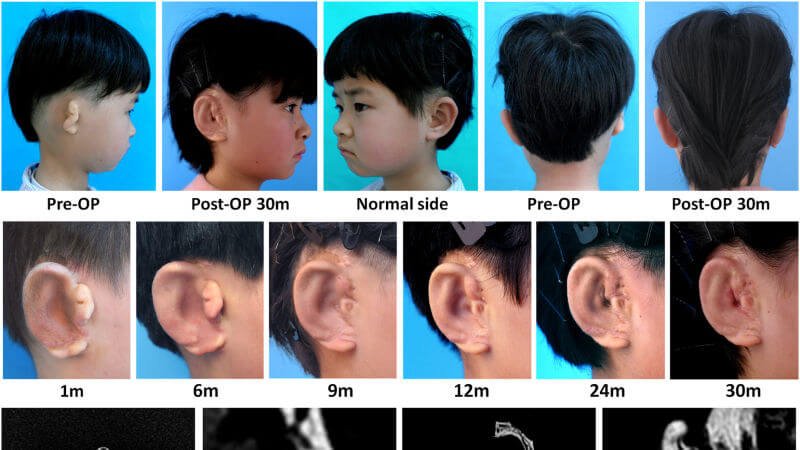
Chinese scientists say theyโ€™ve accomplished something thatโ€™s long been a goal in the world of regenerative medicineโ€”giving someone a new, perfectly compatible ear, freshly grown in the lab. What makes the feat a world-first is that the ear was made using that personโ€™s very own cells.

The experimental procedure was performed on five children, ages six to ten years, with an underdeveloped ear, a condition known as microtia.

โ€ฆ

The researchers created a 3D-printed replica of each childโ€™s normal ear (obtained via a CT scan), but with the dimensions reversed. This replica was then used to create a mold littered with tiny holes and made out of biodegradable material. The mold was filled in with cartilage cells taken from the childrenโ€™s deformed ear that were further grown in the lab. Over 12 weeks, the cells started to grow into the shape of the mold, replacing bits of it that had already disintegrated. This part-ear/part-mold was then grafted onto the children.

โ€ฆ

So far, the ears have stayed put, with no signs of the body inadvertently absorbing or rejecting the material. Cartilage has also continued to gradually replace the mold, resulting in a more natural-looking ear over time. The teamโ€™s results were published in the journalย EBioMedicine.

Read full, original post:ย Five Chinese Children Get Lab-Made Ears Grown From Their Own Cells

{{ reviewsTotal }}{{ options.labels.singularReviewCountLabel }}
{{ reviewsTotal }}{{ options.labels.pluralReviewCountLabel }}
{{ options.labels.newReviewButton }}
{{ userData.canReview.message }}

Related Articles

Infographic: Global regulatory and health research agencies on whether glyphosate causes cancer

Infographic: Global regulatory and health research agencies on whether glyphosate causes cancer

Does glyphosateโ€”the world's most heavily-used herbicideโ€”pose serious harm to humans? Is it carcinogenic? Those issues are of both legal and ...

Most Popular

Picture1-5
Science Disinformation Gap: The transatlantic battle over social media and censorship
Screenshot-2026-04-23-at-11.00.36-AM
Regulators' dilemma: Thalidomide, Metformin, and the cost of getting drug approvals wrong
ChatGPT-Image-May-12-2026-08_39_41-PM
GLP podcast: Big Pharma, Big Ag, Big Foodโ€”health harming industries or life-saving innovators?
Screenshot-2026-05-12-at-9.58.31-PM
'He seems fine': Marty Makary out as FDA commissioner
ChatGPT Image May 10, 2026, 08_16_59 PM 2
Overmedicalization? RFK Jr.โ€™s antidepressant crackdown raises conflict questions over his fee stake in Wisner Baum, the tort firm built on suing drug makers
Screenshot-2026-05-12-at-10.05.11-AM
Pro-vaccine โ€œheroโ€ vs. an anti-vax โ€œvillainโ€: โ€˜Bad Vaxxโ€™ video stirs MAHA backlash
Screenshot-2026-05-01-at-1.29.41-PM
Viewpoint: What happens when whole grains meet modern food manufacturing? Labels donโ€™t tell the whole story.
Picture1-1
Cooling the planet with balloons: Could a geoengineering gamble slow global warming?
ChatGPT-Image-Apr-13-2026-02_20_22-PM
Viewpoint: Misinformation infodemic? Why assessing evidence is so challengingย 
Screenshot-2026-05-11-104424
Hantavirus outbreak research: Trump administration shut down study last year on rodent-to-human transmission
ChatGPT Image May 12, 2026, 10_19_00 AM 2
Viewpointโ€” 'Muscular governance': How authoritarianism is surging corporate-linked energy misinformation
images
The never-ending GMO debate: Pros and cons
glp menu logo outlined

Get news on human & agricultural genetics and biotechnology delivered to your inbox.