CEOs of artificial intelligence companies usually seek to minimize the threats posed by AI, rather than play them up. But on this week’s episode of Converge, Clara Labs co-founder and CEO Maran Nelson tells us there is real reason to be worried about AI — and not for the reasons that science fiction has trained us to expect.
Movies like Her and Ex Machina depict a near future in which anthropomorphic artificial intelligences manipulate our emotions and even commit violence against us. But threats like Ex Machina’s Ava will require several technological breakthroughs before they’re even remotely plausible, Nelson says. And in the meantime, actual state-of-the-art AI — which uses machine learning to make algorithmic predictions — is already causing harm.
…
AI predictions about which articles you might want to read contributed to the spread of misinformation on Facebook and the 2008 financial crisis, Nelson says. And because algorithms operate invisibly — unlike Ava and other AI characters in fiction — they’re more pernicious.
…
Clara’s approach to AI is innocuous to the point of being dull: it makes a virtual assistant that schedules meetings for people.
…
Even a state-of-the-art AI can’t process this message with a high degree of confidence — so Clara hires people to check the AI’s work.
…
Nelson says it’s essential to building AI that is both powerful and responsible.
CRISPR is still new, and no one really knows its potential side effects. Does it cause cancer? How about unintended mutations? To get to the bottom of the issue, a team of researchers from China conducted a comprehensive assessment of CRISPR-modified monkeys, looking for any off-target mutations in the animals’ genomes.
…
For their study, the researchers designed a CRISPR-Cas9 system to make the gene MCPH1 inactive in rhesus monkeys. Mutations in this gene cause the brain to develop abnormally, resulting in the medical condition microcephaly.
The researchers injected their CRISPR-Cas9 system into 15 rhesus monkey zygotes (the single cell produced when sperm fertilizes an egg). They found that the MCPH1 knockout was successful in 13 of the resulting embryos (the next gestation stage, when the cell begins dividing and growing). This showed them their technique worked as they hoped.
…
The researchers found that their CRISPR gene modification worked in all but one of the monkey offspring, including the deceased female. Next, they looked for any de novo mutations (DNM), mutations that aren’t inherited, in the monkeys. They sequenced the whole genomes of each monkey and found that their CRISPR edits produced no DNMs.
…
The researchers’ conclusion? “CRISPR-Cas9 can be considered a relatively safe gene editing system for primates,” according to their paper.
Language and accusations are still exactly what they were in the late 1990s: “Frankenfoods” allegedly threatened the health and lives of millions and doomsday of our environment apparently was around the corner. Well, none of that ever really happened, did it?
Regardless, it seems that warming-up that cold GMO soup, flavouring it with a bit of anti-corporate sentiment and allegations of shady, undue industry lobbying, will still deliver the odd vote on election day next May.
Let’s hope it won’t – and with that help finally lay the black-and-white thinking of good (organic) and evil (non-organic=GMO) agriculture to rest and start talking defined objectives and measurable criteria and deliverables.
Assessing the latest plant breeding methods, the opinion of the ECJ’s Advocate General actually does just that: taking a measured and differentiated view.
True, the latest plant breeding methods will not resolve all our problems with food production and environmental protection. But nobody actually promises that! They are simply new, more sophisticated tools that can help to address agricultural and with that breeding challenges in a quicker and a more targeted manner.
Editor’s note: Garlich von Essen is the secretary-general of the European Seed Association
[E]ven as innovative targeted [cancer] therapies become available, various barriers prevent patients from gaining access to them. One hurdle that surprised me is access to genomic and mutational tests.
…
Our team at Cardinal Health surveyed more than 160 oncologists to better understand their perceptions and concerns about precision medicine and genomic testing. Although 65 percent of the respondents said they routinely used genomic testing to determine the best therapy for their patients, many said they worry about their ability to order these tests efficiently and in a timely manner.
…
Waiting several weeks for test results may not seem like a big deal, but for patients with an advanced cancer, every day can make a difference.
…
Diagnostic companies, along with companies that make cancer drugs, need to make tests easier to interpret and teach physicians how to interpret them. Regulators need to set clearer guidelines for tests to ensure greater consistency and ease of use across the industry.
…
Hospital systems need to invest in staffing and training their pathology teams to ensure they are up to date as more tests and therapies come onto the market.
…
Assuring that genomic tests are carried out and properly interpreted in a timely manner is essential to make sure that all patients who can benefit from newer precision oncology therapies have the opportunity to take advantage of them.
Canadian grain officials are confident that a visiting delegation from Japan will be satisfied that Canada’s wheat system does not contain the genetically modified variety found in a roadside ditch in Alberta last summer.
Based on the testing and the resources that have been put into the investigation, there is every reason to believe that the four wheat heads found beside an oil well access road near Strathmore, Alta., are the end of it.
While the Canadian Food Inspection Agency says it does not know where the GM wheat came from, or the type of wheat involved, it has answered other questions — such as whether the wheat got into the food or distribution system (it did not), whether it made it into any shipments (again, no), whether there are any safety issues (GM traits are perfectly safe in crops) and who developed the trait involved (Monsanto). But the agency should also explain why it took almost a year from the discovery of the GM plants to the public disclosure earlier this month.
Compared to previous incidents in the United States, that is an awfully long time.
Confidence in Canada’s food system is based on science, well-established procedures and trust. The latter is always in danger if something goes wrong.
Read full, original article: Speedy disclosure necessary for respected food system
“Innovations in plant breeding are enabling us to develop plants that meet the needs of a changing world,” said President of the International Seed Federation (ISF) Jean-Christophe Gouache at the opening ceremony of the ISF World Seed Congress 2018 in Brisbane, Australia. “This is down to the ‘power of genetics,’” he said. “Unlocking the potential of genetic resources to produce more with less is the fantastic mission of the seed industry over the coming decades.”
“In previous decades, it was enough to use genetic power to boost the efficiency of agriculture. Increasingly, we need to anticipate the role and the impact of our products to ensure that farming systems are more resilient and more sustainable than ever before,” said Mr Gouache. “Yes, the ‘power of genetics’ can deliver on both efficiency and sustainability,” he concluded.
Honorable Senator James McGrath, Assistant Minister to the Australian Prime Minister, told delegates: “The responsibility for delivering higher yields and more nutritious food rests on the innovation that the seed industry brings to world food production. Your organizations support the entire food chain globally, and are driving innovation in food and fodder production.”
Although my primary educational training is in biological science, I’ve always loved history. To help put myself through college, I worked as a National Park Ranger in the city where I grew up, Lowell Massachusetts. Lowell is a historical park that provides a look at a remarkable transition in American history: industrialization. Based on the area’s convenient and renewable water power which could be harnessed to run looms and thread spinners, a bunch of wealthy white guys used industrial espionage to steal plans from British cotton mills. They set up factories in Lowell that changed many environmental, social, and economic features of the previously sleepy farmland.
My ancestors worked in the Merrimack Mills, among other Lowell factories. Image courtesy of Lowell NHP.
One of the initial directions that the new industrialists wanted go: they wanted to hire women from the surrounding New England farms. They recognized an untapped resource — lonely young women who might work on the new high-tech weaving for a few years, then return back to the farms to raise families. They’d have boarding houses with a sort of dorm mother who would watch over their behavior and deportment — and their morals. It was an unprecedented opportunity for the women to earn an income and live away from a father or husband’s sphere. These women were able to gain an education that was otherwise unavailable to them at the time. Lecturers from Harvard, and numerous other famous and international speakers, came to Lowell during the Mill Girl period. The women contributed to a magazine, The Lowell Offering. One of them, Harriet Farley, was from a poor family in New Hampshire. She had few paths available to her, but came to work in the mills. There, despite very long workdays and workweeks, she found “emancipation”, the chance to “read, think and write” that was not available to her before. She was not the only one who seized this path for income and outlets that were not available back on the remote farms.
Harriet Farley seized the chance to work in the mills, which provided new opportunties for her. Via Notable American Women, 1607–1950: A Biographical Dictionary, Volume 1. E. James, editor.
I think of these women frequently and acutely when I hear people who claim to long for simpler times, before the machines and corporations ruined everything. I used to imagine what my life would have been like had I been born in the same spot in 200 years prior to my Park Ranger gig. Farm chores were difficult, dangerous, and constant, and domestic tasks were also endless. Childbirth was a risky endeavor — with little choice about whether you would opt to have children. For many, farming provided only a meager living. I would have gone to the mills too.
Although the initial utopian Lowell factory system idea decayed, the mills continued to provide jobs for many years. Some of my family arrived because of potato blight. They fled famine in Ireland, and found work in the mills. Life for immigrants is challenging in many ways, but it was better than dying in a field of blackened spuds. Like a lot of immigrant families, eventually hard work, education and military service lifted us to a middle class life that provided paths to jobs in teaching, public service, and science, among others, that were not available to our land-working ancestors.
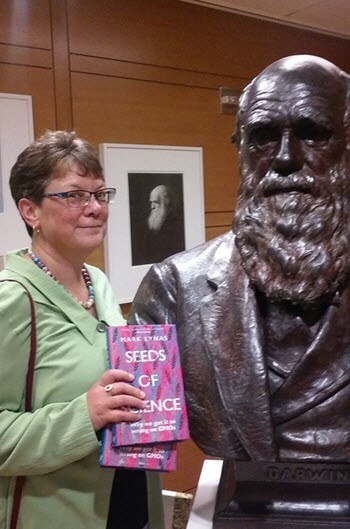
Me and Chuck at Mark Lynas’ NYC book launch event.
Mark Lynas has provided a worthwhile book from a number of perspectives. He describes his personal journey from farm- and science experiment-wrecking thug to someone who values the facts and evidence about plant science today. He looks at his own motivations and examines the reality of the tribal adherance that was keeping him from understanding the issues before.
He also provides an excellent overview of the history of opposition to the DNA modifications of plants and animals that are instructive to place us in the context we find ourselves today….
Having heard Mark describe how he reconstructed parts of the book to attempt to understand and convey the perspectives of opponents of genetic modification, I was eager to see what that looked like. I got to the chapter “What anti-GMO activists got right” and really wanted to figure out what that could be. Mark reconnects with influential activists from his prior life (George Monbiot, Paul Kingsnorth, Jim Thomas), and converses with them to grasp where they stand. Using iPhones and Skype and email, these wealthy white guys bemoan monocultures, corporations, patents, losing touch with nature, and the coldness of math over the abstractions of poetry. They worry about the centralized power dynamics that tech-laden farming or nuclear power plants demand (they claim). Jim Thomas of ETC deftly dodged the question of off-patent GMOs, but we are supposed to believe he’s a deep thinker on this issue — yet can’t figure out if those alter his conception and claims about them.
As with all the other merry-go-round excursions on this, all I saw was GMO-as-a-proxy-for-all-the-other-things-you-dislike. I saw nothing unique to genetic modification. George Monbiot even admitted, “it is absolutely true that there’s a scientific consensus on GMO safety”.
But, but, but… “Nothing human beings do is value-free” says George, about science. Sure. But those farm girls living in pre-tech “simpler times” were constrained by a whole lot of “values” too. Heavy duty “Christianity”, white, heterosexual, male-dominated economic control. Do you think economic power wasn’t concentrated before tech? Do you think that “values” discussions in the dominant religious framework wasn’t concentrated and hugely oppressive? WTF? What magic point back in time do you think we can go to from here? Industrialization and the new opportunities it provided increased women’s access to financial resources. It increased their access to educational enlightenment and new ideas. It gave them a voice they didn’t have before. It put us on a path to access strategies that let us control our fertility for the first time. Increasingly abundant food and medical care allowed us to reduce family sizes, if desired. It gives us access to information that we never would have had before. It gives us time to do other things. It actually gave us control over our lives and choices that we didn’t used to have. My grandmother — Mabel — wasn’t going to be allowed a vote until 1920. But she worked in the mills and had money to support her family, and earned respect as a skilled velvet cutter and later a trainer, with a feeling of purpose until she retired in the 1970s. (In her 70s. She enjoyed working, even though it wasn’t a walk in the woods.)
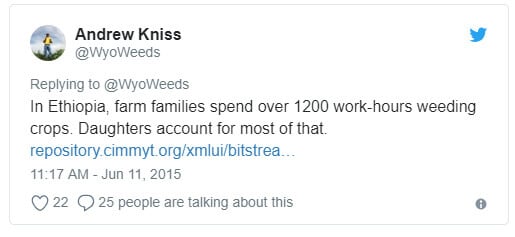
There are still plenty of places in the world that don’t have these options. Many of them are the small, non-corporate farming situations these guys seem to long for. Here’s one:
Daughters are weeding. Do you think that’s by choice? Maybe daughters who weed is what you value. But it’s not at the top of my values list for what kids should be doing.
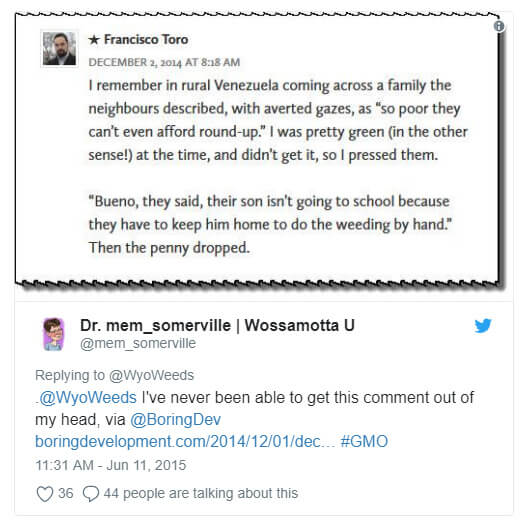
I’ll admit it straight up: I value education, for everyone, more than I value weeding. I value nutrition, so kids are healthy and thrive. I value abundant and inexpensive food. I value reducing the amount of land used for farming, and reducing harmful chemicals while maintaining yields. I value access to key cultural foods, for those who choose cassava or matoke, for example. I value reproductive choice. I value not living under zealots’ values constraints. I value options to reduce disease — like eliminating malaria vectors, or access to GMO insulin, or GMO leukemia treatments. I value low-carbon energy sources because burning your simpler time wood is harmful, especially for women who have to cook with it. I value farmers having access to tools that reduce the burdens for them and their families, and improve their safety. And I value the choice to use technology.
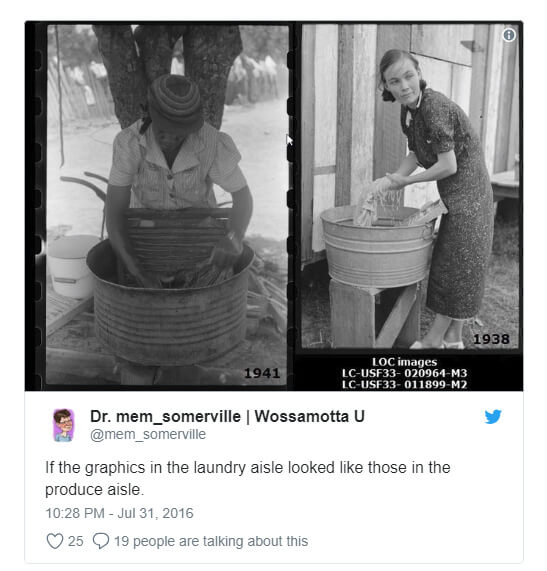
To his credit, by the end of this chapter Mark is making many of these same kinds of arguments. He notes one of the same things I was thinking as I was reading — Hans Rosling’s washing machine talk is an excellent example of tech than changed things for women, in ways that your back-to-nature warm-fuzzies do not.
Yeah — have your nostalgia for pre-technology and pre-corporation, or some undefined unfuture. History was a shitty time for most people, especially women. Their “values” were that I was property and expendable. When I hear these tech critics talk about simpler times and losing touch with nature, I’m like: FFS, no thanks. Don’t pretend your back-to-nature-simpler-times-plan doesn’t force a path that not everyone wants or would thrive in. And nature wants to kill you too.
Poetry isn’t one of the things I value, I’ll admit that too. I’m much too literal. But you know what? GMOs are not precluding poetry. And stop pretending that they are. Nobody is stopping you from moving to the lonely woods and weaving your own clothes and growing your own food. Which you can cook over a wood stove. Or your wife can, while you write.
Go ahead — and if you get malaria or diabetes or cancer you are free to run to Paul Kingsnorth’s tents in the Dark Mountain woods for some tree bark treatments and some poetry. That’s fine. But you don’t get to make that choice for me. And who are you to make that call for Ethopian daughters? I’m going to stick with technology. And work for that choice for others.
Also, you should read Mark’s book. Via printing press or Kindle. Your call.
Mary Mangan, Ph.D., received her education in microbiology, immunology, plant cell biology, and mammalian cell, developmental, and molecular biology. She co-founded OpenHelix, a company providing training on open source software associated with the burgeoning genomics arena, over a decade ago. All comments here are her own, and do not represent OpenHelix. Follow her on Twitter @mem_somerville
Depression is one of the most frequently diagnosed mental illnesses, with an estimated 15 percent of the global adult population experiencing depression at some point in life. Antidepressants are a common treatment, but between 30 and 40 percent of those taking the medication do not respond. Some research suggests that almost half of all depressed patients may have treatment-resistant depression.
A team of researchers at a Japanese university recently provided new insight concerning the problem of antidepressants’ notoriously high failure rates. The team identified the mechanisms behind what some are calling a new form of depression. Though preliminary, their work could lead to the development of new antidepressants that stand to make the overall pharmacological treatment of depression more successful.
“For almost 40 years I tried every antidepressant doctors threw at me, to no avail,” writer and producer Hyapatia Lee told the Genetic Literacy Project. “I felt belittled, ignored, and personally attacked because my body did not respond as others felt it should. … My doctors did not explain anything to me. They blamed me for my situation,” said the 57-year-old, who currently resides in Southern Colorado. “It should not be incumbent upon those of us suffering [with depression] to magically transform into medical professionals and researchers to diagnose ourselves at a time when we are severely incapacitated to begin with.”
Lee’s experiences with treatment-resistant depression led her to look outside conventional medicine. “I coped by turning to my Native American traditional leaders, elders, and roots,” she said. But it was the uncovering of underlying medical conditions that helped solve the problem decades later, after Lee “had been on just about every antidepressant you can name since the late 1970s.”
Mis- and disinformation are distorting science and public policy. Subscribe to our Daily and Weekly Digests for incisive coverage of ‘disruptive’ innovations in AI, agricultural biotechnology, food, chemicals, nuclear energy, vaccines, and other disruptive innovations.
The responses of Lee’s doctors may betray a certain blindspot in the medical community when it comes to treatment-resistant depression. Suggestions given to patients with treatment-resistant depression are frequently along the lines of reminding them to take their medication as directed, stop using drugs and alcohol, manage stress in their lives, get enough sleep and exercise, and focus on healthy eating. In other words, when regular treatment for depression doesn’t work, the finger is often pointed at the patient for what they are and are not doing in their lives to handle their depression.
And other treatment options for treatment-resistant depression include electroconvulsive therapy, repetitive transcranial magnetic stimulation and vagus nerve stimulation. These options do have rare but serious side effects and are not always effective. For example, electroconvulsive therapy (ECT) works well for some and not for others. Some ECT recipients felt no improvement in symptoms following treatment, some said the effects were initially beneficial but wore off quickly, while others said that ECT helped on some occasions but could not be counted upon to help each time. One individual named Tracy was discussed on the University of Oxford’s HealthTalk site: “Tracy suffered from post-natal depression as well as depression at other times of her life. She does not think ECT had any effect on her except to wipe her memory.”
The prevailing framework for treating depression is over 50 years old and is based on the monoamine hypothesis. Any other hypotheses that have since emerged are in their infancy, and have not led to pharmaceuticals with improved antidepressant activity.
The monoamine hypothesis of depression is based on the idea that depression is caused by decreased levels of serotonin, norepinephrine and dopamine. About 90 percent of antidepressants target the imbalance of these monoamine neurotransmitters. The monoamine hypothesis appears to hold true for most cases of depression, but certainly not all.
Some experts, such as Johan A. Den Boer, Senior Director of PRA Health Sciences in the Netherlands and professor of Psychopharmacology and Neuroscience at the University Medical Centre Groningen, have noted that “depression cannot be regarded as a single construct.” When expressed in this way, depression could be understood as several illnesses masquerading as one.
Patients who do not respond to monoamine-directed medications may have a newly discovered form of depression — one based on the levels of a protein called RGS8, encoded by the RGS8 gene, according to a study led by Hiroshima University. The results were published in Neuroscience in May.
The RGS8 protein controls a hormone receptor called MCHR1, or melanin-concentrating hormone receptor 1, which plays a role in regulating sleep, eating behaviors, and mood responses. Previous research has shown that RGS8 inactivates MCHR1, and having low or depleted levels of RGS8 leads to increased symptoms of depression. This points to a neuropeptide explanation for some instances of depression.
The Hiroshima study offered the first-known findings supporting “a modulatory role of RGS8 in the neurobiology of depressive-like behavior,” and was the first to examine RGS8’s effect in mouse models.
The researchers generated mice whose brains overexpressed RGS8. The mice were then tested alongside wild type mice (aka, the normal form of the species) to assess depressive behaviors. The mice did a swim test, which is a common and reliable method to gauge levels of depressive response in rodents. The mice with overexpressed RGS8 showed shorter immobility times compared to the wild type mice, indicating less depressive behaviors.
Research on these findings is only preliminary, but RGS8 is a promising candidate in efforts to create new antidepressant drugs for some individuals with treatment-resistant depression.
Kristen Hovet is a journalist and writer who specializes in psychology, health, science and the intersection of sociology and culture. Follow her on her website, Facebook or Twitter @kristenhovet.
Mark Lynas believed in his heart that he was doing the right thing. He was joining others in tearing out field trials of GE crops, and effectively arrested research and development around crop biotechnology. He participated in a movement that significantly shaped public opinion that influences policy to this day. But Mark is a scientific author, and when writing about climate change understood the need for rigorous evaluation of scientific evidence. When he applied the same thinking to GE crops, it was apparent that he was not following the evidence – and changed his mind. Mark treats the topic of plant biotech with refreshing nuance, sitting cleanly in the interface of sound science and responsible social application. His book details his journey, and is a refreshing primer for all of us that need to check ourselves for self delusion, and ensure that we are pursuing the truth in our discussions.
CRISPR is changing everything we thought we knew about Genetic Engineering, because according to the USDA, they won’t be regulating CRISPR in the same way they regulate “GMO” crops. CRISPR is different. Watch this video to find out how it works!
We’ve put together a list to introduce you to some of the most interesting products that can help you upgrade yourself from head to toe.
…
[Amal Graafstra is] making an NFC, or near-field communication, tag called a VivoKey Mini that can be implanted in your hand and will act as a secure token to help you do things like prove your identity when you log in to your online bank account.
…
[Dana] Lewis, who has type 1 diabetes, founded OpenAPS (also known as the Open Artificial Pancreas System), which helps people like her use an existing diabetes pump and continuous glucose monitor to automatically deliver insulin as their blood-sugar level changes.
…
AlterEgo, a research project created by [Arnav] Kapur, a grad student at MIT’s Media Lab, is a prototype of a gadget that sits on your face and lets you communicate silently with objects and other people.
…
[Tim] Swift runs Roam Robotics, a startup that wants to make inflatable robotic exoskeletons to help people with all kinds of physical activities.
…
[David] Cannington is the cofounder of Nuheara, a startup whose wireless earbuds let you amplify some sounds (such as voices) and quiet others. The devices are meant for people who don’t need a hearing aid but have trouble hearing in noisy environments.
The U.S. Department of Agriculture has come up with cheerful new labels for genetically modified foods. The bright green and yellow circles depict a happy sun, a winking smiley face or a verdant landscape stamped with the letters “BE,” for “bioengineered” — rather than the familiar “genetically modified” or “genetically engineered.”
It’s a shame the government is unwilling to let the facts speak for themselves.
Science has affirmed that GM foods — grown from seeds whose genes have been altered to make them resistant to insects or herbicides, for instance — are safe. There’s no need to dress up the labels to suggest that genetic modification makes foods somehow better. That risks misleading the public, just as Greenpeace and other groups have done with their baseless claims that GM crops are dangerous.
A straightforward description, not propaganda, is what American consumers want. And new evidence suggests that plain labels can help build acceptance for GM foods.
Economists who looked at prevailing attitudes in Vermont before and after a state labeling requirement went into effect there in July 2016 have found that the state’s no-nonsense labels — no logos, just the words “produced with genetic engineering” or “partially produced with genetic engineering” — led to a 19 percent drop in opposition to GM foods.
Editor’s note: This is part of an editorial by Bloomberg
An experimental gene therapy appeared to dramatically increase the production of a muscle-making protein in three young boys with Duchenne muscular dystrophy, a deadly and irreversible disease, according to results being presented by the drugmaker Sarepta Therapeutics.
…
Investors are likely to be focused on a measure of whether a test called the western blot shows that the gene therapy has sufficiently raised levels of dystrophin, the protein that is dysfunctional or missing in Duchenne patients, and without which the body cannot build and maintain muscle.
…
A May analyst note from Nomura Instinet, an investment bank, predicted the gene therapy would lead to dystrophin levels of 5% to 10% of normal.
The actual western blot number: 38.2% of normal, using Sarepta’s western blot method, and 53.7% based on a method developed at Nationwide Children’s that corrects for readings in fat and scar tissue. In other words, quadruple the best case.
…
Sarepta is already planning to start another study of 24 boys. Twelve will receive the gene therapy, and another 12 will receive a placebo. At the end of a year, the 12 patients who received placebo will get the gene therapy, too. The hope is that patients’ function will improve enough that regulators will approve the drug.
It appears the public will never know how Monsanto’s Roundup Ready trait ended up in wheat plants discovered in Alberta 17 years after the company shut down field trials of the MON71200 GM trait.
“All evidence-based lines of inquiry were pursued and have not resulted in any further avenues to be explored,” said the agency.
“Going forward, the CFIA will focus on monitoring the site and will verify that all GM wheat that may germinate is destroyed.”
Many people in the grain industry are trying to figure out what may have happened, including former Monsanto researcher Curtis Rempel, who was involved with the development of Roundup Ready wheat.
One theory is pollen flow but the nearest research facility was located 300 kilometres away from where the GM wheat volunteers were discovered and he said it is near impossible for that to happen.
Read full, original article: Cause of GM wheat escape unlikely to be known
A study ordered by the US Department of Defense has concluded that new genetic-engineering tools are expanding the range of malicious uses of biology and decreasing the amount of time needed to carry them out.
The new tools aren’t in themselves a danger and are widely employed to create disease-resistant plants and new types of medicine. However, rapid progress by companies and university labs raises the specter of “synthetic-biology-enabled weapons,” according to the 221-page report.
…
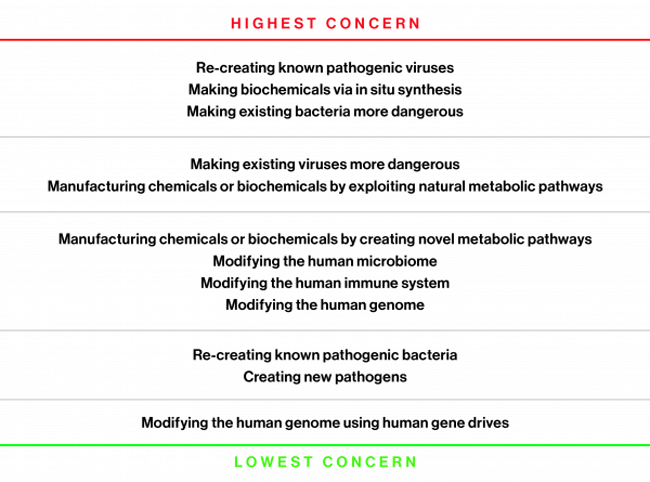
The current report attempted to weigh potential threats by considering factors such as the technical barriers to implementation, the scope of casualties, and the chance of detecting an attack. It found that while “some malicious applications of synthetic biology may not seem plausible right now, they could become achievable with future advances.”
Among the risks the authors termed of “high concern” is the possibility that terrorists or a nation-state could re-create a virus such as smallpox. That is a present danger because a technology for synthesizing a virus from its DNA instructions has previously been demonstrated.
…
“The US government should pay close attention to this rapidly progressing field, just as it did to advances in chemistry and physics during the Cold War era,” says Michael Imperiale, a microbiologist at the University of Michigan.
[Bloomberg journalist] Kristen V. Brown sent her spit to at least three different companies over the years. She went around to them asking them to get rid of what they had on her.
Ancestry.com allowed her to delete her data online, but a week after she called to ask the company to destroy her DNA sample, it was still intact.
23andMe told her initially that the tools needed to delete her data and sample were “not currently available.” Later, the company told her it couldn’t legally delete her genetic info due to government regulations.
Only one company, Exploragen, told the Bloomberg reporter it would completely delete her genetic information.
Because, here’s the thing: in your excitement to figure out if you’re part Native American after all, you might not have realized that you have very little control over where your genetic information goes after it reaches the company you initially sent it to.
A thorough read of the terms of service and privacy policies will reveal that most testing companies have permission to share your DNA data with third parties, such as law enforcement or scientific researchers.
…
Because your DNA data doesn’t stay between you and the testing company, tracking down and deleting every trace of it is essentially impossible.
After questions were raised in a meeting chaired by union agriculture secretary over the rationale in issuing licences for sale of glyphosate-based herbicides in non-tea growing states, Maharashtra government is waiting for directives from Centre on barring its sale. The chemical is linked with sale of illegal herbicide tolerant (HT) seeds. The meeting, which was attended by senior officials of state’s agriculture department, was held a fortnight ago.
US biotech giant Monsanto is one of the major manufacturers of glyphosate which is recommended for tea plantations. In Maharashtra, glyphosate-based herbicides are largely used in cotton fields. The state too has the powers to stop issuing the licences, which have not been exercised yet even as cotton sowing has already begun in different pockets.
Glyphosate is considered to be the root cause for spread of illegal herbicide tolerant (HT) cotton seeds in the state. A special investigation team (SIT) was formed last week to probe infiltration of the illegal seeds.
Ht seeds are genetically modified to be resistant to glyphosate-based herbicides which are sprayed to kill the weeds on the farm.
…
Andhra Pradesh government barred sale of glyphosate-based herbicides during cotton season last year itself.
About 800 million people are currently suffering from hunger in the world, and some 2 billion suffer from some type of important nutritional deficiency. Addressing global food security becomes essential when the population is projected to increase to 9.6 billion by 2050. This will require a global food supply increase of 70 percent, as well as more nutritious foods, especially for countries with problems of nutritional deficiency.
Strategies to combat this have included international food aid programs that provide supplements through pills, or fortification of local foods in the processing phase. However, the success of these efforts has been limited, due to such factors as inconsistent external funding and limited purchasing power and access to markets and hospitals by poor populations.
Another promising strategy — one that dodges these challenges and offers long-term sustainability — has been using plant breeding programs to develop staple crops with higher nutrient levels. These biofortified crops allow people to access specific nutrients through their daily diet, such as rice in Asia, sorghum and banana in Africa, or corn in Latin America. In this way, biofortified crops are an important alternative to alleviate malnutrition in the world.
[Neuroscientist Alice Flaherty] has been toying with the boundaries of illness itself. She likes seeing patients other doctors have given up on. Many have faced questions about whether they’re really as sick as they say. For all of them, getting the proper treatment — pills or infusions or electrical currents — depends on a kind of collaboration with Flaherty, a workshop in which motivations are re-examined, stories reshaped, turns of phrase redefined.
…
There was the woman who came in with an anxiety-related tremor but insisted that, no, these shakes weren’t psychological. “You have to convince them, yes, you really are sick, I understand that, or they’ll never trust you,” Flaherty said. “And they are really sick, they’re disabled, totally.” Then, with a careful tweaking of language, she was able to prescribe the Valium that the patient had been refusing from other doctors, and the tremor faded.
To some, she might sound like a shrink tucked away inside a movement disorder clinic, and that isn’t entirely wrong. Historically, psychiatrists and neurologists often kept to their own floors, as if the feeling-thinking brain and the physical brain were two different organs. Flaherty was merging both long before it became a trend.
…
Above all — whether the symptoms are psychological, physical, or some combination of the two — she wants them to feel heard.