From a distance, Edward Nsubuga’s 12-acre maize field appears to be well-kept. But the crop’s tall, green stalks mask an infestation of armyworm. These stalks won’t last for much longer, if the small-scale farmer does not get rid of the pests. Crop yields will be low, he says.
Nsubuga is searching for a solution to the problem. Other farmers have suggested that he replant the widely consumed crop, this time using genetically modified seeds that are pest-resistant. A bill, currently under review by Parliament, would permit the use of such seeds by maize farmers but would require them to maintain a distance of 200 meters (656 feet) between organic crops and the genetically modified maize crops.
“Two hundred meters is too big a piece of land to be wasted,” he says. Nsubuga would rather deal with the infestation than divide his farmland by crop types.
…
Those who refuse or fail to observe the minimum-distance requirements will be fined or imprisoned for up to five years….
While officials say the bill will allow farmers to grow both GMO crops and organic crops, Isaac Ongu, an agricultural consultant, says that more than 75 percent of the country’s farmers can only choose one.
In our human genome, there are many elusive genetic variants related to medical conditions, but the impact of these variants to actually cause a disease has not been conclusively determined — or ruled out.
In other words, the impact certain variants could have on your health remains a guessing game.
The study, published in the journal Circulation on [June 18], demonstrates for the first time how pairing CRISPR with induced pluripotent stem cell technology could be used to determine the risk of a genetic variant for cardiovascular disease.
…
“Patients often ask us what do these variants of uncertain significance mean. But in reality, we don’t know most of the time ourselves. So we end up having to follow the patients for the next five, 10, 20, or 30 years to see if the patient manifests the disease or not,” [researcher Joseph] Wu said.
“Here, we now have a way to shorten that time because we can generate patients’ induced pluripotent stem cells from blood.”
…
If the heart cells look abnormal, that probably means the variant of uncertain significance is pathogenic, meaning it’s capable of causing disease.
If the heart cells look normal, that probably means the variant of uncertain significance is actually benign.
An early halt to a trial of deep brain stimulation for depression reveals little about the treatment but more about the changing nature of clinical trials.
Some medical experiments are more daunting than others. The one that neurologist Helen Mayberg came up with to test a model of depression she had developed over about 15 years involved drilling two holes in the top of a patient’s skull and sliding two low-voltage electrodes deep into the brain until they reached a region known as Brodmann area 25. In a pair of pale pink curves of neural flesh called the subcollasal cingulate, each about the size and shape of a newborn’s crooked finger, area 25 occupies the fingertips. Once in place, the electrodes were wired to a battery pack implanted in the patient’s chest and turned on.
Between 2003 and 2006, first at the University of Toronto and then Emory University in Atlanta, Mayberg tried this experimental surgery, called deep brain stimulation (DBS), on 20 people who had been torturously depressed for years despite trying every other possible treatment. Area 25, she believed, was a neural junction box that became hyperactive in depressed people. She designed the experiment to see if the thrum of these DBS devices would calm area 25 and relieve their despair. In 2005 she published results from the first six patients, who’d done amazingly well; the other 14 later showed similar progress. Most cut their depression scores by around half. Over a third left their depression behind entirely.
Mayberg’s 2005 paper, published in Neuron, amazed her colleagues. To get such results in patients this sick was stunning. Tom Insel, then director of the US National Institute of Mental Health, called it “a new way of understanding depression”. The attention expanded into the public realm in 2006 – a story I wrote about Mayberg’s work in the New York Times Magazine that April; a CBS News 60 Minutes segment that September. Her phone rang ever more often with calls from reporters who wanted to interview her, universities and institutions that wanted her to come lecture – and scores of hopelessly depressed people, or their family members, who’d seen the press and wanted the treatment. Mayberg was on fire.
It wasn’t long before St Jude Medical, the device company that made the neurostimulators Mayberg used, decided to run a clinical trial to seek US Food and Drug Administration (FDA) approval for the treatment. There were, of course, risks to moving ahead so soon. Mayberg and her colleagues, for instance, had been using the implants with more people and were seeing hints of variables that might affect the treatment’s power – differences in the quality of the patient’s depression, in how the surgeons sited the device – that if explored might make the treatment even more effective. You could of course wait for ever – you could always find out more – but at some point you had to forge ahead. And the thing was working. People were all but rising from the dead.
So in 2008, after much discussion, she signed on as one of more than two dozen researchers from all over North America who would serve as consultants and investigators to help design and execute the trial. As is usual in trials of this size, with multiple treatment centres, the sponsor – St Jude, in this case – would actually administer it. Many of the researchers had done trials before; Mayberg had not. And no one researcher, including Mayberg, could hope to direct everything. She hoped to do what she could to ensure the trial was rigorous and the patients treated well.
St Jude branded the trial the Broaden study – for Brodmann Area 25 Deep Brain Neuromodulation. The plan was to have 20 neurosurgery centres implant St Jude’s DBS devices in 200 people with treatment-resistant depression, then turn on the devices in two-thirds of them. In the other third – the control group – they’d leave the devices for six months before activating them. No one with patient contact would know which patients were which. Then they’d follow all 200 patients for two years after implantation to see how the two groups fared. Would the active-implant group do better than the control group? Would they do as well as Mayberg’s own patients?
By 2017, when it was over – long, long after it should have been – Broaden would reveal not only the answers to those questions, but also deep tensions and confusion about the limits of a clinical trial, the nature of research, and the difference between the two.
It started well, as three of the trial’s surgical teams worked steadily in 2008 and early 2009 to implant the first 30 patients. At that point, as planned, there was a mandated safety review. After a pause of some months to generate a report and review it with the FDA, the implantation programme expanded from three surgical centres to 15.
As data from all those new patients implanted at new centres trickled in over the following months, it became apparent that while many were becoming less depressed, they weren’t progressing as rapidly as Mayberg’s previous, non-trial patients had. This wasn’t surprising. Large, double-blind, control-group trials often fall short of the uncontrolled “open-label” work that inspired them. (“Open-label,” or unblinded, means all patients know they’re getting the treatment.) So these early results didn’t much worry Mayberg.
As the 15 surgical teams implanted yet more patients in 2011 and 2012, the study neared the mark that would trigger its first assessment – an interim “futility analysis” that would evaluate progress when at least 75 patients had been implanted for six months or more, with two-thirds in the active-treatment group and one-third in the control. As it happened, a large group of patients reaching the six-month mark at about the same time allowed the team to include 90 patients in this interim analysis. A critical question in this analysis was how the patients’ progress measured up against the trial’s primary target, or “outcome measure”. In an FDA trial of this sort, the primary outcome had to be declared in the study design; it had to be relatively simple and clear, to prevent the moving of goalposts or other hanky-panky; and it had to reflect the therapeutic goal, which in this case was to reduce depression.
For the Broaden trial, the primary six-month outcome chosen was for at least 40 per cent of the active-group patients to experience a drop of 40 per cent or more in their individual depression scores. The scale used was a common, clinician-administered depression questionnaire called the Montgomery–Åsberg Depression Rating Scale. In this 10-question, 60-point scale, practices in categorising severity vary, with typical schemes rating scores under 9 or 10 as indicating no depression, around 10 to 18 mild depression, 19 to 34 moderate depression, and 35 and up severe depression. The Broaden trial, which was interested mainly in change over time, classified scores under 11 as no depression (or remission), and didn’t categorise severity otherwise.
The Broaden patients, having tried virtually every approved therapy without lasting benefit, had gone years with scores averaging in the mid-30s. For them, a 40 per cent drop would still leave them depressed, but not nearly so badly – an ambitious goal, given how immovably sick they had long been. Yet this seemed reachable given Mayberg’s impressive previous results.
As well as looking at the 40 per cent improvement target, the Broaden team were also keen to see how many patients would achieve full remission; would they match the rates seen in Mayberg’s open-label work?
None of it happened. In late 2012, when the team finally had six months of data on 90 patients, the depression score reductions weren’t even close. Of the 60 active patients, only 20 per cent (12 of them) had reduced their scores the desired 40 per cent after six months, and only 5 per cent (three people) were in remission. This was essentially matched by the control group, who after six months with inactive devices had 17 per cent hitting the improvement target and 7 per cent in remission.
While discouraging, these numbers did not automatically sink the trial. Rather, this interim analysis was done to gauge the trial’s likelihood of hitting its outcome goals if it implanted 200 patients for at least half a year. But if the calculated likelihood fails to clear a trial-specific, predetermined minimum set by the FDA – a sort of kill switch – the FDA will usually end the trial with a so-called “halt for futility”.
For the Broaden trial, the FDA had set this bar at a likelihood of success of one in ten. The futility analysis calculated its likelihood of success as one in six. Modest odds, to be sure, but it easily cleared the FDA bar. The trial could continue.
However.
A trial sponsor can stop a trial at its own prerogative. St Jude now did so. Sometime in 2013, the company informed the Broaden team – Mayberg and dozens of cooperating researchers at the 15 research centres – that it was stopping the trial. St Jude never said why. DBS procedures can cost upwards of $100,000 a patient, so continuing would have been expensive for St Jude. Perhaps they had their own kill-point somewhere north of one in six. In any case, they stopped the trial.
Image credit: Eleanor Shakespeare for Mosaic
St Jude and then Abbott, a larger company that later bought St Jude, would continue to pay for the care of the implanted patients who wanted to either continue or have their devices removed. They’d pay the research centres to continue to collect data until every patient had hit the two-year mark. But they would implant no more patients, and they would cease their attempt to get FDA approval. Five years in, roughly ten million dollars out, and a decade after Mayberg implanted her first horribly sick patient, the trial was over.
The first reaction to this halt – to the end of this keenly anticipated test of a depression treatment hailed as the most original and promising in decades – was crickets. St Jude said nada. The researchers, who’d agreed not to talk until the data was published, zipped it. No one associated with the study publicly marked its halt.
Yet word slowly slipped out.
The first leak came via industry analyst James Cavuoto, who in late December 2013 reported in his newsletter, Neurotech Business Report, that he had learned at a scientific meeting that the Broaden trial had “failed a futility analysis”. This news, Cavuoto wrote, “cast a pall over an otherwise upbeat attendance… Once again, the industry is left to pick up the pieces as a promising new technology gets set back by what could be many years.”
The rest of Cavuoto’s post was nuanced and carefully considered. But the language used by his unnamed source – “failed a futility analysis” – strongly implied that the trial was halted by the FDA because it did not clear the FDA’s chance-of-success threshold. It didn’t help that “failed a futility analysis” just sounds disastrous because in common parlance, if not in the FDA’s, “futile” means “pointless”. Cavuoto made clear in his post that he thought Mayberg’s treatment was useful and promising. But in the silence left by the company and its shushed researchers, his “futility” phrasing set the tone for much of the coverage and conversation that followed.
A handful of journalists and bloggers who had followed the trial soon waded in, some more carefully than others.
In January 2014, a month after Cavuoto’s post, a blogger known as Neurocritic, one of the sharper online writers on neuropsychiatry and a longtime follower of Mayberg’s work, reported and amplified Cavuoto’s scoop. Neurocritic’s measured, context-rich post inspired a measured, context-rich stream of comments that accumulated beneath the post over the next two-and-a-half years. These comments included numerous remarks from about 10 to 12 people identifying themselves as patients in the trial. (An exact count is impossible, as many are signed “Anonymous” and some appear to be follow-up comments.) Two, three, or possibly four said the treatment didn’t help, and one or two reported severe complications of the sort warned of in any trial involving such surgery but that are nonetheless withering to experience and distressing to read about. Somewhere from seven to nine commenters said the treatment had worked for them or their spouses; several called it life-saving.
In March 2014, the Scientific American online columnist John Horgan, who had previously written critically of Mayberg’s work (and – full disclosure – of some of my coverage of it), posted a brief report on the halt that replicated Cavuoto’s phrasing about “failing the futility analysis”. Two readers commented that they’d been in the trial and it had saved them; a third wrote saying his wife had been in the study and suffered “severe memory and cognitive problems as a result”. (These people may or may not have been among those who commented at Neurocritic’s site.) Horgan’s take was factually accurate, if sharply critical. Others drew on mischaracterised or mistaken reads of the sparse data to paint the trial as a massive failure. Speculation filled the data void.
Mayberg, reading such coverage and comments and hearing of rumours flying around among colleagues, was appalled. “I was mortified. I asked the company, Please make a public statement, because all you have now is a rumour mill and the information that a few patients weren’t doing well.” St Jude stayed mum. Before long, colleagues at conferences were offering Mayberg condolences. They’d pull her aside and say they were so, so sorry to hear the trial had failed.
One day she got an email response to a grant application in which the grant officers asked Why are you still working on this if it doesn’t work? Others said similar things. Why write about this, a journal editor asked in a letter rejecting a paper she’d sent, when everybody knows it failed? She began to worry her entire research programme was endangered.
Then something emerged that both sharpened and salved the sting of the trial’s halt. The patients got better.
To be sure, the treatment didn’t work as well as hoped. As expected, it failed to help many. In the first year, ten of the 90 patients left the study (and four had their devices removed), for reasons ranging from worsening depression to a suicide attempt. Eventually, of the 90 patients, 37 – most of those who’d felt no benefit – had the devices removed.
Also as expected for a surgical intervention in so depressed a population, some experienced side-effects and complications of the sort mentioned by commenters on the Neurocritic post. Overall, at least nine people reported increased depression, six got infections, and several more suffered side-effects such as headaches or post-operative discomfort or pain, either at one of the surgery sites or from a condition called “bowstringing”, in which the battery leads running under the skin between chest and skull bond with tissue and create pulling sensations. Three patients grew more anxious. One considered suicide. One tried it and lived. Two tried it and died.
Perhaps the best known of those with complaints was Steve Ogburn, an architect who was implanted at Stanford in late November 2012 and soon experienced complications. In a video he posted in 2014, and cited by John Horgan and several others who then wrote about him, Ogburn reports a harrowing tale of “severe cognitive decline”, continued depression, and severe pain in his head and around the electrical leads running between chest and head. None of these, he says, were relieved when Stanford removed the implants, wiring and battery in December 2013.
Lisa Wick, an elementary school teacher from Minnesota, also suffered complications, but hers developed seven years after what had otherwise been a successful implant. When she was first implanted, in 2008, Wick had been badly depressed for years despite psychotherapy, several antidepressant regimes, and multiple rounds of electroconvulsive therapy. “Just able to survive,” she told me. “I’d teach, then go home and crash.”
Like many other patients who’ve improved with DBS, Wick vividly remembers feeling a sudden change right on the operating table, which she feels certain was the stimulator being turned on. “All of a sudden I was talking. It was like that part in The Wizard of Oz where it goes from black-and-white to colour. I felt better right away.” The pain she’d felt for ages quickly lifted.
Within a year, Wick’s depression eased to a level she was happy with, and she stayed well until an infection that developed after a battery change in 2015 spread up the leads towards her skull and eventually forced the Chicago team to remove the entire implant.
With the implant gone, Wick slid back into the paralysing depression and unceasing psychic pain she’d felt before the surgery. After almost a year of this, with Mayberg’s help, she was reimplanted by a Broaden team in Dallas. According to Mayberg, that team was able to duplicate exactly the first implant’s location and settings. Wick was unconscious this time around, but when she woke, she found the “awful, awful” active pain that was crushing her had vanished. Over the next year she climbed back into the state of full remission she’d had before the infection. “A long wait,” she told me in December 2017. “But I’ve returned to the place where I longed to be. I’m back.”
Stories like Wick’s and Ogburn’s, though mere anecdotes from a statistical perspective, are hardly meaningless. They give a taste of how various, variegated and rich these cases can be, how fickle is fate – and biology. They speak to the tremendous stakes involved in aiming a treatment so intrusive at an affliction so crushing. Yet in the brutally binary terms dictated by a clinical trial, the significance of such cases is largely limited to how well they represent the study’s group-level data. And under those terms, each story represents but one point of data among 90; Wick and Ogburn were dots near the opposite ends of a spectrum. And going by the six-month data, as Mayberg herself is quick to confirm, “the trial clearly failed”.
But what about the treatment? In the months and years after the November 2013 halt, as data accrued from patients who continued with the treatment, it became clear that more and more of them were moving towards and past the 40 per cent improvement threshold; some were even in remission.
Most of the researchers had access to reports about the data as it accrued. But the first presentation of results – a presentation sharply constrained by journal guidelines, St Jude’s proprietary hold on the raw data, and authorial arguments about relevance – was made public only in October 2017.
The paper, finally published in Lancet Psychiatry, presented patient data through 24 months of activation. When tracked for two years instead of the six months used for the futility analysis, the percentage of active-treatment patients whose depression scores dropped by at least 40 per cent more than doubled, to 50 per cent of all those in the original active group. The remission rate also rose, from 10 per cent at six months to 31 per cent at 24 months. These rates come very close to Mayberg’s open-label trials.
Also encouraging was the response of patients in the control group when their implants were activated after six months, for they continued to roughly match that of the group whose implants had been active from the start. The control group’s full-remission rate once active, however, was lower. This may be because the control group’s smaller size can magnify the statistical impact of small differences in the depression scores of those patients. We don’t know, for instance, whether a high number of control-patient scores fell just short of remission (or, conversely, barely reached it) – just one of many things we can’t know because neither St Jude nor Abbott has published the individual-patient data.
In any case, this long-term Broaden data echoes Mayberg’s findings, in several open-label studies done before and during the time of the Broaden trail, that the treatment gains effectiveness over time. The two-year results for these intensely sick people – half reaching the 40 per cent improvement threshold, almost a third in remission – stand sharply at odds with the six-month scores.
Image credit: Eleanor Shakespeare for Mosaic
What we have here is a failed clinical trial – of a treatment that seems to work.
It’s a nasty conundrum. As Paul Holtzheimer, a lead author on the Broaden study, put it at a conference last year, “To imagine that 50 per cent of patients that are this severely ill, this treatment-resistant, would get better and stay better for this period of time… [We] have [a large failed study], we have these really amazing open-label pilot data – it is hard to reconcile those two.”
Holtzheimer’s lament touches on two separate but connected problems. One is why the trial failed even though the patients got better. The other is why it fell short of Mayberg’s open-label studies.
The simpler question first: Why did the trial fail even though the patients markedly improved?
Perhaps the trial’s sharpest constraint was the weight placed on its six-month results. Although six months is actually long for a depression trial (trials of pharmaceutical antidepressants, for instance, typically last only six to 12 weeks), it makes a pretty short leash for Mayberg’s DBS approach, which earlier work had shown led to marked improvements between six and 24 months. A study of her first cohort of patients, operated on in Toronto, found the percentage who markedly improved – that is, cut their depression scores by at least 40 per cent – was 62.5 per cent after one year, 46.2 per cent after two years, and 75 per cent at three years; remission was achieved by 18.8 per cent at one year, 15.4 per cent at two years, and 50 per cent after three years. A study of another 17 open-label patients Mayberg treated at Emory found improvement in 41 per cent of patients at six months, which rose to 92 per cent at two years; remission rose from 18 per cent at six months to 58 per cent at two years. Betting the entire Broaden trial on favourable six-month results proved far riskier than anticipated.
So why just six months? According to several Broaden study authors, the six-month mark was set because of concerns that, given the treatment’s high effectiveness in previous studies, it would be unethical to keep a third of these very sick patients on placebo for any longer. A shorter stretch would also save St Jude a lot of money if the trial did need to be stopped. In any case, Broaden’s six-month outcome target forced an early, one-time-snapshot evaluation of a therapy that did its best work over longer periods. It also meant losing the control group from any analysis beyond six months, making it difficult to assess later progress objectively.
The second question is more involved: Why do patients in Mayberg’s open-label work – especially those she has treated since Broaden started – have such better response rates than those in the trial?
One possible contributor is bias. Researcher bias, which can take many forms, is a potential force in any study. It’s possible – arguably somewhere between likely and certain – that Mayberg’s strong role in her open-label work affected the outcomes. As is standard practice, the depression scoring was done by researchers with no ties to her or her lab. Yet Mayberg is a warm, confident, highly engaged clinician, and the bonds she builds with her patients doubtless give many of them more confidence and faith in the procedure.
As some observers have noted, Mayberg had two conflicts of interest that could bias her work: licensing and consulting fees from St Jude, and part ownership of a patent on the procedure that could generate income should it get approved. During the trial, she and Andres Lozano, the Toronto neurosurgeon who shares the patent with her, received fees from Abbott for a licence to use the procedure in the trial. Mayberg says her own licensing and consulting fees during the trial amounted each year to “about enough to buy a decent used car”. Decent-used-car money is not meaningless. But it is modest next to the shiny-new-Lexus-level fees common in clinical trial consulting agreements, and it falls far short of what Mayberg could likely demand and receive.
Mis- and disinformation are distorting science and public policy. Subscribe to our Daily and Weekly Digests for incisive coverage of ‘disruptive’ innovations in AI, agricultural biotechnology, food, chemicals, nuclear energy, vaccines, and other disruptive innovations.
A more obvious difference was that the open-label work had no control groups and the Broaden trial did. As every Broaden patient was told beforehand, one in three of them would start the trial with a device that would be inactive for the first six months. Possibly this knowledge created a sort of bias within them – a reduced confidence and thus response – in both the placebo and the active groups.
The factors above may well have contributed to the different responses in the trial and the open-label work. But it seems a stretch to think they could make Mayberg’s open-label work twice as effective over six months as the trial was. The answer is more likely found in the many differences between Mayberg’s open-label treatment protocol — which changed as she went along — and the protocol in the Broaden trial.
Even as the Broaden trial was running, Mayberg continued her research, implanting new patients and, in an effort to get ever-better results, refining the way she was using DBS. This meant that her work increasingly diverged from the Broaden study in significant ways. She selected patients differently. She sited and managed the electrodes differently. She supported the patients differently. Any of these had the potential to create or widen a gap in outcome between Mayberg’s open-label work and the Broaden trial. In a sense, that was the point: She wanted to improve on the early protocol on which Broaden was largely based.
The trial and the open-label work differed in how they chose patients. To start with, the Broaden patients had suffered from treatment-resistant depression far longer than Mayberg’s patients had – on average, 12 years instead of five. This longer run may have contributed to their reduced response.
And while Broaden filtered out people with anxiety or personality disorders (as did Mayberg), it did not exclude or prioritise any depressive subtypes. Meanwhile, Mayberg had begun to identify in her open-label patients at least three psychological characteristics that predicted better response: comparatively low “mood reactivity”, or short-term responses to changing environmental conditions; a clear “psychomotor” slowing of thought and movement; and “high negative affect”, or the experience of depression not just as an absence of pleasure but as the distinct mental or even physical pain that the psychologist and philosopher William James, who often suffered depression, called “an active anguish” – the pain that Lisa Wick felt lift both times her device was implanted. These traits characterise what Mayberg calls a “classically melancholic” depression, in which calming area 25 may have more effect. Mayberg now selects for such patients; the Broaden study neither sought nor avoided them.
Another difference was that the Broaden study sited the electrodes by a method that Mayberg happened to abandon as the Broaden study began. Until 2008, Mayberg’s team sited the implants based on so-called gross anatomy. That is, they used conventional MRI scans to place the electrodes in a particular spot within the well-defined brain area, visible in any scan, called area 25. Broaden targeted its placements likewise.
Yet even as Broaden launched, Mayberg began using a newer, more detailed imaging tool, diffusion tensor imaging (DTI), that could reveal not just distinct brain areas but the white-matter bundles, called tracts, that carry neural traffic from one area to another. This DTI work showed that patients responded best if the electrodes sat at particular junctions of white-matter tracts within or next to area 25. Together with adjustments in patient selection, this has helped to improve outcomes in Mayberg’s open-label patients since 2008 – but came too late for use in the Broaden study.
Finally, Mayberg has long offered her patients comprehensive, personally tailored programmes of psychiatric and social-service support to help them rebuild their lives. After years of deep depression, most patients’ lives, relationships and ways of thinking have been entrenched in illness and disability long and deeply enough that surgery alone was unlikely to make them whole. Like a patient with a knee repair, says Mayberg, “they need rehab to get well again”. So her team helps them get psychotherapy, occupational or physical therapy to rebuild skills or physical health, and other assistance to connect them to needed social services.
The Broaden trial offered only post-surgical support, and to prevent statistical confounds it expressly ruled out the addition of any psycho- or drug therapy not underway before the trial. This successfully isolated the surgical intervention statistically – but likely reduced the chance of recovery.
To look at the Broaden trial in light of Mayberg’s larger hypothesis and work is to see that Broaden was a pale outline of the treatment it set out to test – recognisable in its main features, but not to be mistaken for the real thing. Running a clinical trial, of course, all but requires that we strip an experimental therapeutic programme down to its most basic, reproducible and scalable parts. But it would be foolish to take the results of that necessarily reductive exercise as a final verdict on all possible versions of the treatment. A trial of aspirin for headache, for instance, could fail if the patients had migraines, took doses too small, or were assessed for effect after 5 minutes instead of 5 hours.
Mayberg devised her treatment to test her hypothesis, developed after years of scanning work, that area 25 is a crucial node (and thus a possible treatment target) in a neural network critical to depression. The encompassing hypothesis – that such networks play a crucial role in at least some mental-health disorders – suggests that other nodes, treated either alone or in combination with area 25, might also be good targets. Neither of these hypotheses comes close to being proven wrong (or right) by the Broaden trial, any more than a failed aspirin trial would disprove the notion that a headache is at least partly a neurochemical event.
These limits to clinical trials’ implications apply tenfold to any trial halted early. Maureen Meade, a critical care specialist and researcher in clinical trial and research methods, put the case against stopping trials for futility in 2005. She wrote that it impoverishes data not only about the primary outcome measure, but also about secondary measures, adverse effects, or subgroup effects that could be informative scientifically even if the primary target is not reached. Halts for futility thus “increase the risk of misinterpretation”, including the false conclusion that an effective treatment is not.
The whole idea of “futility” is to stop trials that seem almost certain to fail. Meade’s article and the wider halt-for-futility literature make clear that such a halt should be a scientific decision, not a business decision. Thus the usual method described is an interim analysis by a committee of scientists to see if the trial hit a predetermined early benchmark – exactly the kind of review that Broaden passed. Yet St Jude halted it, not the researchers; and at least publicly it cited not any benchmark, nor any data, nor anything at all. As Meade put it, halt decisions made without following clear standards make it more likely that “stopping decisions will be idiosyncratic or self-interested”. Whether St Jude’s halt was idiosyncratic or self-interested can’t be said. But the decision can hardly be considered scientific, because science means showing your data. Today, many companies involved in clinical trials are being more open with data from their studies, even those that ‘fail’, recognising the value of letting other researchers use it to build greater understanding and make more progress faster.
Cast in terms of a courtroom trial, then, the halt of almost any clinical trial – and clearly this one – declares not a verdict but a mistrial. The question at hand remains unresolved, to be answered another day. Both Mayberg’s treatment and her wider hypothesis must still prove themselves. But the Broaden trial has hardly proven them wrong.
Will Broaden’s failure put an end to talk of DBS for depression? Will it jeopardise Mayberg’s research programme?
This no longer seems likely. After a period in which Mayberg had reason to worry her funding might evaporate, the creation of the National Institutes of Health’s Brain Initiative in 2013 led to a friendlier funding atmosphere for her work. In 2017 the National Institute of Mental Health awarded her a $5 million-plus grant to continue her DBS work. And in January 2018, she moved from Emory to the Medical School at Mount Sinai Hospital in New York, where she heads the new Center for Advanced Circuit Therapeutics. There she continues to refine both her hypothesis and her treatment.
Whether any device maker will think it worthwhile to fund another clinical trial of area 25 DBS for depression remains to be seen. Abbott still holds the licence to treat depression in this way. James Cavuoto told me he thinks Abbott likely remains interested. Abbott told me it has “ongoing dialogue” with researchers in DBS and depression.
If Abbott decides to take another shot at area 25, it will be able to work with more flexible trial rules created by the FDA in 2016. These rules allow a study to designate several different outcome measures, including effectiveness measures on different timescales rather than at a single time, to add additional outcome measures based on new hypotheses (which might dictate a change in target or differences in device placement), and to identify and evaluate the characteristics of any subsets of the trial population that are responding particularly well.
Clinical-trial watchdogs rightly note that using too many measures or outcome targets or patient subsets can open the door to cherry-picking or moving the goalposts. But if controlled well, such flexibility could reveal whether a treatment or a variation of a treatment might work well for one population but not another – in people with a particular depression subtype, for instance. This would be roughly akin to the approval of cancer drugs that work on, say, only 1 in 5 people with a broadly defined type of tumour, but in 4 of 5 people whose tumours include a specific genetic signature.
Taken together and managed well, the new rules should allow more flexibility in trials of complex treatments like Mayberg’s. In a way, these rules seek to find a better way to balance what machine-learning people call the explore–exploit trade-off. This is the tension between exploring all possibilities in some arena and finding the quickest way to exploit it. A trial like Broaden is forced to focus on a single point of exploitation. A trial with broader parameters could test several different outcome measures or scales instead, and thus bring at least a bit of the exploratory nature of research into the game.
Cavuoto hopes Abbott will run another trial and try to answer those questions. The FDA rule changes, the continued improvement of the Broaden patients, and the potential gains, he says, make it too ripe to pass up. From a business point of view, he notes there’s “a huge market opportunity. But more important, there are thousands, perhaps millions of patients who are suffering that might not be. This disease is literally killing people.”
In the meantime, says Mayberg, “I just need to keep working.” She wants to identify the success factors – variables in patient phenotype, electrode placement, post-surgical support – well enough that they’re refined into a more transferable protocol.
“My husband asks me when I’m going to retire. I’ll retire when the work is done.
“I can’t stop because some people think it’s worthless. My patients tell me these people are wrong. The data tells me they are wrong… This thing isn’t dead.”
David Dobbs writes about science, medicine, sports, fishing, music, human behaviour and other forms of culture. He has written for publications such as National Geographic, the New York Times Magazine, The Atlantic and Pacific Standard. Follow him on Twitter @David_Dobbs.
Planting season for corn and soybeans across the U.S. corn belt is drawing to a close. As they plant, farmers are participating in what is likely to be one of the largest deployments of insecticides in United States history.
Almost every field corn seed planted this year in the United States – approximately 90 million acres’ worth – will be coated with neonicotinoid insecticides, the most widely used class of insecticides in the world. The same is true for seeds in about half of U.S. soybeans – roughly 45 million acres and nearly all cotton – about 14 million acres. In total, by my estimate, these insecticides will be used across at least 150 million acres of cropland, an area about the size the Texas.
Neonicotinoids are very good at killing insects. In many cases they require only parts per billion, equivalent to a few drops of insecticide in a swimming pool of water.
In recent years, concerns have been raised about the influence of neonicotinoids on bee populations. As an applied insect ecologist and extension specialist who works with farmers on pest control, I believe the focus on bees has obscured larger concerns. In my view, U.S. farmers are using these pesticides far more heavily than necessary, with potential negative impacts on ecosystems that are poorly understood.
Neonicotinoid use by crop from 1992 to 2014. The y-axis represents mass of neonicotinoid active ingredient applied in millions of kg. Tooker, Douglas, Krupke, 2017, doi:10.2134/ael2017.08.0026, CC BY-NC-ND
Pesticides on seeds
Most neonicotinoids in the United States are used to coat field crop seeds. Their role is to protect against a relatively small suite of secondary insect pests – that is, not the main pests that tend to cause yield loss. National companies or seed suppliers apply these coatings, so that when farmers buy seed, they just have to plant it.
The percentage of corn and soybean acreage planted with neonicotinoid seed coatings has increased dramatically since 2004. By 2011, over 90 percent of field corn and 40 percent of soybeans planted were treated with a neonicotinoid. Between 2011 and 2014, the area treated crept toward 100 percent for corn and 50 percent for soybeans. And the mass of neonicotinoids deployed in each crop doubled, indicating that seed suppliers applied about twice as much insecticide per seed. Unfortunately, many farmers are unaware of what is coated on their seeds, while others like the peace of mind that comes from an apparently better protected seed.
Unlike most insecticides, neonicotinoids are water soluble. This means that when a seedling grows from a treated seed, its roots can absorb some of the insecticide that coated the seed. This can protect the seedling for a limited time from insects. But only a small fraction of the insecticide applied to seeds is actually taken up by seedlings. For example, corn seedlings only take up about 2 percent, and it only persists in the plant for two to three weeks. The critical question is where the rest goes.
Clothianidin is a neonicotinoid used almost exclusively as a coating on seed corn. Maps from USGS.
Pervading the environment
Because neonicotinoids are water soluble, the leftover insecticide not taken up by plants can easily wash into nearby waterways. Neonicotinoids from seed coatings are now routinely found polluting streams and rivers around the country.
Neonicotinoids also can strongly influence pest and predator populations in crop fields. My lab’s research has revealed that use of coated seeds can indirectly reduce crop yield by poisoning insect predators that usually kill slugs, which are important crop pests in mid-Atlantic corn and soybeans fields.
Slugs, shown here on a soybean plant, are unaffected by neonicotinoids, but can transmit the insecticides to beetles that are important slug predators. Nick Sloff/Penn State University, CC BY-ND
An exaggerated need
Neonicotinoid advocates point to reports – often funded by industry – which argue that these products provide value to field crop agriculture and farmers. However, these sources typically assume that insecticides of some type are needed on every acre of corn and soybeans. Therefore, their value calculations rest on comparing neonicotinoid seed coatings to the cost of other available insecticides.
History shows that this assumption is clearly faulty. In the decade before neonicotinoid seed coatings entered the market, only about 35 percent of U.S. corn acres and 5 percent of soybean acres were treated with insecticides. In other words, pest populations did not cause economically significant harm very often.
Importantly, the pest complex attacking corn today is more or less the same as it was in the 1990s. This suggests that it is not necessary to treat hundreds of millions of acres of crops with neonicotinoid seed coatings.
From overkill to moderation
Should the United States follow the European Union’s lead and pass a broad ban on neonicotinoids? In my view, action this drastic is not necessary. Neonicotinoids provide good value in controlling critical pest species, particularly in vegetable and fruit production. However, their use on field crops needs to be reined in.
In the Canadian province of Ontario, growers can only use neonicotinoid seed treatments on 20 percent of their acres. This seems like a good start, but does not accommodate farmers’ needs very well.
Integrated Pest Management (IPM), a control strategy based on using pesticides only when they are economically justified, offers valuable guidelines. It was introduced in the late 1950s in response to issues stemming from overuse of insecticides, including environmental damage and pest populations that had evolved resistance. Field-crop growers have a good history of using IPM, but current use of neonicotinoids ignores pest risk and conflicts with this approach.
To implement IPM in field crops with neonicotinoids, seed companies need to acknowledge that the current approach is overkill and poses serious environmental hazards. Extension entomologists will then need to provide growers with unbiased information on strengths and limitations of neonicotinoids, and help farmers identify crop acres that will benefit from their use. Finally, the agricultural industry needs to eliminate practices that encourage unnecessary use of seed coatings, such as bundling together various seed-based pest management products, and provide more uncoated seeds in their catalogs.
These steps could end the ongoing escalation of neonicotinoid use and change the goal from “wherever possible” to “just enough.”
John F. Tooker is an Associate Professor of Entomology and an Extension Specialist at Pennsylvania State University. Follow him on Twitter @jftooker
Scientists have figured how to use a form of the powerful gene-editing tool CRISPR to erase genetic traits normally associated with autism. It is technology that could one day revolutionize the therapies that treat autism and improve the lives of thousands of people who suffer from the developmental disorder, the researchers say.
…A team of scientists in Texas used it to edit out genes associated with autism traits in mice and observed clear results: The animals stopped digging obsessively, their erratic jumping around the cages slowed to a halt and they became more calm, according to the study published in the monthly journal Nature Biomedical Engineering.
This technology might be years away from being tested on humans, but the results are promising, lead author of the study neuroscientist Hye Young Lee told Newsweek.
…
After the procedure, the mice recovered for up to three weeks before the scientists analyzed their behavior to find significant therapeutic results. They saw a 30 percent drop in compulsive digging, and a 70 reduction in jumping, both indicative of autistic behavior.
“You could knock out disease-causing genes and actually see fairly significant behavioral changes,” said bioengineer Niren Murthy, who also worked on the study. A University of California, Berkeley professor, Murthy invented the CRISPR-Gold technique that was administered to the mice.
On May 24, 2018 the FDA approved Golden Rice for consumption in the USA, a curious move, because we will never consume it. Folks here get plenty of vitamin A.
However, when providing a product to the Developing World, many people are rightfully suspicious, and the endorsement of safety from the US-FDA is a good thing. It is symbolic. Period.
However, however, the FDA also stated that the levels of beta-carotene were not high enough to make a health claim.
Based on that last determination, a website called Independent Science News and others reported that the high beta-carotene rice has “no nutritional benefits”.
…
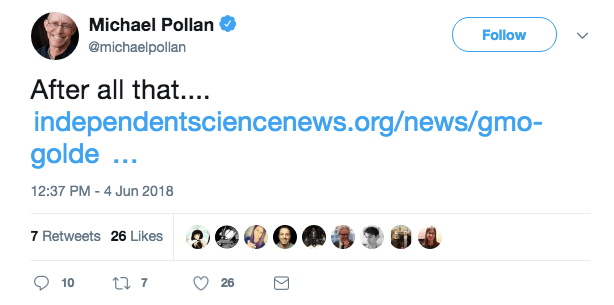
Even influential food writer Michael Pollan cites the ISN misinterpretation without critical evaluation.
…
After activists and their mouthpieces willfully misinterpret the report, the FDA responded. Marriana Naum wrote the following statement. (bold is mine)
It is unfortunate that the statement you reference in our letter responding to BNF 158 has been misconstrued to suggest that there would be no value of the pro-vitamin A in golden rice for its use in the countries where it is intended for distribution.
…
Consuming rice containing the levels of pro-vitamin A in GR2E rice as a staple of the diet could have a significant public health impact in populations that suffer from vitamin A deficiency.
New versions of Bluebird Bio’s gene therapy for inherited blood disorders yielded significant benefits for patients, according to updated results from ongoing clinical trials released [June 15]. But whether those benefits will endure for the patients with those conditions, beta-thalassemia and sickle cell disease, remains an open question.
…
Here’s a rundown:
Bluebird has now treated six sickle cell patients with the new version of LentiGlobin. Among other changes, the new version is derived from stem cells harvested more easily from their blood rather than bone marrow, as was the case with the old version. No serious safety problems have surfaced.
LentiGlobin works by producing healthy, anti-sickling hemoglobin, that, in turn, replaces damaged, sickled red blood cells known to cause anemia and extremely painful sickle cell “crises” in patients.
Four of the sickle cell patients have been followed for longer than three months and are now producing anti-sickling hemoglobin.
…
In a [June 14] interview, Bluebird’s chief medical officer, David Davidson, said the LentiGlobin data being presented this weekend are starting to show convincing evidence that the gene therapy can transform patients with two gene mutations — meaning they have active sickle cell disease — into what is known as “trait” patients: those who only carry a single mutation and are therefore asymptomatic and live normal lives.
The International Service for the Acquisition of Agri-biotech Applications (ISAAA) has warned that the proliferation of counterfeit Bacillus thuringiensis (Bt) corn seeds in the local market could cut the country’s yellow corn production.
Worse, the ISAAA said, the uncontrolled and unregulated spread of fake genetically modified (GM) corn seeds would “jeopardize the longevity and efficiency” of the technology, resulting in lower income for Filipino farmers.
“The large decline of biotech maize area in the Philippines due to counterfeit seeds needs immediate attention because, if not attended to, this will jeopardize the longevity and efficiency of the technology that will weigh heavily on farmer profitability and economic benefits,” the ISAAA said in its annual report on the Global Status of Commercialized Biotech released on June 26.
…
Seed industry stakeholders estimate that about 10 percent of the Bt corn seeds sold in the domestic market are counterfeit.
Counterfeit Bt corn seeds are seeds that contain traits belonging to registered and regulated multinational firms but are produced and sold by unauthorized people.
An influential Chinese scientific advisory board on genetically modified crops met last week for the first time in a year, two sources said, in a sign that Beijing may be preparing to approve new biotech crops for import.
The meeting, which took place from June 20 to June 22, according to one of the sources, comes amid escalating trade tension with the United States, the world’s top producer of GMO crops.
“The meeting happened last week,” said a second source with a Chinese seed company, who closely follows Beijing’s seed approval process.
Both people declined to be identified because of the sensitivity of the matter and because meetings of the National Biosafety Committee, which guides Beijing on GMO safety, are confidential.
The Ministry of Agriculture and Rural Affairs, which has the final say on approvals, did not respond to a fax seeking confirmation of the meeting.
No details of what was discussed were disclosed, but the committee’s meetings are keenly watched by seed companies because the panel typically reviews GMO crops for approval for import.
China does not permit the planting of genetically modified food crops, but does allow GMO imports, such as soybeans and corn, for use in its animal feed industry.
As gynecologist and surgeon Liza Johannesson prepped to deliver the child via cesarean section, she was nervous. Not for the baby—she was used to delivering those—but for the uterus. It was 62 years old. A family friend of the patient, who had been born without her own womb, had donated it.
…
The baby and the mother too both turned out healthy. It would be a month before the journal article announcing the birth would appear, allowing the Swedish-led medical team to tell the world: Uterus transplants are possible. And they can bear life.
…
Hundreds of women’s fertility advocates have applauded Baylor [Medical Center]’s work, and other transplant centers have contacted it to learn its methods. The need seems great.
…
Critics question the necessity of the procedure, given that women have other paths to motherhood, such as surrogacy and adoption. Some wonder if surgeons are undertaking the challenge simply because they can. And then there are the risks. The donor must undergo a medically unnecessary surgery to remove her womb. The recipient must undergo three: one to insert the uterus, another to deliver the baby via C-section, and a third to remove the organ after birth.
…
Finally, there are the costs, which [surgeon Guiliano] Testa estimates at around $250,000, putting the operations beyond the reach of any but the most affluent, and perhaps the most desperate.
Even though consumer awarenessand knowledge of genetically modified organisms (GMOs) aren’t very high, arecent online surveyfrom the International Food Information Council (IFIC) Foundation found that shoppers will typically avoid these foods if possible. In addition, consumers want food labels to tell them whether GMOs are present.
IFIC said about half of consumers (47%) don’t worry about whether foods contain GMOs, but 41% consider the presence of GMOs when purchasing foods, the survey found. Consumers also want to see a GMO symbol or wording on food packaging so they have access to the information while shopping. However, they don’t want to call a number or visit a website to get such information.
The online survey of 1,002 people also found the most common reason people avoided these foods was human health, followed closely by environmental and animal health concerns.
[Dissociative identity disorder is], a condition in which the psyche gives rise to multiple, operationally separate centers of consciousness, each with its own private inner life.
…
Now, a newly published paper by one of us posits that dissociation can offer a solution to a critical problem in our current understanding of the nature of reality.
…
[A]lthough consciousness is indeed fundamental in nature, it isn’t fragmented like matter. The idea is to extend consciousness to the entire fabric of spacetime, as opposed to limiting it to the boundaries of individual subatomic particles. This view—called “cosmopsychism” in modern philosophy, although our preferred formulation of it boils down to what has classically been called “idealism”—is that there is only one, universal, consciousness. The physical universe as a whole is the extrinsic appearance of universal inner life, just as a living brain and body are the extrinsic appearance of a person’s inner life.
…
We know empirically from DID that consciousness can give rise to many operationally distinct centers of concurrent experience, each with its own personality and sense of identity. Therefore, if something analogous to DID happens at a universal level, the one universal consciousness could, as a result, give rise to many alters with private inner lives like yours and ours. As such, we may all be alters—dissociated personalities—of universal consciousness.
Here’s the thing about the spinal cord: you’ve only got one. And right now, if you injure it, doctors can’t fix that. All they can do is try to reduce further damage.
But a new, experimental gene therapy may change that. In new research published [June 14], rats paralyzed from spinal cord injuries were able to move their legs and paws again.
When a person’s (or rat’s) spinal cord gets damaged, they may lose some or all of the ability to control certain limbs or parts of their body, depending on where the injury occurred. Typically, a scar blocks the nerve cells on the spine from communicating with each other and with the muscles they control.
The new gene therapy breaks down that scar tissue over the course of a few weeks. Over time, the paralyzed rats who received the treatment were able to climb a ladder and then had enough fine motor control to grab a sugar cube.
…
If this were possible to do in humans, it could have a huge impact. “Recovering the use of the hands is the top priority for the majority of individuals living with spinal cord injuries,” researcher Elizabeth Bradbury told The Guardian. “It would enable them to do everyday tasks such as washing and dressing independently, picking up a coffee cup, and would be life changing.”
“We’re not saying from this that urban areas are the solution to bumblebee declines or that urban areas are the ideal habitat,” said Ash Samuelson, a graduate student at Royal Holloway University of London in Britain and lead author of the study. “But given the choice of two unnatural situations, they’re actually able to exploit that city environment, which is very different to what they evolved in.”
Bumblebees are important pollinators for flowers and crops that benefit from their vibrating pollination style. But pesticides, disease and habitat loss are wiping out all types of bees, worldwide. Oddly, as sprawling cities and vast agricultural fields replace forests and meadows, people have noticed more bumblebees buzzing around cities. Dr. Samuelson wanted to know if these bees were simply traveling to cities when agricultural fields ran out of food or if they actually were surviving better there and having more babies.
The Office of the Gene Technology Regulator (OGTR) has issued a licence to GO Resources Pty Ltd that authorises the commercial cultivation of genetically modified (GM) safflower in Australia.
The GM safflower has been modified for high oleic acid composition in the seed.
The GM safflower and its products would enter general commerce, with the oil intended for use in the industrial oil market, not for human food, and the meal to be used as stock feed.
…
Suppressing two genes already present in safflower leads to production of more oleic acid (a mono-unsaturated fatty acid), and less linoleic acid (a poly-unsaturated fatty acid) in the seed.
…
The GM safflower also contains a selectable marker gene from a common soil bacterium. This gene confers antibiotic resistance.
The prestigious science journal Nature published [a] breathtaking new discovery [about the oldest DNA ever recovered] in June 1993, a single day before another momentous occasion: the release of Jurassic Park. It seemed like the perfect stroke of luck for famed director Steven Spielberg. The publicity came not from his studio’s $65 million promotional plan, but from real, legitimate scientists.
…
It was a prime example of how science and science fiction can collide in the real world—each can boost the other, and one realm can often nudge another in a different direction.
…
“A lot of science is trial and error and finding out what we don’t know,” [science historian Elizabeth] Jones says. “What makes ancient DNA and the story of Jurassic Park so interesting is that figuring out what ancient DNA could or couldn’t do wasn’t a private affair. Researchers were responding not just at their conferences and their peer review articles, but on a public platform.”
In other words, while the science might not have been right the first time around, it was still part of the exploration process. And for once, the public got a taste of what that debate looked like even as scientists were working out the finer details. So maybe ancient DNA can’t bring back the dinosaurs. But it still brings the tantalizing promise of resurrecting more recent animals—like, for instance, woolly mammoths.
Brilliant disruptor Michael B. Eisen has a provocative essay out recently titled “How GMOs Can Save Civilization and Probably Already Have.” While reasonable people may quibble with some of his minor points (specifically, his argument that we must all shift to plant-based diets), the paper is well worth a read, and his opening premise is indisputable: “It is safe to say that, without systemic genetic modification of crops and livestock, civilization would not exist.”
Ideological opponents to “genetic modification” are seemingly impervious to data and experience, and perhaps unaware of biologicalreality, but those interested in the facts of the matter are obliged to consider and weigh the evidence as we make decisions about, for example, the most environmentally friendly way to grow the food we eat. Some argue passionately for organic farming, claiming that “chemical/GM” agriculture (which they wrongly conflate) is despoiling the planet and consuming our children’s futures. Scientists have moved beyond this false dichotomy, finding that innovations in agriculture over the past 50-plus years, including some derived from organic farming but especially those based on genetic modification, have dramatically increased yields, improved safety, and reduced the ecological footprint of farming. There are those who continue to deny these realities, but their house is built on sand and the “ash heap of history” awaits. And settled as these issues are for those who respect data and experience, it is still possible for new work to reaffirm and extend these findings in ways that deserve attention.
Respected entomologist Galen Dively from the University of Maryland, together with nine colleagues from Maryland, Delaware, New Jersey, Virginia and Minnesota, has published such a paper. With the riveting title “Regional Pest Suppression Associated With Widespread Bt Maize Adoption Benefits Vegetable Growers,” these researchers describe positive environmental impacts from biotech-improved seeds that extend far beyond what most of us expected.
Like humans, certain insect species find corn to be an attractive food. Two such pests (among many others) are widespread and serious in North America: the European corn borer (Ostrinia nubilalis) and the corn earworm (Helicoverpa zea). Historically these plagues have been difficult to control, largely because they burrow into the corn ear, under the husk, where they are substantially protected from pesticide sprays or predators, as many of us who have shucked corn for a summer feast have discovered to our unpleasant surprise. But the incidence of such surprises has declined of late, as biotech improved corn varieties with inbred resistance to these pests entered and dominated the market between 1996 and 2016. Farmers love these biotech-improved varieties, because the pest resistance is packaged with the seed in the form of a protein that is lethal to the pest, but nothing more than demonstrably safe, added nutrition to humans. That protein is known as “Bt,” from the bacterial source, Bacillus thuringiensis. It has been a popular pesticide that has been permitted for organic farmers to use because it is derived from a common soil microbe, targets specific insect pests in a way that is safe for non-target insects and other organisms, and degrades quickly in the environment, lacking any potentially problematic persistence.
Farmer enthusiasm for this innovation has propelled the seeds to market dominance more rapidly than any other innovation in the history of agriculture, reaching over 90 percent market share in less than 20 years. The benefits to farmers are obvious: less pest damage, higher quality and quantity harvests, lower input costs (yes, the biotech-improved seeds cost more, but the savings from reduced pesticide spraying are greater), and less time managing the crop in the field. The benefits to consumers are similarly obvious—fewer unpleasant surprises, and substantial reduction in the presence of cancer-causing contaminants often found in pest-infested corn. This is an open and shut case. But these benefits, dramatic though they are, do not tell the whole story.
Mis- and disinformation are distorting science and public policy. Subscribe to our Daily and Weekly Digests for incisive coverage of ‘disruptive’ innovations in AI, agricultural biotechnology, food, chemicals, nuclear energy, vaccines, and other disruptive innovations.
Those corn pests, the European corn borer and the corn earworm, are not just plagues on corn: They are serious pests for a host of other food crops as well, including most of the vegetables grown in the mid-Atlantic region. And this is where it gets really interesting.
As Dively et al. write:
“Moth populations of both species significantly declined in association with widespread Bt maize (field corn) adoption, even as increased temperatures buffered the population reduction. We show marked decreases in the number of recommended insecticidal applications, insecticides applied, and O. nubilalis damage in vegetable crops in association with widespread Bt maize adoption. These offsite benefits to vegetable growers in the agricultural landscape have not been previously documented, and the positive impacts identified here expand on the reported ecological effects of Bt adoption. Our results also underscore the need to account for offsite economic benefits of pest suppression, in addition to the direct economic benefits of Bt crops.”
In other words, the “Halo Effect” from Bt corn adoption reduces the numbers of a major pest throughout the mid-Atlantic region, decreasing the need for pest control by other vegetable growers including the organic farmers who are prohibited from knowingly planting “GM” seeds! So, the organic marketers who have staked their brands on vilifying safe and green competing products benefit directly from the wider use of the products they denigrate. Ironic.
As we have noted before, the United Nations Food and Agriculture Organization estimates global population will stabilize around 10 billion humans by 2050. Increased demand stemming from both population and economic growth means that between now and then farmers will have to produce as much food again as they have from the dawn of civilization to the present day. How can we avoid mass starvation in the future? Countless studies have shown that to do this with organic farming methods is simply impossible; the nitrogen needs alone would require perhaps twice as much land in cultivation as there is on the planet, leaving little for wilderness, biodiversity, or the “lungs of the world.” On the other hand, seeds improved through biotechnology have spared nearly 50 million acres/year from being converted to agriculture, reduced CO2 emissions by 59 billion pounds/year, reduced farmers’ pesticide use by 37 percent, increased yields by 22 percent, and cut the environmental impact of farming by more than 18 percent.
Some in the organic community see these things as they really are. Daily reports spotlight new ways in which biotech can be harnessed to produce novel biofuels, increase carbon sequestration, and further to improve agriculture and help it “tread more gently on the land.” Those interested in the facts of the matter can see the future, and it cannot arrive soon enough.
Val Giddings is Senior Fellow at the Information Technology and Innovation Foundation. He previously served as vice president for Food & Agriculture of the Biotechnology Industry Organization (BIO) and at the Congressional Office of Technology Assessment and as an expert consultant to the United Nations Environment Programme, the World Bank, USDA, USAID, and companies, organizations and governments around the world. Follow him on twitter @prometheusgreen.
This article originally appeared on the Information Technology and Innovation Foundation’s website as “How GMOs Can Save Civilization” and has been republished with permission.
For years, the standard belief has been that leaving young children in daycare puts their health in jeopardy. And there is some out-of-context justification for that belief. According to the US National Library of Medicine, studies have shown that children in day care centers are more likely to catch an infection than kids who do not attend day care because they are often around other kids who might be sick. But there are benefits to these group settings, as well. “[B]eing around the large number of germs in day care may actually improve your child’s immune system in the long run,” writes the National Institutes of Health, and we are now learning there may be even more profound health benefits.
From wiping down shopping carts with disinfectant to home-schooling children to ‘protect’ them from the vagaries of daycare and public education, some practices in society appear to be over-engineered and instead of improving outcomes, may even make things worse. All this misplaced concern has led to more highly-scheduled and anxiety-ridden children than ever before, erroneous and over-diagnoses of ADHD, and an increase in more pernicious allergies. A new thread of research suggests an explanation for why children who attended daycare seem to have been more protected from a particular type of cancer.
Should ‘dirty’ be the new clean?
An incredible litany of evidence supports the so-called ‘hygiene hypothesis’ which in summary states that the uptick in allergies seemingly reported also coincides with successive generations becoming more and more urbanized and sanitized. The fact that as a society we are too clean may have been a primary cause in the increase of allergies and other immune dysfunctions. Children who have grown up in more rural settings (on farms) seem to have more robust immunity and fewer immune dysregulation conditions than their counterparts in more ‘clean’ environments.
Also, outdoor play has decreased dramatically over the past few decades which is considered an enormous health burden in society – it could lead to more childhood obesity, fewer physical social engagements, and under-developed physico-spatial reasoning. We’ve also found a surprising number of children who live in cities that are vitamin D deficient, which quite literally only needs minutes of daily sun exposure to prevent. There are even serious suggestions that this limited outside play leads to unexpended youthful energy, unexpressed physicality, and therefore increased diagnoses of attention deficit and hyperactive disorders.
Salubrious effects of daycare
While on one hand daycare centers are dozens to hundreds of children co-located who share germs, on the other hand, this is exactly what seems to have a protective effect for prevention of acute lymphoblastic leukemia (ALL). Research published in 2015 demonstrates a link between a type of immune cell called a ‘B cell’ or ‘B lymphocyte’ and this particular type of leukemia.
Dysregulation of B cells and a pair of enzymes responsible for DNA restructuring and fine-tuning was fully-correlated with this leukemia in lab mice as part of the research. Interestingly, since the introduction of the Haemophilus influenzae type B vaccination given to very young children, there has been a concomitant decrease in cases of ALL.
Based on the causal mechanism suggested by the research, this suggests that the introduction of a very mild stimulant to the immune system (the pediatric HiB vaccine) allows the immune system enough exposure to a challenge that it’s more likely to develop properly. So not only is the HiB vaccine associated with a significant drop in cases of pediatric HiB, but also with lymphoblastic leukemia.
The protective effect against ALL seems to be more robust for children who have attended all-day daycare (versus HiB or other vaccines), though there would be nothing particularly special about ‘daycare’ as the venue, it’s just that it represents a place where there are a lot of early exposures to infections.
A version of this article originally appeared on the GLP in September 2016.
Ben Locwin is a behavioral neuroscientist and astrophysicist with a masters in business, and a researcher on the genetics of human disease. BIO. Follow him on Twitter @BenLocwin.
[T]he International Service for the Acquisition of Agri-biotech Applications (ISAAA) and PG Economics, Ltd. released new studies highlighting the continued social, environmental and economic benefits of the global adoption of biotechnology in agriculture.
…
The ISAAA report shows the global biotech crop area increased in 2017 by 3 percent or 4.7 million hectares. This increase is due primarily to greater profitability stemming from higher commodity prices, increased market demand both domestically and internationally, and the presence of available seed technologies. As more developing countries, now 19 in total including India, Pakistan, Brazil, Bolivia, Sudan, Mexico, Colombia, Vietnam, Honduras, and Bangladesh have increased their biotech crop area and continue to allow farmers to adopt biotechnology in food production, smallholder farmers see the direct improvements this offers, allowing them to provide better lives for themselves and their families. In fact, developing countries now account for 53 percent of the global biotech area planted.
From 1996-2016, PG Economics reported biotech crops provided $186.1 billion in economic gains to some 17 million farmers, many of whom are female, smallholder farmers solely responsible for the livelihood of their families and communities.
…
Advances in biotech crops allow farmers to use insecticides and herbicides more strategically, reducing the environmental impact associated with their use by 18.4 percent on GM crop areas since 1996.
Editor’s note: Read the full studies here and here (behind paywall)














 Like humans, certain insect species find corn to be an attractive food. Two such pests (among many others) are widespread and serious in North America: the European corn borer (Ostrinia nubilalis) and the corn earworm (Helicoverpa zea). Historically these plagues have been difficult to control, largely because they burrow into the corn ear, under the husk, where they are substantially protected from pesticide sprays or predators, as many of us who have shucked corn for a summer feast have discovered to our unpleasant surprise. But the incidence of such surprises has declined of late, as biotech improved corn varieties with inbred resistance to these pests entered and dominated the market between 1996 and 2016. Farmers love these biotech-improved varieties, because the pest resistance is packaged with the seed in the form of a protein that is lethal to the pest, but nothing more than demonstrably safe, added nutrition to humans. That protein is known as “Bt,” from the bacterial source, Bacillus thuringiensis. It has been a popular pesticide that has been permitted for organic farmers to use because it is derived from a common soil microbe, targets specific insect pests in a way that is safe for non-target insects and other organisms, and degrades quickly in the environment, lacking any potentially problematic persistence.
 In other words, the “


