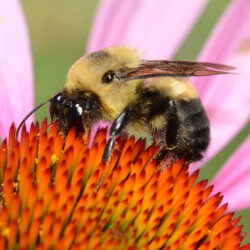
Are bees disappearing due to ‘climate chaos’? Out of 250 bumblebee species around the world, only a few species are in danger

Credit: Michael Owen Baker/L.A. Daily News

It’s easy to find… articles on the internet which claim that bumblebees and wild bees will be extinct in 20 years or less because of rising temperatures.

A recent study from Simon Fraser University in British Columbia questions that narrative. [Ecologist Melissa Guzman] said the real story about bumblebees is more complex.

There are more than 50 bumblebee species in North America and about 250 types of bumblebees around the world.

Many of those species are not suffering. They’re doing fine.

“If you look at all the species, on average, there is no decline,” Guzman said. “Some are OK, some are increasing and some are decreasing.”
Mis- and disinformation are distorting science and public policy. Subscribe to our Daily and Weekly Digests for incisive coverage of ‘disruptive’ innovations in AI, agricultural biotechnology, food, chemicals, nuclear energy, vaccines, and other disruptive innovations.

The public should be informed about wild bees that are at risk in their area so they can take local action to preserve the species, said Sarah Johnson, a bee expert at SFU and one of the study’s authors.

That’s preferable to the “all bees will be extinct in two decades” message, which makes the problem seem insurmountable.

“If you just say every species (of bumblebee) is declining… (then) we’re already in this space where everything is falling apart, past the point of no return…. It makes people feel there is no point in doing anything.”

Read the original post

Related Articles

Infographic: Global regulatory and health research agencies on whether glyphosate causes cancer

Infographic: Global regulatory and health research agencies on whether glyphosate causes cancer

Does glyphosate—the world's most heavily-used herbicide—pose serious harm to humans? Is it carcinogenic? Those issues are of both legal and ...

Most Popular

Bayer Crop Circle in Golden Wheat
Making fertilizer from thin air: Bayer’s gene-editing innovation could dramatically cut chemical fertilizer use in growing food
Picture1
Viewpoint: How badly is the U.S. food-safety net fraying? FDA’s bungled handling of the tainted lettuce crisis deepens concerns over cuts to disease tracking and response
Glossy Plastic Bag of Tokens and Labels
Viewpoint: How CNN got played by environmental activists pushing a plastics scare and litigation agenda
ChatGPT-Image-Mar-10-2026-01_39_01-PM
Viewpoint—“Miracle molecule” debunked: Why acemannan supplements don’t work
Screenshot-2026-10-30-at-10.55.54-AM
Longevity scandal: The huckster who validates the ‘oldest people in the world’ claims
Screenshot-2026-11-03-at-12.31.18-PM
Gene editing once viewed with suspicion by UK  farmers, upwards of 90% now open to their sustainability benefits
Reaching Through the Woven Sky
Challenging genetic modification rejectionists: Our evolving food system has relied on science for thousands of years
Neon Genome_ Fetal Dreamscape
The race to genetically engineer babies
Smiling-Woman-Over-Teal-Abstract-Shapes
Viewpoint: RFK Jr.’s latest foray into junk science: Even Kennedy’s hand-picked NIH director balks at appointment of crackpot mental health director
ChatGPT-Image-Sep-2-2026-02_03_32-PM
How much of a problem is AI’s water use?
Screenshot 2026-07-29 at 10.40
The COVID vaccine turbo cancer scare is back. Science still proves it’s wrong.
Screenshot-2026-10-28-at-3.00.44-PM
Viewpoint: Activist attacks on corporations increasingly depend on "attribution" science to target oil companies for global climate change
glp menu logo outlined

Get news on human & agricultural genetics and biotechnology delivered to your inbox.