How to feed, house, clothe and power 11 billion of us without eliminating very many species and wrecking Earth’s climate is perhaps this century’s greatest challenge.
We must obviously strive to curb growth in resource-intensive demand, but we also need to identify production systems that meet people’s needs at least overall cost to nature.
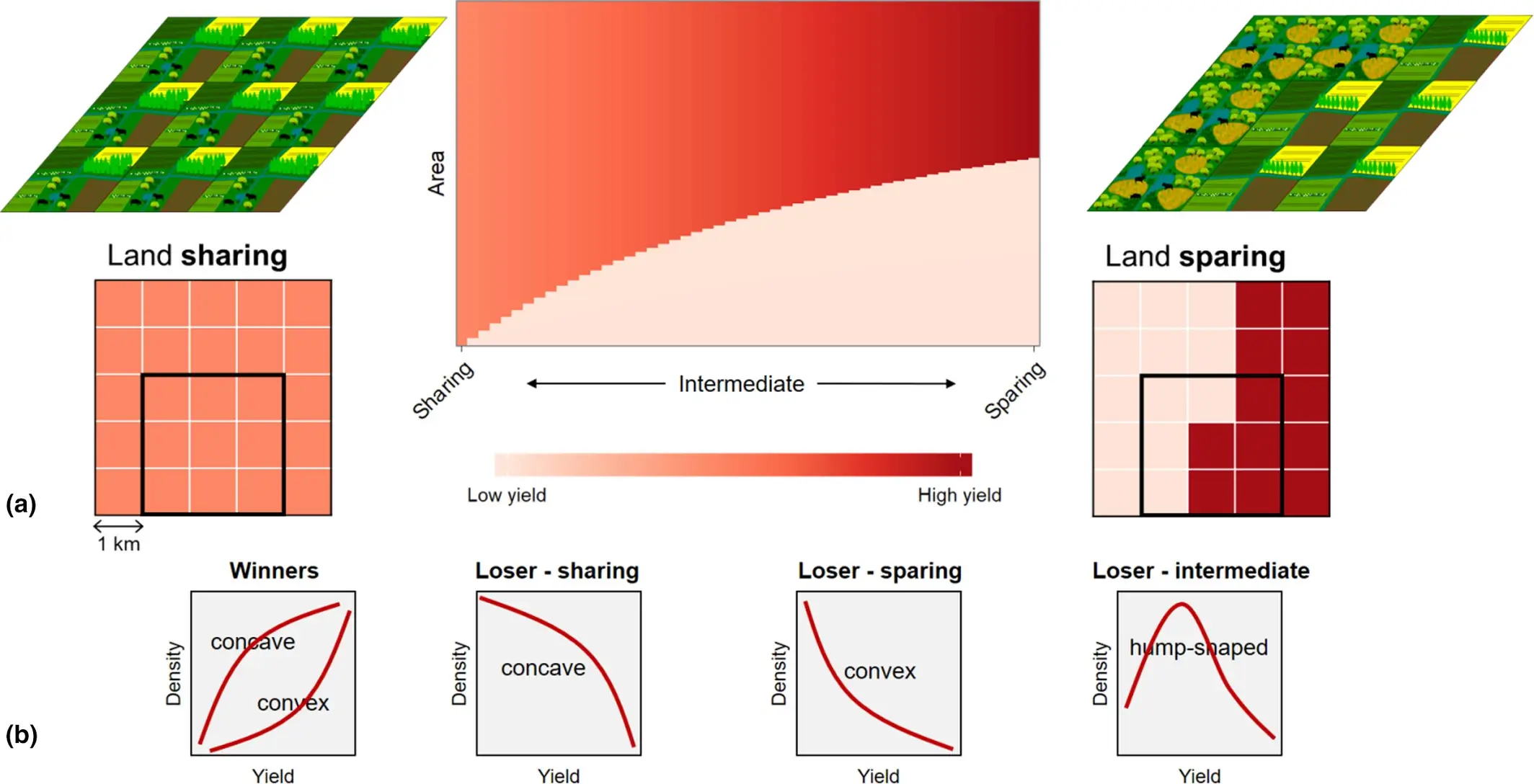
The land-sharing/sparing concept provides a quantitative framework for doing this, centred around the principle that generating meaningful insights requires comparing alternatives that are matched in terms of overall production.
Applications of this framework to >2500 individually assessed species of vertebrates, plants and insects across five continents show that most species decline under farming, and that most would fare least badly under a land-sparing approach – with high-yield production meeting demand in a relatively small, farmed area, freeing-up space for conservation of intact habitats elsewhere in the landscape.
However, important questions remain around how to deliver high yields sustainably, and how to ensure high-yield farming does indeed spare natural habitat.
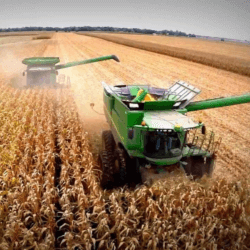


The framework is increasingly being applied in other domains too – including urban planning, recreation, forestry and fisheries – where it has the potential to shed light on long-running debates about whether nature would prefer us to concentrate our impact or spread it more lightly but widely.
There are clearly many questions left to answer. Nevertheless empirical data from sharing/sparing studies in agriculture, in forestry, in urban planning and even in nature-based recreation repeatedly show that very many species – and certainly the majority of those that are specialized or narrowly distributed – are strongly dependent on the continued retention of relatively large areas of natural habitat.
Natural vegetation too is clearly of disproportionate value in sequestering and storing carbon. Giving rising human demands, keeping extensive areas free from the cow, the plough and the chainsaw will require increasing yields elsewhere, and will thus diminish the value of areas of production for other species and for ecosystem services.