Edible metamaterials: The world’s most ‘perfect chocolate’ was 3-D printed

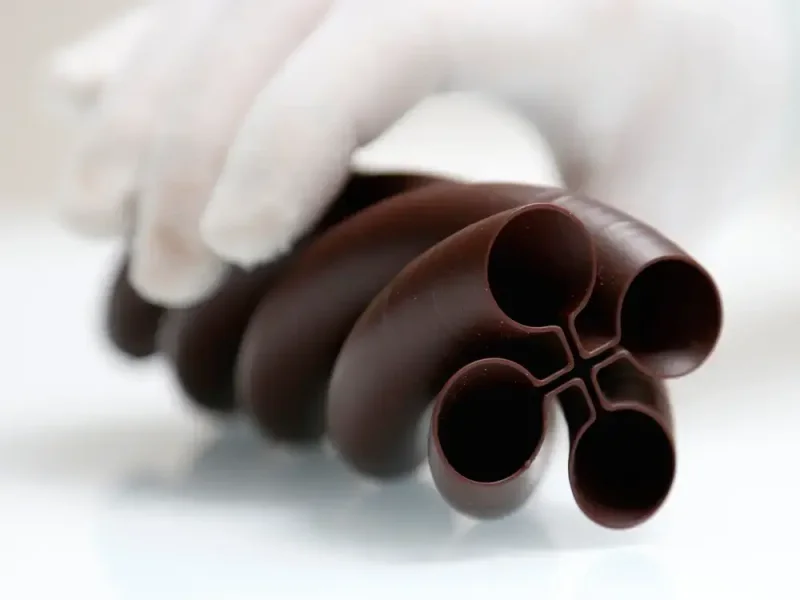
Credit: Francois Lenoir via Reuters

Think about biting into a piece of chocolate. What makes it enjoyable? Is it the sweetness? The way it melts in your mouth? The crunch? The sound it makes? All of the above?

A team at the University of Amsterdam is attempting to use physics and geometry to answer some of these questions, and to—hopefully—create an even more enjoyable treat. Their result, a spiral-shaped 3-D printed candy, doesn’t look like anything currently on the supermarket shelf. But it may just be the future of food.

Mis- and disinformation are distorting science and public policy. Subscribe to our Daily and Weekly Digests for incisive coverage of ‘disruptive’ innovations in AI, agricultural biotechnology, food, chemicals, nuclear energy, vaccines, and other disruptive innovations.

Why does this matter? Well, the next step of the research, published last month in the journal Soft Matter, involved giving the chocolates to a very lucky panel of human testers. The investigators asked which shapes the testers preferred and why.

“The more intricate the shape, the more crack it had, and the more they seemed to enjoy it,” [Dr. Corentin] Coulais says.

…

Using geometry to tailor a food’s mouthfeel could allow researchers to use healthy foods with low carbon footprints (think lentils or tofu) to create interesting, palatable meat substitutes, says Coulais. The same techniques could create special foods for people who have trouble with biting or chewing because of illness or dental issues.


This is an excerpt. Read the original post here

Related Articles

Infographic: Global regulatory and health research agencies on whether glyphosate causes cancer

Infographic: Global regulatory and health research agencies on whether glyphosate causes cancer

Does glyphosate—the world's most heavily-used herbicide—pose serious harm to humans? Is it carcinogenic? Those issues are of both legal and ...

Most Popular

ChatGPT-Image-Mar-10-2026-01_39_01-PM
Viewpoint—“Miracle molecule” debunked: Why acemannan supplements don’t work
ChatGPT-Image-Sep-29-2026-12_16_42-PM
Social media influencers are driving food misinformation across Europe
ChatGPT-Image-Sep-30-2026-01_11_07-PM
How U.S. teamed with Russia to block global human AI weapons oversight
ChatGPT-Image-Sep-21-2026-03_15_09-PM
Viewpoint: Chipotle-inspired lesson: 10,000 sick customers suggest that processed foods can be safer than fresh ones
Screenshot-2026-09-29-at-11.06.43-AM
Astrology, homeopathy, vaccine rejectionism, creationism: Why pseudoscience thrives as science advances
ChatGPT-Image-Sep-23-2026-02_36_39-PM
Viewpoint: After firing the entire National Science Board, Trump reshapes funding initiatives. Here’s the good and the bad.
generated-1790707585414
Facts & Fallacies podcast: America's health care system is broken. A doctor explains how to fix it
Screenshot-2026-09-28-at-1.16.38-PM
Defying public perceptions, U.S. cancer deaths plunged 35% since 1991
Screenshot-2026-09-17-at-1.07.08-PM
'We are dangerously addicted to antidepressants': Should we heed RFK Jr.’s sobering warning?
ChatGPT-Image-Jun-18-2026-04_15_29-PM
Viewpoint: Kennedy’s ‘bad science’: MAGA embrace bolsters HHS secretary’s influence and popularity
ChatGPT-Image-Sep-2-2026-02_03_32-PM
How much of a problem is AI’s water use?
glp menu logo outlined

Get news on human & agricultural genetics and biotechnology delivered to your inbox.