Pesticides and Food: It’s not a black or white issue — How do organic pesticides compare to synthetic pesticides?

Many consumers choose to buy higher-priced organic produce because they believe organic foods are not grown using pesticides and therefore are healthier for humans and for the environment. However, organic farming can include any pesticides derived from natural sources. This distinction does not mean organic pesticides are necessarily less toxic than synthetic pesticides. The reality is more complicated.

[su_panel color=”#3A3A3A” border=”2px solid #3A3A3A” radius=”2″ text_align=”left”]Editor’s note: This is part four of a six-part series on pesticides and food. Read part one, part two, part three, part five, and part six here.[/su_panel]

How do organic pesticides compare to synthetic pesticides?

There is a large variation in pesticide toxicity and environmental impact, within and between organic and synthetic pesticides. For example, even within copper fungicides, which are permitted in organic farming and used by conventional farmers as well, there is a large variation in toxicity.
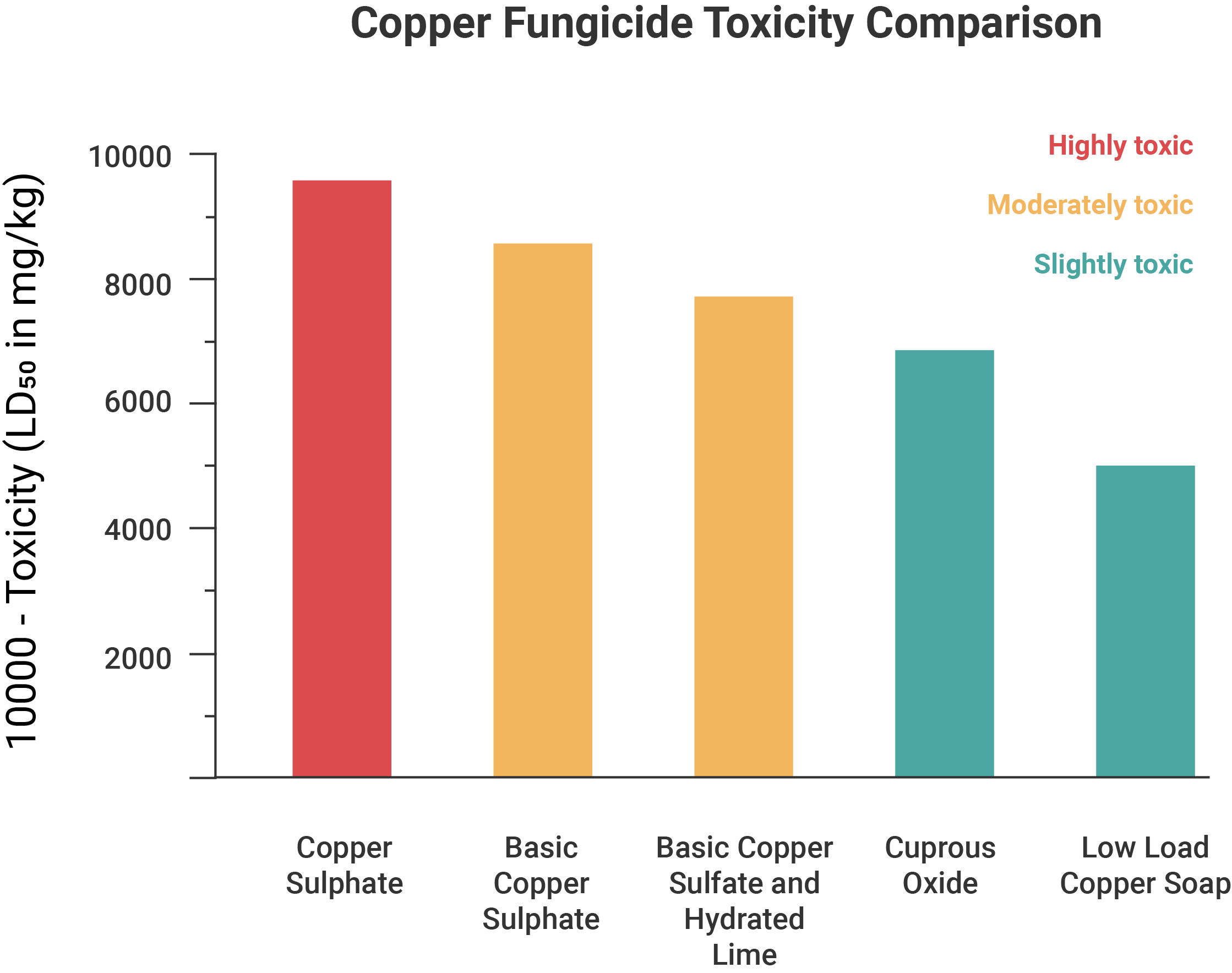
A graph comparing acute toxicity of five copper fungicides (copper sulphate, basic copper sulphate, basic copper sulphate and hydrated lime, cuprous oxide, and low load copper soap).

The graph above shows the median lethal dose (LD50), one way to measure acute toxicity of chemicals. This value is the dose required to kill half the members of a tested animal population after a specified test duration. This means that a high LD50 represents a low-toxicity substance – the higher the number, the lower the toxicity. For the purpose of this graph, I subtracted the LD50 from 1000 so that a high value would represent a high-toxicity substance.

There are some organic pesticides that are very safe and have a low impact on the environment. There are also some synthetic pesticides that are safe and environmentally-friendly.

For example, here is a comparison between two insecticides, one organic (Bt) and one synthetic (diazinon):
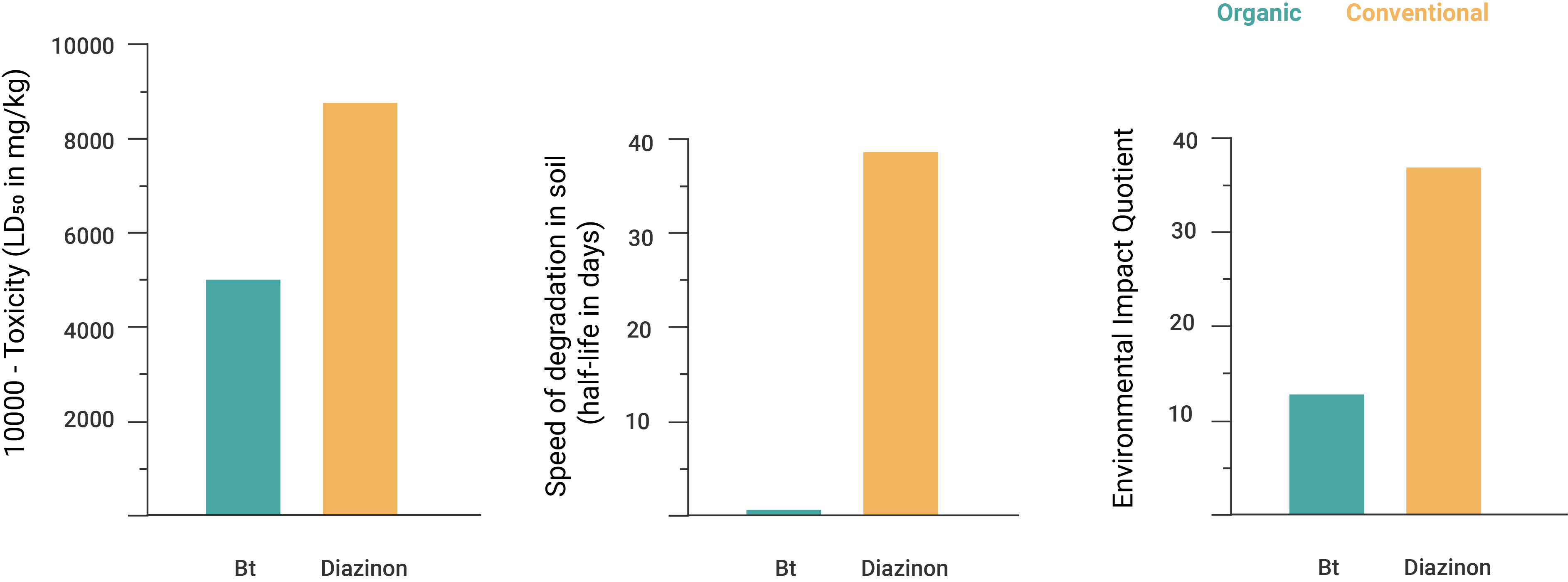
Three graphs showing a comparison of acute toxicity, half-life, and environmental impact quotient for two pesticides: bacillus thuringiensis and diazinon.

In the case of Bt and diazinon, the organic pesticide is less toxic and is less likely to negatively harm the environment. However it’s not always the case that the organic option is the most environmentally-friendly.  Here is a comparison between two organic fungicides and two synthetic fungicides:
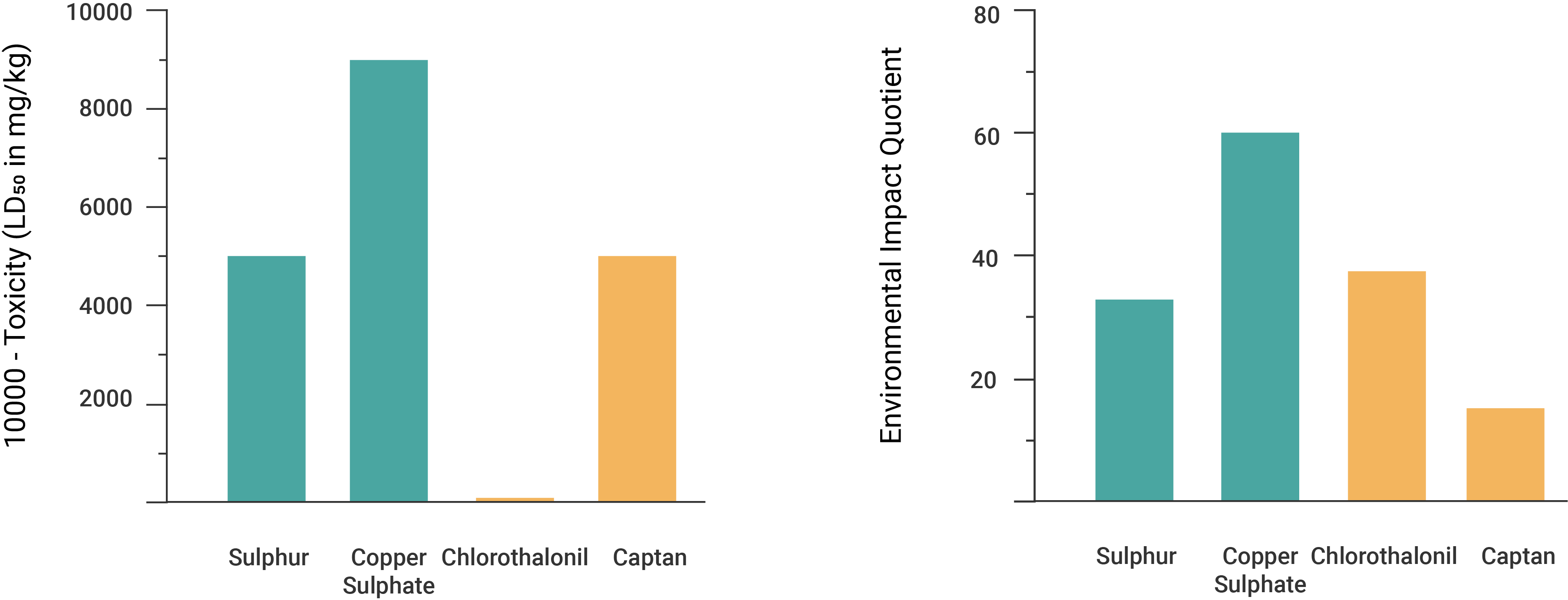
Comparison of acute toxicity and environmental impact quotient for two organic (sulfur and copper sulphate) and two synthetic pesticides (chlorothalonil and captan).

It is clear that toxicity and environmental impact varies quite a bit within both organic and synthetic pesticides.

Follow the latest news and policy debates on sustainable agriculture, biomedicine, and other ‘disruptive’ innovations. Subscribe to our newsletter.

Much of the information about pesticides online focuses on hypothetical dangers of synthetic pesticides and represents organic farming as a pesticide-free alternative that is better for the environment. However, this dichotomy is misleading. The only overall difference in pesticide use between organic and conventional farming, is that organic farming uses only pesticides from natural sources.

Individual pesticides must be compared to understand differences in toxicity and environmental impact because there is so much variability in both organic and synthetic pesticides. This is also true for farming practices. Organic farming practices can be more sustainable, but this is not always the case. In the next post, I will give a specific example of when organic farming practices can be less sustainable than conventional farming.

Kayleen Schreiber is the GLP’s infographics and data visualization specialist. She researched and authored this series as well as creating the figures, graphs, and illustrations. Follow her at her website, on Twitter @ksphd or on Instagram @ksphd

Marc Brazeau is the GLP’s senior contributing writer focusing on agricultural biotechnology. He also is the editor of Food and Farm Discussion Lab. Marc served as project editor and assistant researcher on this series. Follow him on Twitter @eatcookwrite

This article was originally posted on the GLP January 30, 2019.

{{ reviewsTotal }}{{ options.labels.singularReviewCountLabel }}
{{ reviewsTotal }}{{ options.labels.pluralReviewCountLabel }}
{{ options.labels.newReviewButton }}
{{ userData.canReview.message }}

Related Articles

Infographic: Global regulatory and health research agencies on whether glyphosate causes cancer

Infographic: Global regulatory and health research agencies on whether glyphosate causes cancer

Does glyphosate—the world's most heavily-used herbicide—pose serious harm to humans? Is it carcinogenic? Those issues are of both legal and ...

Most Popular

Screenshot-2026-06-15-at-1.55.27-PM
America's trust in Trump-Kennedy's CDC health recommendations is plunging
ChatGPT-Image-Jun-23-2026-03_12_23-PM
Is cellular reprogramming junk science? Nearly 20 patients are getting eye injections in the first FDA-cleared cellular trial
ChatGPT-Image-Jun-24-2026-11_36_47-AM
Why the human genome is less a script than a puzzle
ChatGPT-Image-Jun-17-2026-10_52_43-AM
Anguished parents, doctors in tears: Utah’s long measles outbreak takes a toll
Screenshot 2026-06-25 at 10.55
Leading OB-GYN group challenges RFK, Jr. gutting of maternal vaccine schedule
ChatGPT-Image-Jun-25-2026-12_23_17-PM
No, Bill Gates did not secretly engineer ticks to promote veganism
ChatGPT-Image-Mar-10-2026-01_39_01-PM
Viewpoint—“Miracle molecule” debunked: Why acemannan supplements don’t work
Screenshot-2026-06-22-at-9.04.46-PM
Kennedy's nutrition prescription for medical schools: Real problem, bad cure
Screenshot-2026-06-25-at-1.48.40-PM
Glyphosate affirmed as safe: Supreme Court rejects lawsuit claiming Roundup herbicide causes cancer, upholding EPA determination
Screenshot-2026-06-24-at-2.57.41-PM
Viewpoint: Trump’s Reflecting Pool algae fiasco points to a bigger culprit: Climate change
Screenshot-2026-06-24-at-2.40.46-PM
Hegseth reversal: As Air Force flu outbreak continues to surge, military reinstitutes mandatory vaccines for recruits
ChatGPT-Image-Jun-22-2026-01_30_11-PM
Facts & Fallacies podcast: Psychedelics for PTSD? Examining RFK, Jr's claims about ibogaine
glp menu logo outlined

Get news on human & agricultural genetics and biotechnology delivered to your inbox.