I say unexpectedly because a decade ago there was a lot of fear and misinformation being spread about GMO food, as there is now. And frankly, I thought it was unlikely that facts would sway an urban audience with predetermined views regarding GMOs. [W]hen it comes to the 30% of people who were against them, their views did not change at all during the debate (31% against GMOs at the end of the debate). What did change was the views of the 38% of people with no definitive stance on the topic. At the end of the debate, the majority 60% of the audience voted in favor of the GMO side after listening to a skillfully-moderated, evidence-based discussion of the topic, with 9% remaining undecided.
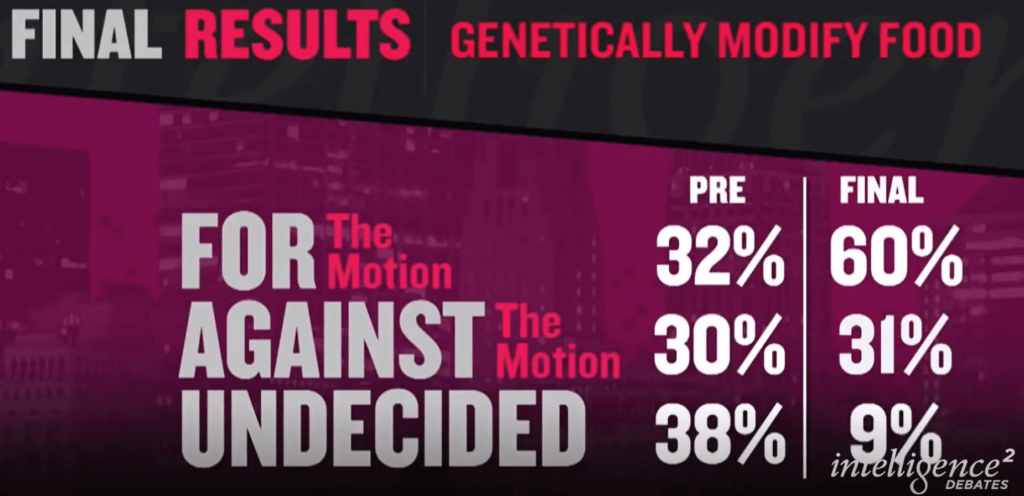
It felt good to win that debate as to whether to Genetically Modify Food, because the environmental benefits, in terms of impacts on pesticide use and carbon emissions of the technology, are clearly evidenced by the peer-reviewed literature, and the economic benefits by the fact that millions of farmers throughout the world chose to plant these seeds. And the safety record is unparalleled.
Ironically, in the closing remarks of the debate I made the argument that “as a parent, it is my responsibility to use the best possible information to protect my children’s health and to determine the scientific consensus on technology. That is why my kids drink pasteurized milk and have had all of their childhood vaccinations! Sometimes the risks that concern people and the risks that kill people are entirely different”.
I used these two examples of widely-accepted and effective public health measures as something no responsible parent would dispute given the well-documented risks associated with contagious diseases like polio and microbial contamination of milk. I think if someone had told me that night in 2014, that in ten [years] pasteurized milk and childhood vaccinations would be controversial, I would have seriously doubted their foretelling abilities. And I would have been so wrong.
I have worked in agricultural science for my whole career, spurred by an interest in food security. I have witnessed various innovations like food irradiation, GMOs, and recombinant bovine somatotrophin (rBST) get demonized by misinformation. In fact, I owe my position countering misinformation in animal agriculture, to American economist Jeremy Rifkin and his think tank, Foundation on Economic Trends (FET) which began targeting rBST in the early 1990s. An article written 30 years ago, before [the] widespread use of social media, lamented “It’s difficult to fight Rifkin and his associates when they have millions of dollars. Rifkin’s teachings are like prairie fires: When they seem to be extinguished, they suddenly ignite from sparks somewhere else.” And spread they did, ultimately resulting in the market withdrawal of this product which was approved in 1993.
 Viewpoint: Why Washington should sharply increase funding for intensive agricultural to address climate change, spur sustainability
 Leaked European Commission document recommends softening EU regulations of gene edited crops and other products of New Genomic Techniques: “The current EU GMO regulation is not fit for purpose”
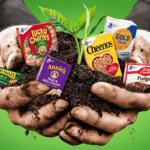

I have watched various agricultural innovations get targeted by influencers and the marketing arm of the natural foods industry – including fertilizers, pesticides, mRNA vaccines for livestock, food preservatives, chemicals (as a concept!), and most recently Bovaer, an approved feed additive to decrease methane emissions from cows. The economic and environmental opportunity costs associated with eschewing this multitude of agricultural innovations for no valid reason are rarely articulated and would be substantial. Needlessly jettisoning technologies that have been developed to solve a problem thereby improving the environmental footprint of agriculture, is ultimately bad for agricultural sustainability.
Public sector scientists who are subject-matter experts willing to defend agricultural innovations have frequently become the target of online attacks and harassment campaigns, often intended to silence their [voices]. Unfortunately, this has often proven effective at discouraging those who are unwilling to subject themselves and their reputation to such [harm]. This is particularly problematic when the topic is agricultural innovations because ignoring advice from experts and basing food production decisions on ideology rather than evidence has a long history of catastrophic outcomes including the Soviet famine in 1932–33, the Great Leap Forward in 1960-62, the “Holodomor”, and most recently the 2022 collapse of the Sri Lankan economy.
So while I reflect on the unexpected win in the IQ2 debate on GM food a decade ago, I contend that in this case science won that small battle but has lost the war. The sparks of disinformation regarding agricultural innovations have now ignited into an uncontrolled wildfire, fueled by wellness influencers, conspiracy theorists, and competing market interests. And I fear agricultural communicators, formally trained in the scientific method and assuming good-faith, evidence-based reasoning, are ill-equipped to fight this tidal wave of baseless disinformation.
Alison Van Eenennaam is an Extension Specialist in Animal Biotechnology and Genomics, Department of Animal Science, University of California, Davis. Follow her on Twitter @biobeef
A version of this article was originally posted at BioBeef and has been reposted here with permission. Any reposting should credit the original author and provide links to both the GLP and the original article.