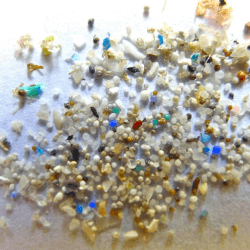

Plastic production is increasing sharply. This has raised concerns about the effects of microplastics (typically defined as plastic particles smaller than 5 millimetres in diameter) and nanoplastics (smaller plastic particles that are less than 1,000 nanometres in diameter) on human health. These concerns are partly influenced by alarming findings of the presence of microplastics in various human tissues, including the brain and placenta. … [W]riting in Nature, Li et al. provide strong evidence supporting the air as being a major route for plastics to enter plants.
Plants can absorb plastic particles directly from the air. Particles in the air can enter leaves through various pathways, such as through structures on the leaf surface called the stomata and through the cuticle. Stomata are small openings made of cells, and the cuticle is a membrane, covered in insoluble wax, that is well suited for absorbing microplastics.