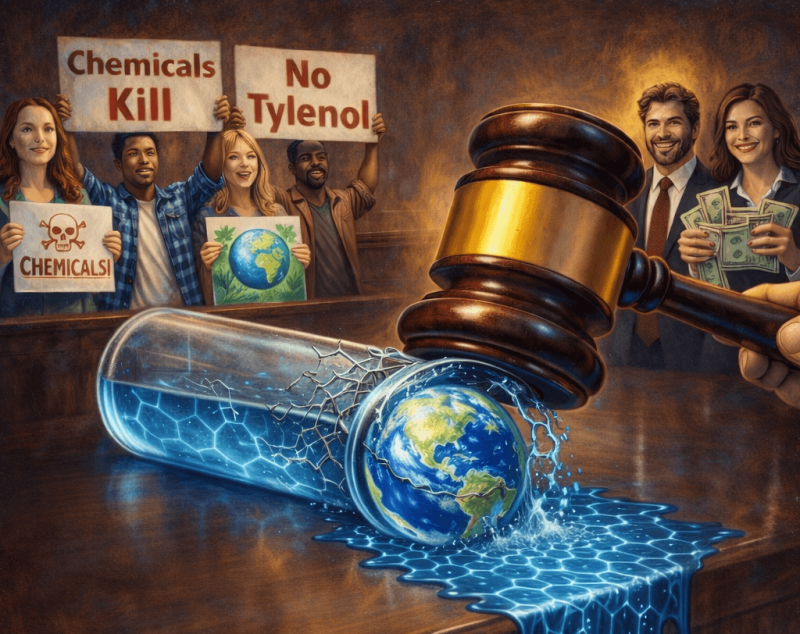
Chemophobia — the reflexive fear that “chemicals” are inherently dangerous — stokes public anxiety about health and the environment. It has evolved into an effective engine for monetized activism and litigation. Increasingly, this dynamic is not driven by strong evidence of harm; rather, it depends on a repeatable narrative — amplified by advocacy groups, picked up by the media, and repeated by credulous outlets — that turns uncertainty into suspicion and suspicion into profit.
Current litigation against glyphosate and Tylenol, despite their very different uses, illustrates how the same playbook is applied again and again. Both have been the subject of thousands of research pages and dozens of regulatory reviews and have been found safe. Yet both are cause célèbres among activists and a focal point of the predatory tort system in the U.S., which often targets safe but controversial chemicals, leading to adverse judgments in the hundreds of millions or even billions of dollars.
The process starts with framing the public narrative, which activists have been expert at for years. The bedrock of many of their campaigns: distorting the science of risk versus hazard. They emphasize contamination and toxicity — hazards — while avoiding discussions of dose and exposure, which determine comparative risk. The difference between a theoretical hazard and real-world danger is blurred. Botulinum toxin is one of the most harmful chemicals on the planet, but is perfectly safe when injected into your body at very low doses. Instead of asking whether a chemical causes harm at actual levels of use, the scientific and regulatory question shifts to whether it is dangerous. Once that shift occurs away from risk and toward hazard, safety debates are no longer scientific — they are moral. In activist parlance, a chemical is either “clean” or “toxic,” and nuance disappears.
The activist narrative is amplified by a credulous media. Stories warning of hidden dangers, regulatory failure, or corporate deception attract attention and fit neatly into broader cultural distrust of institutions. Early or speculative studies are often treated as breakthroughs, while later reviews that find little or no risk receive far less coverage. Over time, repetition creates familiarity, and familiarity becomes belief. The public does not need to follow the science closely; it only needs to recognize the name of a chemical and associate it with harm.
Glyphosate demonstrates how this narrative has become economically productive. Advocacy groups transformed the herbicide from an indispensable agricultural tool, far less toxic than previous or current products, particularly organic alternatives, into a symbol of poisoned food and corporate indifference. Scientific classifications that focused narrowly on potential cancer hazards were promoted as definitive proof of danger, even though every major regulatory agency in the world has found it safe under current guidelines, including:
- Joint FAO/WHO Meeting on Pesticide Residues (JMPR)
- U.S. Environmental Protection Agency
- European Food Safety Authority (EFSA)
- European Chemicals Agency (ECHA)
- German Federal Institute for Risk Assessment (BfR)
- Health Canada
- Food Safety Commission of Japan (FSCJ)
This overwhelming consensus — no chemical in history has been more scrutinized than glyphosate — has not deterred the predatort coalition. Whenever their twister narrative is threatened, the activist–tort community coalition jumps into action, priming public opinion, so when lawsuits emerge, juries will encounter a story they already “knew”: chemicals kill, especially those made by Big Ag or Big Pharma. Verdicts and settlements then generate headlines that reinforce the original claims, regardless of whether they reflect scientific consensus. Activism produces fear; fear produces litigation; litigation spurs activism; journalists credulously recirculate jury-validated propaganda. Wash, rinse, recycle.
The MAHA movement has amplified this cycle by embedding chemophobia in a broader worldview that links modern life, industrial chemistry, and chronic disease. While it differs politically from traditional environmental activism (MAHA is a left-right hybrid, not just a product of the activist left), both converge on a shared message: chemicals and drugs are the underlying cause of widespread illness and environmental degradation, and regulators cannot be trusted. This convergence expands the market for fear-based messaging and normalizes litigation as a form of accountability rather than a speculative gamble.
Robert F. Kennedy, Jr. is the titular czar of this movement. Before his current position as Secretary of Health and Human Services, Kennedy had a decades-long history of promoting and litigating claims linking common commercial, consumer and medical products to developmental disorders and environmental degradation. He is a longtime partner with the Church of Scientology-linked law firm Wisner Baum, which, under its former iteration (Baum Hedlund), filed the first three lawsuits targeting glyphosate.
RFK, Jr. has personally collected billions of dollars through this affiliation, and he refused to cut ties with Wisner-Baum even as he assumed the role of HHS director. The Scientology firm is currently involved in lawsuits targeting both glyphosate and Tylenol, along with many other safe chemicals and drugs, including the latest RFK, Jr. target, antidepressants. (Baum Hedlund’s successful suits targeting Prozac decades ago literally rescued the cult religion from bankruptcy).
What’s easy to forget in today’s red/blue framing is that Kennedy’s most influential vaccine skepticism was incubated inside the establishment progressive-adjacent ecosystem. Although he is now reviled by many on the left, for roughly three decades, he was embedded in the mainstream liberal environmental-advocacy world.
RFK, Jr. personifies the science and ethical ambiguity, and often the outright hypocrisy, of today’s ideological left. For more than twenty-five years, he was Senior Attorney at the Natural Resources Defense Council (NRDC). Beginning in 2005, Kennedy leveraged this credibility to push the vaccines→autism narrative (via thimerosal). It was eagerly embraced and propagated by Hollywood and the wellness left, many of whom are now stalwarts in the MAHA movement.
NRDC did nothing to challenge Kennedy’s kooky and illiberal positions articulated in hundreds of articles and interviews, and on most starkly on display through his science-averse propaganda arm, Children’s Health Defense. It was only in 2024, as his MAHA movement blended with Trumpers and MAGA, that NRDC formally distanced itself from him over what it now calls his “anti-science positions.”
The activist movement — tort attorney alliance playbook was in full display last summer when RFK, Jr. promoted his longhand conviction linking prenatal Tylenol use and autism. As with glyphosate, the lack of definitive proof did not restrain his narrative — it fueled it. In this system, doubt is not a weakness; it is an asset that sustains claims, recruits plaintiffs, and prolongs legal battles.
Litigation is not incidental to this ecosystem — it is its financial backbone. Activism generates attention and moral urgency. Media coverage confers legitimacy. Lawsuits convert public anxiety into revenue through settlements, fees, and fundraising. It’s the activist left piggybank. Even unsuccessful cases can be profitable by sustaining publicity and reinforcing the narrative of hidden harm. Each stage feeds the next, creating a self-reinforcing loop.
Chemophobia, as weaponized by the advocacy left-MAHA-predatort alliance is no longer just a cultural misunderstanding of science. It is a thriving business model and a political trampoline. By turning complexity into fear and fear into claims, monetized activism and litigation thrive on uncertainty, ensuring that the cycle continues long after the evidence has been weighed.
To better challenge this profit-driven misinformation ecosystem, the Genetic Literacy Project is transitioning to the Science Literacy Project — a name that better captures our expanded focus and the growing urgency of the moment. This evolution is not a departure from our origins, but a renewed and broadened commitment to challenging misinformation wherever it threatens evidence-based understanding, public policy, and trust in science. As scientific issues become increasingly entangled with ideology, high-impact debates and emerging technologies have become prime targets for distortion.
As GLP becomes SLP, we will maintain our longstanding deep reporting on agricultural innovation, crop protection, and advances in gene editing and gene-based medicine. At the same time, we will broaden our coverage to additional areas where misinformation is pervasive, including vaccines and public health, chemical risk assessment, energy technologies such as nuclear, fracking, and geothermal, and the rapidly accelerating influence of artificial intelligence.
Our six-part retrospective of major features that have run on the GLP over the past year exemplifies this expanded and yet more targeted mission. Organized into thematic sections, these feature articles highlight both the breadth of modern science and the recurring tactics — ideological framing, influencer amplification, and monetized activism — used to misrepresent scientific evidence and shape policy debates.
- Politicization of Health & Science
- Vaccines Under Fire
- Deadly Rise of Wellness Grift
- Disinformation Attacks on Food and Farming
- Chemophobia and Monetized Activism
- AI’s Open Questions
In Part 5, we illustrate how chemophobia, misinformation, and dark money activism have become the machinery of litigation — a tactic leveraged by RFK, Jr. and the MAHA movement to shape public policy. Chemophobia has become a profitable playbook in which activists and influencers seed fear, media amplify it, and lawyers monetize uncertainty through litigation — turning scientific complexity into a self-sustaining cycle of outrage, lawsuits, power, and influence.

Looking back better prepares us to continue challenging chemophobia. Illustrating our refined focus going forward, these seven pieces from 2025 expose how reckless activism and a lack of science literacy, amplified by credulous media and leveraged by the burgeoning predatort industry, are endangering science and society.
Chemophobia and Monetized Activism
Precautionary and “doomsday” activism, along with supportive media coverage, often exaggerate the risks of biotechnology by emphasizing worst-case scenarios and uncertainty, shaping a misleading public narrative that discourages innovation and resists correction even as scientific understanding improves.
Viewpoint: Environmental activists’ doomsday pessimism undermines agricultural biotechnology by Jon Entine
Emotionally compelling scare narratives about pesticides persist long after scientific evidence weakens or contradicts them, sustained by activist messaging, media incentives that reward alarm, and public distrust of regulators, creating a durable story that is largely insulated from new data.
Why scare stories about crop chemicals outlive the science by Joseph Maina
Chemophobia functions as a shared strategy linking environmental activists and trial lawyers, turning public fear of synthetic chemicals into political leverage, fundraising opportunities, and a steady pipeline of lawsuits built on suspicion rather than demonstrated harm.
Viewpoint—Chemophobia: The alliance of environmental activists and lawyers by Andrea Love
Activist groups, media outlets, and predatory lawyers have portrayed fluoropolymers in medical devices as dangerous “forever chemicals,” calling for broad PFAS bans despite long-standing scientific evidence that these materials are inert and safe. Any one-size-fits-all regulation ignores crucial differences within PFAS and could jeopardize essential medical uses.
Viewpoint: PFAS—Fluoropolymer panic shows how the activist-tort lawyer-media complex threatens a lifesaving medical technology by Jon Entine
RFK, Jr’s claims linking Tylenol to autism show how scientific uncertainty and weak associations can align law firms to generate mass tort litigation, encouraging parents to reinterpret routine medical advice as evidence of hidden injury. In this case, we also see how this playbook can be applied at the highest levels of government to shape public policy.
Making Lawyers Wealthy Again: RFK, Jr., Tylenol, and torts by David Zaruk
Philanthropic funding networks quietly support long-term anti-chemical activism, financing advocacy groups, research messaging, and media campaigns that shape public opinion and policy debates while eroding trust in scientific and regulatory institutions.
Viewpoint: Newly-formed non-profits are the ‘dark money’ foundation of the activist environmental movement by David Zaruk
Interlocking relationships among activists, lawyers, and media figures amplify chemophobic claims, blur distinctions between hazard and risk, and convert fear-driven narratives into political influence, litigation revenue, and sustained public distrust of science.
Viewpoint—Toxic Narratives: The lucrative environmentalist–tort lawyer-media disinformation network driving drug and chemical scares by Jon Entine
Follow our six-part Year in Review series on Instagram
Jon Entine is the founding executive director of the Genetic Literacy Project and winner of 19 major journalism awards. He has written extensively in the popular and academic press on agricultural and population genetics. You can follow him on X @JonEntine
Joseph Maina is a Senior Lecturer in the Department of Earth and Environmental Sciences at Macquarie University, Sydney. His work integrates diverse disciplines, including macro-ecology, climate science, oceanography, remote sensing, hydrology, fisheries management, and decision science.
Emily Bass is Associate Director of Federal Policy, Food and Agriculture at Breakthrough Institute. Follow Emily on X @EmilyJane_Bass
Dr. Andrea Love, a microbiologist and immunologist, provides the facts (and the data!) on science and health topics. Follow Andrea on X @dr_andrealove
David Zaruk is the editor of Firebreak, and also writes under the pen name The Risk Monger. David is a retired professor, environmental-health risk analyst, science communicator, promoter of evidence-based policy and philosophical theorist on activists and the media. Find David on X @Zaruk