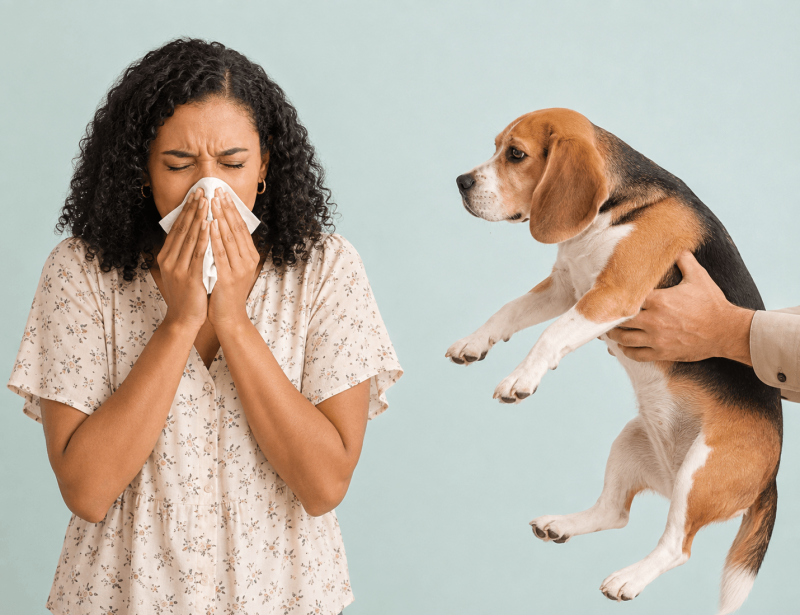

For people who love dogs but can’t escape the sneezes, hives, and watery eyes around man’s best friend, scientists may have created a furry solution.
Researchers from the biotech company Kindred Companion Sciences used CRISPR to prevent the expression of a dog gene associated with allergies in people, leading to two gene-edited beagles not producing the allergen two years after their birth. The team recently published their findings in The CRISPR Journal.
“We like to think this is hopefully helping dogs and humans,” said Matt Walker, the cofounder and chief executive officer of Kindred. “It’s an exciting application of this gene-editing tool and has a lot of potential to be used for treating animal conditions as well.”
But the work raises questions about the ethics of introducing possible health problems in dogs for the purpose of addressing a minor concern in people, said Eleanor Raffan, an animal geneticist and former veterinary surgeon at the University of Cambridge who was not associated with the study.

“It seems like this is something that is likely to be detrimental to the health of dogs—if not these individual puppies, but the population that would be derived from them—in order to benefit some people who have an avoidable condition,” Raffan said.
After a lifetime of avoiding dog ownership due to allergies, Walker got the idea to tackle these allergies with CRISPR while working as a research associate in the Columbia University lab of Nobel Prize-winning biologist Martin Chalfie. So he started Can9 Bioengineering LLC in 2020—now doing business as Kindred—to begin working on the experiments.
His goal was to use the gene-editing technology CRISPR to block expression of the gene Canis familiaris allergen 1 (Can f 1), which generates a protein in dog saliva, hair, and dander that underlies many people’s allergies to dogs. Can F 1 has been known as the source of dog allergies since the late 1990s, but researchers have yet to discover its biological role, Walker said.
To create the dogs, Walker and his team generated fibroblasts from a beagle’s skin cells and then used CRISPR to add a base pair at the beginning of the gene that prevents it from expressing the Can F 1 protein. They injected the nucleus of those cells, now carrying the edited Can f 1 gene, into eggs from which the nucleus had been removed, creating embryos that were then implanted into a surrogate beagle.
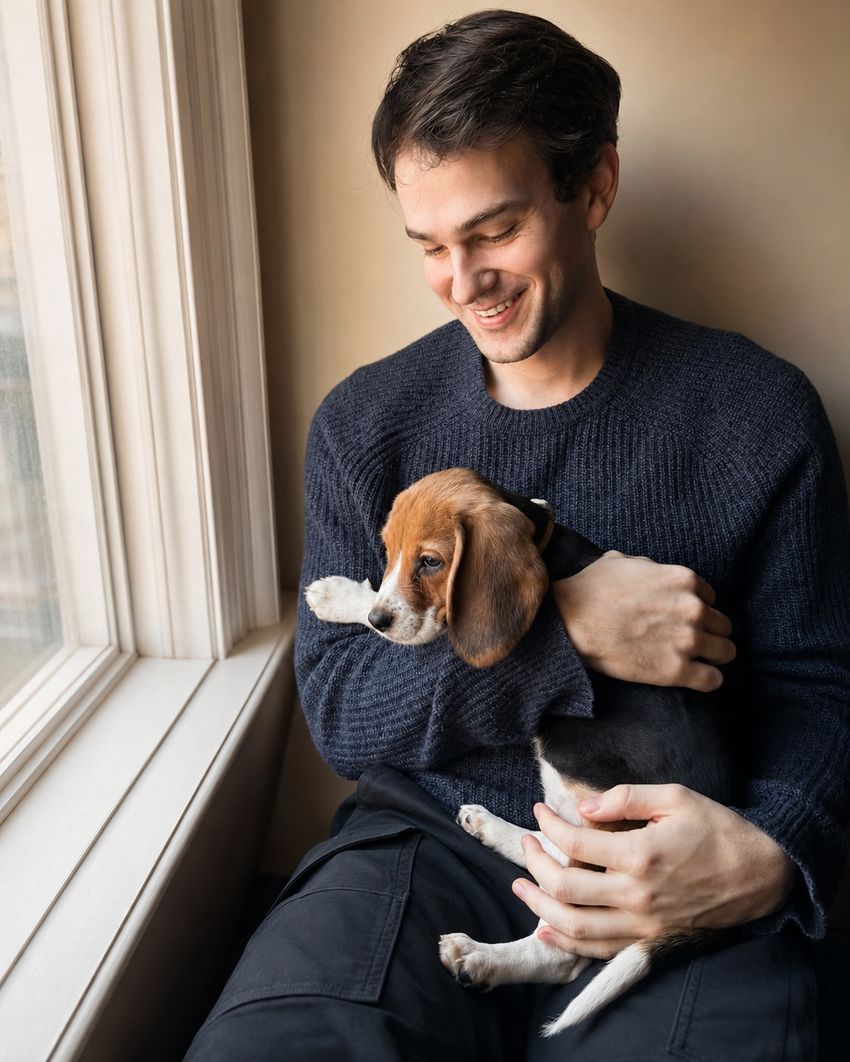
The resulting pups, Alfie and Bailey, were born September 22, 2024, and are genetic clones. They are also clones of the donor beagle, other than their Can f 1 change. Bailey lives with Walker, Alfie with Kindred’s co-founder in Florida.
Walker’s team tested the two beagles’ saliva, hair, and dander for the presence of Can F 1 proteins and compared them to samples from another beagle as well as two dogs widely assumed to be hypoallergenic, a poodle and a goldendoodle. Alfie and Bailey’s samples contained no Can F 1, the researchers reported, whereas the other three dogs’ did.
Walker underwent skin-prick tests with solutions made from saliva and hair from one of the edited dogs as well as the controls. His skin reacted to all of the samples, save for the one from the edited pup. Walker said that he hasn’t experienced any allergy attacks living with Bailey.
The study is a proof of concept that gene editing could work for addressing allergies as well as health issues in dogs such as breathing problems and spinal disorders, Walker said—many of which are the result of selective inbreeding for aesthetic traits.



“Our focus is more on the claims we’re making about removing this specific allergen,” Walker said, “rather than trying to make blanket claims about, ‘This is going to affect everyone. This is going to be a solution for everyone.’”
The team also continues to monitor the animals’ health and development, receiving veterinary exams including urine analysis, whole blood count, and radiology, Walker said. So far, they have not seen any concerns.
In 2016, researchers with the International Mouse Phenotyping Consortium knocked out both copies of odorant-binding protein 2A gene, the closest mouse analog to Can f 1, in embryonic mice and found that the edit didn’t produce ill effects.2 “This gave us initial confidence that it wouldn’t affect health,” Walker said.
But it’s too early to say whether the edit will have any impact on the dogs’ long-term health, Raffan said. Dental disease often occurs later in a dog’s life, for example, and it’s possible Can F 1 contributes to oral health in a way that has yet to be uncovered, she said.
Oral and dental health exams are part of the dogs’ veterinary monitoring, Walker said.
|
Related on the SLP
‘Here, CRISPR critter’: How to gene edit a hypo-allergenic cat
|
Even if the edit proves safe for individual dogs in the long-term, there could be population-level problems that result from breeding large numbers of dogs from a small original population. Such breeding from so-called “popular sires” can spread unrelated mutations into the population, increasing the odds that two dogs carrying one copy of a problematic allele will mate and produce offspring with health problems.
Those risks may not be balanced by the potential benefit to people, Raffan said—dog ownership is not, generally speaking, medically necessary.
One exception may be guide dogs, said Walker, who sees potential in creating hypoallergenic dogs for people with dog allergies that could benefit from a service animal. Families also often give up dogs after realizing they are allergic, he added.
Before any edited dogs could be available commercially, Kindred would need approval from the Food and Drug Administration (FDA), which regulates genetically edited organisms. Kindred has started the FDA regulatory process, Walker said.
Laura Dattaro is a freelance science and health journalist. Her work has been published in Drug Discovery News, Nature, Quanta, and The Washington Post. Find Laura on X @LauraLauraDat
A version of this article was originally posted at The Scientist and has been reposted here with permission. Any reposting should credit the original author and provide links to both the GLP and the original article. Find The Scientist on X @TheScientistLLC