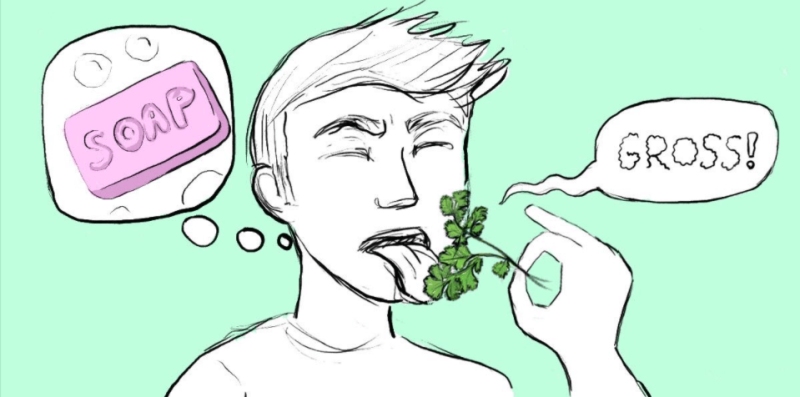
Cilantro is one of the most loved — and hated — herbs. Why does it taste like soap to some people?

Credit: Sam Brosnan/Food Beast

Coriander, also known as cilantro, is one of the most commonly used herbs in the world, but a preference for this little leafy green is just one more thing that divides people.

Humans have hundreds of receptors, which send signals to our brains to produce what we recognize as aromas and flavors.

But exactly how this works is complex and differs from person to person. The same chemical can be found in both appealing and unappealing places — cheese and body odor, for example. Conversely, the same ingredient — such as cilantro — can contain both pleasant and unpleasant chemicals. Whether stinky cheese and cilantro are delicious or disgusting depends on your particular perception of many different chemicals.

The two genetic variants used in 23andMe’s Cilantro Taste Aversion trait report are both located in a cluster of olfactory receptor genes. These are biological sensors that detect chemicals in the air and in food. These receptor genes are also linked to the ability to detect what are called aldehydes, chemical compounds that are found in soap and thought to be a major component of cilantro aroma.

Follow the latest news and policy debates on sustainable agriculture, biomedicine, and other ‘disruptive’ innovations. Subscribe to our newsletter.

One of the eight genes near the variants 23andMe uses in its report codes for a receptor called OR6A2, which is known to detect aldehydes such as those found in cilantro. 

Read the original post

Related Articles

Infographic: Global regulatory and health research agencies on whether glyphosate causes cancer

Infographic: Global regulatory and health research agencies on whether glyphosate causes cancer

Does glyphosate—the world's most heavily-used herbicide—pose serious harm to humans? Is it carcinogenic? Those issues are of both legal and ...

Most Popular

ChatGPT-Image-Mar-10-2026-01_39_01-PM
Viewpoint—“Miracle molecule” debunked: Why acemannan supplements don’t work
ChatGPT-Image-Sep-13-2026-10_24_17-AM
Bayer urges court to approve $7.25 billion Monsanto Roundup settlement that could limit its future liabilities
ChatGPT-Image-Aug-28-2026-03_33_46-PM
Viewpoint: Bad science—Five bogus Trump administration claims about vaccines and autism
Screenshot-2026-09-10-at-12.20.19-PM
'Jet fuel didn't melt the steel': 9/11 conspiracy theories debunked
ChatGPT-Image-Sep-15-2026-06_05_13-PM
CRISPR fine-tuning unlocks vitamin C-rich potatoes without yield loss
ChatGPT-Image-Sep-15-2026-05_59_18-PM
RFK Jr. spent two years distancing himself from Children’s Health Defense. Now he’s keynoting its anti-vaccine DC conference.
ChatGPT-Image-Sep-2-2026-10_30_14-PM
Zero: That is the official American measles death toll for 2026. Here is what RFK Jr.’s CDC leaves out.
Screenshot-2026-09-14-at-10.52.30-AM
AI is being used in dangerous bioscience experiments
Screenshot-2026-09-11-at-2.26.23-PM
Newly approved GMO chestnut trees planted across from the White House are stirring debate
screenshot at  am
‘Glyphosate is not carcinogenic’: Independent EU chemical oversight agency reaffirms—for the 3rd time in 9 years—that the herbicide is safe-as-used
Screenshot-2026-09-10-at-11.50.46-AM
Did COVID vaccines kill 2,500 service members? RFK Jr. hires an investigator who compares vaccine promoters to Nazi doctors
ChatGPT-Image-Sep-14-2026-11_36_25-AM
How the reckless AI race among Anthropic, OpenAI and China spawned today’s safety crisis
glp menu logo outlined

Get news on human & agricultural genetics and biotechnology delivered to your inbox.