Gates Foundation, GMO banana face renewed attacks

Among the controversial projects funded by the Bill and Melinda Gates Foundation is the development and testing of a biofortified GMO banana developed to boost its iron, Vitamin E and proVitamin A content.

To this end the Foundation, via its Grand Challenges in Global Health Initiative, has so far given $15 million to Queensland University of Technology for the program run by Professor Dr James Dale, with a latest tranche of $10 million handed over this year.

The declared purpose is to roll out nutritional benefits across the tropics, but initially to India, Uganda, Kenya, Tanzania and Rwanda – all countries that suffer from widespread nutritional deficiencies.

And Dale is certainly enthusiastic, telling the Independent that “This project has the potential to have a huge positive impact on staple food products across much of Africa and in doing so lift the health and wellbeing of countless millions of people over generations.”

So what’s so controversial about that?
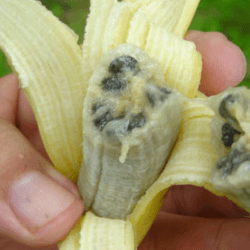
What Dale has done is to take the high beta-carotene banana gene for his GMO ‘super-bananas’ from an existing Fe’i banana variety from Papua New Guinea, following a study that compared ten cultivars with yellow to orange fruit.

The trouble is, this makes Dales’ GMO ‘super-banana’ a clear case of biopiracy. The original Asupina, collected 25 years earlier from Papua New Guinea and held by the Queensland Department of Primary Industries (Q-DPI), is the rightful property of the nation and the communities that developed it.

Could his real intention be to capture a commercial market in selling a premium, novelty ‘high nutrient’ banana to northern consumers? And in the process pave the way for other GMO bananas with commercially desirable qualities?

Read full, original article: Why is Bill Gates backing GMO red banana ‘biopiracy’?

Related Articles

Infographic: Global regulatory and health research agencies on whether glyphosate causes cancer

Infographic: Global regulatory and health research agencies on whether glyphosate causes cancer

Does glyphosate—the world's most heavily-used herbicide—pose serious harm to humans? Is it carcinogenic? Those issues are of both legal and ...

Most Popular

ChatGPT-Image-Mar-10-2026-01_39_01-PM
Viewpoint—“Miracle molecule” debunked: Why acemannan supplements don’t work
ChatGPT-Image-Sep-2-2026-02_03_32-PM
How much of a problem is AI’s water use?
ChatGPT-Image-Sep-22-2026-10_32_46-AM
There has been a slew of recent reports of food recalls and foodborne outbreaks. Do we face an escalating problem?
ChatGPT-Image-Aug-26-2026-12_46_16-PM
Viewpoint: The fake controversy over whether combining childhood vaccines is dangerous— a debate science resolved 25 years ago
ChatGPT-Image-Sep-21-2026-03_41_02-PM
Viewpoint: Does IQ really measure intelligence? BBC gets it wrong.
Screenshot-2026-09-17-at-12.00.30-PM
Investigative group ProPublica finds links between ectopic pregnancy deaths and abortion bans
ChatGPT-Image-Sep-18-2026-01_38_09-PM
Microsoft exec: AI is a ‘doom loop’ scraping the ‘largest theft of labor in human history'
ChatGPT-Image-Sep-23-2026-11_47_32-AM
Facing pressure from Trump administration, fewer hospitals offer medical treatment for transgender minors
Screenshot-2026-09-23-at-11.55.01-AM
How can we know if social media bans actually help teens?
Screenshot-2026-09-17-at-1.07.08-PM
'We are dangerously addicted to antidepressants': Should we heed RFK Jr.’s sobering warning?
ChatGPT-Image-Sep-10-2026-01_44_53-PM
Viewpoint: Why medical and health nonsense spreads so casually on pop culture media
Screenshot-2026-09-16-at-3.14.20-PM
19%: Plunging support for Trump-RFK, Jr. measles vaccine safety oversight
ChatGPT-Image-Sep-17-2026-12_28_43-PM
Vitamin D, omega-3 fish oil and glucosamine supplements could cause brain damage 
glp menu logo outlined

Get news on human & agricultural genetics and biotechnology delivered to your inbox.