


Daily Human Digest

Poppy genome reveals ‘bizarre’ biological errors that gave us ‘intoxicating medicines’
A series of bizarre events and biological errors over evolutionary history were responsible for the intoxicating medicines found inside the ...

The Disordered Mind: How our brains control our emotions
The following is an excerpt of The Disordered Mind: What Unusual Brains Tell Us About Ourselves by Eric Kandel. We are all ...

Giving artificial intelligence a ‘memory’ and why that’s so remarkable
AI systems’ tendency to forget the things it previously learned upon taking on new information is called catastrophic forgetting. … For ...

8 things to know about anti-aging research and why there’s ‘no doubt’ humans can live to 150
Dr. [Michael] West is the CEO of AgeX Therapeutics, a biotech company that is developing novel therapeutics to target human ...

UC Berkeley loses another round in legal dispute with Broad Institute over CRISPR patents
A federal appeals court has rejected arguments that UC Berkeley has exclusive rights to patents for the powerful CRISPR gene-editing ...

Cancer advocacy: How one man and his family have coped with glioblastoma
[Adam and Whitney Hayden] waited to find out if today was the day they would learn that the cancer had ...

Why some researchers have urged caution with CRISPR gene editing
Despite all the excitement surrounding CRISPR editing, researchers have urged caution about moving too fast. Two recent studies have raised ...
Brain implants could control epileptic seizures with chemical stimulants
People who suffer severe epileptic seizures may one day be able to control or even prevent them with an electronic ...

Golden eagle genome gives conservation effort a ‘blueprint for life’
British scientists have made a breakthrough that could help safeguard the future of one of the world's most admired birds ...

She’s blind, but sees movement. Woman’s condition may help us understand brain’s inner workings
Milena Canning can see steam rising from a coffee cup but not the cup. She can see her daughter’s ponytail ...

Diagnosing autism: Proposed revision of global diagnostic manual raises concerns
The proposed new version of the global manual for diagnosing medical conditions gets many things right about autism — but ...
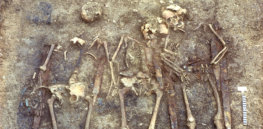
Medieval graves yield genetic clues about kinship of Germanic warrior family
A dozen lavish medieval graves holding the remains of 13 people have finally spilled their genetic secrets, now that researchers ...

In-body gene editing successful in first trial, targeting Hunter syndrome
A therapy that edits genes directly in the human body might be safe, suggest early findings from the first trial ...

Artificial intelligence could predict where earthquake aftershocks will strike
A new artificial intelligence is turning its big brain to mapping earthquake aftershocks. Scientists trained an artificial neural network to ...

Pinpointing the internal clock that helps us mark the passage of time
Manmade clocks may precisely measure time, but, from a human perspective, the passage of time is remarkably fluid. It drags ...

Opioid pain killer without risk of addiction? It may be possible
The ultimate goal of pain medicine—a powerful painkiller with few to no side effects, such as dependence or overdose—is still ...

3 reasons Mars colonization might be a bad idea
I wanted to look at the case against Mars; three reasons humans should leave the red planet alone. … [T]he first argument ...

Family ties: Searching for autism origins in the genes of unaffected siblings
Scientists have historically focused on studying a “quartet” of two biological parents and two autistic children. Yet more recent research ...

Repairing paralysis? ‘Growth cocktail’ shows promise for severed nerves
[R]esearchers have coaxed nerve cells to span the divide of a complete spinal cord injury. Their findings, described August 29 in Nature, ...

Could artificial intelligence protect the world from humanity’s ‘shortsightedness’?
There are fears that tend to come up when people talk about futuristic artificial intelligence — say, one that could ...

Why is ‘party drug’ ketamine such a powerful treatment for depression?
In recent years, the party drug and anesthetic ketamine has been embraced as a rapidly-acting, if still off-label, medication for ...
Were Neanderthals wiped out by icy climate change?
About 40,000 years ago, Neanderthals began disappearing from Europe, but exactly why they died out is a mystery. … Researchers propose ...

Why cognitive inequality demands our attention
[April 28, 1996, Martin Bryant used] two rifles and a shotgun stashed inside a sports bag on the passenger seat ...

Wearable robotic ‘exoskeletons’ merge humanity and machinery
Ever since the appearance of the power loader in the sci-fi classic Aliens, the idea that powered exoskeletons could let workers ...

Social science ‘reproducibility crisis’: Only 13 of 21 prestigious studies replicable
The “reproducibility crisis” in [social] science is erupting again. A research project attempted to replicate 21 social science experiments published between 2010 and ...

Large drug trials are expensive and results often misleading. A new genetic tool might cure those problems.
[C]orrelation is not causation. The fact that two phenomena or trends are correlated in time does not mean one causes ...

23andMe study probes links between cannabis use and schizophrenia
There’s evidence of a connection between cannabis use and schizophrenia, but it’s unclear whether the drug leads to the disorder, ...
