Each year between 30,000 and 60,000 thousand children are conceived using donated eggs and sperm, but regulations surrounding the identity and openness of those donations have not caught up with the science.
These regulations vary by country: in the United Kingdom for instance, a donor can register as anonymous or open and has the opportunity to change his or her mind. In the United States, however, there are no national or state level registries or legal protection of anonymity. Nor is there a formal process for donor-conecieved children to identify their donor.
Recently, a movement to legally outlaw anonymous donation in the States has picked up steam.
Kieth Ablow, a medical doctor, wrote on FoxNews.com:
Outlaw anonymous sperm and ova donation entirely. Let the donors be known to the recipients and the children thus conceived, or block the donations.
Without seemingly having given it much thought at all, our society now allows tens of thousands or more of men and women to create children who will never know one or sometimes both of their biological parents, because states allow these anonymous donations. And this policy inherently presupposes that bearing children who have no opportunity to know their biological fathers or mothers does not deprive them of anything that is inherently theirs – as a fundamental human right.
Ablow goes on to say that donor-conceived children should never have been born and essentially calls donor-assisted conception a convenience for old, rich couples.
But ignoring the ‘family values’ vitriol, is it possible that knowing your biological heritage is a fundamental human right?
Inmaculada de Melo-Martín writing at the Hastings Report asks the questions in a more subtle way:
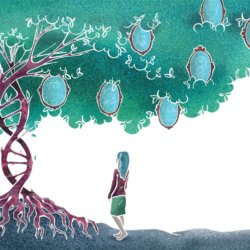



A variety of factors, such as the increasing number of children born by means of gamete donation, advances in genetic science and technology that make it easy to discover the identity of a person’s genetic parents, and the widespread belief that genetic information is important for protecting people’s health, have made this alleged right quite salient, even leading some to challenge the ethical appropriateness of gamete donation practices altogether.
There are health benefits of knowing ones ‘family health history’. That information is important in knowing personal risk factors for disease. However, it could be argued that personal genomic screening will one day replace the family history. Interestingly, sperm donors seem to be put through much less rigorous screenings by clinics and by potential recipient parents than egg donors. This seems like a bizarre form of sexism given that mom and dad give (almost) equal genetic material.
Although Ablow argues donor assisted conception has nothing to do with adoption, it may be the closest parallel available in our society. While closed adoption has fallen out of vogue, for some very good reasons, it is still very much legal in the United States. Moreover, no one has moved legislation forward to make it illegal, despite the fact that these children often don’t know their family medical histories or genetic identities.
Surely, there could be a better way to access the donor health data and protect the anonymity of the donor, if that is truly their wish. In closed adoptions medical history is often passed onto parents without the identities of biological parents being exposed.
The anonymity issue only underscores the lack of regulation of the fertility industry in the United States. Perhaps the United Kingdom’s minimal, national register is the right idea. Donor Chris Whitman (a pseudonym) documented his decision about identifying himself as a donor in The Guardian:
“In my case, I no longer had a compelling reason to remain anonymous and I came to feel that to deny someone the opportunity to try to find what he or she is seeking would be an act of selfishness on my part.
In the end it was probably a mixture of egoism, altruism and curiosity that finally led me to re-register with the Human Fertilisation and Embryology Authority as an identifiable donor. Offspring over the age of 18 could now request information about me, including the contact details I provided. I chose to give just an email address and the name of the town where I now live.”
Additional Resources:
- Egg donation: Some ‘progressives’ say women shouldn’t control own bodies, Genetic Literacy Project
- Walking the ethical edge: ‘Made-to-order’ embryos address genuine needs, Genetic Literacy Project