Growing wheat in Africa? Variety developed with advanced breeding techniques can withstand 104 degrees

In the northern Senegalese village of Ndiayene Pendao, close to the border with Mauritania, Fatouma Sow is pulling weeds. Her team of female farmers tread carefully among the tall, ripening plants as they prepare to harvest the country’s first ever crop of durum wheat.

They had grown onions and tomatoes on the one-hectare plot (2.47 acres), Sow explains, but the crops took too long to grow and disrupted the essential rice growing season. Now the wheat offers a fast-growing, lucrative alternative.

Following four years of trials, which saw thousands of wheat varieties tested in the unforgiving sub-Saharan heat, scientists have successfully turned what was first thought of as a “crazy idea” into a vital new food crop. With more than 1 million smallholders living along the Senegal River basin, which also runs through Mali and Mauritania, it was an important strategic area to trial the wheat.

The strain of wheat can withstand constant 40C [104 degrees Fahrenheit] temperatures, and has been developed by the International Centre for Research in the Dry Areas (Icarda). The so-called drylands cover more than 40% of the world’s land surface and despite the challenges, remain huge centres of agriculture, supporting half the world’s livestock.

…

Rather than go down a GM route, Icarda used advanced breeding techniques and its unique seedbank to combine characteristics of both modern and ancient strains.

Read full, original post: Wheat in heat: the ‘crazy idea’ that could combat food insecurity

Field study finds no negative impact on bees from neonicotinoid insecticide

bee

In the last decade, the use of neonicotinoid insecticides increased significantly in the agricultural landscape and meanwhile considered a risk to honey bees. Besides the exposure to pesticides, colonies are treated frequently with various acaricides that beekeepers are forced to use against the parasitic mite Varroa destructor.

Here we have analyzed the impact of a chronic exposure to sublethal concentrations of the common neonicotinoid thiacloprid (T) and the widely used acaricide τ-fluvalinate (synthetic pyrethroid, F) – applied alone or in combination – to honey bee colonies under field conditions.

…

We could not find a negative impact of the chronic neonicotinoid exposure on the population dynamics or overwintering success of the colonies, irrespective of whether applied alone or in combination with τ-fluvalinate.

This is in contrast to some results obtained from individually treated bees under laboratory conditions and confirms again an effective buffering capacity of the honey bee colony as a superorganism.

Yet, the underlying mechanisms for this social resilience remain to be fully understood.

Read full, original post: Chronic exposure to a neonicotinoid pesticide and a synthetic pyrethroid in full-sized honey bee colonies

Pancreatic cancer rates are surging. Here’s why

obesity

Five years ago [pancreatic cancer] was the fourth-leading cause of cancer deaths in the U.S. Today it’s number three and expected to soon overtake colon cancer for the number-two spot, right behind lung cancer. Even more frightening, this lethal condition is becoming more common.

…

What’s behind these trends? There are multiple intersecting factors at work.

…

[R]efined ways of testing biopsied tissue and higher-resolution imaging have meant that mystery tumors that once couldn’t be seen or were labeled “of unknown origin” can now be identified, and some turn out to be pancreatic. The aging of our population also contributes: it’s pushing up the rates of many kinds of cancer.

…

Smokers face more than twice a nonsmoker’s risk of pancreatic cancer, and even though smoking has slumped in the U.S., there is a 30- to 40-year lag time before we see a corresponding drop in cancer rates. In theory, pancreatic cancer should be waning, thanks to the dramatic falloff in smoking that began in the 1970s. But sadly, a new villain on the block is taking up some of the slack: soaring rates of obesity and type 2 diabetes, which are also risk factors.

…

[P]recision medicine therapies will ultimately help his patients, particularly the 10 percent or so whose cancer is more driven by heredity than way of life. But the bigger message is prevention, [oncologist Robert Wolff] says.

Read full, original post: Why Pancreatic Cancer Is on the Rise

Viewpoint: GMO crops are ‘natural step’ in long history of plant breeding innovations

Maler der Grabkammer des Sennudem

Humanity has been benefiting from plant science innovations since the Egyptians first bred edible corn more than 2000 years ago.

Genetically modified crops are simply the next natural step in plant breeding. Unfortunately, it is non-scientific regulations, in conjunction with some very successful and fear campaigns by activist groups, that have impeded the full benefits of these innovations being delivered to farmers and the community.

…

Despite the significant annual growth in GM crop adoption (currently about 18 million farmers in 26 countries), we have still not seen the predicted introduction of new crops because of these unnecessary regulatory hurdles and a public discourse on these issues that is anything but fact-based.

In a 2012 survey of the major private sector technology developers, it was found that on average, it costs $US136 million over 13 years to develop a GM crop and take it to market. Most of this cost is in the regulatory science and registration part of the product timeline.

That is not an issue of technology developers not being able to deliver on innovation, but that the regulatory system unnecessarily inhibits the innovation getting to farmers.

…

The future of agricultural biotechnology is bright; but only if the science can prevail and public policy and regulation is based on facts, not activist falsehoods.

Editor’s note: Matthew Cossey is the CEO of CropLife Australia

Read full, original post: Fear is holding back GM uptake

Earth’s first life forms were incredibly resilient to dramatic environmental changes

luca

Life on Earth could have originated in cold conditions near the surface, before spreading to warmer environments, according to research that analyzes the possible gene sequences belonging to the earliest life.

All life on Earth today originates from two distinct developments in our planet’s biological history. These are the emergence of the first life forms billions of years ago, and the subsequent evolution of the last universal common ancestor (LUCA) of all extant organisms.

Whatever they were at the time, these two extinct species – the first life and LUCA – likely occupied radically different environments, suggesting that early life had to undergo a series of evolutionary changes.

…

The scientists suggested that life first emerged near Earth’s surface under some form of radiation shield, such as water, ice cover, sediment or other barriers, and had access to unshielded environments that could generate key biomolecules. Temperatures on Earth may have also been relatively cold at that time.

…

In contrast, the last universal common ancestor – the microbial species from which all life that exists today came from – may have lived in moderate temperatures, perhaps at least four billion years ago.

…

The researchers suggested that since life apparently originated in a very different environment than the one in which LUCA lived, early organisms likely evolved to survive radical changes in their surroundings.

Editor’s note: Read full study

Read full, original post: Early life had evolutionary power to survive radical changes in environment

‘Natural’ label lawsuits: What you need to know

all natural large jpg x q crop smart
The U.S. Food and Drug Administration (FDA) has had the term “natural” on its regulatory plate for a long time. Already in 1993, the FDA informed that public that it would not define the term “natural” because “there are many facets of this issue that the agency [would] have to carefully consider” and due to “resource limitations and other agency priorities.” The FDA reiterated this stance of not defining “natural” in a January 2014 letter. After the Grocery Manufacturers Association (GMA) petitioned the FDA to define the term in later 2014, the FDA initiated a consultation process about providing a definition. But as of January 2018, the FDA has not promulgated a regulation providing a food law definition of “natural.”

What the FDA has not said about defining “natural” is that prescribing a definition would be an exercise akin to medieval theologians trying to define how many angels danced on the head of a pin.  Science provides no natural dividing line for defining “natural.” Additional resources will not help FDA. FDA would be picking winners and losers by drawing lines that will not be easily defensible.  In other words, by defining the term “natural,” the FDA will be involved in politics, not science.  Traditionally the FDA tries to stay a scientific regulatory agency as much as possible.

As a consequence of FDA’s understandable reluctance to define the term, food companies and consumers look to the informal comments that the FDA made in 1993 about what the term “natural” means:  “… nothing artificial or synthetic (including all color additives regardless of source)” and “minimal processing” – whatever “minimal processing” encompasses.  Remember that these are informal comments by the FDA and do not carry any legal authority as a binding definition.

In response to the fact that no food law definition of “natural” exists, Consumer Reports (a prominent U.S. consumer magazine) has urged the FDA to ban the use of the term on food labels.  Consumer Reports holds the position that the term is “inherently false or misleading” on food labels and that any FDA attempt to define the term for food law would become a stew of confusion and unintelligibility.  So far, FDA has also been unwilling to use its statutory powers to ban the term from food labels. FDA may be reluctant because of U.S. constitutional protections for freedom of speech. After all, the word “natural” is a natural word in the vocabulary of American consumers and food companies.

natural 4 2 18If the FDA won’t define “natural” and won’t ban the term, what is a red-blooded American to do if she thinks she has purchased a food labeled “natural” only to read the ingredient label very carefully at home and decide that she was misled into purchasing an unnatural product?  The answer: find a class-action lawyer and engage in that American national (or is it, natural) pastime – litigation. Or more precisely, sue the food company by asserting various federal and state common law and statutory claims for false and deceptive advertising, unfair and fraudulent business practices, and consumer deception.  Now we’re making sausage!

These lawsuits have focused on three textures of not “natural”:

  • synthetic or artificial chemicals such as preservatives, colorings, or high-fructose corn syrup;
  • chemicals used in the production of a food or a food ingredient such as pesticides, herbicides, or synthetic fertilizers, particularly if chemical testing can taste a chemical residue; and
  • genetically modified organisms either, directly, as an ingredient or raw food from a genetically-modified crop or, indirectly, as a food product from animals that have consumed genetically-modified feed even though no trace of that feed exists in the food (e.g, cheese or meat).

Many lawsuits present a mixture of these three textures about being not “natural,” though several recent cases have been 100% pure disputes about genetic modification.

The judicial and food company responses to these “natural” label lawsuits have been a smorgasbord of legal delights.

Food companies have settled some of these lawsuits by agreeing with the complainants to substitute ingredients in the product or to rewrite the label to delete the word “natural.”  In these settlements, the food companies generally did not admit the merits of the legal claims.  By settlement, however, the company avoided the costs of litigation and the potential negative publicity that could bubble up among the company’s consumers.  Of course, the settlement invariably came with a financial sweetener of some measure for the named complainant in the class-action and the lawyers who filed the lawsuit.

In some lawsuits, the courts avoided the sticky substantive issues by deciding the case on issues that are not about the meaning of the term “natural”.  For example, several courts have dismissed the lawsuit by filtering out plaintiffs who had not purchased the not “natural” product. Without being an actual purchaser, some judges ruled that the complainant had not shown any injury requiring judicial intervention to provide a remedy.  Other courts have ruled against the complainants, making claims related to approved pesticides as not “natural,” that the federal act governing the registration and labeling for pesticide usage and residues preempted the lawsuit. Under the Federal Insecticide, Fungicide, Rodenticide Act (FIFRA), the Environmental Protection Agency (EPA) prescribes the mandatory label.  These courts ruled that the “natural” label lawsuit would make food companies label their food products with words contrary to the EPA mandatory label. In the U.S., federal law can be supreme over state law and common law and, thereby, preempt legal claims based on state statutes and the common law.

Still, other courts have evaded the substantive issues by holding particular “natural” label lawsuits in abeyance.  These judges have decided that the FDA, not courts, has primary responsibility (jurisdiction) for defining the term “natural.”  The judges have paused the particular lawsuits to allow the FDA time to provide a food law definition.  As indicated in the opening paragraphs to this commentary, the FDA responded to these judicial requests by stating that the FDA did not intend to provide a definition.  But the FDA does now have a proposal, three years old, for consultation about defining the term “natural.” Maybe like cheese and wine, the definition will become sharper and have fuller body by going through the process of legal aging.
nature valley 4 2 18And at last, in four recent cases, courts have issued judicial opinions addressing the substantive issues in “natural” label lawsuits.

In General Mills, Glyphosate Litigation, 2017 WL 2983877 (D. Minn., July 12, 2017), U.S. District Judge Michael J. Davis dismissed the complainant’s lawsuit with prejudice.  Judge Davis opined,

The Court concludes that Plaintiffs have failed to plausibly allege tht the statement ‘Made with 100% Natural Whole Grain Oats’ means, or could be interpreted by a reasonable consumer to mean, that there is no trace of glyphostate in Nature Valley Products.  It is implausible that a reasonable consumer would believe that a product labelled as having one ingredient – oats – that is “100% Natural” could not contain a trace amount of glyphosate that is far below the amount permitted for organic products. The Court further concludes Plaintiffs fail to state a claim because Defendant (General Mills) did not represent or warrant that Nature Valley Products would be free from trace glyphosate.

In Kinn v. Quaker Oats Company, 2017 WL 3922068 (N.D. Ill., Sept. 6, 2017), U.S. District Judge Charles R. Norgle dismissed the complainants’ lawsuit with prejudice on the three grounds: 1) lack of standing for claims based on products complainants did not purchase; 2) federal preemption because federal statutes and regulations exist “expressly deeming safe and permitting trace levels of glyphosate”; and 3) “also failed for other reasons, including that Plaintiffs’ claims were implausible as a matter of law. …  Plaintiffs have not alleged the omission of any material fact in Quaker’s public representations.” Under the Federal Food, Drug and Cosmetic Act, the FDA has authority to take action for false or misleading labeling when a food company omits a “material fact” about its food product or its ingredients. Federal Judge Norgle apparently concluded, as a matter of law, that crops being grown with a herbicide (glyphosate) is not a “material fact” that a food company must state on its label.

In Lee v. Conagra Brands, Inc., 2017 WL 6397758 (D. Mass., October 25, 2017), U.S. District Judge Richard D. Sterns dismissed a lawsuit complaining of deceptive advertising because Conagra vegetable oil came from genetically-modified corn, soybean, or canola.  Judge Sterns dismissed the lawsuit because the “100% natural” label was consistent with FDA policies about labeling related to genetically modified crops. Although the FDA has not formally adopted a definition of “natural,” the court noted that  FDA has consistently stated:

it is not aware of any information showing that foods derived by these new methods [genetic modification] differ from other foods in any meaningful or uniform way, or that, as a class, foods developed by the new techniques present any different or greater safety concerns than foods developed by traditional plant breeding.

Thus, the court said that FDA had ruled against mandatory labeling of genetically-modified food products. In an aside, Judge Sterns added, “For what it is worth, humans have been genetically altering organisms for our use for about 30,000 years.”

Fourth and finally, U.S. District Judge Katherine B. Forrest dismissed a lawsuit claiming that Dannon yogurts cannot be labeled “natural” because the cows’ milk came from cows that had eaten feed formulated with genetically-modified crops.  Podpeskar v. Dannon Company, Inc., 2017 WL 6001845 (S.D. N.Y., December 3, 2017).  Judge Forrest opined,

There is no legal support for the idea that a cow that eats GMO feed or is subjected to hormones or various animal husbandry practices produces ‘unnatural’ products; furthermore Dannon does specifically represent that its products are either GMO-free or not given hormones or antibiotics.  The Court therefore finds plaintiff’s argument too speculative to state a plausible claim and grants defendant’s [Dannon’s] motion to dismiss.

dannon 4 2 18While the four cases specifically discussed and cited above do not mean an end to “natural” label lawsuits, these four cases may indicate a trend.  The courts will not define natural but the courts will say what is not unnatural – the breeding and agronomic methods by which farmers and livestock owners grow their crops and animals.  Might not this be a recipe for the FDA too?

In other words, the FDA does not need to define the term “natural.”  But the FDA could lessen the volume of “natural” label litigation by issuing a regulation making clear that the breeding and agronomic methods by which farmers and livestock owners grow their crops and animals does not preclude a food company from advertising the resulting food or food ingredient as “natural.”  If the FDA did so, then two of the three textures giving rise to this litigation would be ended; this FDA regulation would preempt two of the three textures of litigation. Thereafter, “natural” label litigation would be legally restricted to lawsuits about synthetic and artificial chemicals and minimal processing.

Moreover, FDA should seriously consider following the recipe provided by these four named, recent opinions because the U.S. mandatory labeling law for genetically-engineered (GE) foods will not have an impact on “natural” label litigation.  Even after U.S. foods carry mandatory GE labels (final regulations due in August 2018), food companies may still place the word “natural” on the label. And class-action lawyers and their consumer complainants may still file lawsuits claiming that these GE foods violate consumer expectations about the meaning of “natural.”

During preliminary debates about the labeling law, Congress did discuss proposals mandating that either FDA or the USDA provide a definition.  However, Congressional committees deleted that “natural” provision from the legislation as it progressed through Congress. Consequently, the U.S. mandatory labeling law, as adopted, is completely silent about the “natural” label controversy.

Finally, this commentary discussed the litigation filed in United States federal courts.  Many cases exist in State courts under state consumer protection laws. Without the FDA getting involved to create federal preemption, state litigation will continue despite the four cited, recent federal opinions that provide a recipe for significant resolution of this litigation.  Thus, with the U.S. mandatory labeling law silent about the term “natural,” the FDA needs to roll up its sleeves, put on its baker’s hat, and bake it the regulatory pan. Minimal recipe (see the named four opinions in this commentary) and baking time recommended.

Drew Kershen is professor emeritus at the University of Oklahoma College of Law. He has taught, researched and lectured on agricultural biotechnology law and policy. He is a member of the Genetic Literacy Project’s Advisory Board.

A version of this article was originally published in the World of Food Ingredients as “The Ins and Outs of ‘Natural’ Labels” and has been republished here with permission.

Direct-to-consumer genetic test results 40 percent wrong in small study

test

At-home DNA tests are “not intended for medical use,” meaning that the data they give you shouldn’t be used as a replacement for a real medical diagnosis.

At-home genetic testing companies like 23andMe, Ancestry.com, Family Tree DNA and My Heritage are gaining popularity as a relatively cheap way to understand one’s ethnicity and genetic history.

Yet new research suggests that some results identifing genetic issues may be innaccurate—and that as much as 40 percent of analyses of these at-home genetic tests implying genetic disorders could be innacurate.

Researchers at AmbryGenetics conducted a study of 49 individuals who had done “direct-to-consumer” DNA tests…AmbryGenetics then checked those analyses with a more detailed and expensive genetic test. They found that only 60 percent of the genetic variance results could be confirmed.

While this is a relatively small sample of 49 people, the thirteen results that came from the company 23andMe were confirmed accurate. In an email to Newsweek, they noted that their product “undergoes an incredibly rigorous, FDA-mandated accuracy review process – much more rigorous than this study which only used 49 samples from several different companies, whereas we test hundreds of samples.”

The study was published Monday [April 2] in the journal Nature.

Read full, original post: Nearly Half of At-Home DNA Test Results Could Be Wrong

‘You have to have the courage to do it’: Kevin Folta on why scientists need to communicate with the public about GMOs

JfN YSNIbVLsYCIb O NkA

On Sunday, September 6, 2015, scientist Kevin Folta made the front page of the New York Times.

…

[T]he Times article … [pointed] to a donation the university received from Monsanto to fund Folta’s GMO education workshops.

Despite the fact that the funding wasn’t used for research and that Folta met university requirements in reporting potential conflicts of interests, this didn’t stop people from questioning his credibility. It led to online attacks, to threats against his wife, and to having his lab broken into.

While Folta doesn’t gloss over the impact this harassment has had on his personal and professional life, he is adamant that this will not make him stop.

“Even though there are potential pitfalls in doing this, you have to have the courage to do it,” he says. “It’s too important of an issue. We are talking about people dying every day from malnutrition, a fragile environment that needs solutions, and farmers who are aging and aren’t making a huge profit – if they are making one at all.

“That’s the crisis. My personal problems are nothing,” he adds.

Read full, original post: Kevin Folta’s crusade for science

What would happen if we suddenly stopped dreaming?

dream

Rowan Hooper, the managing editor at New Scientist, reports that chronic dream deprivation is damaging our waking hours in numerous ways.

…

This trend is wreaking havoc on our immune and metabolic systems, leading to a variety of diseases and obesity. Forget about focus: the devices that keep us up late at night are ruining our sleep patterns, which has long-term consequences on our memory system.

…

We might think this is just a sleep problem, but dreaming is inseparable from our nighttime sojourn through the darkness. Dream problems and sleep problems go hand in hand.

…

Memory consolidation is a critical reason for dreaming at all. The combination of sleeping and dreaming acts as an emotional stabilizer. We’re able to integrate the day’s events in a place where, physically speaking, we’re vulnerable—our ancestors didn’t have locks on their doors. Incredibly, we heal from emotional trauma more quickly when we sleep, and dream, properly.

Except we’re not getting enough sleep to cycle through the stages to take advantage of this circadian anti-depressant. Instead, we get depressed and turn to substances like alcohol and pharmaceuticals to nod off. This only makes things worse.

…

As with finding the motivation to hit the gym, we need to motivate ourselves to get to bed earlier, without screens or other technological stimulation right before trying to slip into sleep.

Read full, original post: The serious health consequences of not dreaming

Life on Earth: How aliens might go about discovering us

https F Fblueprint api production s amazonaws com Fuploads Fcard Fimage F Ffe c cce ff b e c ceb
[L]ight-years from our solar system, other intelligent beings on a similar planetary oasis might be gazing in our direction and seeing us as a sign that they’re not alone in the universe.

…

First, they’d need to find Earth from afar, either by watching our sun wobble as the planet’s gravity tugs against it, or by seeing the sun dim as Earth blocks a tiny fraction of sunlight during its orbit.

…

Once spotted, our planet would likely intrigue E.T. Our sun is relatively stable, not prone to disastrous flares that’d rip our atmosphere to shreds. What’s more, we fall squarely within our sun’s habitable zone.

…

In addition to oxygen molecules, alien astronomers would look at our atmosphere’s levels of nitrogen, carbon dioxide, nitrous oxide, and methane. Only life could keep Earth chemically off-kilter enough for all these gases to persist at once. Beyond those chemical clues, alien astronomers with truly massive telescopes might even be able to map Earth’s surface from afar, down to major urban areas.

…

If intelligent life is nearby, the most straightforward way to find earthlings would be to listen for us. For the last century, human civilization has been broadcasting its existence to the cosmos via our leaky radio transmissions.

…

If aliens are anything like us, perhaps the news that they aren’t alone in the cosmos wouldn’t be their equivalent of earth-shattering.

Read full, original post: Aliens Could Detect Life on Earth. Here’s How.

Viewpoint: Chemical-free gardening is a myth

ecogastronomia

So-called “nature” is teeming with chemicals, in soil, in plants, in rain and not only in nettles. Chemical-free gardening is a total myth. All plants depend on drawing up chemical elements from moisture in the soil.

…

Chemical companies are not out to kill us and our gardens. Their research is extremely finely tuned and without it, there would not be many tomatoes left in commerce or citrus crops left alive. I was recently in Florida, expecting to enjoy the scent of orange trees wherever I cycled. There was none. The trees had all been killed by pests that not even Monsanto could control.

Genetic modification is another potential godsend. It has not led to fabled super invaders. If somebody could modify carrots so that they never succumbed to carrot fly, I would crown them. As for organic gardening, it is a fuzzy muddle. If you register as a grower of organic vegetables, you will be surprised by the list of chemicals you are allowed to use without losing organic status. The word is vacuous. It does not mean that shoppers are buying chemical-free vegetables in supermarkets. If they were chemical-free, they would never have grown in the first place.

Read full, original post: Why chemical-free gardening is a myth

Australian politician compares anti-GMO activists to ISIS

GMO x

WA [West Australia] Upper House Liberal member and former grains farmer Jim Chown says anti-Genetically Modified (GM) crop activists are equal to Islamic State operatives, due to undue interference not only in legal farming systems, but also the courts.

In a speech … using parliamentary privilege, Mr Chown doubled down on his questioning of anti-GM activities linked to the Marsh v Baxter legal test-case, to ventilate his concerns about the potential perverse outcomes of a current inquiry in the WA parliament into a proposed compensation fund for non-GM farmers.

…

“It is now patently obvious that the anti-GM movement and its supporters are bereft of any morals and will take any action, whether it is legal or otherwise, to pursue its ideological stance against an agricultural crop that is grown over billions of acres worldwide, a crop that has justifiably been scientifically scrutinised and peer-reviewed to the point at which today it is without fear as the safest form of food that the human population on this planet has ever produced,” he said.

“These anti-GM activists are, in effect, the equivalent of ISIS operatives.”

Read full, original post: Chown: anti-GM cropping activists equivalent of ISIS operatives

Improved ‘brains’ grant robots dexterity that could soon rival humans

F F F f F f c bfb efda a fa

It might not look that special, but the robot above is, according to a new measure, the most dexterous one ever created. Among other tricks, it could sort through your junk drawer with unrivaled speed and skill. The key to its dexterity is not in its mechanical grippers but in its brain. The robot uses software called Dex-Net to determine how to pick up even odd-looking objects with incredible efficiency.

…

[Professor Ken] Goldberg’s robot is a lot closer to matching the adroitness of a human than anything developed previously. Industrial robots with better dexterity could find application in warehouses and factories as well as hospitals and homes.

…

Humans are capable of between 400 and 600 mean picks per hour. In a contest organized by Amazon recently, the best robots were capable of between 70 and 95. The new machine reaches 200 to 300 mean picks per hour, Goldberg says. The results will be presented at a conference in Australia later this year. During his presentation, Goldberg added that within five years, he expects that robots will reach “human or even superhuman mean picks per hour.”

…

Besides factory or warehouse work, more sophisticated manipulation may lead to the first useful robots for helping people in places such as hospitals and elder-care facilities.

Read full, original post: This is the most dexterous robot ever created

No outrage: Why news of first cloned monkeys barely moved the needle

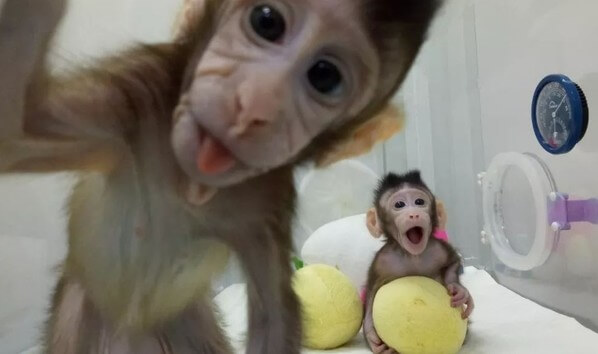
[Cloned monkeys] Zhong Zhong and Hua Hua were created at the Chinese Academy of Science’s Institute of Neuroscience in Shanghai.

…

[I]s society ready to accept cloned primates for medical research without the attendant hysteria about fears of cloned humans? It appears so. While much of the news coverage expressed this predictable worry, my overall impression is that the societal response was muted. Where was the expected outrage?

…

In the just past 30 days we have seen more cloning headlines. Another cultural icon, Barbara Streisand, revealed she owns two cloned Coton de Tulear puppies. The other weekend, the television news show “60 Minutes” devoted close to an hour on the cloned ponies used at the top level of professional polo. And in India, scientists just cloned the first Assamese buffalo.

And you know what? After years of panic, none of this has caused much of a stir. It’s as if the future described by Alvin Toffler in “Future Shock” has arrived and we are just living with it. A couple of cloned monkeys barely move the needle.

…

I think Zhong Zhong and Hua Hua will soon be joined by a legion of cloned macaques and probably marmosets. We humans are enduring plagues of dementia and Alzheimer’s, and we will need more monkeys. I will take mine cloned, if it will speed the mending of these consciousness-destroying afflictions.

Read full, original post: The First Cloned Monkeys Provoked More Shrugs Than Shocks

How indoor farming and ‘metagenomics’ could change how we grow vegetables

Urban Produce Indoor Vertical Garden

Trevor Charles has three decades of experience in bacterial genetics, molecular biology and metagenomics and is CSO at Metagenom Bio Inc. Trevor is enthusiastic about the huge potential of microbiome management in hydroponic systems for enhancing health, productivity and quality of indoor farming crops.

headshot trevorcharles metagenom square x
Trevor Charles

…

How would you explain the concept of metagenomics to a lay person?

Metagenomics (and microbiomics) tells us what microbes are doing, and how they affect something. A good example is detecting the good and bad microbes that influence the health and productivity of plants. Knowledge of this information can help to improve food production by improving efficiency, reducing plant stress and disease, and decreasing the farmer’s costs. Controlled environment systems such as vertical farms are perfect for this.

How do you envisage metagenomics being used in indoor agriculture?

We see these tools being used in two different, but interrelated ways. First, we can provide a measure of the “health” of the hydroponic system using DNA sequencing. Secondly, we can improve that health, by providing amendments, including inoculant products that we have developed specially for these hydroponic systems.

…

Which crops will be most affected and how soon?

Leafy greens, tomato, cucumber and pepper are the initial emphasis. … Our goal is for our metagenome/microbiome solutions to attain a significant presence in indoor agriculture over the next three years.

Read full, original post: 5 plant genomics questions with Dr Trevor Charles of Metagenom

Viewpoint: Organic campaigners in Uganda use ‘scare tactics’ to keep GMO crops from farmers

MaizeDroughtResistant x

The organics are marketed as “sustainable agriculture”, “agro-ecology farming”, and “farming God’s way”. Organic products are branded natural, organic, safe, nutritious and healthy to appeal to the emotions of buyers.

The challenge of organic agriculture is in its inability to support the food need for the ever increasing population. The stringent requirements associated with growing “organics” mean fewer farmers are willing to indulge in it and the few who do end up overcharging consumers, making organic products a preserve of rich elites.

…

Genetically modified organisms are considered a threat to the organic’s profits and are being fought hard by the organic industry. This is because some genetically modified crops have the potential of doing away with chemicals translating into more crops being grown without spraying. This type of genetically modified crops would guarantee more supply of non-sprayed produce, resulting in the potential reduction in prices of organics.

It is not surprising that the same tactic that was used to scare farmers away from my fertiliser demo is still being used to exclude African farmers from growing genetically modified crops because the price of organics must remain highest.

Read full, original post: Organic can be promoted without scare tactics

Autistic children and their siblings less likely to be vaccinated

d f c c ace c e fd d a

Children with autism spectrum disorder are significantly less likely to be fully vaccinated than children unaffected by autism, new research finds. And the same is true of their younger sisters and brothers.

…

The study was published [March 26] in the journal JAMA Pediatrics. Autism is a neurodevelopmental disorder characterized by challenges with social skills, communication and repetitive behaviors. The cause of autism spectrum disorder is unknown, though research suggests that both genetic and environmental factors play a role.

Scientific studies also report no association between vaccines and autism, although many parents fear such a connection.

…

“What we found is that there are large disparities in vaccination rates between children with and without” autism spectrum disorders, [researcher Ousseny] Zerbo said. Comparing the two groups of children, “we found that 80% of children with autism received all vaccines recommended for children between ages 4 and 6, versus 94% among children without autism,” he said.

…

“Fears about an autism-vaccine link persist and contribute to growing numbers of unvaccinated or undervaccinated children,” said Goin-Kochel, who was not involved in the new study. “In turn, this has resulted in — and will continue to result in — increases in outbreaks of vaccine-preventable diseases.”What the study shows is how perception drives behavior “in a way that significantly influences public-health safety,” she said.

Read full, original post: Children with autism less likely to be fully vaccinated, study finds

Calling for a ‘richer’ global conversation about CRISPR, gene editing

crispr

Over the past three years, leading scientists have called for global deliberation on the possible effects of gene editing on the human future. In our view, the discussions that have taken place fall far short of the expansive, cosmopolitan conversation that is needed.

An important milestone was the International Summit on Human Gene Editing, held in Washington DC in December 2015.

…

[However,] the meeting format offered little opportunity for deeper listening or learning.

Instead, it encouraged an all-too-common pattern. Discussion split into two camps: scientific experts explored technical issues, whereas scholars who study science and society addressed questions about the possible disruption to social norms. The two camps did not inform each other.

To break out of this bifurcation between the ‘science’ and the ‘ethics’, methods must be found to get people to engage substantively with each other. In our view, an entirely new type of infrastructure is needed to promote a richer, more complex conversation — one that does not originate from scientific research agendas but that instead invites multiple viewpoints.

We advocate the establishment of a global observatory for gene editing, as a crucial step to determining how the potential of science can be better steered by the values and priorities of society.

…

An international, interdisciplinary observatory would be an important step in this direction.

Editor’s note: Sheila Jasanoff is a professor of science and technology studies at the Harvard Kennedy School. Benjamin Hurlbut is associate professor of biology and society at Arizona State University.

Read full, original post: A global observatory for gene editing

Animal scientist: Genetic engineering can improve livestock health, growth and well-being

New born Frisian red white calf

One method [Jon Oatley, director of the Center for Reproductive Biology at Washington State University] and his team of researchers use to improve the genetics of food-producing cattle is through gene modification rather than more traditional methods, like selective breeding.

“What we can do now is we can use sophisticated tools, molecular tools, to really refine and enhance the genetics of an animal for them to have the traits that we want,” Oatley said. “We can make leaps in improving the health, growth and well-being of animals, compared to the baby steps that we’ve been taking for thousands of years.”

This process creates genetically modified organisms, which Oatley said saves researchers much-needed time.

“We are going to have 10 billion people on Earth before the year 2050. In the next 30, 40 years, we will double the number of people we have on Earth. And we don’t have the resources to double the amount of food that we produce right now,” Oatley said. “We have to find a way to do things differently, more efficiently, so we can provide food to the increasing world population at today’s nutritional standards. I’m hoping that our research is one of the ways we can do that.”

Read full, original post: Washington researcher working to solve world hunger