Podcast: Can you inherit more than half your genes from one parent? Debunking genomic myths and misconceptions

dna test
Credit: Ali Blackwood
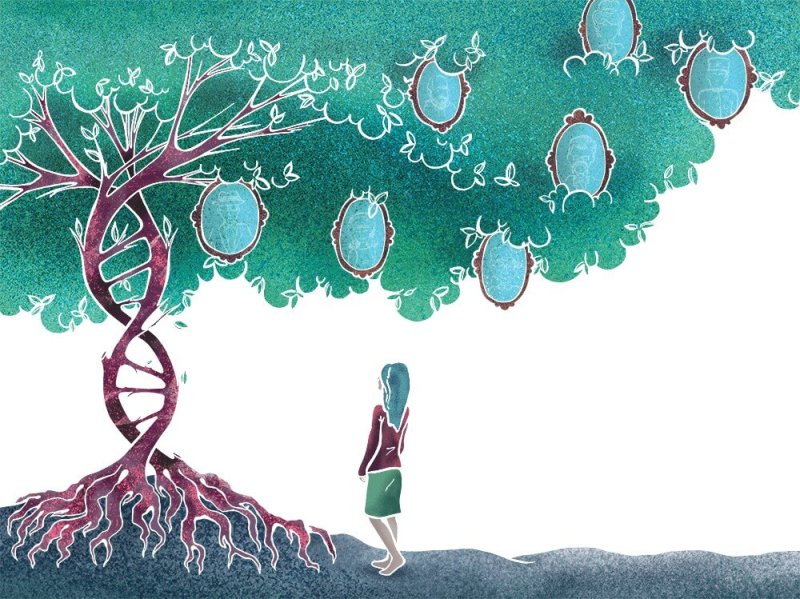
The Distaff Gospels, a collection of medieval Old Wive’s Tales, warns that if a pregnant woman eats hare she’s likely to have a baby with a cleft palate, while eating fish heads leads to a ‘trout pout’. While these ideas certainly aren’t supported by modern science, there is still plenty of confusion surrounding genetics today—for example, the idea that an inherited disease is the result of something bad happening in the family, that mutations are always bad, or that looking more like one parent than the other means you’ve inherited more of their genes.

Geneticist Kat Arney explores some of the myths and misconceptions about genetics, genomics and inheritance, in partnership with the Genomics Education Programme. 

Genetic tests—and increasingly, more detailed genomic analysis—are providing an unprecedented amount of information about the underlying genetic variations and alterations that affect health. The pace at which genomic data and technologies are coming into the clinic is impressive. At the same time, it can leave patients, the public and healthcare providers feeling overwhelmed and trying to figure out what it all means.

Laura Boyes, Consultant Genetic Counselor for the West Midlands, explains where we get our ideas about inheritance from, and how they shape our family relationships. She also talks about the need to normalize the idea of genetic variation: nobody has a perfect genome, and we are all carrying our own unique alterations.

Anna Middleton, Head of Society and Ethics Research at the Wellcome Genome Campus in Cambridge, discusses whether media portrayals of genetics are helpful or harmful, and whether scientists should get worked up about ‘bad science’ in the movies.

Finally, Arney speaks with Michelle Bishop, the Education Lead for the Genomics Education Programme,  about the importance of providing accurate and understandable information about genomics, and the need for educators and healthcare professionals to keep up to date with advances in this fast-moving field.

The Genomics Education Programme is running a week of action from the 16th to the 20th March 2020, designed to raise awareness about the impact of genomics in healthcare and what we can all do to tackle some of the myths and misconceptions that are out there. Following @genomicsedu and #GenomicsConversation on Twitter or visit genomicseducation.hee.nhs.uk for more information.

Full transcript, links and references available online at GeneticsUnzipped.com

Genetics Unzipped is the podcast from the UK Genetics Society, presented by award-winning science communicator and biologist Kat Arney and produced by First Create the Media.  Follow Kat on Twitter @Kat_Arney, Genetics Unzipped @geneticsunzip, and the Genetics Society at @GenSocUK

Listen to Genetics Unzipped on Apple Podcasts (iTunes) Google Play, Spotify, or wherever you get your podcasts

Related Articles

Infographic: Global regulatory and health research agencies on whether glyphosate causes cancer

Infographic: Global regulatory and health research agencies on whether glyphosate causes cancer

Does glyphosate—the world's most heavily-used herbicide—pose serious harm to humans? Is it carcinogenic? Those issues are of both legal and ...

Most Popular

Crumbling MAHA Stage Portrait
Cataloging the RFK Jr.-MAHA crushing midterm collapse
Blue Checklist in Centered Hand
Viewpoint: From Medicaid cuts to MAHA-backed anti-vaccine and chemical hysteria, voters reject Republicans’ science-skeptical agenda
ChatGPT-Image-Mar-10-2026-01_39_01-PM
Viewpoint—“Miracle molecule” debunked: Why acemannan supplements don’t work
Microscopic IVF Egg Injection
With technical barriers to human embryo editing falling, ethical concerns escalate
Screenshot-2026-11-05-at-1.20.54-PM
$7.35 billion PFAS settlement: 3M to pay people who blame health problems on ‘forever chemicals’ phased out of firefighting foam for more than 20 years
Hipster eugenics: better babies for billionaires
Viewpoint: “Positive eugenics”: Reviving a movement reviled and condemned for a century
Picture1
Viewpoint: How badly is the U.S. food-safety net fraying? FDA’s bungled handling of the tainted lettuce crisis deepens concerns over cuts to disease tracking and response
Reaching Through the Woven Sky
Challenging genetic modification rejectionists: Our evolving food system has relied on science for thousands of years
Smiling-Woman-Over-Teal-Abstract-Shapes
Viewpoint: RFK Jr.’s latest foray into junk science: Even Kennedy’s hand-picked NIH director balks at appointment of crackpot mental health director
Screenshot 2026-11-04 at 12.02
Ever wonder why AI can so easily be duped into manufacturing health misinformation?    
Screenshot-2026-10-29-at-11.18.34-AM
Viewpoint: ‘Just the flu’: Skipping your child’s flu shot could be a fatal mistake
Screenshot-2026-11-02-at-11.34.28-AM
Farmers are collateral damage in the PFAS “forever chemicals” crossfire. Here’s what they need to know.
Aerial Sprayer Over Gradient Fields
Farming, food, and chemicals: Post-midterms, the MAHA alliance between Democrats and MAGA Republicans is bruised but not cowed. What comes next?
Screenshot-2026-10-28-at-3.00.44-PM
Viewpoint: Activist attacks on corporations increasingly depend on "attribution" science to target oil companies for global climate change
Bayer Crop Circle in Golden Wheat
Making fertilizer from thin air: Bayer’s gene-editing innovation could dramatically cut chemical fertilizer use in growing food
glp menu logo outlined

Get news on human & agricultural genetics and biotechnology delivered to your inbox.