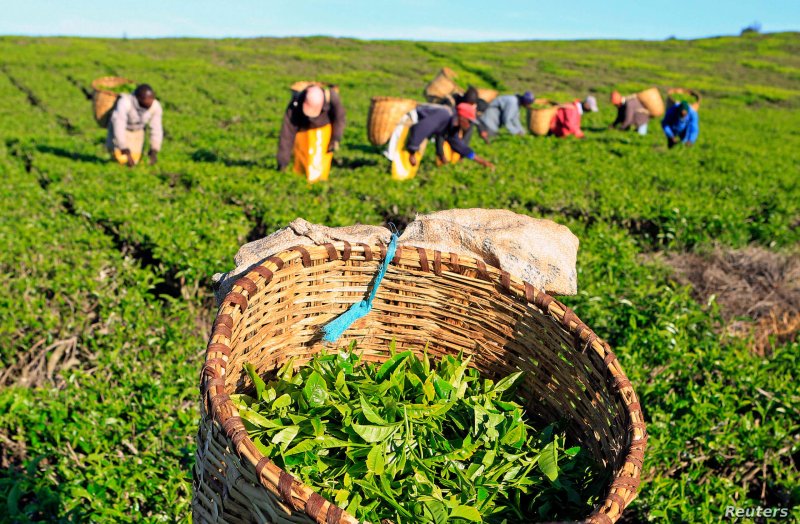
The crop is facing a near-century of sweeping climatic changes that could diminish its competitive savor. But a leading African scientist has proposed using the tools of biotechnology to build in climate resiliency and help maintain the signature flavor that gives Kenyan tea an edge in the international market.

“Tea is grown in many places — Aberdares, Kericho and Mount Kenya areas,” said Professor Shem Wandiga, former acting director at the University of Nairobi’s Institute for Climate Change and Adaptation (ICCA). “In the future, after a 2-degree rise in temperature, most of those areas may lose their tea growing ability. Kericho may still grow tea but it might not be of the same quality, unless we genetically find a brand of tea that grows with a hotter climate.”
Tea thrives in a hot, moist climate, with temperatures ranging from 10-300C (50-86F) and minimum annual precipitation of 1250 millimeters (49 inches). It prefers acidic soils, hill slopes that ensure good drainage and elevations up to 2000 meters (6500 feet). These conditions limit tea production geographically to a few areas around the world, and the crop is highly sensitive to changes in growing conditions.
Studies have shown a correlation between variations in climate and both tea quantity and quality, with research pointing to options for genomic refinement that can help develop a more diversified set of tea flavors.
Research on the tea tree genome identified expansions of genes associated with flavonoid metabolic biosynthesis, which enhance catechin production, terpene enzyme activation and stress tolerance — all of which are important features for tea flavor and adaptation.
Wandiga noted that Kericho, which heavily relies on convectional rainfall from Lake Victoria in East Africa, could be the biggest casualty of the climate changes afflicting Kenya’s tea-growing regions.

“By the year 2100, and onwards, the amount of evaporation may change, and therefore the rainfall will not be the same,” Wandiga told the Alliance for Science. “Hence, the temperature on land and in the air over Kericho may not be suitable for tea growing anymore.”
Even slight increases in temperature could have a profound impact on crops grown globally and in various parts of Africa, which underscores the need for greater climate resilience, particularly for the dominant cash and staple food crops.
“A temperature increase of 2 degrees Celsius in Uganda could wipe out the robusta coffee grown in the country,” Wandiga said.

Kenya and other parts of East Africa have witnessed various impacts of climate variability that have taken shape in the continent over the years, marked by increasing temperatures, sea level rise, changing precipitation patterns and extreme weather. All of these factors pose a looming threat to human health, food and water security and socioeconomic development.
“Crop yields are going to decrease,” Wandiga said. “In some cases, we may not even have the same crops that we used to have. Irrigation will be more demanded because of the drought, but as demand for irrigation increases, the water level is decreasing because of changes in precipitation. We have a Catch-22.”
Arid and semi-arid land in Africa could increase by between 60 and 90 million hectares, representing a maximum increase of 8 increase, according to Wandiga. Wheat production may disappear from the continent by the 2080s, with crop revenues dipping by as much as 90 percent by 2100. Small-scale farms will be the most affected.
“In Egypt, for example, climate change could decrease national production of many crops, ranging from -11 percent for rice to -28 percent for soybeans, by the year 2050,” he said. “It is estimated that by 2100, parts of sub-Sahara Africa will likely experience agricultural losses of between 2 and 7 percent of the GDP.”
Kenya’s Tea Research Institute acknowledges the expected negative impact of climate change on tea. To this end, the Institute says it is developing new technologies to mitigate the effects, which includes development of new tea varieties resistant to negative impacts of climate change.
A study on future climate scenarios and their impact on tea growing in Kenya showed that some areas in the country would become unsuitable for tea by 2050, which would require farmers to identify alternative crops. Some of the tea-growing areas will remain suitable for tea, but only when the farmers adapt their agronomic management to the new conditions their specific areas will experience. There will also be areas where suitability of tea will increase, while some areas where today no tea is grown will in the future become suitable for the crop.
With genome editing, Kenyan tea could retain its distinct liquor and maintain the country’s stronghold in key global markets, particularly Europe, where the East African country is the leading supplier. But even as the gathering storm that is climate change builds in the country’s prime tea-producing highlands, the more daunting challenge may prove to be overcoming Europe’s hesitancy towards genetic engineering.
Dr. Joseph Maina is a Senior Lecturer in the Department of Earth and Environmental Sciences at Macquarie University. Joseph’s ultimate goals are to understand and predict the impacts of environmental variability and change on social and ecological systems at local and global scales to support spatial planning & management.
A version of this article was originally posted at the Cornell Alliance for Science and has been reposted here with permission. The Cornell Alliance for Science can be found on Twitter @ScienceAlly