‘Uniquely helpless’: ‘Growing Up Human’ discusses why our species has such an extraordinarily long childhood

Credit: Brenna Hassett

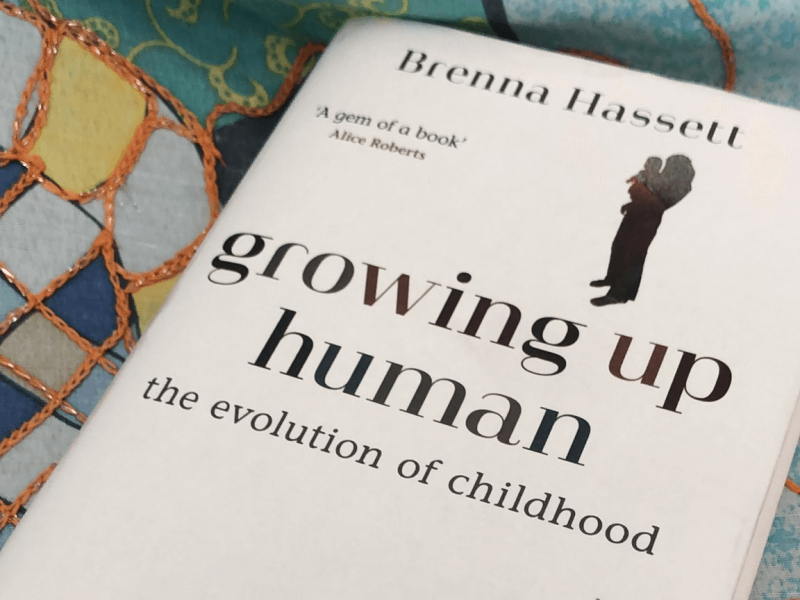
Despite all the advice books written for parents about infancy and childhood, there have been surprisingly few treatments of childhood from an evolutionary perspective. It’s a gap that “Growing Up Human” admirably fills, emphasizing aspects of childhood that are so obvious that they are rarely examined.

Follow the latest news and policy debates on sustainable agriculture, biomedicine, and other ‘disruptive’ innovations. Subscribe to our newsletter.

Human childhood is a conundrum because we take so much longer than other species to grow up. Our slow walk to adulthood imposes real costs: It requires a lot of parental resources, notably time and effort, and over-burdened parents are hard-pressed to reproduce again, which, after all, is the ultimate arbiter of evolutionary success. Moreover, without such investment, our prolonged childhood means a prolonged period of vulnerability. This increases the risk that offspring might die before themselves reproducing. So, there darned well better be some payoffs to our extended childhood.

Sure enough, there are. Highest on the list is social learning. As [author Brenna] Hassett emphasizes, learning to live in the world means learning to live with other creatures, and she surveys how various animals do so. Our species, though endowed with some instinctive inclinations for getting along with others, requires an immense amount of social education.

Ms. Hassett offers a tour of mating, pregnancy, birth, lactation, weaning, toilet training and physical growth—especially bones and teeth. She explores the various stages of toddlerhood, early childhood and adolescence.


This is an excerpt. Read the original post here

Related Articles

Infographic: Global regulatory and health research agencies on whether glyphosate causes cancer

Infographic: Global regulatory and health research agencies on whether glyphosate causes cancer

Does glyphosate—the world's most heavily-used herbicide—pose serious harm to humans? Is it carcinogenic? Those issues are of both legal and ...

Most Popular

ChatGPT-Image-Mar-10-2026-01_39_01-PM
Viewpoint—“Miracle molecule” debunked: Why acemannan supplements don’t work
ChatGPT-Image-Sep-13-2026-10_24_17-AM
Bayer urges court to approve $7.25 billion Monsanto Roundup settlement that could limit its future liabilities
Screenshot-2026-09-10-at-11.50.46-AM
Did COVID vaccines kill 2,500 service members? RFK Jr. hires an investigator who compares vaccine promoters to Nazi doctors
ChatGPT-Image-Sep-15-2026-06_05_13-PM
CRISPR fine-tuning unlocks vitamin C-rich potatoes without yield loss
Screenshot-2026-09-10-at-12.20.19-PM
'Jet fuel didn't melt the steel': 9/11 conspiracy theories debunked
ChatGPT-Image-Aug-28-2026-03_33_46-PM
Viewpoint: Bad science—Five bogus Trump administration claims about vaccines and autism
ChatGPT-Image-Sep-15-2026-05_59_18-PM
RFK Jr. spent two years distancing himself from Children’s Health Defense. Now he’s keynoting its anti-vaccine DC conference.
Screenshot-2026-09-11-at-2.26.23-PM
Newly approved GMO chestnut trees planted across from the White House are stirring debate
ChatGPT-Image-Sep-2-2026-10_30_14-PM
Zero: That is the official American measles death toll for 2026. Here is what RFK Jr.’s CDC leaves out.
Screenshot-2026-09-14-at-10.52.30-AM
AI is being used in dangerous bioscience experiments
ChatGPT-Image-Sep-14-2026-11_36_25-AM
How the reckless AI race among Anthropic, OpenAI and China spawned today’s safety crisis
screenshot at  am
‘Glyphosate is not carcinogenic’: Independent EU chemical oversight agency reaffirms—for the 3rd time in 9 years—that the herbicide is safe-as-used
glp menu logo outlined

Get news on human & agricultural genetics and biotechnology delivered to your inbox.