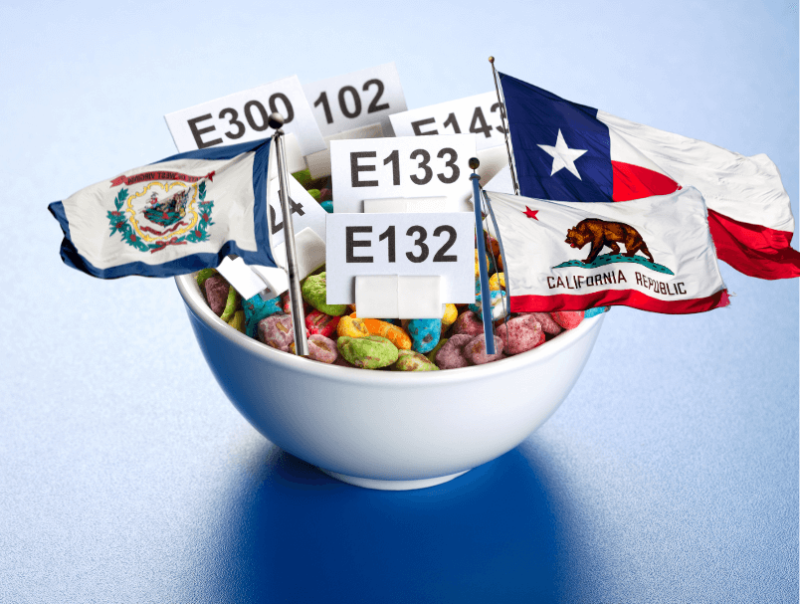
A coalition of major food companies and industry associations launched Americans for Ingredient Transparency (AFIT), aimed at stopping the growing trend of state-level bans on food additives. The group, backed by companies like Nestlé, PepsiCo, and Kraft Heinz, wants Congress to create unified federal standards rather than allowing each state to set its own rules on food ingredients.
Consumer advocacy groups immediately condemned the effort, with the Center for Science in the Public Interest and Consumer Reports framing it as an industry attempt to eliminate state protections for consumers. But after reviewing the proposals and discussing the implications with colleagues (including Dr. Carrie McMahon, a food regulatory scientist with decades of experience), I’m finding myself with mixed feelings about this fight – and concerned that reflexive opposition based on who’s proposing what is preventing sensible policy solutions.
The reality is more nuanced than either side admits. A state-by-state regulatory patchwork poses genuine problems for consumers, businesses, and public health communication, while the current federal oversight system clearly needs reform. The tragedy is that both industry and consumer groups actually agree on many core issues – but political tribalism is preventing progress. Let’s discuss…Subscribe
The Regulatory Patchwork Problem: When 50 States Go 50 Different Ways
The emergence of AFIT highlights a legitimate concern that transcends partisan politics: the nightmare scenario of 50 different state regulatory frameworks for food additives. This isn’t just a business concern – it’s a fundamental challenge to how we communicate food safety to consumers and maintain a functioning national food system.
A state-by-state patchwork creates multiple problems:
For consumers: How do you make informed decisions when the same product might be “safe” in Texas but require warning labels in Louisiana? This regulatory fragmentation undermines consumer confidence rather than enhances it. We already struggle to communicate nuanced food safety information effectively – imagine trying to explain why an ingredient is banned in West Virginia but approved in neighboring Maryland.
For businesses: Companies face the impossible task of either creating 50 different product formulations or defaulting to the most restrictive state’s standards – essentially allowing California or West Virginia to set national policy by default. Moreover, for each formulation, a different food label would be needed. Each formulation and formulation-specific label would incur manufacturing costs and raise the potential for errors, whether applying the wrong label or shipping to the ‘wrong’ state. According to one source, labeling errors are already the leading cause of food recalls in 2024, with an estimated cost of $1.9 billion in direct recall expenses. This isn’t just about large corporations; small and medium food businesses would be devastated by compliance costs. And who will have to bear the burden of those costs? Consumers.
For trade: International trade partners already struggle with U.S. regulatory complexity. Adding 50 different state frameworks can make American food products less competitive globally and complicate imports that supply our food system. If state bans on food and color additives are not science-based, these will open the US up to trade disputes under international agreements, such as the World Trade Organization Agreement on Sanitary and Phytosanitary Measures. And if the US fails to adhere to these agreements when determining the permissibility of imported food, we’ll undermine our ability to hold other nations to the same when accepting our exports.
The Historical Precedent: Why Federal Food Regulation Exists
This situation eerily parallels the conditions that led to the Pure Food and Drug Act of 1906. Back then, states had wildly different standards for food safety and labeling, creating chaos in interstate commerce and consumer confusion. Moreover, consumers faced rampant deception – milk diluted with formaldehyde, “embalmed beef,” and other adulterants were used with no disclosure. (This is particularly relevant to the current situation: the argument then and now is that consumers have the right to know what is in their food.) The federal framework for regulating foods and drugs emerged specifically to solve this problem – to create uniform, science-based standards that protected consumers, along with labeling standards that helped consumers to make informed food purchases while enabling a functional national market.
To see this framework in action, we need to look back no further than about a decade to a time when individual states were debating GMO food label laws. By 2013, at least 25 states had considered legislation to require GMO labels. With the stage set for disruption of interstate commerce, Congress passed the National Bioengineered Food Disclosure Act in 2016, requiring a national mandatory standard for disclosing foods that are or may be bioengineered, preempting state laws.
Constitutional side-bar: Under the 10th Amendment, “powers not delegated to the United States by the Constitution, nor prohibited by it to the States, are reserved to the States respectively, or to the people.” This delegation of power to state governments allows specific local needs to be met through a state’s own laws. However, to ensure we have a unified national economy, the Commerce Clause of the Constitution gives Congress the legislative power to regulate commerce between states. Federal law preemption of state law was established through the inclusion of the Supremacy Clause.
We’re essentially relitigating a debate our great-great-grandparents already settled: interstate commerce requires federal oversight. The alternative is chaos.
The Political Paradox
What’s particularly striking here is the political inversion happening. Industry groups are calling for stronger federal oversight and GRAS reform (changing the regulation of ingredients whose use in food is ‘Generally Recognized as Safe’) – positions traditionally associated with progressive consumer advocacy. Meanwhile, groups like CSPI and Consumer Reports are defending state-level actions that create the exact regulatory fragmentation they would typically oppose.
I discussed this briefly with my friend and nutrition scientist, Dr. Kevin Klatt, and he expressed bewilderment that consumer advocacy groups seem to be aligning with MAHA advocates to reflexively oppose industry proposals – especially when industry is calling for risk-based FDA oversight and GRAS reform, the exact changes food policy advocates have championed for years to strengthen federal oversight to ensure a nationwide safe food supply.
When AFIT proposes “GRAS reform” and “science-based FDA oversight,” these aren’t industry talking points designed to weaken regulations – they’re the same reforms consumer advocates have demanded for decades. But because businesses support it, it’s suddenly suspect. We don’t say this to be industry-friendly – consumer advocacy groups need to be watchdogs to ensure any federal oversight and reform doesn’t get co-opted by industry to weaken standards. The potential for that influence doesn’t obviate the severe concerns with going to state-level regulations and the consequences that follow.
Performance Politics Meet Public Health
The RFK Jr./MAHA dimension adds another layer of complexity. The movement’s approach – relying on voluntary corporate commitments rather than enforceable regulations – creates its own problems. As CSPI correctly notes, voluntary commitments can be reversed, narrowly interpreted, or simply ignored when public attention moves elsewhere.
But the state-level bans inspired by MAHA aren’t necessarily more scientific. When states ban ingredients based on political momentum rather than rigorous risk assessment, we get performative regulation that may not actually improve public health. Case in point: In 2024, several states, including Indiana and Connecticut, proposed bills to ban high fructose corn syrup, which would presumably be replaced with table sugar. This is a perfect example of political theater over science, since we know this swap provides no health benefit; they’re nutritionally equivalent sugars.
 Leaked European Commission document recommends softening EU regulations of gene edited crops and other products of New Genomic Techniques: “The current EU GMO regulation is not fit for purpose”
 Viewpoint: Why Washington should sharply increase funding for intensive agricultural to address climate change, spur sustainability



Similarly, the synthetic colors that are the subject of so much debate are considered safe for most people according to numerous expert bodies. Current labeling requirements already mandate that synthetic colors be identified by name in ingredient lists, allowing consumers who want to avoid them to make that choice – a system that respects both safety science and consumer autonomy.
Do we really want state officials, thirsty for votes and performative action, to undertake ingredient regulation? Recent MAHA targets aren’t science or risk-based – they’re selected for maximum political impact.
The Slippery Slope Concern
We’ve seen food trends spill over to other areas – tropes like ‘if you can’t pronounce it, don’t eat it’ were readily weaponized during the COVID pandemic to question vaccine safety. The advocates pushing for state-by-state approaches won’t stop at food dyes. Once we abandon science-based, centralized risk assessment in favor of state-level political decisions, where does it stop? Tomorrow, it could be medicines, cosmetics, or any other product that becomes politically expedient to target. We’re watching the same playbook that transformed food safety into a political football being applied across public health.
Finding Common Ground
The tragedy here is that there’s actually significant consensus:
- Everyone agrees GRAS needs reform.
- Everyone wants transparent, science-based safety assessments.
- Everyone recognizes the current system has problems.
- Everyone wants to protect consumer health.
But instead of building on this consensus, we’re watching groups retreat to their corners based on who’s on which “team” rather than what policies would actually improve food safety.
(It’s worth noting that the ingredients being targeted by state bans – synthetic colors and additives – are FDA-approved substances, not part of the self-GRAS process that’s the actual subject of reform efforts. Conflating these issues only adds to consumer confusion.)
The practical reality is that federal regulation of interstate commerce exists for good reasons – reasons that date back over a century. A unified, science-based federal framework with real enforcement mechanisms (not voluntary commitments) would serve everyone better than either the status quo or a chaotic patchwork of state laws.
Industry’s support for federal oversight isn’t inherently suspicious – it’s rational. Companies need predictable, science-based regulations to operate effectively. And consumer groups’ skepticism of voluntary measures is completely justified. But opposing sensible reforms because of who proposes them serves no one – not consumers, not businesses, and certainly not public health.
Moving Forward
The question isn’t whether we want federal or state regulation – it’s whether we want coherent, science-based food safety policy or a political free-for-all where regulatory decisions are made based on which way the political winds are blowing in each state capital.
A state-by-state regulatory patchwork will be terrible for consumers trying to understand what’s safe, terrible for businesses trying to make and distribute food, and terrible for U.S. global trade. It’s a complex issue with roots going back to the forces that drove the passage of the Pure Food and Drug Act in 1906, and we should learn from that history rather than repeat it.
What we need is real reform, stronger FDA oversight with adequate funding and enforcement powers, and science-based risk assessment – not 50 different politically-driven regulatory schemes. That some of these reforms are being proposed by industry doesn’t make them wrong. Sometimes good policy is good policy, regardless of who’s proposing it.
Jess Steier is a public health scientist dedicated to bridging the gap between complex scientific evidence and public understanding. Jess is the Founder of Unbiased Science, CEO of Vital Statistics Consulting, and Executive Director of The Science Literacy Lab (a 501c3 non-profit organization).
Elana Pearl BenJoseph is a physician with a focus on pediatrics, health communication, and public health. Find Elana on LinkedIn
Carrie McMahon is a retired FDA scientist with 23 years of experience in the safety and regulatory evaluation of food ingredients, including food from GMOs. Find Carrie on LinkedIn
A version of this article was originally posted at Unbiased Science and has been reposted here with permission. Any reposting should credit the original author and provide links to both the GLP and the original article. Find Unbiased Science on X @unbiasedscipod