Calyxt’s gene-edited high-fiber wheat won’t be regulated as a GMO, USDA confirms

whole grain breads jpg x q

Calyxt, Inc., a consumer-centric, food- and agriculture-focused company, announced that the Company’s high fiber wheat product has been declared a non-regulated article under the “Am I Regulated?” process by Biotechnology Regulatory Services of the Animal and Plant Health Inspection Service (APHIS), an agency of the United States Department of Agriculture (USDA). This is Calyxt’s first consumer-centric wheat product and second wheat product (following Calyxt’s powdery mildew resistant wheat, which received non-regulated status by the USDA in February 2016), and seventh product overall, to be given this designation.

…

Calyxt’s high fiber wheat was developed using the Company’s proprietary gene-editing technology, TALEN, and does not contain any foreign DNA. With this USDA confirmation, Calyxt will now continue its trait validation in small- and large-scale field trials and food application development.

…

“Calyxt’s high fiber wheat flour will have up to three times more dietary fiber than standard white flour, with enormous potential to disrupt the multi-billion-dollar industry at large,”[said Manoj Sahoo, Calyxt CCO.]

Calyxt’s high fiber wheat is currently in Phase 1 of the development process and on track for commercialization as early as 2020/2021. This product is now part of a total of seven Calyxt products that have been deemed non-regulated by the USDA, including powdery mildew resistant wheat, high oleic soybean, high oleic / low linolenic soybean, improved quality alfalfa, cold storable potato and reduced browning potato.

Read full, original post: Calyxt’s High Fiber Wheat Deemed Non-Regulated By USDA

Harvard geneticist David Reich NY Times’ op-ed ignites debate over whether ‘races’ exist

race

On Monday morning, I woke up to a tweet from Sam Harris, the bestselling author and popular podcast host, referencing a debate we never quite had over race and IQ.

…

Harris is touting a New York Times op-ed by David Reich arguing that “it is simply no longer possible to ignore average genetic differences among ‘races.’”

…

The background to Harris’s shot at me is that last year, Harris had Charles Murray on his podcast. Murray is a popular conservative intellectual best known for co-writing The Bell Curve, which posited, in a controversial section, a genetic basis for the observed difference between black and white IQs.

Harris’s invitation came in the aftermath of Murray being shouted down, and his academic chaperone assaulted, as he tried to give an invited address on an unrelated topic at Middlebury College…

Harris returns repeatedly to the idea that the controversy over Murray’s race and IQ work is driven by “dishonesty and hypocrisy and moral cowardice” — not a genuine disagreement over the underlying science or its interpretation. As he puts it, “there is virtually no scientific controversy” around Murray’s argument.

 …

Here is my view: Research shows measurable consequences on IQ and a host of other outcomes from the kind of violence and discrimination America inflicted for centuries against African Americans. In a vicious cycle, the consequences of that violence have pushed forward the underlying attitudes that allow discriminatory policies to flourish and justify the racially unequal world we’ve built.

To put this simply: You cannot discuss this topic without discussing its toxic past and the way that shapes our present.

Viewpoint: Sweeping impact of gene editing demands better way to educate the public

Kmiec Research Team x

If the history of public engagement surrounding other recent scientific innovations is a guide, efforts to explain the science behind gene editing will intensify, such as through news stories, at science festivals, in public lectures and in museums. And there will be a rash of small, disconnected workshops involving members of the public that are designed to inform specific policy decisions.

…

Instead of waiting for an outcry about a specific potential application, governments and key stakeholders must design a new kind of engagement.

…

The kind of engagement model I propose would require government support and impetus from 10–15 organizations initially, to include the multitude of actors invested in and concerned about gene editing — perhaps with a single coordinating body.

…

Ultimately, the consortium would have two functions: connecting people to the science and policy debates, and connecting scientists and policymakers to other people.

…

This could involve the consortium engaging on social media, producing videos, communicating with the media or providing information to relevant groups.

…

[T]he model I propose will require significant investment of time and money (in the region of US$700,000 to $1.5 million per year). Yet, as many experiences with genetically modified crops have illustrated, simply trying to convince people that the science is safe, and that they should accept the applications that emerge, can be much more costly.

Read full, original post: Rethink public engagement for gene editing

Which came first, intensive agriculture or complex society?

AgRev

A fundamental question about the precise role of agriculture in early human history remains unanswered.

Did the advent of intensive farming practices encourage people to live around farmland in communities and develop complex social structures?

Or did the drive to live in social groups create spur the development of agricultural practices to feed all those hungry mouths?

Typically, the conventional assumption the development of intensive agriculture paved the way for primitive social groups, such as hunter gatherers, to form permanent communities and develop structured societies.

But a team of scientists from the University of Auckland and the Max Planck Institute for the Science of Human History has released a study which uncovered compelling new evidence.

“The findings suggest that intensification of agriculture and the rise of more hierarchical, socially complex human societies promoted each other, perhaps as a part of a feedback loop that may also have involved population growth,” says lead author and University of Auckland PhD candidate Oliver Sheehan.

The scientists argue that farming and social and cultural factors played an equal part in driving the creation.

Editor’s note: Read full study

Read full, original post: Did farming create complex societies?

Sri Lankan government split on whether to lift ban on glyphosate herbicide

Screen Shot at AM e

The Cabinet [the council of ministers that form the central government of Sri Lanka] is to decide whether the ban on the controversial Glyphosate weedicide should remain, amidst lobbying by ministers for and against the ban. The move comes after a committee of experts recommended to the Government that Glyphosate was not directly linked to Chronic Kidney Disease (CKDU) epidemic, a cabinet minister said.

Agriculture Minister Duminda Dissanayake told the Sunday Times that the committee’s recommendations would be submitted to the Cabinet [the week of March 26-30] to decide whether the Government should lift the ban on Glyphosate.

But, Health Minister Rajitha Senaratne and Parliamentarian Ven Athureliye Ratharana Thera are insisting that the ban should stay.

The Ven Rathana Thera who is strongly campaigning for the use of organic fertiliser said he had met President Maithripala Sirisena who gave him an assurance that the ban would remain at least for one more year.

“The President told me that some groups are calling for the lifting of the ban, but he assured me that the ban will not be lifted at least for a year and we need not worry,” he said.

Read full, original post: Cabinet divided over Glyphosate ban

Woman’s death blamed on bee-sting acupuncture promoted by Gwyneth Paltrow’s Goop

jun abelha pica braco de um paciente na fazenda de abelhas em silang nas filipinas joel magsaysay usa o veneno das abelhas para curar pacientes com doencas com

A 55-year-old Spanish woman has died following repeated exposures to an acupuncture method that uses live, stinging bees instead of traditional needles, according to a recent case report in the Journal of Investigational Allergology and Clinical Immunology.

The painful and dangerous practice—called apipuncture—is generally peddled by nonmedical practitioners and, in recent years, has generated buzz among celebrities, most notably Gwyneth Paltrow and her chic lifestyle brand Goop. Paltrow and other proponents claim that insect venom can relieve a swarm of ailments, including inflammation, arthritis, generalized pain, scarring, and skin issues.

But evidence to back those claims is weak and mixed, and numerous medical studies have tallied serious risks and adverse events, including anaphylaxis, stroke, and death. Perhaps most alarming is that people with no history of allergies to bee venom can become sensitive to it over time. In fact, the more exposure, the greater the risk of developing a sensitivity. And life-threatening reactions appear unpredictably. That seemed to be the case for the Spanish woman.

…

[D]octors there determined that she had suffered a massive stroke from severe anaphylaxis (acute allergic reaction) and slipped into a permanent coma. She died several weeks later from multi-organ failure.

…

“Therefore, the risks of undergoing apitherapy may exceed the presumed benefits, leading us to conclude that this practice is both unsafe and unadvisable,” they conclude.

Read full, original post: Woman dies from bee-sting therapy that Goop, Gwyneth Paltrow promote

Here’s what we really know about transgender genetics—so far

trans
The week started strangely.

On [March 19], the author of a new book on transgender identity emailed me, asking about my research (I don’t have any). She’d read my comments in The Daily Mail about an abstract from a meeting identifying gene variants associated with transgender identity in a handful of people. But the writer, with whom I hadn’t communicated, didn’t name the researcher. So people thought it was me.

Soon, Google Alerts sent me the full version of the article in The Times, by Oliver Moody, and then I recalled having emailed with him. (This is the Times of London; the New York Times rejects anything I send.)

[Editor’s note: Read the GLP’s excerpted story: Identify as straight? Gay? Transgender? That may be deeply influenced by genetics, study shows]

Since then I’ve been quoted in several outlets with whom I never corresponded – such is the nature of echo-chamber journalism these days – and I’ve had requests from people seeking genetic testing for transgender identity. It’s way too soon!

How hype is born

I deduced that Moody had contacted me after reading “Is Transgender Identity Inherited?” at DNA Science from about a year ago, or had heard an NPR interview follow-up. The end of my post states that “a genomewide SNP screen, or even genome sequencing, might one day identify a genetic ‘signature’ for individuals more likely to identify as transgender.”

trans 3 23 18 2In the new abstract, “Understanding the Genetic Basis of Transgender Identity,” presented at the Society for Reproductive Investigation’s annual meeting in San Diego March 6-10, J. Graham Theisen, MD, from the Medical College of Georgia at Augusta University and colleagues described a strategy midway between my suggestions. They sequenced exomes (protein-encoding portions of the genome) of 30 individuals who identify as transgender.

When Moody sent me the abstract last month, I was ready to tear it apart – but I was impressed. Hence my quote, “These are highly reputable folks going about this exactly the right way, searching the genomes of transgender people to highlight which genes they have variants in. It lends legitimacy, if that needs to be added, that transgender is not a choice but a way of being.”

Alas, despite Moody’s emphasis on the preliminary nature of the findings, and a spot-on lede (“Transgender men and women may carry genetic variants that influence their gender identity, a study suggests,”) his article fell victim to hyped editorial packaging.

The headline “Science pinpoints DNA behind gender identity” is absolutely untrue. Worse is the image beneath the headline of a stereotypical bespectacled, lab-coated old white dude pointing seriously to a DNA sequencing gel, with the caption “The DNA of those with gender dysphoria was found to have nine variants that may cause the condition.” Cause? I don’t think so. And the project leader, Dr. Theisen, actually looks like a young Chris Reeve (aka Superman), not the older guy.

Looking for genetic clues in 30 individuals

The researchers sequenced the exomes of 14 female-to-male and 16 male-to-female people identifying as transgender. In the “round-up-the-usual-suspects” approach used for various types of genome-wide studies, the investigators began with variants of a logical group of candidate genes (which regulate steroid metabolism in the brain during development) and are rare (fewer than 1 in 10,000 individuals) in the general population. A database called ExAC compiles gene variant frequencies from many research groups.

Would the selected rare gene variants show up among the participants, and if so, would that trend persist in a much larger group? Then those variants might be associated with some aspects of transgender identity. But it’s a long way from association to correlation to causation. Some comments from readers of the Times piece pointed out the small sample, but conducting a pilot study is how science works. Funding agencies aren’t about to fork over the pounds or dollars for a large-scale investigation without a preliminary look-see.

trans 3 23 18 3

The team whittled down 120,000 genetic variants of possible interest among the participants, then selected 30 variants, representing 20 genes, for further investigation (the exact figures haven’t been analyzed yet). Eleven of the variants changed one amino acid in the encoded protein to another (a missense mutation), and 9 variants were deemed “pathogenic” for neurological development and/or sex steroid metabolism – adding up to the 20 of interest.

“Pathogenic” is genetics jargon for a gene variant that has an effect—it doesn’t mean that transgender identity is a disease. I have a few pathogenic gene variants myself – we all do. Most are recessive and present in only one copy (heterozygous) so are never noticed. The researchers are still re-sequencing the candidate genes for confirmation, but so far only 2 variants are present in two copies (homozygous) in anyone.

The conclusion is clear: “We identified genetic variants in 20 genes that may play a role in transgender identity.” But it is still a powerful statement, for it lends justification to the idea that identifying as transgender is neither a mental illness nor a lifestyle choice – it is a variation on the theme of being human, as we all are in one way or another.

Dr. Theisen cautions, “Our research is still preliminary in nature, and we are a very long way from knowing what (if any) significance our findings have. The DNA of any randomly chosen individual will contain unique variants, and as a result, identifying variants alone is not sufficient to make any claims regarding causation of, or even relation to, a given phenotype. Therefore, we have not yet identified any particular genes or genetic variants that we know to be involved in the development of transgender identity, though that is the eventual goal of our research.”

The bigger picture

I’m not an expert on gender issues by any means, despite my being quoted this week in Gay Times and LGBTQ Nation. But I think and write a lot about genetic information. Would genetic testing for transgender identity do harm or good?

Consider the categories of DNA tests: ancestry, forensics, health, and traits. Ancestry and forensics aren’t relevant, so that leaves health-related genetic tests and traits.

If Dr. Theisen’s team or another validates a panel of gene variants associated with transgender identity in a larger population, a few things could happen.

DNA sequence2a 3 23 18Companies will spring up, like mushrooms after a spring rain, to package and pitch products to consumers. This could happen with more thought to economics than to the potential problems that might arise, such as a parent sending off a spit sample from a young child convinced she is a he or vice versa.

Then, with more research, if the association becomes a correlation or even a cause (such as zeroing in on a particular mutation), might health insurers cover a greater variety of transitioning-related procedures? Again, it’s economics versus consequences. Could expanded insurance coverage medicalize transgender identity, and would that counter the change of “gender identity disorder” to “gender dysphoria” in the 2013 Diagnostic and Statistical Manual of Mental Disorders (DSM-5)? The new designation denotes individuals who are distressed by the mismatch between their gender identity and anatomy, but it keeps others who identify as transgender out from under the psychiatric umbrella.

A better alternative would be for DNA tests for transgender identity to fall into the category of what direct-to-consumer genetic testing company 23andMe lists as, simply, traits. Their offerings are both popular and ridiculously obvious, like eye color, freckles, dimples, cleft chin, unibrow, and hair color, loss, and texture. Findings support what a person already knows from looking in the mirror.

Isn’t the same true of gender identity? Won’t a profile of gene variants only confirm what a person already knows?

I eagerly await publication of the full paper on the work from Dr. Theisen and colleagues.

Ricki Lewis has a PhD in genetics and is a genetics counselor, science writer and author of Human Genetics: The Basics. Follow her at her website or Twitter @rickilewis.

A version of this article was originally published on PLOS Blog’s website as “20 Gene Variants and Transgender Identity: What Does It Mean?“ and has been republished here with permission.

The human cost of the anti-GMO movement: Why one scientist is quitting GE crop research

CROP rectangle large
A few weeks ago, like thousands of other scientists around the globe have done before, I stood up in front of a public audience and “defended” my PhD thesis to a jury of senior scientists.

The PhD defense is probably the single-most significant milestone in a career in science. It’s part examination and part ritual – PhD defenses in the Netherlands, for instance, feature a robed jury and a master of ceremonies with a ceremonial mace. In my university in Switzerland, tradition dictates that PhD students get whimsical “hats” made by fellow researchers which are donned just as the results (hopefully a pass) are announced. My hat featured (among several digs at my Twitter fixation) references to CRISPR technology and the several genetically-modified plants I worked on for my PhD.

You see, for the last four years I’ve been embedded in a Swiss research group that specializes in creating genetically modified organisms, or GMOs (scientists prefer to use the terms genetic engineered organisms or transgenics rather than GMO). And no, we are not funded by Monsanto, and our GMOs are largely patent-free.

massive logoNevertheless, my time in GMO research creating virus-resistant plants has meant dealing with the overwhelming negative responses the topic evokes in so many people. These range from daily conversations halting into awkward silence when the subject of my work crops up, to hateful Twitter trolls, and even the occasional fear that public protesters might destroy our research. Little wonder then, that having finished my PhD, I’m part-excited and part-relieved to move to a new lab and work on more fundamental questions in plant biology: how plants are able to control the levels at which their genes are active.

Unfortunately, I am not alone. The first commercially available GMO crops were first developed in the early 1990s in publicly funded labs in Europe and the US. In the years since, as many as a quarter of European universities have shut down their GMO research programs, some due to a loss of funding and others because scientists are leaving the GMO sphere, tired of the backlash and criticism.

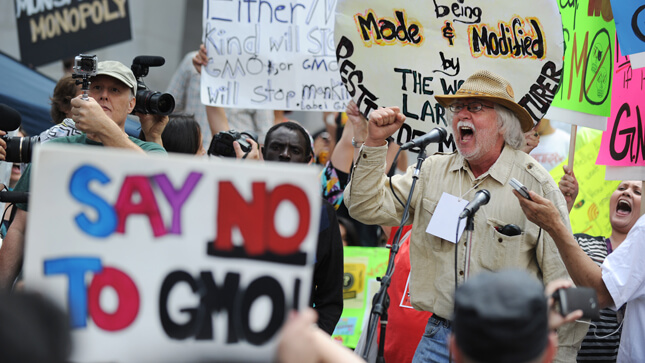
My first experience of the intensity of anti-GMO belief occurred during a public panel discussion about patenting crops and GMOs organized by my colleagues. The panel was interrupted by a protestor shouting about how GM food was responsible for their American friends’ child’s autism. As the panelists tried to explain, there is no causal link between autism and GMOs (or vaccines for that matter) and GMOs have repeatedly been found to be perfectly safe for human consumption. But the protestor readily dismissed these arguments in favor for what can only be described as a fervently held, conspiracist belief. It really showed how futile researchers’ attempts at science communication can be.

gmoprotest
Image credit: ROBYN BECK/AFP/Getty Images

Interactions like these – in person and over social media – happen all the time in discussions about GMOs and vaccines across the globe. There seems to be a constituency of aggrieved activists convinced that some scientists are out to harm their children, and nothing we can say will ever change their minds.

Personally, the thought that no matter what steps I take there’s always going to be people who think my research will harm them is profoundly distressing, and feels really unfair. Unfair because as GMO researchers, we are required to do the type of heavy lifting when it comes to arguing for science that I feel my colleagues in fundamental research never have to. For instance, one of my best friends works on a cure for a rare skin disorder. I’m fairly certain he has never had to deal with questions like, “is your research going to be patented?” or the evergreen accusations of being a shill for Big-Ag.

Apart from the sheer hate spewed by anti-GM activists both in person and online, I also find fault with my fellow scientists. Too often, other scientists ignore the issue of GMOs, or just treat it as a technology that we can do without (we can’t, by the way. Not if we want to feed 9 billion people by 2050). For example, it is an open-secret among the plant science community in Europe that GMO-research proposals have a very low chance of getting public funding. This is despite the fact that several European agencies, scientific societies, and publicly funded studies have deemed GMOs perfectly safe and even a valuable tool to fight world hunger.

One result of this demonization of GMOs, even in academia, is that researchers in a newer field of genetic engineering called synthetic biology now use the “GMO-case” as an example of bad science communication, and try to draw nonscientific boundaries between GMO crop research and their own, possibly in an attempt to escape the GMO tag.

Scientists working with new breeding technologies do the very same thing. In an attempt to avoid the GMO label, they’ve begun to draw up, in my opinion, nonsensical distinctions between different types of genetic engineering products such as cisgenics and GMOs/transgenics (the former are plants which have been engineered to contain “genes” from the same or related species, instead of transgenics, which contain genes from a different species). This is a scientifically meaningless distinction created simply due to a fear of, again, the “GMO” label. With the advent of CRISPR, I have noticed the same phenomenon where scientists market their CRISPR products by proudly saying they’re “non-GMO,” even though they know that GMOs are just fine to consume and grow.

Another part of what makes science communication particularly difficult for GMO-researchers like me is the enormous gulf between anti-GM activists in the rich world and the farmers and consumers in the Global South for whom we conduct our science. As an Indian scientist working in Switzerland, I see this all the time at work. How am I supposed to explain the consequences of abandoning a technology that can help feed millions to Swiss students who enjoy the world’s highest standard of living? I have yet to find the answer, and I don’t think I ever will.

Beyond the issue of public acceptance and, frankly, a caving-in of many in the scientific community to pseudoscientific beliefs, I’m also glad to be moving away from transgenic research because anti-GMO activism over the last couple of decades has made a career in GMO research a risky proposition. The lab where I conducted my thesis research has a storied history in GMO science. It was in this Swiss lab (and with collaborators across the border in Germany) that Golden Rice was conceived and created. Golden Rice is a vitamin A-fortified rice developed specifically for Asian countries where it has the potential to alleviate the problem of vitamin-A deficiency (the leading cause of preventable blindness in children). The scientist behind the project, Ingo Potrykus, started the research in 1991 and produced the first Golden Rice plants in 1999 – a remarkable achievement that saw him grace the cover ofTime magazine. (Potrykus retired from my university that year.) Almost 20 years later, his creation, a plant variety that has repeatedly passed regulatory safety testing, is still not available to the children who need it most.

greenpeace activity
Image credit: Luis liwanag/Greenpeace

A couple of years ago, Potrykus (then 81), published an article in the journal The Annual Review of Plant Biology called, “From the Concept of Totipotency to Biofortified Cereals” – which unlike the very academic name suggests, is a fascinating autobiography of a “successful” GMO researcher. In the article, Potrykus presents a firsthand account of how the initial excitement of creating rice grains containing vitamin A slowly turned into a story of repeated disappointment. He recounts his joy at being able to present his astonishing findings at his retirement seminar at my university and then the slow deceleration of the project in the face of public opposition. From negative press driven by anti-GMO activists; regulatory blocks which slowed down the adoption of the technology into rice varieties used by Asian farmers; reluctance by public institutions to face down activist opposition; and a lack of funding for various experiments, the 20-year story of Golden Rice is one of continual despair.

Nevertheless, the Golden Rice project (and its more recent successes) has inspired several other European scientists to initiate publicly funded research into GMO-crops for noncommercial gain. Among these are my PhD supervisors, who have staked large portions of their careers on GMO-research.

However, to me, Potrykus’ autobiography reads like a cautionary tale for a young scientist. I just cannot find the kind of unreasonable optimism dosed with a spoonful of fatalism that GMO-research in the current climate of public opinion calls for. Potrykus himself says it best when reflecting on the Golden Rice story: “Although progress is slowly being made, had I known what this pursuit would entail, perhaps I would not have started. Hopefully Golden Rice will reach the needy during my lifetime.”

I have spent four-and-a-half very rewarding years working in the field of GMO research. My research has given me the opportunity to visit smallholder farms in two African countries, to teach a student from the Global South the kind of modern biological techniques that remain a dream for many in her country, and to make discoveries that might help with an important problem in food security in the tropics. As a result, yes, I do feel a measure of guilt at leaving this field of research, and quitting my lab’s quest to engineer better varieties of cassava for African and South Asian farmers halfway through the project.

On balance though, I am, somewhat selfishly, glad to move on to a field of research that does not come with the same public relations challenges and the same degree of relentless suspicion. But you never know – perhaps the developed world may yet give publicly developed GMO technology the chance it deserves at feeding our fellow humans, and I may still return to the fold.

Devang Mehta was a PhD candidate in plant biotechnology at ETH Zurich. Follow him on Twitter @_devangm

This article was originally published at Massive as “Why I’m quitting GMO research” and has been republished here with permission.

Double mastectomy improves prospects for patients with BRCA1 mutation but not BRCA2, study finds

d c b a c c c bf

Women with a mutant gene that increases their risk of breast cancer can increase their life expectancy with a radical double mastectomy, however this depends on which mutation they carry, a study has found.

Patients with a mutation in the gene BRCA1 lowered their risk of dying prematurely by pre-emptively removing both breasts, according to Dutch researchers.

However the same study, which followed 2,700 women with mutations increasing their risk of breast cancer, found those with the related gene (BRCA2) did not further reduce their risk of dying of the disease by having both breasts amputated.

…

”For BRCA1 mutation carriers, bilateral risk-reducing mastectomy not only drastically reduces the risk of developing breast cancer, but, as a consequence, also improves breast cancer-specific survival when compared to surveillance,” said lead researcher Dr Annetee Heemskerk-Gerritsen, from Erasmus University Medical Centre in Rotterdam.

…

Emma Pennery, clinical director at Breast Cancer Care, said it was vital women were talked through all the risks and benefits when considering their options, and these findings could guide decision making.

“Discovering you have a faulty BRCA gene can be extremely distressing – on top of worrying about getting cancer, people are faced with the excruciating decision of whether to have a double-mastectomy. This research will help steer many towards a course that is right for them.

Read full, original post: Double mastectomy lowers risk of breast cancer death for some women with mutant gene, study finds

Philippine anti-GMO groups step up attacks on Golden Rice as governments around the world affirm its safety

gpeacegoldenrice e

A regional coalition of farmers, consumers, and environment activists [in the Philippines] has called on the government to reject “foreign safety stamps” on the genetically-engineered “golden rice,” which might pose risk to public health.

The Stop Golden Rice Network asserted that such stamp of approval from other countries might be a ploy to exploit the nation’s weak regulations and policy loopholes on genetically modified organisms (GMOs) in order to have the golden rice released in the Philippines.

In a statement, the coalition said the recent approval in foreign countries of the genetically-modified crop might soon lead to “start feeding trials among children and pregnant women in Philippines and Bangladesh.”

Health Canada posted its approval decision of GM Vitamin A enhanced “Golden Rice” last March 16, 2018 amid public concerns, according to the group.

The Network said the International Rice Research Institute (IRRI) had also filed application for safety approval and trade clearance of golden rice last 2017 to the United States, Canada, and Australia.

But these decisions, according to the group, are questionable.

Read full, original post: Group warns PH vs ‘golden rice’: It’s not the solution to malnutrition

Viewpoint: House Democrats’ ‘glyphosate-is-dangerous’ report shows liberals can be science deniers too

Screen Shot at AM

The discussions around agricultural technologies, especially herbicides, are nuanced and complex.  So if someone gets the basic information completely wrong, why would you trust them?

Such is the case of a Minority Staff Report prepared for congressional members of the Committee for Science, Space and Technology. That’s right, these are the same folks that extol the realities of anthropogenic climate change, now “preparing” a document that has activist fingerprints all over it.

[Editor’s note: See the report here]

It is a lot of the same-old same-old conspiracy nonsense– that herbicide science is a corporate scam where regulators are paid dupes and all of the scientists in the world are corporate liars. The scientists that make D.O.A. claims that are not supported by good science are not described as inept or soft, instead they are heroes, slienced by a well-organized corporate machine.

…

Ironically the whole document is activist spin, and the only scientists silenced are the ones they never bothered to interview– actual scientists that know stuff. The whole thing is embarassing, and shows how anti-farming activists attempt to influence policy with fabrications and distortions– the exact tactics they claim of others. It also shows that science denial runs on both sides of the aisle.

Read full, original post: Science Denial, Glyphosate, and Democrats

Building an Alzheimer’s early warning system through artificial intelligence

ai
[A flat white box attached to the wall] knows when [David Graham] gets out of bed, gets dressed, walks to his window, or goes to the bathroom. It can tell if he’s sleeping or has fallen. It does this by using low-power wireless signals to map his gait speed, sleep patterns, location, and even breathing pattern. All that information gets uploaded to the cloud, where machine-learning algorithms find patterns in the thousands of movements he makes every day.

The rectangular boxes are part of an experiment to help researchers track and understand the symptoms of Alzheimer’s.

…

Currently, there’s no easy way to diagnose Alzheimer’s. No single test exists, and brain scans alone can’t determine whether someone has the disease. Instead, physicians have to look at a variety of factors, including a patient’s medical history and observations reported by family members or health-care workers. So machine learning could pick up on patterns that otherwise would easily be missed.

…

Over time, the device creates large readouts of data that show patterns of behavior. The AI is designed to pick out deviations from those patterns that might signify things like agitation, depression, and sleep disturbances.

…

“If you can catch these deviations early, you will be able to anticipate them and help manage them,” [geriatric physiatrist Ipsit] Vahia says.

Read full, original post: AI can spot signs of Alzheimer’s before your family does

What spurred the Cambrian explosion? Evolving animals may have led to more oxygen, not other way around

Ediacaran creatures

Scientists have long sought to determine what caused the Cambrian explosion, and to explain why animal life didn’t take this step at any point about a billion years earlier. The most popular narrative puts oxygen front and center.

…

[M]any researchers argue that this suggests low oxygen availability had been holding greater complexity at bay — that greater amounts of oxygen were needed for energy-demanding processes like movement, predation and the development of novel body plans with intricate morphologies. “It’s a very attractive, intuitive explanation,” said Nicholas Butterfield, a paleobiologist at the University of Cambridge. “And it’s wrong.”

..

According to his theory, changes in environmental conditions weren’t the cause, but rather the consequence, of animals migrating and perturbing their surroundings.

…

In a paper published in the January issue of Geobiology, Butterfield braided fluid dynamics and ecology to present his case for animals driving oxygenation instead of the other way around. First, he argued, if there was enough oxygen to power unicellular eukaryotes 1.6 billion years ago — which was indeed the case — then there would have been enough to run a whole assortment of animals.

…

As for what may have happened millions of years ago during the Cambrian — “Well, at this point the relationship between oxygen and animals is clear,” [geologist Timothy] Lyons said, “but it goes back to the classic chicken-or-the-egg argument.”

Read full, original post: Complex Animals Led to More Oxygen, Says Maverick Theory

CRISPR strawberries? Monsanto-backed gene-editing venture developing sweeter fruit

Strawberry Inflammation

In a move aimed at securing a place in the rapidly-evolving food technology scene, agricultural giant Monsanto has invested $125 million in a fresh gene-editing startup called Pairwise.

The alliance could tee-up Monsanto, long known for its controversial dealings with farmers and its role in popularizing GMOs, to introduce some of the first produce made using the blockbuster gene-editing tool CRISPR. Sweeter strawberries with a longer shelf-life could be among the earliest offerings.

The tool allows scientists to accurately target specific problem areas within the genome of a living thing, opening up the potential to tweak the DNA of everything from row crops like corn and soy to produce like apples and asparagus in order to make the produce taste sweeter, last longer on the shelf, and even tolerate drought or flooding.

Monsanto and Pairwise aim to get some of the first fruits and vegetables made with CRISPR on grocery store shelves within the next five to 10 years, Tom Adams, who previously served as Monsanto’s vice president of global biotechnology but will leave the company to become the CEO of Pairwise, told Business Insider….

If successful, the move could help the company skirt the misinformation that has plagued previous gene editing tools like GMOs.

Read full, original post: A new Monsanto-backed company is on the verge of producing the first fruit made with a blockbuster gene-editing tool that could revolutionize agriculture

Recording and playing back dreams isn’t here yet, but may be on the way

dreams
[W]hat if you could record your dreams, and play them back for analysis, or even share them with friends? Theoretically, experts say, that might one day be possible.

In 2011, researchers from the Gallant Lab at the University of California, Berkeley had participants watch movie trailers, and researchers were then able to reconstruct low-resolution videos of what they were viewing using only their brain activity. They improved on the process and published a follow-up study in 2016. The actual reconstructions were rough patterns rather than high-definition reproductions of the trailers. Still, this computational marvel piqued the curiosity of other scientists who wonder if a similar approach could be used to record dreams.

…

In April 2017, a group of scientists from the University of Wisconsin-Madison identified a “posterior cortical hot zone” in the brain that could indicate whether a person was dreaming (having a subjective experience) or not.

…

In addition to identifying cues from the brain that indicate a dream state, these researchers also found that parts of the brain involved in perception during our waking hours behave the same way during sleep.

…

[M]ost of our inferences about dreams and the role they serve in our lives will be coarse, subjective. These preliminary, yet intriguing, efforts to peel back the veil of hidden movies are a step toward a deeper understanding of dreams.

Read full, original post: Theoretically, Recording Dreams Is Possible…Scientists Are Trying

Agroecologist: Gene-edited animals aren’t the solution to livestock diseases

ehp a g

It is very worrying not only to read about yet another blunder by the industrial farming sector (Pigs in the pink: gene editing is set to revolutionise the farming industry, 17 March) but also that the article didn’t attempt to counterbalance with a different viewpoint. We know that healthy, agroecological, farming systems support healthy animals and plants that are then, by and large, resilient to disease. The solution for a sick animal is not to edit genes, because this does not address the cause of the problem and only makes it worse, as the ill health will only find a different way to express itself. In the meantime we are supporting unhealthy farming systems and their associated diseases, and consuming sick pigs.

This isn’t contributing to health or welfare, or saving money, but it keeps farmers lurching from one disaster to another and keeps them dependent on new technology.

…

The problem is this kind of unsustainable livestock production that emanates from industrialised mindsets.

Editor’s note: Julia Wright is a senior research fellow, agroecological futures, at the Centre for Agroecology, Water and Resilience at Coventry University in the UK

Read full, original post: Gene editing: don’t bet the farm on this pig in a poke

Viewpoint: ‘Race’ may be a social construct, but denying ancestral-based group genetic differences is ‘indefensible’

endometriosis miscarriage ectopic preterm

With the help of [advances in DNA sequencing], we are learning that while race may be a social construct, differences in genetic ancestry that happen to correlate to many of today’s racial constructs are real.

…

I am worried that well-meaning people who deny the possibility of substantial biological differences among human populations are digging themselves into an indefensible position, one that will not survive the onslaught of science. I am also worried that whatever discoveries are made — and we truly have no idea yet what they will be — will be cited as “scientific proof” that racist prejudices and agendas have been correct all along, and that those well-meaning people will not understand the science well enough to push back against these claims.

…

So how should we prepare for the likelihood that in the coming years, genetic studies will show that many traits are influenced by genetic variations, and that these traits will differ on average across human populations? It will be impossible — indeed, anti-scientific, foolish and absurd — to deny those differences.

…

It is important to face whatever science will reveal without prejudging the outcome and with the confidence that we can be mature enough to handle any findings. Arguing that no substantial differences among human populations are possible will only invite the racist misuse of genetics that we wish to avoid.

Editor’s note: David Reich is a professor of genetics at Harvard

Read full, original post: How Genetics Is Changing Our Understanding of ‘Race’

Macular degeneration patients see hope in embryonic stem cell treatment

Doctors have taken a major step towards curing the most common form of blindness in the UK – age-related macular degeneration.

…

The macula is made up of rods and cones that sense light and behind those are a layer of nourishing cells called the retinal pigment epithelium.

When this support layer fails, it causes macular degeneration and blindness.

Doctors have devised a way of building a new retinal pigment epithelium and surgically implanting it into the eye.

The technique, published in Nature Biotechnology, starts with embryonic stem cells. These are a special type of cell that can become any other in the human body.

They are converted into the type of cell that makes up the retinal pigment epithelium and embedded into a scaffold to hold them in place.

The living patch is only one layer of cells thick – about 40 microns – and 6mm long and 4mm wide.

It is then placed underneath the rods and cones in the back of the eye. The operation takes up to two hours.

…

So far the patients, the other is a woman in her early sixties, have maintained improved vision in the treated eye for a year. They went from not being able to read with their affected eye at all, to reading 60 to 80 words per minute. Eight more patients will take part in this clinical trial.

Read full, original post: Macular degeneration: ‘I’ve been given my sight back’