Viewpoint: Consumers with special dietary needs forced to buy overpriced, less nutritious ‘non-GMO’ foods

xFyy CRL SX

Because of a tick-borne disease I contracted last year, I am no longer able to eat beef, pork, or dairy products without getting an allergic reaction. The past few months have been spent searching for alternatives, which often means selecting vegan options that tend to be inferior in taste and nutrients. That is in addition to an overwhelming number of those products carrying the annoying little butterfly logo of the Non-GMO Project.

That logo is virtually inescapable when you have genuine dietary limitations and need to seek out niche foods

….

There is a real need for niche products that don’t give in to the Non-GMO Project label. I’m sure that many companies (General Mills, for example) are looking for ways to play both sides of the fence in an increasingly competitive food market. The likes of Dr. Oz and Food Babe and Zen Honeycutt have sown the seeds of doubt about today’s farmers into the public’s psyche.

…

[W]hen an organization such as the Non-GMO Project sets out to vilify farmers by saying that bioengineered crops “pose a serious threat to farmer sovereignty and to the national food security of any country where they are grown” or falsely that farmers who use these kinds of crops are beholden to “the world’s largest chemical companies,” simply watching the world pass us by is, morally, an option we don’t have.

Read full, original article: When you can’t avoid the Non-GMO Project label

Using brain ‘fingerprints’ to study and refine autism treatment

autism
[T]he National Institutes of Health has been supporting research into the ‘human connectome’— the collection of information pathways in the brain that coordinate sensation, emotion, action and thought.

The goal is to better understand how the 100 billion cells of the brain work together to perform the brain’s many functions. These complex interconnections shed light on the moment-to-moment activity of a typical brain, as well as how this activity can go awry in conditions such as autism.

…

In a 2014 paper, we formalized the phenomenon of a personalized brain signature — the idea that each person’s brain is uniquely wired.

…

[T]he mental processes involved in solving a geometry problem or leading a staff meeting do not enlist identical neural pathways in every person. Much of the variation in activity tends to occur within the brain’s most sophisticated networks, the ones that relate to memory, thinking and decision-making.

…

Our next step is to do fMRI-derived brain fingerprinting in people with autism. From there, we aim to isolate clusters of individuals with autism whose connectotypes share common features.

Ultimately, we hope to classify the various brain-network profiles that are associated with autism. That information will help investigators test which treatments work best for which individuals with the condition. It may also help scientists zero in on the genetic underpinnings of the relevant neural networks.

Read full, original post: Unique brain ‘fingerprints’ may narrow search for autism subtypes

Secret to longer life? Specific genes in worms can increase lifespan by almost 400%

marinewormsm

In a project called MacModel, researchers are using the flatworm Macrostomum lignano, which is normally found living in the tidal sands of the Adriatic Sea, to investigate ageing mechanisms. Previous research observed that the animals had a remarkable ability to regenerate, and that the worms tended to live for longer after repeated amputation, suggesting that something about the regeneration process also rejuvenated them.

Professor Eugene Berezikov, principal investigator for MacModel and a stem cell researcher at the University of Groningen in the Netherlands, and his team, tried to investigate further by severing the worms’ heads to induce regeneration.

…

[B]oth worms that underwent amputations and those that did not tended to live longer than the median 200-day lifespan seen in the previous research. Many of Prof. Berezikov’s worms were still alive after a whopping 740 days.

…

Prof. Berezikov and his colleagues delved into the worm’s genome and now believe they have found a possible explanation for its longevity – several genes that were more active in older worms. These genes, which are also found in humans, are involved in various processes responsible for a cell’s wellbeing.

…

‘This is a very good example of where we started with one thing and ended up with something completely different,’ said Prof. Berezikov. ‘We found something even more remarkable, we think – that the animal is a Methuselah with natural mechanisms to offset ageing.’

Read full, original post: Worms may hold the secret to longer life

Viewpoint: ‘Regenerative agriculture’ could reverse soil degradation and save our farmland along the way

GrowingaRevolution

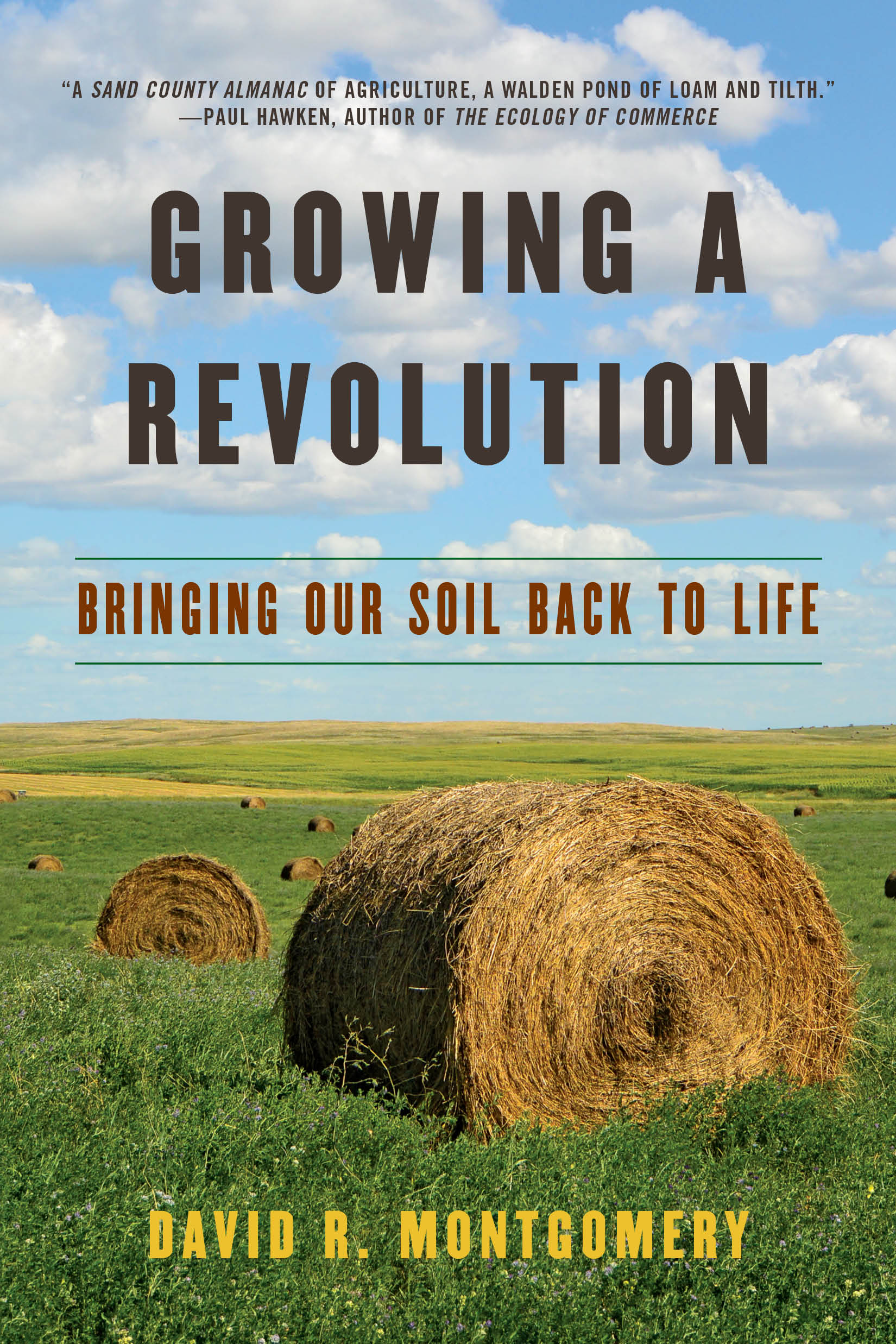
New technologies and genetically modified crops are usually invoked as the key to feeding the world’s growing population. But a widely overlooked opportunity lies in reversing the soil degradation that has already taken something like a third of global farmland out of production. Simple changes in conventional farming practices offer opportunities to [return] health to the soil that grows our food.

…

And while mechanization, agrochemicals, and the Green Revolution transformed agriculture and boosted crop yields in the 20th century…The combination of highly disruptive mechanized tillage and heavy fertilizer use took a toll on soil organic matter and beneficial soil life…So far, America’s farms have lost about half their soil organic matter since colonial days.

…

Rebuilding fertility on the world’s degraded farmland is not only possible; we could do it remarkably fast—and profitably—with something called “regenerative agriculture.” I learned about this as I embarked on a six-month journey to visit small subsistence and large commodity farms while researching my book Growing a Revolution.

…

The secret to success? Giving up on plowing so as to minimize disturbance of the soil; planting cover crops to both protect the ground from erosion and build up soil organic matter; and adopting complex crop rotation pattern to thwart pests and pathogens.

Editor’s note: David R. Montgomery is a professor of geomorphology at the University of Washington. This article discusses his new book: Growing a Revolution: Bringing Our Soil Back to Life.

Read full, original article: To Feed the World Sustainably, Repair the Soil

This 11-year-old girl inherited her genes almost entirely from one parent, her father

Father’s Day Gift Ideas for Kids

An 11-year-old girl from the Czech Republic was born with genes that came almost entirely from her father, instead of half from each parent.

Only about 25 people in the world — all girls — have been reported with this genetic syndrome, and the Czech girl appears to be the first to have inherited it without developing cancer.

…

When she was 9 years old, a genetic test revealed that she had two identical copies of a rare gene. At first, the scientists thought it was extremely bad luck, inheriting the same super-rare gene twice, once from each parent. But as it turned out, the rare gene was, “surprisingly, not in her mother,” wrote the scientific team.

…

[S]he had inherited two copies of her father’s gene.

…

The girl is not quite a twin of her father, but what’s known as a genetic “mosaic,” showing variation in different tissues. Only about 7% of her blood cells, for example, showed any maternal genes. And 74% of the cells in her saliva held only paternal genes.

…

In the girl’s case, instead of the DNA from her father’s sperm and mother’s egg pairing [to make a zygote], two copies of the father’s genes zipped together to create a dad-dad set of 23 chromosomes, the full human genome.

Read full, original post: An 11-Year-Old Got Most Of Her Genes From Her Dad, And Almost None From Her Mom

Viewpoint: German farmers say neonicotinoid ban throws them back into ‘plant protection stone age,’ forces use of ‘dangerous’ pesticides

ls medium

With the ban on the three most effective insecticides [Imidacloprid, Clothianidin and Thiamethoxam] for the protection of beet seeds, beet growers must come up with something different in 2019 to protect the seedling and the growing plantlets against mossbug beetles, virus-transmitting aphids and beet flies.

“The ban throws us back into plant protection stone age,” says Martin Pfeuffer, sugar beet farmer from Ochsenfurt, Franconia, and assistant to the management of the [regional sugar beet farmers associations].

…

The German beet farmers will need to spray up to 120 tons of conventional insecticides such as pyrethroids and carbamates in the future instead of the approximately 20 tons of [the recently banned synthetic chemicals] in order to protect the crops effectively.

…

For the agricultural expert [Horst-Henning] Steinmann, [agronomist at the University of Göttingen] the future lies primarily in alternative, environmentally friendly methods. These include pest-resistant varieties, longer crop rotation, mechanical fieldwork, the use of modern technology such as robots and drones, [and] the…targeted use of…so-called biopesticides that fight harmful organisms without synthetic chemicals.

…

There are probably few farmers who would deny that there is a high potential for saving pesticides… Most of these alternative methods require more labor from the farmers and higher crop losses, which in turn increases production costs and thus the price on the store shelves. The development of virus-resistant varieties, however, takes, according to experience, five to ten years, so in the short term, it’s not a solution.

Editor’s note: This article was originally published in German. This English summary was prepared with Google Translate and lightly edited for clarity.

Read full, original article:  Pestizidverbot – und nun?!

Molecular pharming: Could cancer treatments one day grow on trees?

pills x

Could you imagine a world in which clinical treatments for illnesses such as cancer grew on trees? Professor Julian Ma of St George’s, University of London, UK, is doing just this: growing antibodies – proteins made by the immune system to target pathogens – in transgenic tobacco plants.

This manufacturing technique, called molecular pharming, has been in development for 20 years, but regulatory hurdles have only recently been overcome. Now, molecular pharming facilities worldwide are growing regulatory-standard biopharmaceuticals using robotic automation.

Read full, original article: How Plant Biotechnology Can Give Us Better Food and Medicines

Grain wars: Ethiopia fights to reclaim intellectual property rights of its ancient ‘supergrain’ teff

howtocook

Teff is a grain dating back time immemorial in Ethiopia cuisine. Its flour is used to produce injera, a staple spongy flatbread used as a base to serve vegetables and meat. It would take European and U.S. scientists until the 1990s to study and conclude that teff is a super-grain.

…

Since 2000, teff flour and its food-related products (bread, pancakes, cakes, etc…), according to the European Institute of patents, was “created” by a Dutchman named Jans Roosjen, director of Health and Performance Food International. The company holds exclusive intellectual property rights over the sale of teff and its sub-products in Germany and other European countries, according to Nexo Jornal.

…

The Norwegian research firm, Instituto Fridtjof Nansens, reported in 2012 that “as a result of several circumstances, Ethiopia was left with less possibilities than ever to generate and share in the benefits resulting from the use of genetic resources of teff” due to the Dutch company, which has since gone bankrupt.

…

The Ethiopian Intellectual Property Office, a government cabinet tasked with handling questions related to intellectual property, is not taking the matter lightly.

In May, the cabinet announced a series of legal and diplomatic actions to regain control of the grain and its sub-products so germane to Ethiopian gastronomy. Now, Ethiopia’s attorney-general will bring a case against the company at the International Court of Arbitration.

Read full, original article: Ethiopia vs Europe: The Intellectual Property of an Ancient Grain, Teff

Viewpoint: We should just retire the whole ‘feed the world’ thing when it comes to promoting GMOs

feed
How often do we hear something along the lines of “We won’t be able to feed 10 billion people by 2050 without GMOs”? A friend said something similar to me in relation to a recent piece on the Bt and Roundup Ready traits. I replied, “I disagree a bit with that framing. I think they will be an important set of tools in the toolbox, though for some crops they may well provide the only path forward via disease resistance traits. There are a lot of other tools that will prove equally crucial.” In turn, he asked me if I thought it would be possible to feed more than 10 billion humans without them. My immediate reaction was “Of course.” My next thought was that the whole concept of “feeding the world” is meaningless.

And it’s meaningless in two ways.

What does it mean to feed the world?

The first way that it is meaningless is that the term is undefined, and different people use it to mean different things. So in conversations across political/cultural tribes, it’s functionally meaningless.

Have we met the condition of having fed the world only when there is no hunger? Or does it mean simply producing more than enough calories to feed everyone and then letting the market and governments decide who eats and who doesn’t? Does producing junk food and soda count towards Feeding the World? Does it count when a restaurant serves a plate of “Parmesan cream pasta” topped with meatballs, sausage, pepperoni and bacon the size of your head and clocking in at 2,310 calories — the full days energy requirements for a medium sized adult —with 25-40 percent of that dish ending up in a landfill?

Does it refer to ending hunger? Or does all food production count, no matter how decadent, wasteful, or lacking in wholesome nutrition? Depends on who you ask or who doing the listening.

AND … when we refer to feeding the world, is it implicit that we mean “feeding the world without wrecking the environment beyond repair”?

When people outside of farming and major food companies hear the phrase, they mostly hear “end hunger“. When the agriculture community uses it they are referring to something that is much more about commerce, but essential, necessary commerce — as opposed to the commerce that results in phone apps that involve popping bubbles.

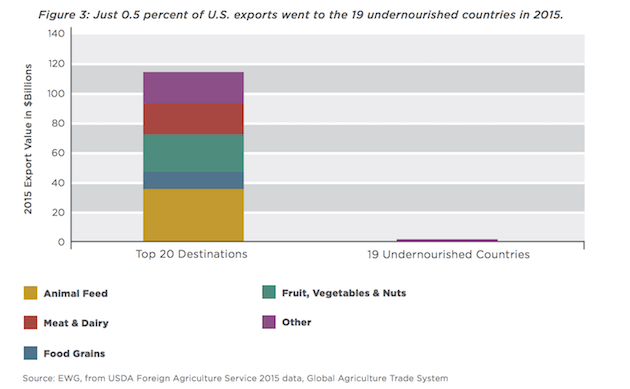
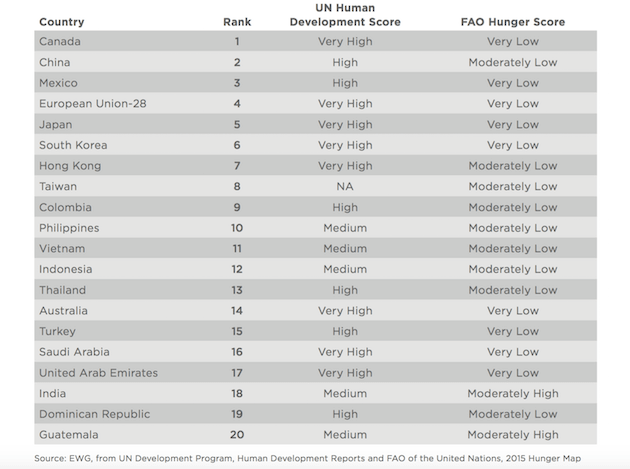
This first became clear to me in a discussion in the Food and Farm Discussion Lab forum regarding claims that GMOs would feed the world. I had posted an article in Mother Jones titled “No, Giant Farms Are Not Feeding the World. They’re Feeding Canada“. The piece went over the data on where US commodity crop exports end up. Only 0.5 percent of US agricultural exports went to the 19 most malnourished countries in 2015.
chart
Meanwhile of the top 20 destinations for US exports only India and Guatemala — ranking at 18 and 20 — rate high on the FAO hunger score.
CHART

My framing for the discussion was this:

I would tend to agree with Tom Philpott here that people should tread a little more lightly in making the “Feeding the poor and hungry” appeal when defending an unpopular or misunderstood aspect of the industrial food system. It generally comes across as propaganda, largely because it is. That said, where I think we would disagree is that I think the poor and hungry parts of the world need more industrial food production, not less.

After people in the group got done making sure everyone understood they didn’t like Mr. Philpott, the perspective of the production ag community was well summarized by David Miller of the Iowa Soybean Association (someone I consider a friend and bottomless fount of wisdom and information on production farming in the US):

Clearly, US (and Canadian) exports are a significant addition to the food supplies of countries that can pay for food — so yes, we are “feeding the world”. Just because a majority of our exports do not go to countries that are not capable of paying for food does not diminish the role trade & exports play in helping a lot of the world in being well nourished. I don’t have the data readily available, but I suspect that both the US and Canada are major suppliers of food aid to the most impoverished peoples of the world.

Granted, creating an abundant global food supply that kept food prices low in countries with at least moderately functioning economies does contribute mightly to reducing hunger and creating stable societies, but the idea that feeding the world was essentially a proposition of pure commerce struck me as less heroic than I’d previously been reading it. I was assured by a number of people that it was never meant to imply anything heroic.

That didn’t strike me as quite right. I’d always heard it in the ag community as part of the reason why farming — hard work, risky, not particularly well understood or appreciated — should be understood as a noble calling above beyond any financial renumeration.

You can follow the discussions here and here.

I don’t think I’m the only one:

“It’s getting lonely,” said Donn Teske, who farms near Wheaton (population 103). “It doesn’t make much sense to keep going, does it?”

Teske is president of the Kansas Farmers Union, and carries the weight of experience in his sigh—the same world-weariness I heard in other farmers’ voices as I traveled the state. For years, he’s watched friends and neighbors urge their children to go work in the city because the land doesn’t offer enough of a future. Now it appears they were right.

“I’ve been fighting this fight my whole life,” he told me. “Everything always works to help the big get bigger. I farm 1,000 acres,” he said, and that’s not big enough any more. Kansas farmers “are really good people and they’ve been fed a line.”

The line I heard again and again on this trip, and throughout my childhood, is “Kansas farmers feed the world.” Both today and in years past, I heard this truism spoken with deep pride, a rationalization for all the hard work and money spent to keep improving yields. For some, though, this rural mantra has started to smack of a con. While farmers have toiled to increase output at every opportunity, they now are seeing their incomes fall in return.

And you can see it all levels of identity and storytelling in ag.

Consider MorganMeyers, a PR and branding firm that specializes in food and ag companies. Their tagline is, “We are a strategic communications firm that builds, protects and promotes great brands that help feed the world.” It’s hard not to take that as the rationalization for why they are proud of their work – they see their clients engaged in something noble.

Mis- and disinformation are distorting science and public policy. Subscribe to our Daily and Weekly Digests for incisive coverage of ‘disruptive’ innovations in AI, agricultural biotechnology, food, chemicals, nuclear energy, vaccines, and other disruptive innovations.

I certainly took it that way when I stumbled across them in a tweet by a new recruit, fresh out of college who was psyched about his new job with a company that helps #feedtheworld! While they have clients that I (as proponent of industrial agriculture) do see as contributing to feeding the world — Monsanto/Seminis (seeds) and Case IH (farm equipment), it seems a stretch to when I see Miller Beer, Phillip Morris, Hershey’s, Pillsbury and McDonald’s on their list of clients. Certainly people eat products made by those companies, but that would seem to me more in the category of “People Need to Eat and Lots of Them Have Money. If We Don’t Do It, Somebody Else Will” more than “We’re Feeding the World!” category. If Miller Beer is feeding the world, then the phrase doesn’t seem to mean much of anything other than “People With Money Will Pay for Food”.

Either way, on this count, an argument about the necessity of genetically engineered crops (or livestock or salmon) that hinges on the idea of feeding the world is likely to suffer from the risk of people talking past each other because they take the idea to mean different things.

So what, exactly, is the challenge at hand?

The population we’re going to need to feed by 2050 is in the 9-11 billion range.

So what can we agree on to reasonably fulfill the condition of feeding the world? How much structural hunger is tolerated? How much disruption is allowed for? What range of spending on food as a percentage of a median income counts as accomplishing the task? How much environmental damage and degradation can be tolerated?

Taking the last first, I’d suggest that success means leaving the environment in better shape than we found it. Maintaining or shrinking the current land use footprint, improving water efficiency so as not to tip major droughts in catastrophes, improving soils and water quality, and first and foremost reducing the greenhouse gas emissions of farming commensurate with what is necessary to bring emissions down to 350 parts per million … avoiding “2 degrees Celsius limit. Take your pick.

On disruption and portion of household income spent on food, I wouldn’t see success in a scenario with greater than current rates of farm closures that result in bankruptcies, suicide, and long term unemployment — or much of any increase in the portion of incomes people of modest means have spend to keep themselves fed.

As to structural hunger, that’s a bit tougher because it is largely a function of income, not food supply. In some locals that rely entirely on subsistence farming it is related to food supply. There isn’t much that improvements in production ag can do to feed people that don’t have money, that’s function of political and economic reform, much more than agricultural reform. But it should be a goal that either subsistence farming has been made obsolete, or that it can be done robustly with far greater stability.

That’s at least a broad thumbnail of what I personally would consider successfully feeding a population of 10 billion people between now and 2050.

Can we do it without GMOs?

We can probably broadly meet most of those conditions without biotech crops and animals, but it will be a lot easier with those tools in the toolbox.

On specifics, I fully expect at least one crop among grapes, banana, coffee, cacao and citrus to require biotech disease resistance to continue production. Does maintaining grapes, banana, coffee, cacao and citrus as commercially viable crops count as feeding the world? I’d say it does, but a motivated person could make the case that we don’t need them, if the price is using “GMOs” to save them. That’s game this devolves into. Do we need GMOs? Not when we could just stop wasting 40% of what we produce (as if it were that easy.)

If we had to, I don’t doubt that we will end up feeding in some way whoever is around. If food becomes scarcer and more expensive, that will throttle population growth, so the two sides of the challenge meet asymptotically.

I have come to see the whole “feeding the world” as a non-issue. It’s a meaningless proposition. Not to go full neo-liberal, but at the most basic level its an issue markets will roughly sort out no matter what happens.

We will “feed the world” no matter the population. The questions is at what environmentally and economically and at what level of equity to the bottom billion?

Marc Brazeau is the GLP’s senior contributing writer focusing on agricultural biotechnology. He also is the editor of Food and Farm Discussion Lab. Follow him on Twitter @eatcookwrite.

Gender, sex and identity: Sports’ ruling bodies struggle to draw lines to ensure fairness for all

unnamed
The case of Caster Semenya is as fascinating as it is multi-faceted. And while the debate can be endless due to the multitude of factors, the position one ends up taking really pivots on just a single point: how gender is defined.

Is the two-time Olympic champion sprinter a woman? Is “she” really a man? Is her biological makeup a combination of both genders? That all depends on, yes, the definition of gender.

[Editor’s note: This is the first in a three-part series on the complicated and fluid issue of gender and sexual identity in elite sports. Read part two and part three.]

To that end, the governing body of global track and field has determined that since its organization exists – at least for the meantime – only in a two-gender world, the bottom line is it must have a way of separating the men’s division from the women’s. And that, it has determined, must be done using one metric: testosterone.

Specifically, it says, a measurement over a certain level requires a runner to compete with men (in certain, shorter races, because those are the ones where testosterone has been shown to have the greatest effect).

Moreover, since the 27-year-old South African has a form of testes, which produces testosterone in levels that exceed those produced by women athletes, the International Association of Athletics Federations has ruled that Semenya, and athletes like her, must either reduce their high level using hormone treatment or compete against men in those races.

And most importantly, since she has a chromosomal makeup that is not purely XX (female) but one that is however-partially XY (male), when you get right down to it, it makes sense for the IAAF to determine that’s where the line separating the two genders belongs. In essence, if you have any “Y” in your chromosomes – as far as racing is concerned – you can’t be considered a female.

Following the IAAF’s decision, which is scheduled to take effect in November, Semenya announced in June that she would challenge the new rule in the Court of Arbitration for Sport, in Switzerland, where international sports cases are adjudicated.

“I just want to run naturally, the way I was born,” Semenya said recently after the rule was announced. “It is not fair that I am told I must change. It is not fair that people question who I am.”

Fairness, an excellent issue.

Yes, she has a firm, defensible belief that she’s not being treated fairly. The two-time 800-meter champion is being told to medically alter her biology, her natural body, if she still wants to compete in that race. But by the same token, is it fair that she has some form of testes – an anatomical advantage, which produces more testosterone – that her competitors do not? No, that’s not fair to the other women competing against Semenya, a constituency that IAAF must represent as well and one far bigger than a single runner.

Semenya doesn’t have a “natural” advantage over her competitors in the same way that taller basketball players can score more easily because they’re closer to the rim than shorter opponents. The reason is that all the players on the court are the same gender. That’s a crucial distinction that the IAAF is making, and if one’s anatomy – i.e., testes – is different, then you’re no longer competing against those of the same gender.

The IAAF could have made its gender decision on the differences and existence/non-existence of external genitalia. Or how a competitor was raised as a child, or a range of other criteria. But in choosing to focus on testosterone – and specifically, any presence of anatomical differences that corrupt a pure XX make-up – it appears perfectly reasonable for the IAAF to draw the gender line where it did.

Erik Lief has produced news and sports programs for CNBC, CBS News, ESPN and the Associated Press.

This article was originally published by the American Council on Science and Health as Deciding Where The ‘Gender Line’ Is In Track & Field, and has been reproduced here with permission.

‘Wake-up call’? CRISPR gene editing may cause ‘genetic havoc’, study suggests

tl webart machinelearn genome interview

From the earliest days of the CRISPR-Cas9 era, scientists have known that the first step in how it edits genomes — snipping DNA — creates an unholy mess: Cellular repairmen frantically try to fix the cuts by throwing random chunks of DNA into the breach and deleting other random bits. Research published on [July 16] suggests that’s only the tip of a Titanic-sized iceberg: CRISPR-Cas9 can cause significantly greater genetic havoc than experts thought, the study concludes, perhaps enough to threaten the health of patients who would one day receive CRISPR-based therapy.

The results come hard on the heels of two studies that identified a related issue: Some CRISPR’d cells might be missing a key anti-cancer mechanism and therefore be able to initiate tumors.

…

The DNA chaos that CRISPR unleashes has been “seriously underestimated,” said geneticist Allan Bradley of England’s Wellcome Sanger Center, who led the study. “This should be a wake-up call.”

Read full, original post: Potential DNA damage from CRISPR has been ‘seriously underestimated,’ study finds

Increasing cases of crop injury could threaten future use of effective herbicide dicamba

dicamba damage

Half way through the year, complaints about the weed killer dicamba are increasing. This could mean efforts to stop the chemical from drifting across property lines aren’t working.

The Office of the Indiana State Chemist  (OISC) received almost 70 complaints about dicamba so far this year. That’s up from roughly 40 complaints at the same time last year — which was already exceptionally high.

purduecomplaints

State Chemist Pesticide Administrator Dave Scott says in 2017 new dicamba products came on the market along with types of dicamba-resistant soybeans. He says farmers with tolerant soybeans were spraying dicamba that would drift and harm non-resistant soybeans.

…

Scott says dicamba can harm unprotected soybeans in a number of ways — anything from stunting the growth of the plant to killing it. He says it’s too early to tell exactly what’s caused the increase. The OISC still needs to investigate many of this year’s complaints.

“I can’t tell you if the additional restrictions have failed, I can’t tell you if these incidences are applicator negligence,” he says.

…

This fall, the EPA will decide if dicamba can be used again next year.

Read full, original article: Despite Efforts To Stop Drift, Dicamba Complaints Up

In lower risk groups, lifestyle, rather than genetics, plays the largest role in diabetes and heart disease, study shows

healthy heart

The data-miners have found a new vein of data, the UK Biobank, which contains genetic information on about 500,000 of their citizens.

…

The question posed was the interaction of lifestyle choices and our genes; in this case looking at cardiovascular disease and diabetes.

…

Polygenic patterns were identified for coronary artery disease, atrial fibrillation (an irregular heartbeat), stroke, high blood pressure and diabetes.

…

The higher genetic risk group had a greater incidence of all of the target diseases. Intermediate risk and low-risk groups showed little difference in the frequency of the targets. So at least for the higher genetic risk profiles, we identified a change in health outcome.

Poor lifestyle increased the risk of an adverse outcome in each of the genetic risk groups. The poorest results were those individuals with the highest risk and worst lifestyle.

…

The findings of those with intermediate genetic risk, and remember that is the majority, you and me, were essentially the same as the low-risk genetic group. The most significant effect was solely due to poor lifestyle.

…

To summarize, the researchers found no interactions between genetic risk profiles and lifestyle; the role of genes, at least based upon our current knowledge of genetic risk made little contribution to health outcomes for cardiovascular disease and diabetes. The fault does not appear to lie in our genes but our choices.

Read full, original post: Genetics Or Lifestyle – Where Is The Cause Of Disease?

Viewpoint: Once fierce opponents of GMOs, Australian Greens may be softening their hard-line stance

gmo aus

A former radical environmental activist who made a stunning reversal on genetically-modified crops believes Australian farmers need access to the technology to help feed the world.

British writer Mark Lynas spent the 1990s railing against genetically-modified organisms (GMOs), including wrecking GM crops and attempting to steal the famously-cloned Dolly the Sheep.

But in 2013 he was ostracised from the movement he helped create after a shock “coming-out” speech detailed why no longer opposed GMOs.

…

Mr Lynas is in Australia to promote his latest book explaining his shift, saying he couldn’t defend the scientific consensus on climate change without doing the same on GM crops.

He believes farmers can get help from GM crops to counter the impacts of the changing climate, including higher temperatures, droughts and erratic rainfall.

…

While the Australian Greens maintain a policy calling for a moratorium on the further release of GMOs into the environment, Lynas believes groups like Greenpeace are softening their stance.

Lynas expects this country’s Greens will look for a way to get on “the right side of science” by moderating the party’s position.

Recently elected Liberal state governments in Tasmania and South Australia have promised to review the remaining moratoriums on GMOs in Australia.

Read, full original article: Anti-GM crop tide turning in Australia

Viewpoint: Republicans signal support for Obama-era global agricultural aid bill that could usher in higher tech African Green Revolution

maxresdefault

The Global Food Security Act, an Obama-era piece of legislation that marshals foreign aid to speed up agricultural growth and reduce hunger in poor countries, will expire this year if it is not renewed.

Fortunately, it seems to have bipartisan support, as evidenced last month when the Republican-controlled Senate reauthorized the legislation for another five years. It will soon face a vote in the House, and its odds there are relatively high — with 107 cosponsors (including 30 Republicans) already lined up.

But even if the bill passes both houses, it remains to be seen whether President Donald Trump will sign it into law. If the administration’s stance on another very similar Obama-era initiative — the Global Agriculture and Food Security Program, which increases food security by boosting agricultural productivity, predominantly in African countries — is anything to go by, the chances for renewal appear quite low. On the one-year anniversary of the Trump presidency, the Treasury Department declared the US would pull out of that program.

…

Development experts and advocacy groups in the US who are fighting against food insecurity are right to appeal for increased US aid for African agriculture. But given the political climate at home that renders aid highly precarious, they should also encourage African leaders themselves to do the right thing by their poor populations.

Read full, original article: What Trump and African leaders need to know about food security

Don’t expect ‘instantaneous eureka moment’ in search for alien life

RTR M L

From War of the Worlds and Arrival to SETI and Stephen Hawking, both pop culture and scientists feed the expectation that the discovery of extraterrestrial life will be a sudden event. History teaches us the opposite. Even with TESS, we shouldn’t expect a stunning discovery of extraterrestrial life anytime soon. In fact, we shouldn’t expect it at all.

That’s not to say we’ll never find evidence of life, but rather that there’s a long, difficult road between suggestive evidence and established fact.

..

In 1924, new methods for measuring extraterrestrial temperatures and atmospheric compositions suggested temperatures above freezing and atmospheric water vapor on Mars, prompting American physicist William W. Coblentz to suggest that the planet was home to vegetation. Later observation revealed that the detected water vapor rested in Earth’s atmosphere, but only barren surface images taken by 1976’s Viking landers finally refuted the plant hypothesis.

…

Even seemingly revolutionary discoveries—like Copernicus’s recognition that the Earth orbits the sun, or Darwin’s that life evolves through natural selection—were not instantaneous eureka moments. They were key contributions to centuries-long, relatively undramatic processes of observation and explanatory argument. These processes build, step by step, toward answers—answers that only look like discrete “discoveries” through the simplified hindsight of history.

Read full, original post: There Won’t Be a Single Moment When We “Discover” Alien Life

As USDA pushes deregulation, organic food producers invent their own quality standards to protect profits

National Organic Program

Stringent regulations are crucial to maintaining consumer confidence in the organic label that the U.S. Department of Agriculture oversees, according to many producers. They also help manufacturers command premium prices. Even some traditional food giants, including Perdue Farms and General Mills, have made the case for certain new regulations.

…

Deregulation doesn’t make sense for an industry that wants it, said Laura Batcha, executive director of the Organic Trade Association. She warns of “collateral damage” to an industry that has experienced robust growth.

Over the last five years, the organic-food business has grown 10 percent annually, on average, and now accounts for 5.5 percent of food sold in the U.S., the group said. Strong regulations give the organic label strength and differentiates it from other marketing terms, such as “natural,” Batcha said.

…

Representative Chellie Pingree, a Maine Democrat who’s an organic farmer herself, said the administration’s long-term policy for organic isn’t clear.

The last thing you want is “for consumers to have a hint of uncertainty about what they are paying for,” she said. “That’s got to be sacred.”

…

Some organic farmers have become so frustrated by the direction of the government’s organic program that they have come up with their own enhanced standards, called the Real Organic Project.

…

“We’re not trying to undermine the National Organic Program,” said Dave Chapman, a Vermont farmer and executive director of the Real Organic Project. “We are trying to save it.”

Read full, original article: Trump’s USDA Is Killing Rules That Organic Food Makers Want (Paywall after 10 free articles)

Why you may need a second, or even third, opinion on your genetic test results

Lynch Syndrome Knowing Your Cancer Risk Could Save Your Life x
[Radiology resident Joshua Clayton] sent a sample of his saliva to 23andMe, the genetic testing company.

His report was pretty mundane — no new revelations. But then he sent the profile created by 23andMe to a separate company called Promethease, which promises to do a more in-depth analysis for genetic mutations that cause disease.

The news was not good. Dr. Clayton got back a report with a sinister red box at the top saying he had a mutation linked to Lynch syndrome, a frightening genetic disorder that leads to potentially deadly cancers at an early age.

…

After two weeks of panic and yet another genetic test at a company with expertise in medical diagnostics, he learned the red box result was wrong. He simply didn’t have the mutation.

…

In one small study, Ambry Genetics — a lab certified to do medical testing — looked at 49 samples sent in by physicians whose patients had been told that they had disease-causing mutations by third-party interpreters.

Ambry found that 40 percent were wrong. In addition, some genetic variations classified by second companies as threatening actually were benign.

…

Greg Lennon, a co-founder of Promethease, said that the company’s reports include a disclaimer saying the data are “not intended for medical or health purposes.” Customers are warned to seek out “an independent, clinically validated test.”

Read full, original post: The Online Gene Test Finds a Dangerous Mutation. It May Well Be Wrong.

Scientists find ‘glimmer of hope’ in early HIV vaccine trial

file yx rp p o j wq

There may be a glimmer of hope in the fight to protect people from HIV-1, the most widespread type of the virus and the one that causes the most disease globally.

A new vaccine appears to be safe and induced an immune response in humans and rhesus monkeys in an early stage trial, according to new research published [July 6] in the journal The Lancet.

That means it’s safe enough to go into the next phase of testing, which involves a larger number of humans. It’s one of only five experimental HIV-1 vaccine concepts that have gotten this far.

…

In addition to being well-tolerated by all the test subjects and inducing an immune response against HIV in humans, the vaccine provided 67% protection against infection from the simian-human immunodeficiency virus in the rhesus monkeys.

…

Researchers caution that the results of the early trial do not mean a viable vaccine. The ability to induce HIV-specific immune responses does not necessarily mean the vaccine will protect humans from HIV infection.

…

“Despite all the advances we have had with HIV, we need a vaccine. It is critical, and this new vaccine, while there is a long way to go, it is nice to see robust evidence to move on to the next phase of testing,” [said researcher Carlos del Rio].

Read full, original post: Scientists cautiously optimistic about HIV vaccine candidate