The same set of genes that allows seagrasses to grow in saltwater is lying dormant and unused in many of our terrestrial crops such as rice, wheat, and corn. If we could activate these genes, those crops could be grown in brackish water—or even directly in the ocean—becoming a formidable new asset in the global food supply chain. To feed the world in 2050, we’ll need to produce almost 60 percent more food compared to 2010.
Ocean agriculture startup Alora is trying to do exactly that. Using CRISPR tools, they are piloting an effort to grow rice plants on land in salty waters, and eventually move to growing it on floating platforms off the coasts of African and Asian countries.
“I was able to find a particular pattern of eight genes, in things like seagrasses and mangroves, that work together to allow the plant to not only defend itself against the saline environment, but actually use it to its own benefit as a way to power growth,” says Alora’s co-founder Luke Young, a 26-year-old biology graduate of Durham University in the U.K., who started the company three years ago. “We can activate those genes in terrestrial crops in the same pattern as these marine plants, without introducing anything else from any other organism.” One of the main objections to genetically modifying foods like soy beans and corn is the process of introducing genes from one species into another, creating transgenic organisms. By tinkering the plant’s own genome, no foreign DNA is introduced.
Alora is starting with rice, the world’s third most produced agricultural crop (after sugarcane and corn) and the most important staple food for half of Earth’s population. Rice is particularly vulnerable to saltwater intrusion, the invasion of coastal soil by ocean water, which is exacerbated by human activities such as groundwater extraction and the rise in sea levels due to climate change. “Salt does two things to plants,” says Young. “First it draws water out, reducing the plant’s ability to grow and defend itself against the elements; then it slows the plant’s metabolism and impairs its ability to photosynthesize, cutting yield.”
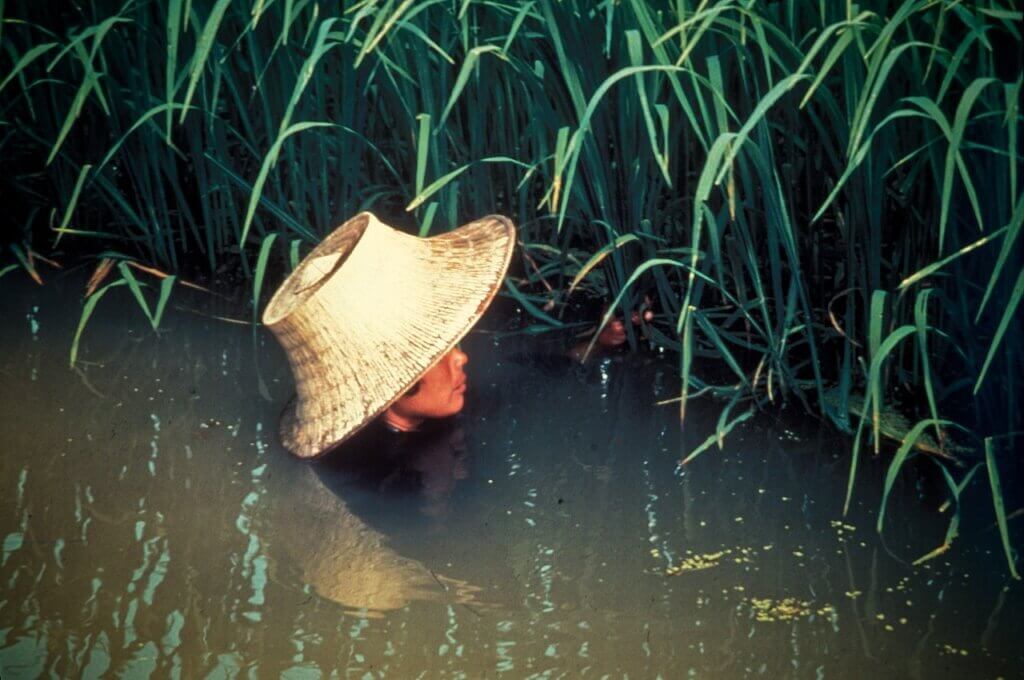
The problem of saltwater intrusion is affecting coastal agriculture everywhere in the world, and is particularly acute in Southeast Asia, where it is already damaging crops. Alora is about to start a trial in the Mekong Delta, a dizzying maze of swamplands, streams, rice paddies, and river towns in between Ho Chi Minh City and Phnom Penh. It’s one of the region’s most prominent agricultural areas and accounts for 50 percent of the rice production in Vietnam—the world’s fifth-largest producer of rice, with exports topping $3.27 billion in 2021. Seawater naturally flows into the delta every year, but recent droughts and manmade structures like dams have reduced the delta’s ability to dilute and wash away the salt through freshwater. The Vietnamese government is now taking steps against saltwater intrusion, like planting crops earlier and installing gates in irrigation channels to keep freshwater in and saltwater out. The problem caused a loss of one million tons of rice in the delta in the 2015–2016 harvesting season alone.
Rice is severely compromised by a salinity level above 3 grams per liter, about a tenth of the saltiness of seawater. Those levels have already been surpassed in some parts of Vietnam, Young says, but he claims Alora’s plants are far more resistant. “At the moment we’ve got plants that are comfortably growing in half the level of oceanic salt water [16 grams per liter],” he says. “We know exactly what to do to get from 16 to 32, which is full oceanic salt level.”
Young says Alora is currently working on a handful of rice varieties from Japan and Vietnam, with more coming: “We have a small seed bank of varieties from pretty much every major rice production area in the world: the U.S., Southeast Asia, Russia, Japan, India, East and West African countries, a couple from Europe as well. All of those will be developed into salt-resistant varieties over the course of the next year and a half.”
 Leaked European Commission document recommends softening EU regulations of gene edited crops and other products of New Genomic Techniques: “The current EU GMO regulation is not fit for purpose”
 Viewpoint: Why Washington should sharply increase funding for intensive agricultural to address climate change, spur sustainability



Alora is part of a new generation of food researchers using CRISPR tools. The first CRISPR tomatoes went on sale last year in Japan and they might soon be followed by browning-resistant mushrooms which have a longer shelf life. Young illustrates the gene-editing process as a form of sped-up evolution: “It’s very much as if you had evolved this crop over 100,000 or 200,000 years, and bred it consistently for salt tolerance,” he says. He believes that CRISPR will enjoy higher consumer acceptance and fewer regulatory hurdles compared to GMOs, however that remains to be seen. Critics of the technique, such as U.K. campaign group GM Freeze, have argued that mistakes can happen and that CRISPR is being described by its supporters with deliberate oversimplification, to make people feel comfortable about it.
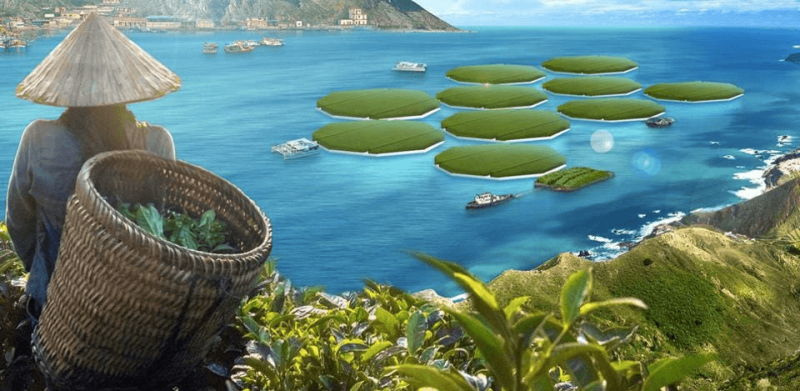
Once positive results from land agriculture trials have been achieved, Alora plans to move on to ocean agriculture. That will involve starting the rice plants for two to three weeks on land and then transferring them to platforms up to 30 feet across, floating on the water in aquatic farms. They can survive as much as 120 miles from the coast—any further and the levels of nutrients in the water drop too much (although Alora is working on a solution that involves developing a bacterium that would feed the plants carbon). Young says a pilot project is planned within the next year or so in Singapore, initially in a lab setting. More countries have expressed interest in hosting trials of both the land and ocean agriculture varieties, he adds, including Kenya, Namibia, South Africa, the Philippines, Indonesia, Malaysia, and Thailand.
Ed Barrett-Lennard, an expert in saline agriculture who is not involved with Alora’s company but is familiar with its research, works with the Australian government and the University of Western Australia. Reached by email, he says the startup’s technology has him “skeptical but hopeful,” and he adds that the most exciting thing is the proof of concept: Making crops salt tolerant would be hugely transformative. “Even only getting part [of] the way there would encourage other scientific groups to take up the baton and move in this direction,” he says. “This issue is not just about rice, but all staple crops.”
Young says he is ready for the challenge. “We’re starting to work on corn and soybeans this week, actually, which will look to be developed over the next year or two.”