


Daily Human Digest

‘People are primed for ET’: Why the discovery of alien life won’t frighten us
On [October 30] 80 years ago, actor Orson Welles announced to audiences in a chilling radio performance that Martians were ...

Viewpoint: What ‘New Atheists’ get wrong about science and religion
New Atheism is a literary movement that sprung up in 2004, led by prominent authors like Sam Harris, Richard Dawkins, ...

FDA approves 23andMe’s direct-to-consumer DNA test assessing patient’s ability to respond to antidepressants
The U.S. Food and Drug Administration (FDA) announced [October 31] that it has approved the marketing of 23andMe’s reports on ...

Ancient spearheads raise new questions about North America’s first inhabitants
[A]rchaeologists have uncovered evidence of a human settlement stretching back as far as 15,500 years: hammer stones and broken knives, ...

Viewpoint: Why the West should worry about losing the gene-editing race
I fear that the West is losing today’s version of the “space race” — this one to use and control gene ...

These 12 guidelines could protect us from threats from artificial intelligence
After months of work, a set of guidelines designed to protect humanity from a range of threats posed by artificial ...

Nothing to fear from hallucinations linked to macular degeneration, study shows
Hallucinations linked to vision loss from macular degeneration are caused by abnormally heightened activity in the visual cortex of the ...

Rarely studied African genes fill in ‘blank canvas’ of early human history
Humankind’s early history in Africa is coming into sharper focus with a new study of 180 genomes from a dozen ...
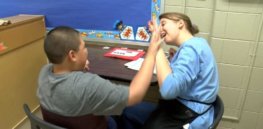
Autism and chemical messenger receptors: Study challenges popular theory
New results from brain scans of adults with autism are at odds with the popular theory that autism involves weak ...

‘Cradles of diversification’: Lagoons played key role in evolution of first vertebrates
Scientists have discovered that shallow, lagoon-like environments were the cradle for vertebrate evolution, giving rise to our distant ancestors. A ...

Small patient pool in Alzheimer’s drug trial casts shadow on positive results
Facing pressing questions about its latest clinical trial in Alzheimer’s disease, Biogen may have sowed further doubt on the future ...

Why things aren’t looking good for cryogenically frozen people
Corpse-freezing hasn’t exactly gone mainstream, but most people are now familiar with the concept: you lay out a ton of ...

‘De-extinction’ engineers dream of reviving the lost passenger pigeon
Once the dominant species in eastern North America, passenger pigeons roamed the forests in giant flocks up to several billions ...

Why it’s probably not the stress that’s shrinking your brain
A new study shows that people with higher levels of the “stress hormone” tend to have smaller brains — but ...

‘In someone else’s shoes’: How virtual reality is altering autism research, treatment
For more than two decades, scientists have experimented with [virtual reality] to set up controlled scenarios to study autistic traits. At the ...

One scientist’s quest for an anti-aging drug
Judith Campisi has been a leading figure in the biology of aging since the early 1990s, when her research on ...

500,000-genome-strong UK Biobank offers ‘wisdom from crowds’
Precision medicine aims to improve treatments for individuals, but to do so it needs information from crowds. Only by tracking ...

Which contraceptive is best for you? Precision medicine could provide the answer
Approximately 900 million women around the world use contraceptives. It’s a shame that, even with the best available evidence and resources, an ...

Chocolate labs plagued by consumer-driven ‘genetic bottleneck’
New research shows that chocolate Labrador retrievers are more likely to experience health problems and die younger compared to their ...

Cross-country road trip gave AI a chance to write a novel—the result was a bit ‘surreal’
Last year, a novelist went on a road trip across the USA. The trip was an attempt to emulate Jack ...

Inside a couple’s quest to pay for an experimental gene therapy to save their children
“We need your help, we really do,” Gary [Landsman] says, his voice breaking. The Landsmans’ two sons—Benny, then 18 months, ...

Boltzmann brain: You may be living in your own simulated reality
The paradox of the Boltzmann Brain can really pull the rug from under you if you follow it to all ...

Human evolutionary theory challenged in global study by diversity of birth canals
The shape of a mother’s birth canal is a tug-of-war between two opposing evolutionary forces: It needs to be wide ...

Why the patent system could help shape the future of gene editing
A crucial part of the arsenal for shaping the future of gene editing is hiding in plain sight: the patent ...

What makes human brain cells so powerful?
Spanish neuroscientist Santiago Ramón y Cajal revolutionized the study of the brain when he observed neurons for the first time ...

Viewpoint: Stop using human intelligence to explain machine learning
It’s common to hear phrases like ‘machine learning’ and ‘artificial intelligence’ and believe that somehow, someone has managed to replicate ...

Beyond the binary: Science suggests there’s more than just male or female
Sex can be much more complicated than it at first seems. According to the simple scenario, the presence or absence ...
