An international consortium involving over 50 institutions has announced an ambitious project to assemble high-quality genome sequences of all 66,000 vertebrate species on Earth, including all mammals, birds, reptiles, amphibians, and fish. With an estimated total cost of $600 million dollars, it’s a project of biblical proportions. It’s called the Vertebrate Genomes Project (VGP).
…
Indeed, there’s more to VGP than just sequencing animal genomes. Like the Human Genome Project, this endeavor will undoubtedly produce breakthroughs in high-resolution sequencing and genome-assembly methods, while resulting in lower costs and fewer errors. The project will also address important questions in biology and disease, and make immediate impacts on the fields of evolution, genomics, and conservation biology. On that last point, a complete catalogue of Earth’s vertebrate species could serve as a safeguard against extinction—both in terms of preventing extinction, and possibly reviving extinct species in the future.
…
Indeed, it wasn’t too long ago that it cost millions of dollars and years of effort to complete the genome of a single animal. New sequencing technologies could soon make it possible to create an entire genome in a single week.
…
The new sequences will be stored and made publically available at the Genome Ark database, a digital open-access library of genomes.
…
Once complete, we’ll have a remarkable repository at our disposal, one even Noah would be proud of.
The world’s largest agribusiness expects the United States Environmental Protection Agency (EPA) to announce a renewal and an updated label for the herbicide dicamba in the coming weeks.
…
Following high drift and volatility complains in 2017, Bayer claims those numbers are lower this season thanks to mandatory training and spraying restrictions.
“We knew that training was key,” says Bob Reiter, new head of Research and Development for the Crop Science division of Bayer. “Helping growers to use the product in the right way makes all the difference in the world.”
…
According to Bayer, by August this season there were 13 complaints per million acres of seed. That compares to 99 per million acres last year.
Not all of agriculture is rallying behind the technology. Beck’s Hybrids has recently taken the position that dicamba should only be allowed as a pre-plant application. It says the controversy has the potential to do more harm than good.
…
While Bayer executives say 2018 should speak for itself in terms results, ultimately the decision will be made [by the EPA] in Washington.
Read full, original article: Bayer Anticipates Dicamba Label Decision Soon
[Our] so-called “fight-or-flight” response served our ancestors well, but its continual activation in our modern-day lives comes with a cost. Scientists are starting to realize stress often exacerbates several diseases, including depression, diabetes, cardiovascular disease, HIV/AIDS and asthma. One theory is hoping to explain the link between stress and such widespread havoc by laying the blame on an unexpected source—the microscopic powerhouses inside each cell.
…
[R]ecent animal studies have shown chronic stress not only leads to mitochondrial damage in brain regions such as the hippocampus, hypothalamus and cortex, it also results in mitochondria releasing their DNA into the cell cytoplasm, and eventually into the blood.
The genetic cast-offs are not just inert cellular waste. “This circulating mitochondrial DNA acts like a hormone,” says [psychobiologist] Martin Picard.
…
These studies are all part of an emerging field of research on mitochondrial DNA, where scientists are recognizing that the tiny organelles have effects across a wide range of diseases. “Mitochondrial DNA is probably the most sensitive thing in your body,” says Douglas Wallace, director of the Center for Mitochondrial and Epigenomic Medicine at The Children’s Hospital of Philadelphia. “If your mitochondria are sensing a problem, then all the rest of you is in trouble, too.”
On [September 17th], the startup, called New Age Meats, let a handful of journalists and prospective investors taste its prototype product — a pork sausage made from many of the same ingredients in the kind of breakfast sausage you’d buy at the store, such as pork muscle and fat, spices, sausage, casing, and vegetable stock.
But unlike other breakfast sausages, this meat was made from animal cells — without killing any animals.
…
New Age Meats cofounders Brian Spears and Andra Necula served three fresh cooked pork-sausage links made using fat and muscle cells generated from a single sample of a live pig named Jessie ….
…
As Spears, a chemical engineer by training, and Necula, a cell biologist, watched, the sausage sizzled in a pan with a little grapeseed oil. Slowly, it began to brown on each side like conventional sausage. The room filled with the smell of breakfast meat. After a few minutes — just before the sausage casing began to blister — we dug into our bite-sized samples.
It tasted like meat. Then again, it is meat.
The texture was distinctly sausage-like. After I’d chewed my bite, I wasn’t sure I would have been able to tell the difference between this pork sausage and any other ….
Suzana Herculano-Houzel spent most of 2003 perfecting a macabre recipe—a formula for brain soup. Sometimes she froze the jiggly tissue in liquid nitrogen, and then she liquefied it in a blender. Other times she soaked it in formaldehyde and then mashed it in detergent, yielding a smooth, pink slurry.
Herculano-Houzel had completed her Ph.D. in neuroscience several years earlier, and in 2002, she had begun working as an assistant professor at the Federal University of Rio de Janeiro in Brazil. She had no real funding, no laboratory of her own—just a few feet of counter space borrowed from a colleague.
“I was interested in questions that could be answered with very little money [and] very little technology,” she recalls. Even so, she had a bold idea. With some effort—and luck—she hoped to accomplish something with her kitchen-blender project that had bedeviled scientists for over a century: to count the number of cells in the brain—not just the human brain, but also the brains of marmosets, macaque monkeys, shrews, giraffes, elephants, and dozens of other mammals.
Her method might have seemed carelessly destructive at first. How could annihilating such a fragile and complex organ provide any useful insights? But 15 years on, the work of Herculano-Houzel and her team has overturned some long-held ideas about the evolution of the human mind. It is helping to reveal the fundamental design principles of brains and the biological basis of intelligence: why some large brains lead to enhanced intelligence while others provide no benefit at all. Her work has unveiled a subtle tweak in brain organization that happened more than 60 million years ago, not long after primates branched off from their rodent-like cousins. It might have been a tiny change—but without it, humans never could have evolved.
The questions that Herculano-Houzel sought to answer go back more than 100 years, to a time when scientists were just starting to study the relationship between brain size and intelligence.
In August 1891, laborers working for the Dutch anatomist Eugène Dubois began excavating trenches along a steep riverbank on the Indonesian island of Java. Dubois hoped to find early hominin remains.
The first Homo erectus fossil ever discovered, found in 1891 in Java, Indonesia, brought new questions about the relationship between brain size and intelligence in the Homo genus. In this photo, the two white squares indicate where the femur (left) and the skullcap (right) of this “Java man” were unearthed. Aleš Hrdlička/Wikimedia Commons
Over the course of 15 months, layers of sandstone and hardened volcanic gravel yielded the petrified bones of elephants and rhinos, and, most importantly, the skullcap, left femur, and two molars of a human-like creature thought to have died nearly a million years before. That specimen, named Pithecanthropus erectus, and later Java man, would eventually come to be known as the first example of Homo erectus.
Dubois made it his mission to infer the intelligence of this early hominin. But he had only three fragments of seemingly relevant information: its estimated brain size, stature, and body weight. Would this be enough?
Zoologists had long noticed that when they compared different species of animals, those with bigger bodies had larger brains. It seemed as if the ratio of brain weight to body weight was governed by a mathematical law. As a start, Dubois set out to identify that law. He gathered the brain and body weights of several dozen animal species (as measured by other scientists), and using these, he calculated the mathematical rate at which brain size expands relative to body size. This exercise seemed to reveal that across all vertebrates, the brain really does expand at a similar rate relative to body size.
Follow the latest news and policy debates on sustainable agriculture, biomedicine, and other ‘disruptive’ innovations. Subscribe to our newsletter.
Dubois reasoned that as body size increases, the brain must expand for reasons of neural housekeeping: Bigger animals should require more neurons just to keep up with the mounting chores of running a larger body. This increase in brain size would add nothing to intelligence, he believed. After all, a cow has a brain at least 200 times larger than a rat, but it doesn’t seem any smarter. But deviations from that mathematical line, Dubois thought, would reflect an animal’s intelligence. Species with bigger-than-predicted brains would be smarter than average, while those with smaller-than-predicted brains would be dumber. Dubois’ calculations suggested that his Java man was indeed a smart cookie, with a relative brain size—and intelligence—that fell somewhere between modern humans and chimpanzees.
Dubois’ formula was later revised by other scientists, but his general approach, which came to be known as “allometric scaling,” persisted. More modern estimates have suggested that the mammalian brain mass increases by an exponent of two-thirds compared to body mass. So a dachshund, weighing roughly 27 times more than a squirrel, should have a brain about 9 times bigger—and in fact, it does. This concept of allometric scaling came to permeate the discussion of how brains relate to intelligence for the next hundred years.
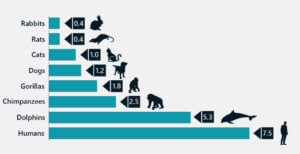
Seeing this uniform relationship between body and brain mass, scientists developed a new measure called encephalization quotient (EQ). EQ is the ratio of a species’ actual brain mass to its predicted brain mass. It became a widely used shorthand for intelligence. As expected, humans led the pack with an EQ of 7.4 to 7.8, followed by other high achievers such as dolphins (about 5), chimpanzees (2.2 to 2.5), and squirrel monkeys (roughly 2.3). Dogs and cats fell in the middle of the pack, with EQs of around 1.0 to 1.2, while rats, rabbits, and oxen brought up the rear, with values of 0.4 to 0.5. This way of thinking about brains and intelligence has been “very, very dominant” for decades, says Evan MacLean, an evolutionary anthropologist at the University of Arizona in Tucson. “It’s sort of a fundamental insight.”
The encephalization quotient measures the ratio of a species’ actual brain mass to its predicted brain mass. Cay Leytham-Powell/SAPIENS
This paradigm still held sway when Herculano-Houzel was going through graduate school in the 1990s. “The intuition behind it made perfect sense,” she says. When she began trying to count neurons in the early 2000s, she imagined herself simply adding a layer of nuance to the conversation. She didn’t necessarily expect to undermine it.
By the early 2000s, scientists had already been counting neurons for decades. It was slow, painstaking work, usually done by cutting brain tissue into ultra-thin prosciutto-like slices and viewing these under a microscope. Researchers typically counted hundreds of cells per slice. Tallying enough neurons to estimate the average number of cells for a single species was time-consuming, and the results were often uncertain. Each nerve cell is branched like a twisty oak tree; its limbs and twigs crisscross with those of other cells, making it hard to know where one cell ends and another begins.
This is the problem that Herculano-Houzel set out to solve. By early 2003, she realized that the best way to count nerve cells in brain tissue might be to eliminate the complexity altogether. It occurred to her that each nerve cell, no matter how branched and contorted, should contain only one nucleus—the little sphere that holds the cell’s DNA. All she had to do was find a way to dissolve the brain tissue while keeping the nuclei intact. Then she could count the nuclei to figure out how many cells there were; it would be as simple as counting checkers on a checkerboard.
After 18 months, she settled on a procedure that involved hardening the brain tissue with formaldehyde and then mashing it gently with detergent—repeatedly pushing a plunger into the glass tube, turning it as she went, until she had a uniform slurry. She diluted the liquid, squeezed a drop of it onto a glass slide, and peered at it through a microscope. A constellation of blue dots lay scattered across her field of view: the cell nuclei, lit up with a DNA-binding dye. By staining the nuclei with a second dye, which binds to specialized nerve proteins, she could count how many of them came from nerve cells—the cells that actually process information in brains—rather than other types of cells found in brain tissue.
Neuroscientist Suzana Herculano-Houzel holds up a tube that contains a liquid suspension of all the cell nuclei that once made up a mouse brain. James Duncan Davidson/Flickr
Herculano-Houzel counted a few hundred nerve cells over the course of 15 minutes; by multiplying this number up to the entire volume of liquid, she was able to calculate a totally new piece of information: An entire rat brain contains about 200 million nerve cells.
She looked at brains from five other rodents, from the 40-gram mouse to the 48-kilogram capybara (the largest rodent in the world, native to Herculano-Houzel’s home country of Brazil). Her results revealed that as brains get larger and heavier from one species of rodent to another, the number of neurons grows more slowly than the mass of the brain itself: A capybara’s brain is 190 times larger than a mouse’s, but it has only 22 times as many neurons.
Then in 2006, Herculano-Houzel got her hands on the brains of six primate species during a visit with Jon Kaas, a brain scientist at Vanderbilt University in Nashville, Tennessee. And this is where things got even more interesting.
What Herculano-Houzel found in these primates was totally different from rodents. “The primate brains had many more neurons than we expected,” she says. “It was right there, staring us in the face.”
Herculano-Houzel saw a clear mathematical trend among these six species that are alive today: As the primate brain expands from one species to another, the number of neurons rises quickly enough to keep pace with the growing brain size. This means that the neurons aren’t ballooning in size and taking up more space, as they do in rodents. Instead, they stay compact. An owl monkey, with a brain twice as large as a marmoset, actually has twice as many neurons—whereas doubling the size of a rodent brain often yields only 20 to 30 percent more neurons. And a macaque monkey, with a brain 11 times larger than a marmoset, has 10 times as many nerve cells.
The assumption that everyone had been making, that different mammalian species’ brains scaled up the same way, “was very obviously wrong,” says Herculano-Houzel. Primate brains were very different from those of rodents.
Herculano-Houzel published these first nonhuman primate results with Kaas and two other co-authors in 2007. And in 2009, she confirmed that this pattern holds true from small-brained primates all the way up to humans: At roughly 1,500 grams, the human brain weighs 190 times as much as a marmoset brain and holds 134 times as many nerve cells—about 86 billion in total. Her subsequent studies, published between 2009 and 2017, suggest that other major mammal groups, such as insectivores and cloven-hoofed artiodactyls (like pigs, antelopes, and giraffes), follow the rodent-like scaling pattern, with neuron numbers increasing much more slowly than brain mass. “There’s a huge difference between primates and non-primates,” says Herculano-Houzel, who moved to Vanderbilt University in 2016.
Her results didn’t reveal the exact process of evolution that led to the modern human brain. After all, she could only count brain cells in species that currently exist—and because they’re alive today, they aren’t human ancestors. But by studying a diversity of brains, from small to big, Herculano-Houzel learned about the design principles of brains. She came to understand that primate and rodent brains faced very different constraints in the way that they could evolve.
People in the anthropological community have responded positively to her work—though with a touch of caution. Robert Barton, an anthropologist who studies brain evolution and behavior at Durham University in the U.K., is convinced that neurons are packed more densely in the brains of primates than they are in those of other mammals. But he’s not yet convinced that the mathematical trend line—the rate at which brains add new neurons as they get bigger from species to species—is any greater in primates compared to other mammals. “I’d like to see more data before I completely believe it,” he says. He points out that Herculano-Houzel has so far studied the brains of about a dozen, out of several hundred known, primate species.
As brain size expanded over the course of primate evolution, the number of neurons in the primate brain increased quickly, leading to big improvements in cognition. In rodents, however, the expansion of brain size led to only small increases in the number of neurons, with little or no improvement in cognitive ability. Catherine Gilman/SAPIENS
But Herculano-Houzel’s results have already dealt a serious blow to conventional wisdom. Scientists who calculated EQs had assumed that they were making apples-to-apples comparisons—that the relationship between brain size and number of neurons was uniform across all mammals. Herculano-Houzel showed that this wasn’t so.
“It’s a brilliant insight,” says MacLean, who himself has spent years studying the intellectual capacities of animals. “It’s pushed the field forward enormously.”
MacLean’s own work has also undermined the universality of EQ. His study, published with a large consortium of co-authors in 2014, compared the brains and cognitive abilities of 36 animal species—including 23 primates and a sprinkling of other mammals, and seven birds. MacLean assessed them on their capacity for impulse control (measured, for example, by an animal’s ability to calmly reach around a transparent barrier to obtain some food, rather than smashing against it in an impulsive grab). Impulse control is an important component of intelligence, which, unlike algebra skills, can be measured across diverse species.
MacLean found that EQ did a poor job of predicting this quality. Chimpanzees and gorillas have mediocre EQs of 1.5 to 2.5, but, says MacLean, “they did super well [in impulse control]. They were at the top.” Squirrel monkeys, meanwhile, scored far worse than chimps and gorillas on self-control, even though this species sports an EQ of 2.3.
Despite a relatively small sampling of animals and a lot of scatter in the data, MacLean found that the best predictor for self-control was absolute brain volume, uncorrected for body size: Chimps and gorillas may have EQs no better than squirrel monkeys, but their brains, in absolute terms, are 15 to 20 times bigger. (Their EQs may be thrown off because they have unusually big bodies, not small brains.) For primates, a bigger brain was a better brain, regardless of the animal’s size. (This was also the case for birds.)
In 2017, Herculano-Houzel published a study in which she looked at the same measurements of impulse control that MacLean had used, but she compared them to a new variable: the number of neurons that each species has in its cerebral cortex—the upper layer of brain tissue, often folded, that performs advanced cognitive functions, such as recognizing objects. Herculano-Houzel found that the number of cortical neurons predicted self-control about as well as absolute brain size had in MacLean’s study—and it also smoothed out a major glitch in his results: Birds may have tiny brains, but Herculano-Houzel found that those brains are densely packed. The Eurasian jay has a brain smaller than a walnut, but it has nearly 530 million neurons in its pallium (the brain structure in birds that is roughly equivalent to the mammalian cortex). Her numbers provided a compelling explanation for why these birds scored better on impulse control than did some primates with brains five times larger.
“The simplest, most important factor that should limit cognitive capacity,” concludes Herculano-Houzel, “is the number of neurons that an animal has in the cortex.”
If the secret to intelligence is simply having more neurons, then one might ask why rodents and other mammals didn’t just evolve bigger brains to accommodate their larger neurons. The reason is that ballooning neuron size presents a staggering problem. It eventually becomes unsustainable. Just consider a hypothetical rodent with the same number of neurons as a human—about 86 billion. That beast would need to drag around a brain weighing 35 kilograms. That’s nearly 25 times bigger than a human brain—about as heavy as nine gallons of water. “It’s biologically implausible,” says MacLean. It “would be insane—you couldn’t walk.”
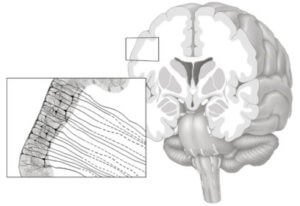
White matter in the brain contains fat-coated axons that make long-distance connections between neurons in gray matter. Frontiers in Psychiatry
This problem of ballooning neuron size was probably one of the major factors that limited brain expansion in most species. The burning question is how primates managed to avoid this problem.
The usual curse of an ever-expanding neuron size may stem from the basic fact that brains function as networks in which individual neurons send signals to one another. As brains get bigger, each nerve cell must stay connected with more and more other neurons. And in bigger brains, those other neurons are located farther and farther away.
“Those are problems that have to be solved when you enlarge brains,” says Kaas, who often collaborates with Herculano-Houzel. He hypothesized that rodents and most other mammals addressed these problems in a simple way: by growing communication wires, called axons, that are longer, causing each neuron to take up more space.
In 2013, Herculano-Houzel found evidence for this theory by looking at white matter in the brains of five rodent and nine primate species. White matter contains much of the brain’s wiring—the fat-coated axons that cortical neurons use to make long-distance connections. Her work showed that the volume of white matter grows much more quickly in rodent species with larger brains than it does in primates. A large rodent called an agouti has eight times as many cortical nerve cells as a mouse, while its white matter takes up an astonishing 77 times as much space. But a capuchin monkey, with eight times as many cortical neurons as a small primate called a galago, has only 11 times as much white matter.
So as rodent brains get bigger, more and more brain volume has to be devoted to the wires that simply transmit information. Those wires don’t just get longer, they also get thicker—which allows signals to travel at a higher speed, to make up for the longer distances they have to cover. As a result, less and less space is available for the nerve cells that do the important work of actually processing information.
The downfall of rodents, in other words, is that their brains don’t adapt well to the problems of being big. They don’t compensate efficiently for the communication bottlenecks that emerge as brains increase in size. This constraint has severely limited their capacity for intelligence.
Primates, on the other hand, do adapt to these challenges. As primate brains become larger from species to species, their blueprints do gradually change—allowing them to circumvent the problem of long-distance communication.
Kaas thinks that primates managed to keep most of their neurons the same size by shifting the burden of long-distance communication onto a small subset of nerve cells. He points to microscopic studies showing that perhaps 1 percent of neurons do expand in big-brained primates: These are the neurons that gather information from huge numbers of nearby cells and send it to other neurons that are far away. Some of the axons that make these long-distance connections also get thicker; this allows time-sensitive information, such as a visual image of a rapidly moving predator, or prey, to reach its destination without delay. But less-urgent information—that is, most of it—is sent through slower, skinnier axons. So in primates, the average thickness of axons doesn’t increase, and less white matter is needed.
This pattern of keeping most connections local, and having only a few cells transmit information long-distance, had huge consequences for primate evolution. It didn’t merely allow primate brains to squeeze in more neurons. Kaas thinks that it also had a more profound effect: It actually changed how the brain does its work. Since most cells communicated only with nearby partners, these groups of neurons became cloistered into local neighborhoods. Neurons in each neighborhood worked on a specific task—and only the end result of that work was transmitted to other areas far away. In other words, the primate brain became more compartmentalized. And as these local areas increased in number, this organizational change allowed primates to evolve more and more cognitive abilities.
All mammal brains are divided into compartments, called “cortical areas,” that each contain a few million neurons. And each cortical area handles a specialized task: The visual system, for example, includes different areas for spotting the simple edges of shapes and for recognizing objects. Rodent brains don’t seem to become more compartmentalized as they get larger, says Kaas. Every rodent from the bite-sized mouse to the Doberman-sized capybara has about the same number of cortical areas—roughly 40. But primate brains are different. Small primates, such as galagos, have around 100 areas; marmosets have about 170, macaques about 270—and humans around 360.
In primates, some of these new areas took on novel social tasks, such as recognizing faces and the emotions of others, and learning written or spoken language—the very skills that helped to drive the evolution of hominin culture, and, arguably, human intelligence. “Primates with large brains have really superior processing,” says Kaas. “But rodents with larger brains may be processing things almost the same as rodents with smaller brains. They haven’t gained much.”
Anthropologists have spent decades studying the important changes in brain structure that happened after the appearance of H. erectus (1.9 million years ago) or the split between hominins and great apes (8 million years ago). But Herculano-Houzel has now added a new piece to this picture by identifying another key moment in the evolution of human intelligence. In a sense, she has unearthed a new origin story for humanity—one that is no less important than the others we already knew.
This story unfolded a little over 60 million years ago, not long after early primates had split off, in quick succession, from three other major groups of mammals that include modern-day rodents, tree shrews, and colugos (a.k.a. “flying lemurs”).
These early primates were smaller than rats. They crept quietly along tree branches at night, grasping twigs with their prehensile fingers and toes as they hunted insects. They didn’t look like much at all, says Herculano-Houzel.
But a subtle tweak had already occurred deep in their little brains—a change in the genes that guide how neurons connect to one another during fetal development. This change probably made little difference at first. But over the long run, it would profoundly separate primates from the rodents and other groups that they had parted ways with. This tiny change would keep nerve cells small, even as brains gradually got bigger and bigger. It would bend the arc of evolution for tens of millions of years to come. Without it, humans never would have walked the earth.
In the wake of the decision by a California federal court concluding that Monsanto’s Roundup, whose active ingredient is glyphosate, likely caused a gardener’s cancer, many countries in Europe may be tempted to reassess the herbicide’s future. In 2017, the EU member states agreed on a five-year renewal period for glyphosate, instead of the originally proposed 15 years. This was only possible since Germany unexpectedly voted in favor of renewal. French President Emmanuel Macron said then that he would ban glyphosate “as soon as alternatives have been found, or within three years at the latest.” It’s not clear how the recent California decision might change the timetable or impact Germany’s position. The net of the situation is that the public is even more confused about the impact of genetically engineered crops even though every major agricultural and health agency in the world has declared them safe.
Two studies published in 2016 and 2017 by the research team that includes Gilles-Eric Séralini, the French scientist notorious for his discredited ‘cancer-twisted rats’ study (see below) and getting renewed attention because of the California trial is further clouding the waters. One study claimed that a GM Roundup-tolerant maize (sprayed or unsprayed with Roundup)was not “substantially equivalent” to its (non-genetically engineered) isogenic line. This was based on some differences in the levels of a limited number of metabolites and proteins between the GM and the control maize line. The authors speculated that these data may explain their previous claims (in 2012, republished in 2014) of negative health effects due to the consumption of this maize. The second article performed similar experiments using rats administered Roundup for two years and claimed observing rat liver dysfunction due to this exposure.
Gilles-Eric Séralini
Scientists rebut claims in same journal
Now Scientific Reports, the source of the original two articles, has published a rebuttal. It cites numerous concerns, from flaws in design to methodology and interpretation. Having read the rebuttal article by Dennis Eriksson, Klaus Ammann, Bruce Chassy and Aakash Chawade, a number of lessons can be learned from their analysis. The central flaw in the papers in their use of omic technologies’. The so-called “omic technologies” are large scale profilings of metabolites, or proteins, or gene activity in a given organism. They are extensively used in research, but are not yet considered as reliable for risk assessment.
Considering the host of problems this research raises, it seems legitimate to question the editorial decision to publish these flawed studies in the first place, and more generally of other articles dealing with “GMO” assessment, which have subsequently been rebutted.
First, it is important for editors to realize that the review of these kinds of papers not only requires cross-disciplinary expertise (i.e. molecular biology, biochemistry, toxicology, agronomy, animal science, veterinary medicine, nutrition, statistics) of larger scope than most other papers, but also that each reviewer be fully aware of specific guidelines for GMO assessment.
Second, because GMOs and pesticides are highly politicalized issues, special care is warranted before accepting publications dealing with their potential risks and impacts. Editors and reviewers should not surrender to politics or political correctness or sensationalism, but need to maintain the highest standards of excellence.
Follow the latest news and policy debates on sustainable agriculture, biomedicine, and other ‘disruptive’ innovations. Subscribe to our newsletter.
Third, the track record of rebutted articles by some authors of the above-mentioned articles should not be ignored. Back in 2007, their claims in an article entitled New Analysis of a Rat Feeding Study with a Genetically Modified MaizeReveals Signs of Hepatorenal Toxicity were rejected by all risk assessment agencies which examined them (see EFSA;BfR:Food Standards Aus/NZ). The French agency AFSSA (now ANSES even stated (translation):
These authors seem to ignore the elementary rule regularly emphasized by the scientific community and international institutions, namely that a significant statistical difference does not necessarily lead to a biological conclusion”. Regarding a 2009 paper by the same team (a comparison of the effects of three GM corn on mammalian health), FNANZ concluded that the authors “have distorted the toxicological significance of their results by placing undue emphasis on the statistical treatment of data, and failing to take other relevant factors into account.
Their high profile 2012 paper claiming “Long term toxicity of a Roundup herbicide and a Roundup-tolerant genetically modified maize” was finally retracted by Food and Chemical Toxicology.This flawed studywas later republished without peer-review by Environmental Sciences Europe allegedly “to give the scientific community guaranteed long-term access to the data in the retracted paper”, according to its editor-in-chief.Thus, no consideration was given to the widespread criticism raised by the original publication. It should also be mentioned that European research programs have re-examined the safety of this maize and that “No toxicologically relevant effects related to the GM maize NK603 or the GM maize NK603 treated with Roundup were observed”.
The flawed publications take us to the concept of “parallel science”. “Parallel science” mimics science, but it is not science since its conclusions precede experimentation. It is “parallel” since it will never join scientific knowledge and consensus, never take criticism into account. Political ecology is repeatedly using this strategy, especially regarding risk assessment of technologies it dislikes.
There are many reasons which can explain the rise of “parallel science”. One obviously being the dark side of the force of the environmental movement and its financial ability (such “parallel science” has repeatedly been financed by “green” lobbies or industries exploiting this “green” ideology for their own profit).
A second reason is linked to the postmodern “deconstruction” of the Enlightenment values in the Western world, which as far as scientific truth is concerned occurred even in the heart of scientific institutions. As stated by Andrew Calcutt, “more than 30 years ago, academics started to discredit ‘truth’ as one of the “grand narratives” which clever people could no longer bring themselves to believe in. Instead of “the truth”, which was to be rejected as naïve and/or repressive, a new intellectual orthodoxy permitted only “truths” – always plural…”
“Plural truths” is actually a synonym of “post-truth”. In 2016, Oxford Dictionaries selected “post-truth” as the ‘Word of the Year’. Theydefine it as “relating to or denoting circumstances in which objective facts are less influential in shaping public opinion than appeals to emotion and personal belief”, with the comment that “in this era of post-truth politics, it’s easy to cherry-pick data and come to whatever conclusion you desire”. The reason for selecting this word was obviously linked to the Brexit referendum in the UK and the presidential election in the USA. However, the Oxford Dictionaries definition of post-truth strikingly also applies to what happened in the scientific and technological fields: activists’ biased risk claims have become dominant in the media and on the internet, and are increasingly present in the scientific literature.
In summary, post-truth is actually consubstantial of the contemporary postmodern ideology. What is true or false has less and less importance. What matters is to bow to political correctness. A so-called democratization process dictates that all opinions should be given equal value, even in science and in deeply complex technological fields! The “epistemological anarchy” of philosopher of science Paul Feyerabend has materialized: “anything goes”!
Marcel Kuntz is a director of research at Centre National de la Recherche Scientifique (CNRS) in the Cell & Plant Physiology Laboratory in Grenoble (France). You can find him on LinkedIn and his research at ResearchGate. Professor Kuntz has no conflicting financial interests
There is a vanilla crisis. The familiar flavor agent is a mixture of chemicals from an orchid- and there’s not enough being produced to satisfy demand. But Dr. Alan Chambers knows that crisis and opportunity travel together. He is currently engaging in breeding of vanilla orchids, hoping to improve yields and product quality. In this episode he covers vanilla’s natural history, its current challenges in cultivation and future outlook.
[Matt Fender] wasn’t worried last December when he clicked a button to dump all the raw data from his 23andMe genetic test into a DNA search engine called Promethease, which sorts through data for gene variants that have received a mention in the medical literature.
…
Mr. Fender’s update included something new: the terms “PSEN1” and “pathogenic.” Mr. Fender is a coder, not a geneticist, but he had spent enough time scrolling through his 23andMe results to know he had gotten some bad news.
The PSEN1 mutation is associated with an early-onset form of Alzheimer’s, and it is often described as “100 percent penetrant,” which he quickly came to understand meant no exceptions — everyone with the variant gets the disease.
…
Meanwhile, he happened to see a holiday special — $69 — for Ancestry’s genetic risk test. He realized he could use it to, in effect, get a second opinion about his PSEN1 variant.
Five weeks later, the results were ready. He downloaded his raw data and returned to Promethease. An hour later, he had a new report. He looked for PSEN1 at the top of the list. It wasn’t there.
…
[Matt] eventually persuaded his doctor to order a clinical test of the PSEN1 gene. It was negative.
…
A person with fewer resources or different inclinations might have lived for years under that cloud, waiting to get sick.
In recent weeks, there has been an uptick in the conversation about the safety of glyphosate, a common weed killer, used in our food production. Below, [MSU Center for Research on Ingredient Safety] experts answer your top five questions about glyphosate ….
…
Can I eat it?
You should never consume concentrated glyphosate! …. Thankfully you will not find concentrated glyphosate in foods available in grocery stores. However, you will find safe levels of glyphosate residue in some foods. ….The EPA has strict guidelines on the amount of glyphosate residue safely allowed in any food.
Calculating Safety
[The EPA] determines the amount of a substance a person can consume before being impacted by adverse health effects. This is called a “reference dose.”
The reference dose is the estimated daily oral exposure to the human population …. that is not likely to cause harmful effects during a lifetime.
The reference dose is expressed in units of milligrams per kilogram of bodyweight per day (mg/kg/day). The EPA reference dose for glyphosate is 1.75 mg/kg/day.
That means if a person weights …. 176 lbs they would be able to consume approximately 140 mg of glyphosate every day with no adverse health effects. For a sense of scale, 1mg/kg is [comparable] to 1 minute in 2 years!
Educational neuromyths include the idea that we learn more effectively when taught via our preferred “learning style”, such as auditory or visual or kinesthetic (hear more about this in our recent podcast); the claim that we use only 10 per cent of our brains; and the idea we can be categorised into left-brain and right-brain learners. Belief in such myths is rife among teachers around the world, according to several surveys published over the last ten years. But does this matter? Are the myths actually harmful to teaching?
…
[Research has shown] that this is merely an assumption: “Put simply,” they write in their new paper in Frontiers in Psychology, “there is no evidence to suggest neuromyths have any impact whatsoever on teacher efficacy or practice”.
…
The University of Melbourne researchers used the same neuromyths questionnaire as used in the earlier surveys, which comprises 32 statements about the brain, 15 of which are myths. Participants must indicate whether each one is correct, incorrect, or say if they don’t know.
For 13 of the 15 neuromyths, including learning styles, the 10 per cent myth and left-brain/right-brain learners, belief was just as high among the award-winning teachers as among the trainees and non-award-winning teachers. “This suggests there is not a clear or obvious relationship between neuromyth acceptance rates and teacher effectiveness,” the researchers said.
Amidst the growing interest in soil health and soil-plant interactions is a fledgling collective of newer concepts and products, from biologicals to nanotechnology to genetic editing …. Somewhere in that group, plant growth regulators (PGRs) — also known as plant hormones — are beginning to test the market, looking for cost-efficient means of pushing yields to new limits.
…
Without the primary five hormones present and functioning in plants, there could be no corn, wheat, soybeans or any other crop. Auxins, gibberellins, cytokinins, ethylene and abscisic acid are vital components in plant production ….
Research into the use of gibberellins is …. trying to determine the optimum timing for supplementary and external applications … Other research is trying to determine its viability as a seed treatment.
For Valent BioSciences scientists Regina Rieckenberg and Peter Petracek, the development of gibberellins for field crops, particularly in corn, is something that will happen. It’s no longer just a “might.” …. The challenge now is to develop practical, cost-effective products.
…
“Most of the time, we can see with the application of [gibberellins] on to the corn, we do get an increase in growth …. Larger plants mean more biomass, and potentially, faster plant establishment, better root and shoot growth …. with potentially better drought tolerance as well.
It’s become a heartbreakingly common sight on the internet: People using crowdfunding sites to raise money for their expensive health care, including cancer treatment. But a new report published [September 12] in the BMJ suggests that desperate people are often using this money to pursue dubious, possibly dangerous treatments from unscrupulous charlatans.
…
According to the analysis, around £8 million ($10.4 million) has been raised for alternative cancer treatments, meaning those not covered by the country’s public health system, since 2012.
The majority of this money was used for treatments provided outside of the UK, via privately funded clinics in countries including the U.S., Mexico, and Thailand. Many of these clinics, as well as the doctors leading them, have been criticized and even officially punished for their medical claims and activities.
In Texas, for example, Polish-trained doctor Stanislaw Burzynski has run the Burzynski Clinic for decades, claiming that his experimental antineoplastons can treat even the most terminal of cancer cases. But antineoplastons have never been approved by the Food and Drug Administration, nor has any randomized clinical trial ever shown them to be effective.
…
According to the report, hundreds of thousands of pounds have been raised for people to visit the Burzynski Clinic.
…
GoFundMe told the BMJ it would be “taking proactive steps” to better inform its users about these clinics.
Following the July European Court of Justice decision to regulate gene-edited crops as GMOs, a debate over the costs and benefits of CRISPR-Cas9 and other gene editing techniques has raged between activists and scientists. As the GLP reported in July:
…. this ruling will force gene-edited plants to go through a regulatory process that typically costs about $35 million, …. meaning only large companies will be able to afford to walk the regulatory gauntlet, effectively pricing out universities, nonprofits and small companies which are poised in other countries to lead the gene editing revolution. That then tees up the new technology for attacks from European advocacy groups which will undoubtedly then claim that gene editing is yet another new product of ‘Big Ag.’
In this discussion hosted by Canadian news outlet TVO, biotech researchers and science communicators attempt to clear up the confusion around gene editing and explain how it could impact our food supply.
U.S. consumers are increasingly scanning labels to check that products do not contain certain ingredients, such as gluten, GMOs, antibiotics, pesticides and allergens, according to Bloomberg. The trend is having a huge impact on how manufacturers source, prepare and package foods and beverages.
Sales of these “free-from” foods are expected to grow 15%, or $1.4 billion, between 2017 and 2022 — with the U.S. as the largest global growth market, according to Euromonitor data.
…
The gluten-free market in particular has been on the rise. Gluten-free labeling claims saw a 24% average annual growth rate between 2013 and 2017. That’s despite the 35% of U.S. consumers who don’t have any particular dietary reason to buy these products, a study from The Hartman Group found.
…
Oats are naturally gluten-free but are often contaminated with it through the fields where they are grown, the trucks in which they are transported, and the facilities where they are milled. General Mills spent five years building a sorting facility to try and ensure that not even a speck of gluten got into the 1 billion pounds of oats it uses each year to make Cheerios ….
…
As long as products sporting free-from labels continue to attract consumers — and potentially premium prices — food and beverage makers are going to continue to be interested in meeting demand and searching for innovative ways to do it.
Hundreds of thousands of girls and women with autism are going undiagnosed due to it being viewed as a “male condition”, according to one of the UK’s leading neuroscientists.
Prof Francesca Happé, director of the Social, Genetic & Developmental Psychiatry Centre at King’s College London, warned that the failure to recognise autism in girls and women was taking a stark toll on their mental health.
“We’ve overlooked autism in women and girls and I think there’s a real gender equality issue here,” she said. “I think we are missing large numbers and misdiagnosing them too.”
Until recently, autism without intellectual impairments, sometimes called Asperger syndrome, was thought to predominantly affect boys and men, at a ratio of 10 to every one woman.
However, there is growing evidence that the number of girls and women with the condition may have been vastly underestimated. Recent research, based on active screening rather than clinical or school records, found a ratio of 3:1. Happé and others believe this could fall further – potentially to as low as 2:1 – as diagnostic processes become better tailored to identifying autism in girls and women.
…
The failure to diagnose autism is of concern because many of those affected experience secondary mental health issues such as anxiety, depression and self-harm.
[September 19th], Congress passed an appropriations bill that kept funding intact for the …. International Agency for Research on Cancer (IARC). The House version of the bill originally included a provision that would have placed strings on U.S. funding for IARC …. IARC produces cancer classifications for chemicals and other environmental factors ….
…
The Competitive Enterprise Institute details why IARC is so problematic in a paper released [September 20th]. The paper demonstrates that not only should the HHS stop funding IARC, policymakers around the world should disregard its cancer classifications.
…
Dr. Timothy Pastoor, CEO of Pastoor Science Communications, pointed out the absurdities of IARC’s hazard-focused approach at a congressional hearing earlier this year …. the organization’s refusal to consider the potency and exposure levels [of chemicals] …. explains why IARC’s classification system absurdly places plutonium and salty fish in the same “known carcinogen” category.
…
The 2015 classification of the weed killer glyphosate as “probably carcinogenic to humans” offers an egregious example of a classification that appears politically driven …. the IARC working group enlisted Environmental Defense Fund (EDF) senior contributing scientist Christopher Portier …. as an “advisor” on the decision. Given EDF’s strident anti-chemical agenda, it should have no influence over [IARC]. Incidentally, Portier had a serious financial conflict of interest. You can read more here about that scandal.
The butchered remains of extinct elephant birds could push back the date of human habitation of Madagascar by 6,000 years, according to a controversial study published in Science Advances.
The analysis of leg and foot bones from two species of Madagascan elephant bird – Aepyornis and Mullerornis – revealed grooves and indentations that the authors say are consistent with the half-tonne birds having met their demise at the hands of prehistoric humans.
…
“What this tells us is that humans were present much earlier in Madagascar, and they could have been living side-by-side, only causing limited hunting pressure upon the animals for 9,000 years,” says James Hansford from the Zoological Society of London’s Institute of Zoology, UK, who led the study.
But the claim is a controversial one.
…
Ratcheting the date back a further 6,000 years based on the elephant bird bone cut-marks, is, according to [archaeologist Simon] Haberle, “a leap too far,” especially without ruling out damage that could have occurred during fossilisation or excavation.
…
An absence of cracks around the cut-marks, for instance, clearly shows that the bones were the soft, wet bones of a fresh kill when they were cut. Damage caused centuries later, perhaps by careless excavation of the remains, would have produced obvious fractures as well as contrasting colours on the inside and outside of the cuts, [Hansford] says. But this wasn’t the case for the elephant bird bones.
Ten years ago technology writer Nicholas Carr published an article in the Atlantic entitled “Is Google Making Us Stupid?” He strongly suspected the answer was “yes.”
…
Where does the idea that we are becoming “stupid” come from? It derives in part from the knowledge that digital devices capture our attention. A message from a friend, an anecdote shared on social networks or a sales promotion on an online site can act like a treat for the human brain. The desire for such “treats” can draw us to our screens repeatedly and away from other things we should be concentrating on.
…
In 2009 Eyal Ophir, then at Stanford University, and his colleagues discovered that multitasking on the Internet paradoxically makes users less effective at switching from one task to another. They are less able to allocate their attention and are too vulnerable to distractions.
…
In other words, digital multitasking does little more than produce a dangerous illusion of competence.
The good news is that you do not need to rewire your brain to preserve your attention span. You can help yourself by thinking about what distracts you most and by developing strategies to immunize yourself against those distractions. And you will need to exercise some self-control. Can’t resist Facebook notifications? Turn them off while you’re working.
China has experienced large and sustained reductions in pesticide use as a result of adopting GMO cotton, according to the largest-ever scientific study on the impacts of Bt cotton use in that country.
…
The study, lead-authored by Wei Zhang of the International Food Policy Research Institute, examines cotton pest severity and insecticide use at a county scale in China over a 25-year period, from 1991 to 2015.
Although Bt was only targeting the cotton bollworm, the subsequent reduction in pesticide applications allowed natural predators to further control other insect pests, such as aphids, suggesting benefits to farmers resulting from a more healthy ecosystem.
…
Reducing pesticides in Chinese cotton farming is a top priority because China is the largest cotton producer in the world, using four times more pesticides (in tons of active ingredients) than the United States.
…
As expected, both cotton bollworm infestations and the use of insecticide sprays to control the pest declined dramatically between 1997 and 2015. The use of pesticide sprays to control aphids also declined slightly over that time period.