GMO wine: Are we ready for it?

wine

Grapes that make wines are some of the most genetically modified organisms in the world. It’s just that this modification hasn’t happened using modern gene-editing.

But now, a number of studies are underway to introduce new traits in wine grapes through GMO techniques. While the techniques could help winegrowers face significant challenges to grape harvesting, many issues could stand in the way. Surprisingly, they nothing to do with anti-GMO activism.

While there are tens of thousands of grape varieties that could be candidates for a perfectly good (maybe even excellent) wine, most aren’t used. That’s because the industry focuses on just a few centuries-old varieties, like Chardonnay, Pinot or Cabernet Franc. And in some growing areas like France, Italy and California, only those varieties will do. According to a USDA study, wine-grapes have been harvested for at least 8,000 years, and our well-known successful varieties have been cultivated (and kept genetically the same) for nearly that long.

This makes introducing traits through conventional breeding impossible. As veteran plant biologist Steve Savage pointed out, a new variety, no matter what it could do, wouldn’t be acceptable:

For annual crops like grains or vegetables, new varieties are bred on a regular basis to solve pest issues or to improve features like taste or shelf life.

Conventional breeding isn’t a viable option for wine grapes, not because it couldn’t be done, but because in an industry so focused on quality and tradition, no one would consider it. The wine industry is based on specific varieties which are hundreds of years old and for which no new variety would ever be acceptable.

vineyard

So, these wine grapes have been cloned, growing from cuttings or grafts. This practice doesn’t just make traditional breeding an unthwartable obstacle. It also makes the grapes highly susceptible to disease. Breeding could have avoided susceptibility to a number of diseases plaguing wine grapes today, including Downy Mildew, leafroll virus, and Pierce’s disease (a bacterial disorder spread by an insect).

But genetic engineering could help, because introducing a gene creates a trait, and doesn’t change the variety. Gene editing would also produce the same result. A number of experiments are underway to see what improvements — including defense against disease could be managed by genetic engineering. The technique could even eliminate hangovers!

  • At Rutgers University in New Jersey, researchers led by Rong Di’s plant genetics lab isolated three genes in grapes that appear to allow powdery mildew spores to attach and attack wine grapes, particularly chardonnay. The lab is using the CRISPR/Cas9 technique, which precisely edits and splices out areas where a gene may exist, or can precisely add a gene or new gene domain. This technique could shut down the functions of genes that can make an attack powdery mildew easier.
  • In the summer of 2016, Isak Pretorius, Vice Chancellor of Macquarie University in Australia and a specialist in plant and wine biotechnology, wrote a review of the yeast that sparks wine fermentation, Saccharomyces cerevisiae. The yeast was the first organism to function with a completely synthetic chromosome. This year, wine yeast was engineered to express a synthetic metabolic pathway to synthesize a raspberry ketone aroma, 4-[4-hydroxyphenyl]butan-2-one. Other synthetic pathways could create vanillin (part of oak-aged red wines), and resveratrol, a molecule in red wines believed to have inflammation-fighting and other health-promoting traits (though suitably large clinical trials have yet to confirm these).
  • A genetic engineering effort showed techniques that could increase levels of resveratrol, a compound in red wine at last tentatively linked to certain health effects, and also to reduce or even eliminate the hangover effects from drinking wine. Researchers from the University of Illinois at Urbana-Champaign used a RNA-guided Cas9 nuclease (which is close to but not exactly like the CRISPR-Cas9 method) to cut multiple copies of a gene in yeast, which allowed them to block certain pathways that either led to hangovers, or restricted resveratrol production. Yeasts, being polyploid (having many copies of a gene) had been very difficult to edit in this way because of these multiple copies of genes.
Follow the latest news and policy debates on sustainable agriculture, biomedicine, and other ‘disruptive’ innovations. Subscribe to our newsletter.

These research projects look promising for fending off disease and other issues with creating wine, even promoting desirable traits in the drink. The techniques also have the advantage of not actually changing a variety, so your Cabernet Sauvignon will be the same Cabernet it’s been for centuries (maybe millennia).

But it’s still genetic engineering, and that fact has garnered some opposition. The environmental group and GMO-foe Greenpeace issued a study in the United Kingdom showing retailers and wine merchants would be hesitant to sell genetically modified wine. France has made similar statements, while the wine-growing region of Mendocino County, California, has tried to block the use of GMO plants, including wine grapes.

However, a little light shown on how genetic engineering actually works can convert a skeptical public. A study from Washington State University showed that when presented with information about genetic modification of wines and wine grapes, 321 study participants began to hold GMO grapes in a more positive light. According to the researchers, “consumers would choose a GM wine over traditional options if the GM wine has a superior appearance and the ability to eliminate a hangover. Furthermore, consumers express equal acceptance of GM wines and traditional counterparts when there are no differences in aroma and taste.”

There may, after all, be a time for GMO wine.

A version of this article originally ran on the GLP on Jan 30, 2017.

Andrew Porterfield is a writer and editor, and has worked with numerous academic institutions, companies and non-profits in the life sciences. BIO. Follow him on Twitter @AMPorterfield


Sexual reproduction may not be the best evolutionary strategy. So why do we do it?

Screen Shot at AM

Most of the single-celled organisms in the world, like bacteria, reproduce asexually by making copies of themselves. So how did sex come to rule the animal kingdom? Scientists have been trying to figure out the origin of sex for hundreds of years, without much luck.

Asexual reproduction is more convenient and requires less effort: there’s no search for a partner and you get to pass all your genes along, from the U.K.’s National History Museum:

In many ways asexual reproduction is the better evolutionary strategy: only one parent is needed and all of their genes are passed on to the next generation.  All bacteria, most plants and even some animals reproduce asexually at least some of the time.
Sex is less efficient. Finding a mate can take time and energy, and any gametes that aren’t fertilised go to waste. Plus, each parent only passes half of its genes to the offspring.

But 99 percent of multicelled animals use sex to reproduce. They form gametes, mix those together and create progeny with an entirely new genome.  Scientists have long wondered what processes caused sex to evolve and become so incredibly prevalent in the animal world.

Most hypotheses about the evolution of sex point out that when genes are mixed between individuals sexually, bad genetic mutations can be eliminated more quickly than in asexual reproduction. But, since the 1880s, scientists have been unable to prove one hypothesis or another explains Megan Scudellari in Scientist magazine:

In 1886, German evolutionary biologist August Weismann proposed that sexual reproduction reshuffles genes to create “individual differences” upon which natural selection acts. Additional ideas have emerged since Weismann’s hypothesis: sex rids the genome of deleterious mutations; sex rapidly introduces beneficial mutations; sex helps organisms dodge parasitic infections. Yet these evolutionary justifications for sex have remained hypotheses because there is not enough evidence to suggest that any of them provide enough of a benefit to surmount the exquisitely high costs of sex, which include the time and energy it takes to find a mate, the passage of only half of one’s genes to the next generation, and the breaking apart of favorable gene combinations.

Follow the latest news and policy debates on sustainable agriculture, biomedicine, and other ‘disruptive’ innovations. Subscribe to our newsletter.

Part of the problem, Sculdellari says, is where scientists look to try to test these ideas. Most of the organisms we know the most about sexually like flies, humans and bacteria only reproduce sexually or asexually. But there are some species that can do both depending on the environmental circumstances surrounding them. Yeast, snails and rotifers, microscopic freshwater animals reproduce both sexually and asexually. By studying these organisms, scientists can compare the relative health of their asexually and sexually produced offspring.

The Red Queen hypothesis, named after the Alice in Wonderland character, suggests that sex is really about eliminating the chance of disease through the exchange of cell surface genes that alter the proteins where diseases try to invade:

The Red Queen hypothesis for sex is simple: Sex is needed to fight disease. Diseases specialize in breaking into cells, either to eat them, as fungi and bacteria do, or, like viruses, to subvert their genetic machinery for the purpose of making new viruses. To do that they use protein molecules that bind to other molecules on cell surfaces. The arms races between parasites and their hosts are all about these binding proteins. Parasites invent new keys; hosts change the locks. For if one lock is common in one generation, the key that fits it will spread like wildfire. So you can be sure that it is the very lock not to have a few generations later.

Evidence in a species of New Zealand lake snail shows that those that produced sexually were much less likely to be infected by a common parasite than those that were the product of asexual production. But in subsequent generations that pattern flips, which may mean that for organisms that go both ways, reproductively, the ability to switch itself conveys a benefit.

Looking for evidence explaining why sex persevered is even more complicated. We may someday know why sex started in the first place, but figuring out why asexual reproduction was never resurrected in the animal kingdom is trickier.

Sex allows species to adapt to the loss of food sources, the arrival of parasites, rising temperatures, and more. There is some doubt, however, whether the environment fluctuates fast enough to warrant the prevalence and persistence of sex in the eukaryotic kingdom. “Is the force favoring sex large enough in the face of the costs?” asks theoretical biologist Sally Otto. “The niggling doubt in the back of my head is that it is not.”

A version of this story originally ran at the GLP on November 28, 2016.

Meredith Knight is a freelance science and health writer. Follow her on Twitter @meremereknight

Feeding Africa’s hungry countries may require ‘a dozen Green Revolutions’

farmer

Despite agriculture’s progress in feeding more people on less land than at any time in history, there are still more than 800 million people who experience chronic hunger. As the world population grows, so too does the trend toward increased urbanization, which means that competition for limited natural resources between cities and rural communities will only intensify. To minimize this, we need to strike the right balance between meeting our nutritional needs and preserving our environment.

While this challenge exists everywhere, it is particularly evident in Africa. Over the past 50 years, agricultural production in Africa has increased about fourfold, a feat which rivals that of India’s well-publicized Green Revolution. However, Africa’s population has grown more rapidly than that of India and as a result, food production per person fell during the latter half of the 20th century …. To achieve transformative change, a dozen Green Revolutions may be required. But this also presents an opportunity for African farmers.

To capitalize on its potential, Africa needs access to the same technologies that are driving productivity gains elsewhere. These include hybrid seeds and traits to deliver high-yielding crops tailored for a diverse farm environment, modern biological and chemical crop protection tools, and novel digital technologies to help smallholders reduce costs and farm more effectively.

Read full, original article: LIAM CONDON: Africa: Continent of challenge and opportunity

1 in 10 children diagnosed with ADHD: Why so many?

ADHD meds gty hb hpMain x

The number of children diagnosed with attention-deficit/hyper­activity disorder (ADHD) has reached more than 10 percent, a significant increase during the past 20 years, according to a new study.

The rise was most pronounced in minority groups, suggesting that better access to health insurance and mental-health treatment through the Affordable Care Act (ACA) may have played some role in the increase. The rate of diagnosis doubled in girls, although it was still much lower than in boys.

But the researchers say they found no evidence confirming frequent complaints that the condition is overdiagnosed or misdiagnosed.

Nonetheless, those doubts persist. Stephen Hinshaw, who co-authored a 2014 book called “The ADHD Explosion: Myths, Medication, Money, and Today’s Push for Performance,” compared ADHD to depression. He said in an interview that neither condition has unequivocal biological markers, which makes it hard to determine whether a person has the condition. Symptoms of ADHD can include inattention, fidgety behavior and impulsivity.

[T]he study’s authors tied the higher numbers to better understanding of the condition by doctors and the public, new standards for diagnosis and an increase in access to health insurance through the ACA.

Advances in medical technology also may have contributed to the increase, according to the research. Twenty years ago, preterm and low-birth-weight babies had a harder time surviving. Those factors increase the risk of being diagnosed with ADHD.

Read full, original post: ADHD numbers are rising, and scientists are trying to understand why

Are some people just ‘jerks’? New study identifies four major personality types

jerk

Personality type tests are hugely popular, though if you ask working psychologists, they’ll tell you the results are little better than astrological signs.

[However] in a report published [September 17] in the journal Nature Human Behavior, researchers at Northwestern University in Illinois identify four personality types: reserved, role models, average and self-centered. The new approach was nothing like the basis for widely used personality tests such as the Myers-Briggs.

Social psychologists dispute whether personality types exist. Traits are another matter. Personality traits “can be measured consistently across ages, across cultures,” said [Luís A. Nunes] Amaral, co-director of the Northwestern Institute on Complex Systems. The five best-established traits, or Big Five, are openness, conscientiousness, extroversion, agreeableness and neuroticism.

So the scientists used a sophisticated machine learning algorithm to identify clusters of traits, or what [psychologist William] Revelle called “lumps in the batter,” in this 5-D population.

“What is unique about the current study is their choice of the Big Five trait domains as a starting point,” [psychologist John] Johnson said, “rather than some theoretical types that sprang from the imagination of the theorist.”

People who scored very high in extroversion but were below average in agreeableness, conscientiousness and openness were “self-centered.” Amaral put it in a “nontechnical way”: Some people are “jerks.”

Read full, original post: Scientists identify four personality types

Conventional dairy farms do less environmental damage than their organic counterparts

French dairy industry convalescing

Organic farming has long been considered more environmentally friendly than intensive, conventional farming. But a study led by scientists at the University of Cambridge suggests this may not be the case – provided that more natural habitats can be “spared the plough.”

The team behind the study, published in the journal Nature Sustainability, worked with 17 organisations across the …. the globe ….

The researchers measured the environmental costs of what they called major “externalities” – such as greenhouse gas emission, fertilizer and water use generated by high- and low-yield farming systems.

Although the scientists found the data is limited, they concluded that many high-yield systems are less damaging to the environment and use less land.

The study only looked at organic farming in the European dairy sector, but found that for the same amount of milk, organic systems caused at least one-third more soil loss and take up twice as much land as conventional dairy farming.

“Across all dairy systems we find that higher milk yield per unit of land generally leads to greater biological and economic efficiency of production,” said co-author Phil Garnsworthy from the University of Nottingham.

Read full, original article: Intensive farming may be less damaging than organic, study finds

Proxima Centauri b: Why Earth’s cosmic neighbor could be suitable for life

centauri

Ever since the discovery of the exoplanet—known as Proxima Centauri b—in 2016, people have wondered whether it could be capable of sustaining life.

Now, using computer models similar to those used to study climate change on Earth, researchers have found that, under a wide range of conditions, Proxima Centauri b can sustain enormous areas of liquid water on its surface, potentially raising its prospects for harboring living organisms.

Proxima Centauri b orbits in its star’s habitable zone, meaning it’s at just the right distance to receive enough starlight to keep its surface above the freezing temperature of water. But this zone is extremely close to the star, Space.com, a Live Science sister site, reported. So it’s likely that the planet has become tidally locked due to gravitational forces.

The team ran 18 separate simulation scenarios in total, looking at the effects of giant continents, thin atmospheres, different atmospheric compositions and even changes in the amount of salt in the global ocean. In almost all of the models, Proxima Centauri b ended up having open ocean that persisted over at least some part of its surface.

“The larger the fraction of the planet with liquid water, the better the odds that if there’s life there, we can find evidence of that life with future telescopes,” [researcher Anthony] Del Genio said.

Read full, original post: The Closest Exoplanet to Earth Could Be “Highly Habitable”

Myth busted: Only ‘Big Ag’ develops GMO crops

Depositphotos original x

Farmers in other parts of the world — particularly in third world countries — are experiencing REAL problems that the general public is probably not aware of. These issues could be:

  • Disease
  • Drought
  • Chemical dependency
  • Poor yields
  • Climate change issues

These are just a few important examples. After having a chat with Dr. Nigel Taylor and Dr. Dilip Shah, I was very excited to be invited to the world’s largest independent plant research center called the Donald Danforth Plant Science Center in St Louis.

I think it’s a popular myth that only large agribusinesses work on developing GMO crops. This center is completely independent from all large agribusiness companies. There are hundreds of researchers; some from startups, some from smaller companies, some greenhouse space can be leased or rented to the “little guys” in the plant breeding arena to make it more affordable for them.

inset danforth x

So, what about these problems mentioned above? …. At this research center [see photo above], they’re breeding crops for drought tolerance. They’re looking to utilize crops like sorghum for sources of bioenergy. They’re studying why some plants use water more efficiently than others. They’re taking thousands of data points, developing new cover crops, investigating carbon dioxide levels within the plant biotech sector ….

Read full, original article: GMO advancement isn’t dependent on ‘big ag’ to succeed

Viewpoint: Precision medicine promises a lot, but has delivered little

fg logo

Doctors and hospitals love to talk about the patients they’ve saved with precision medicine, and reporters love to write about them. But the people who die still vastly outnumber the rare successes.

There has been real progress, of course. Testing for genetic mutations has become standard in lung cancer, melanoma and a handful of other tumor types. But the number of people with advanced cancer eligible for these approaches is just 8 percent to 15 percent, experts estimate. And these targeted therapies help about half of patients who try them.

At the most recent meeting of the American Society of Clinical Oncology, researchers presented four precision-medicine studies. Two were total failures. The others weren’t much better, failing to shrink tumors 92 percent and 95 percent of the time. The studies received almost no news coverage.

Hospitals promote their precision-medicine programs by showcasing the stories of long-term survivors. Companies that sell the tests that look for mutations — such as Foundation MedicineCaris Life Sciences and Guardant Health — highlight only the best-case scenarios.

Against this backdrop of hope and desperation, how are patients supposed to make informed decisions?

The phrase “precision medicine” suggests a high rate of success. While its successes should be celebrated, its failures must be acknowledged, reminding us how much is left to learn.

Read full, original post: Are We Being Misled About Precision Medicine?

Will glyphosate-cancer lawsuits block development of safer pesticides?

Monsanto Roundup pesticide ap img

Dewayne Johnson sued Monsanto because he claimed the Round-Up he sprayed as part of his job as a schoolyard groundskeeper caused him to develop cancer. [Johnson] relied upon IARC’s classification of glyphosate, the active ingredient in Round-Up, to make his case. The jury believed [him], and also believed Monsanto hid knowledge of glyphosate’s role as a carcinogen.

Politico reported there are over 5,000 other cases just like [Johnson’s]. That is, people who have developed cancer, blame it on exposure to glyphosate, and want Monsanto to compensate them.

Just for fun, I did the math to see how much money [Bayer] would have to pay out if they lost all 5,000 lawsuits in the same fashion as they lost to [Johnson]…. they would be on the hook for:

$1,445,000,000,000

I don’t share that number because I’m afraid for Monsanto …. I’m afraid these lawsuits will create a chilling effect on the development of new, better pesticides. What company can risk thousands of multi-million dollar jury verdicts? The lesson here is that the risk is there even if the company’s product is effective, safe, and not known to cause disease in humans.

Read full, original article: This Is How Many Lawsuits Are Still Pending Against Monsanto For Glyphosate

Viewpoint: Everyone needs to feel the benefits of an ‘AI-reliant society’

bigstock artificial intelligence supersize
[A]rtificial intelligence technology could actually boost the global economy. If it’s allowed to play a major role, AI will make our jobs easier yet more productive, and create vast new wealth. But that will only happen if global AI-based economies are set up to benefit everyone.

The latest report from McKinsey & Company, a research and consulting group, hints that this resentment may emerge, which would impede innovation and widespread adoption of the technology. The 64-page report published this month [September], titled “Notes From the Frontier: Modeling the Impact of AI on the World Economy,” describes exactly how the nations that have begun to prepare for and explore AI will reap the benefits of an economic boom. The report also demonstrates how anyone who hasn’t prepared, especially developing nations, will be left behind.

But if we want to bring about the prosperity that AI could deliver, we need to think now about how we want our economies to function, because our current systems won’t cut it. Maybe governments will implement progressive universal basic income systems, or proactively re-train those who are at risk of automation-related layoffs. Perhaps they’ll set up international accords that heavily feature voices from developing nations. But if this report is to be believed, something needs to be done now to make sure that our future AI-reliant society is one where everyone feels the benefits.

Read full, original post: If Artificial Intelligence Only Benefits a Select Few, Everyone Loses

Viewpoint: Catering to anti-GMO activists is a losing business strategy

non gmo

A few years ago …. Brent Smart, CEO of advertising giant Saatchi & Saatchi’s, headquartered in New York, who had managed their General Mills campaign …. talked about why General Mills had rolled out a new non-GMO label on Cheerios.

He was …. completely wrong about Cheerios and the non-GMO movement. He believed it was about that one issue, and that if they conceded on that issue …. sales would go up …. Organic executives do not care really about GMOs …. [and] at the top levels they know their “organic” chemicals are not safer than any “synthetic” chemical. They are going to find something in their competitors to criticize ….

Organic and natural food marketing groups, aided by politically or financially sympathetic academics like Drs. Naomi Oreskes and Marion Nestle, instead complained that Cheerios are still “processed” food and therefore harmful.

Here is my advice, for food companies and agricultural companies (both seed and crop protection), gleaned after 12 years as an insider in science communication: [The GMO debate] is not about an ingredient or a process and changing those will not placate your enemies …. even if they grudgingly pretend to be on the side of science.

Read full, original article: General Mills Discovered It’s Not About GMOs, Activists Are In A War Of Extinction

What do toddlers and chimpanzees have in common? They use the same unspoken language

p dw

Prior to developing the capacity for speech, toddlers communicate their desires, demands, and discontent using a diverse repertoire of physical gestures. As a new study shows, there’s a significant amount of overlap between the gestures employed by human children and those made by other ape species, a finding that’s casting new light on the origin of primate communication.

“We thought that we might find a few of these gestures—reaching out your palm to ask for something or sticking your hand up in the air—but we were amazed to see so many of the ‘ape’ gestures used by the children,” said [researcher Catherine] Hobaiter.

In terms of differences, the toddlers used pointing gestures more frequently than apes (weirdly, chimps struggle to grasp finger pointing, whereas dogs and wolves totally get it). Also, the practice of waving our hands to say hello or goodbye appears to be a distinctly human gesture, the researchers say.

The big takeaway of this paper is that, though many differences exist between us and our great ape relatives, humans have retained some shared behavioral aspects, which are expressed at an early stage in our development. These gestures, the authors say, likely play an important role for children before they develop the capacity for verbal speech.

Read full, original post: Toddlers and Chimpanzees Share a Surprising Unspoken Language

Do GMOs ‘contaminate’ our food? Survey probes consumer views of biotech crops

Is a non-browning apple less “natural” than non-fat milk? In one case, people have injected something into apple DNA to prevent it from turning brown after it’s cut. In the other, people used technology to remove something that appears naturally in milk.

The question of what constitutes “naturalness” — and consumers’ attitudes about it — lies at the heart of Washington University in St. Louis research from lead author Sydney Scott, assistant professor of marketing in the Olin Business School. The paper …. “An Overview of Attitudes Toward Genetically Engineered Foods,” was published …. in the Annual Review of Nutrition.

“In some contexts, people view nature and naturalness as sacred and genetically engineered food as a violation of naturalness,” the authors wrote. The prevailing research also shows that consumers follow “the magical law of contagion” — the idea that the slightest contact between natural foods and something else contaminates it. Thus, a housefly’s wing in a bowl of soup renders the entire serving inedible.

“It’s an overview of where we are,” said Scott, who previously published research on the “moralization” of genetically modified foods and the role of consumer “disgust” in their consumption. “It’s looking at the state of what’s been done in the regulatory landscape and the research in understanding attitudes.”

Read full, original article: Research confronts ‘yucky’ attitudes about genetically engineered foods

Things to consider before taking a genetic test for Alzheimer’s risk

test

Thanks to advances in genetic testing, there is now a way for consumers to test for the greatest genetic risk factor for late-onset Alzheimer’s disease.

Alzheimer’s disease is a progressive and fatal neurodegenerative disorder that primarily affects older adults. It is the most common cause of dementia. It is the third leading cause of death, behind heart disease and cancer. An estimated 700,000 Americans 65 and older will have Alzheimer’s when they die. In a recent study asking Americans age 50 or older the condition they were most afraid of, the number one fear was Alzheimer’s, with 39 percent; followed by cancer, at 30 percent.

Clinically, patients with Alzheimer’s most commonly present with insidiously progressive memory loss, difficulty thinking and understanding and mental confusion.

As a scientist who has been involved in Alzheimer’s research for the past 18 years, I think genetic testing represents a significant advance in being able to assess one’s risk for this disease. But people should be aware that there are several things to consider before testing for this treacherous disease at home.

Why is ApoE important for Alzheimer’s risk?

The vast majority of Alzheimer’s cases have late onset, or after age 65, and advancing age is the greatest risk factor. Alzheimer’s affects one in 10 people over the age of 65, and almost two-thirds of Americans with Alzheimer’s are women.

In addition to advancing age, there are known genetic risk factors associated with Alzheimer’s, with a gene called ApoE4 being the most important of all of them. The ApoE gene provides instructions for making a protein called apolipoprotein E. This protein combines with fats, or lipids, in the brain to form molecules called lipoproteins. Lipoproteins are responsible for packaging cholesterol and other fats and ferrying them around in the brain. Scientists have long known that ApoE4 is related to a buildup of amyloid in the brain, one of the hallmarks of Alzheimer’s. But a recent study suggested that ApoE4 also contributes to the buildup of tau, a second protein that has long been implicated in the development of Alzheimer’s. Thus, the question of ApoE4 testing becomes even more urgent for many.

The ApoE gene has three different alleles, or variations of a gene that can occur by mutation: ApoE2, ApoE3 and ApoE4. These alleles occur at the same location as the gene.

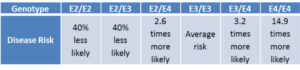
Everyone has two copies of this gene, and the combination of alleles determines your ApoE “genotype” – E2/E2, E2/E3, E2/E4, E3/E3, E3/E4 or E4/E4. The E2 allele is the rarest form of ApoE, but it’s a good one to have. Carrying even one copy appears to reduce the risk of developing Alzheimer’s by up to 40 percent.

The ApoE3 is the most common allele and doesn’t seem to influence risk. The ApoE4 allele is less common than E3, present in about 10 to 15 percent of people, but it confers a significant risk for AD. Having one copy of E4 (E3/E4) can double or triple your risk, while two copies of (E4/E4) can increase the risk by 10-15 times. It is noteworthy that 65-80 percent of all Alzheimer’s patients have at least one APOE4 allele.

This allele also lowers the age of onset.

8-13-2018 file-20180523-51121-1kl68du
Risk of susceptibility, based on alleles. Alzheimers.org. CC BY-SA

Testing for ApoE4

Testing has become incredibly easy and fast through 23andMe, the personal genetics company that won approval from the FDA in April 2017 to market genetic testing directly to consumers. In its late-onset Alzheimer’s report, 23andMe provides people with their ApoE gene status, following the mailing of a saliva sample to the company.

8-13-2018 file-20180730-106502-1799k2d
A woman and her doctor discuss healthy aging. Dennis Sabo/Shutterstock.com

But a much more difficult question is: Should I be tested? There are important implications of learning one’s ApoE4 genetic status, and consumers should consider these before they decide to be tested. Indeed, most professional medical organizations, including the National Institutes of Health, recommend genetic testing of ApoE4 status only for people volunteering for clinical trials.

Pros of testing may include:

  • It is currently known from prevention research that people with the APOE4 gene can take a number of lifestyle steps to mitigate their risk.
  • Being able to participate in clinical trials.
  • APOE4 also has some predictive value for cardiovascular risk.

Cons of testing may include:

  • Stress on family.
  • Emotional distress.
  • Financial implications in terms of insurance or long-term care options.
  • Effect on employment.

The effect of knowing your status

One of the major drawbacks to being tested for the ApoE4 gene is that the test is considered what is called a susceptibility test because it has limited predictive value. Having the E4 allele does not mean that a person will be diagnosed with Alzheimer’s. Many E4 carriers may live long lives without ever developing the disease, and many noncarriers still have risk for Alzheimer’s. This is critically important to understand before having genetic testing for ApoE4.

Several studies have now examined the impact of ApoE4 testing on individuals. The NIH REVEAL-SCAN project examined the effect of learning ApoE4 status in those who were not showing any symptoms of dementia but had first-degree relatives affected by Alzheimer’s. The data indicated that knowing one’s ApoE status caused only mild and brief psychological problems in those found to have inherited E4 alleles.

In a more recent study, adverse psychological reactions were reported by a fraction of the participants, including those who had specifically sought testing. However, nearly all of those interviewed said that they had benefited in the long term from lifestyle changes they subsequently made.

Follow the latest news and policy debates on sustainable agriculture, biomedicine, and other ‘disruptive’ innovations. Subscribe to our newsletter.

Consideration of other risk factors

Harboring the ApoE4 allele is the most important genetic risk factor for late-onset Alzheimer’s, and knowing one’s E4 allele status certainly could be transforming, particularly in terms of preventative, beneficial lifestyle changes individuals may undergo.

However, there are important considerations to take into account before testing to help mitigate stress and anxiety associated with a positive E4 test. Other experts and I suggest that people start by becoming well-informed about the basics of ApoE4. If testing is carried out and a higher risk is revealed, it is critically important those individuals obtain genetic counseling and be actively assisted about how to proceed.

Whether you carry the ApoE4 gene or not, many other risk factors are thought to contribute to Alzheimer’s, not just genes and old age. What you eat, how much you exercise, formal education, smoking, how mentally active you remain and other factors have all been implicated.

Ultimately, the choice of whether to get a genetic test remains a personal one – all the more reason it’s important to be informed about the pros and cons of Alzheimer’s screening and what doctors know about your risk for the disease and whether viable treatment options are available.

Troy Rohn is a Professor of Biology at Boise State University. Rohn’s laboratory is involved in the research involving neurodegenerative diseases including to a large extent, Alzheimer’s disease. Follow him on Twitter @ttrohn

 A version of this article was originally published on the Conversation’s website asGenetic testing: Should I get tested for Alzheimer’s risk?and has been republished here with permission.

Viewpoint: UC-San Francisco is the ‘academic home of the anti-GMO movement’

UCSF x

Being anti-GMO is the biotech equivalent of being anti-vaccine.

The scientific literature overwhelmingly and definitively has concluded that GMOs are safe. Vaccines do not cause autism, and GMOs do not cause cancer (or allergies or autoimmune disorders or environmental problems or Indian farmer suicides). Insisting otherwise is now intellectually indefensible.

Yet, the University of California-San Francisco (UCSF) remains a stubborn holdout against reality. UCSF is nothing short of the academic home of the anti-GMO movement. In fact, the university is so dedicated to this position, that it openly collaborates with fringe activists and conspiracy theorists.

UCSF collaborates with conspiracy theorists and anti-vaxxers

U.S. Right to Know (USRTK) is an anti-GMO organization funded almost exclusively by the organic food industry. To its credit, USRTK doesn’t hide it. They openly boast that their financial support comes from [people] like Dr. Bronner, a bona fide snake oil salesman (who peddles everything from fluoride-free toothpaste to aesthetically questionable tie-dye shirts), and the Organic Consumers Association (OCA).

Who is the OCA? Well, it’s a group of conspiracy theorists.

As we wrote previously, the OCA “publishes anti-vaccine propagandapromotes alternative medicinelies about nuclear power, and peddles all sorts of conspiracy theories, including 9/11 trutherismchemtrails, and FEMA’s secret plan to implement martial law.” They also contend that pesticides cause school shootings.

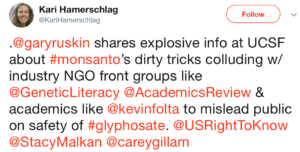
People who believe these sorts of things are usually found yelling on a street corner or in a straitjacket, but they can also be found giving a talk at UCSF. Gary Ruskin, who operates USRTK — and colludes with the Kremlin propaganda outlet RT gave a talk at UCSF, in which he accused biotech scientists of being liars who knowingly poison the public.

berezow

To rub a little extra salt in the wound, UC-Berkeley bussed in some journalism students from a class taught by Elena Conis. Who is Elena Conis? She’s an anti-vaccine sympathizer.

Stop and think about all this for a second. A publicly funded university is using taxpayer dollars to smear other scientists and to promote the beliefs of anti-GMOers and anti-vaxxers. That might be legal, but it’s wrong. It’s unethical. And it really should stop.

Follow the latest news and policy debates on sustainable agriculture, biomedicine, and other ‘disruptive’ innovations. Subscribe to our newsletter.

UCSF is not accountable to anybody

But it won’t stop. UCSF is not accountable to anybody. The university also collaborates with USRTK to run an archive of cherry-picked e-mails and documents that allegedly “expose” industry secrets. Earlier this year, I contacted the university about this, specifically questioning their anti-biotech rhetoric. They responded but refused to answer any of my questions.

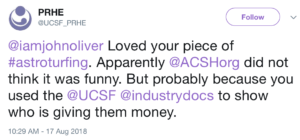
Because there are no consequences for their actions, UCSF continues to behave with utter impunity usually anonymously, it should be noted. Recently, UCSF applauded comedian John Oliver for smearing us.

berezow

Once again, stop and think about that. A publicly funded university is using taxpayer money to smear scientists using “news” that it got from a late-night comedian. So, for a second time, I contacted UCSF with a list of pointed questions. This time, nobody responded. Here is the e-mail I sent in its entirety:

Dear Dean King, OB/GYN Chairwoman Murtha, Ombudsperson Brodie, and PRHE:

I’m Alex Berezow, a science writer and PhD microbiologist. I am also a contributor to USA Today and several other international news outlets.

I noticed that an official UCSF Twitter feed attacked my employer’s credibility based on a comedy sketch by a late-night comedian. This is the URL:

https://twitter.com/UCSF_PRHE/status/1030506939489251329

(Note: I have taken a screenshot, in case the person who operates the feed deletes it.)

As a publicly funded institution, you have a responsibility to be accountable for your public statements. I expect a response by end of business on Wednesday, August 29 to the following questions:

1) Does UCSF PRHE’s Twitter feed represent the official position of UCSF, its medical school, PRHE, or its OB/GYN department?

2) PRHE tweeted that industry perpetuates fake science. Is that the official position of UCSF?

https://twitter.com/UCSF_PRHE/status/1030497339121655809

3) PRHE tweeted a comedy video by John Oliver that attacked ACSH as an “astroturf” organization. Is that a position endorsed by UCSF?

4) I have noticed that the UCSF PRHE Twitter feed disproportionately promotes the work of Dr. Tracey Woodruff. In fact, she has been promoted by the feed four times in the last three weeks:

https://twitter.com/TrishKoman/status/1034469198750261248

https://twitter.com/UCSF_PRHE/status/1029771473613803520

https://twitter.com/UCSF_PRHE/status/1029468957344858112

https://twitter.com/UCSF_PRHE/status/1026518207304097792

Does Dr. Woodruff operate the UCSF PRHE Twitter account? Is she using official UCSF resources to promote herself and attack other scientists?

4) Does UCSF condone its employees using official university channels and resources to undermine the reputation of other scientists?

Thank you.

Academia in meltdown

It may be tempting to write off UCSF as an anomaly, but it is not. UCSF is simply the most egregious offender among institutions of higher learning. A few months ago, a professor in Europe was fired for being pro-GMO. All across academia, scientific inquiry is being assaulted by postmodernists, or even actively suppressed. If a scientist upsets the wrong person, his research can literally vanish. Scientists who bravely refuse to be silenced suffer character assassination.

And your tax dollars pay for it.

Dr. Alex Berezow joined the American Council on Science and Health as Senior Fellow of Biomedical Science in May 2016. Follow him on Twitter @alexberezow

This article originally appeared at the American Council on Science and Health as UCSF: An Academic Home For Conspiracy Theorists, Anti-Vaxxers and has been republished here with permission.

Improving the sports concussion ‘tool kit’: Virtual reality goggles promise speedier diagnosis

football

As the 2018 [football] season gets into full swing, some college teams are keeping a new gadget on the sidelines: a pair of virtual reality goggles designed to diagnose concussions. The Pac-12 conference will actually use the VR goggles in every sport.

The Eye-Sync goggles, made by Palo Alto, California-based company SyncThink, work by displaying a dot traveling in a rough circle and tracking the user’s eyes as they follow the movement of the dot. While the goggles track eye motion, the device is really measuring the brain’s ability to predict the dot’s movement, says SyncThink founder Jamshid Ghajar.

“What we need is a toolkit—eye tracking could be one of the tools,” Ghajar says.

A variety of other diagnostic techniques are also being developed to fill that toolkit. In the spring, researchers announced that certain biomarkers in plasma could accurately predict whether college athletes had sustained a concussion. Other research suggests that measuring changes in the speed of blood flow to the brain might identify concussions. A spit test that measures genetic material in saliva has shown promise identifying concussions in young patients suffering from long-term symptoms.

Determining whether someone just had their “bell rung,” or if their brain slammed into the side of their skull with enough force to temporarily inhibit cognition, is a tricky science.

Read full, original post: How Virtual Reality and Sideline Brain Scans Could Help Diagnose Concussions

Organic farming’s positive impact on bees may be ‘overestimated,’ new study suggests

bee

Intensive agricultural landscapes can be hostile for bees due to a lack of floral and nesting resources, and due to management-related stress such as pesticide use and soil tillage …. We studied the effects of farming intensity (organic vs. conventional, number of insecticide applications) and availability of semi-natural habitats at the field and landscape scale on pollinator visits and pollen delivery to pumpkin in Germany.

In contrast to our expectations, local management (organic farming and field-bordering seminatural habitats) had no significant effects on pollinator visits and consequently on pollen delivery. This may be owing to the large foraging ranges of honey and bumble bees in combination with the high attractiveness of pumpkin flowers.

The number of insecticide applications did not differ significantly between organic and conventional management in our study. However, management varied strongly within organic farming. Organic fields managed according to the EU-Eco regulation 834/2007 had more insecticide applications than conventional fields and organic fields managed by rules from organic associations, which ban insecticides completely ….

Overall, the positive effects of organic farming on beneficial insects may have been overestimated owing to studies only including farms under very strict organic management without any pesticide use.

Read full, original article: Dominance of cropland reduces the pollen deposition from bumble bees

Cancer will be the ‘single biggest barrier to increasing our life expectancy,’ report says

The number of people around the world who have cancer is “rapidly growing,” with 18.1 million new cases and 9.6 million deaths in 2018 alone, researchers estimate in a new report.

By the end of the century, cancer will be the No. 1 killer globally and the single biggest barrier to increasing our life expectancy, according to the report, released [September 12] by the World’s Health Organization’s International Agency for Research on Cancer.

The number of cancer cases is increasing for a number of reasons, the report says: The global population is growing, and more people means more cancer. The population is also aging, and cancer risks grow as you age.

The good news is that prevention efforts seem to pay off, the report says. Countries with strong public awareness campaigns and laws that encourage people to quit smoking, such as in Northern Europe and North America, have seen a decline in the number of cases of lung cancer.

“These new figures highlight that much remains to be done to address the alarming rise in the cancer burden globally and that prevention has a key role to play,” said Dr. Christopher Wild, director of the International Agency for Research on Cancer. “Efficient prevention and early detection policies must be implemented urgently to complement treatments in order to control this devastating disease across the world.”

Read full, original post: Cancer will kill nearly 10 million people this year, report estimates