A conservative agricultural spokesperson, has spoken out against a report on pesticides which she says “misrepresents” the findings of the European Parliament’s own researchers.
Member of the European Parliament (MEP) Anthea McIntyre delivered a scathing criticism of the report which has been drawn up by the Parliament’s Environment Committee when it was debated at Strasbourg’s plenary sitting of the house.
…
McIntyre believes it to be part of a wider campaign by the ecological extremists to create a climate of fear over Plant Protection Products (PPPs) and to erode public confidence in the safety of the authorization process.
…
McIntyre says the report ‘misrepresents the findings’ of the 588-page study ran up by the European Parliament Research Service.
The report comes as a Special Committee on Pesticides, set up at the insistence of Green and Socialist MEPs, has begun to consider its own recommendations on the authorisation or PPPs following a lengthy deadlock over the re-licensing of the popular weedkiller Glyphosate.
A few years ago, I began to see children in my practice who seemingly responded to marijuana-derived extracts. And as a result, I grew cautiously optimistic that these extracts might be good treatments for the condition.
As a devout believer in evidence-based medicine, I still needed experimental data that could distinguish bona fide effectiveness from a deceptive impression of benefit — a placebo effect.
But my desire to study marijuana ran headlong into a seemingly immovable obstacle: the U.S. Drug Enforcement Agency (DEA). The agency’s illogical and stubborn stance makes it all but impossible for scientists to study cannabidiol. I persevered and eventually succeeded in launching a study, but no doubt many others give up, robbing us of valuable insight into marijuana’s potential benefits.
…
Although medical marijuana is legal in 31 states and recreational marijuana in 9, the federal government continues to consider marijuana a ‘Schedule 1 controlled substance,’ putting it in a category of drugs, along with heroin and LSD, considered to have no medical value and a high potential for abuse.
…
People with these conditions are potentially missing out — and why? The more I learned about the federal stance toward marijuana, the clearer it became that it is medically uninformed and often defies common sense.
First, for the third straight year …. the number of undernourished people in the world has increased …. 821 million people are undernourished; about 50 million more than there were in 2015 or one out of every nine people on the planet …. The other flashing red light is …. that “exposure to more complex, frequent and intense climate extremes is threatening to erode and reverse gains made in ending hunger and malnutrition.”
…
At the Bill & Melinda Gates Foundation, we are increasing our focus on the threat of climate change to agricultural production in developing countries because it impacts our core mission, which is to find solutions to problems that prevent the world’s poorest people from living healthy, productive lives.
…
[Scientists] are working to produce …. new crop varieties and livestock breeds that will enable farmers to be both more productive and resilient. The results thus far include rice that can withstand flooding, and new varieties of climate-ready beans, including beans that can thrive in scorching temperatures and others that can evade drought thanks to long roots and a short maturing time.
Sowbugs, armadillos, hedgehogs… and DNA? The same strategy that some animals use to avoid being attacked — roll into a ball and keep your vulnerable bits beyond predators’ reach — turns out to let genes avoid being sliced up by the genome-editing molecules of CRISPR, scientists reported on [September 10]. When a segment of DNA wraps itself around a protein into what’s called a nucleosome, CRISPR-Cas9 can no more cut it than a hungry hawk can bite a rolled-up hedgehog.
If CRISPR “can’t see DNA when it’s wrapped around a nucleosome,” said biochemist Dana Carroll of the University of Utah, who led the study, “it could be an issue.”
Nucleosomes exist because fitting the 6-foot-long human genome into a cell nucleus is akin to packing 30 miles of yarn into a basketball: It needs to be rolled up. When a cell doesn’t need a particular gene at a particular moment, that gene rolls around a protein, becoming inaccessible to the cell’s gene-activating machinery.
…
The nucleosome issue is only the latest in an expanding list of challenges, including genomic havoc and concerns about cancer, to using CRISPR to treat diseases. As with those others, it’s too early to know whether rolled-up DNA will be an impediment to the use of CRISPR to repair disease genes in people.
My husband and I manage a farm in Rhineland-Palatinate [in Germany] with agriculture and livestock. Agriculture thinks in generations, so we, like many farmers, want at least one of our children to take over the farm later – just as we took it over from our parents. But agriculture has changed.
…
Is the farming profession still attractive in times when farmers are made public enemies? Can we still recommend in good conscience that our children become farmers?
…
Many people are now critical towards farmers, sometimes even hostile. “The farmers poison our soils and our food with pesticides,” they say. It doesn’t matter that these claims are false.
…
Constantly, new laws and regulations force farmers to sit down at a desk to do paperwork, but bureaucracy creates frustration instead of food, because cereal does not grow on a desk …. Agriculture nevertheless has been able to survive thanks to …. advances in breeding, machinery, better planning and expert advice.
…
But politics, driven by ideologies that are well-intentioned but lacking expertise, puts more and more obstacles in the way of agriculture. These policies endanger agriculture’s future.
Editor’s note: This article was originally published in German. This summary was prepared with Google Translate and lightly edited for clarity.
A new study in mice pinpoints how a stretch of DNA likely turned our ancestors into marathoners, giving us the endurance to conquer territory, evade predators, and eventually dominate the planet.
…
Human ancestors first distinguished themselves from other primates by their unusual way of hunting prey. Instead of depending on a quick spurt of energy—like a cheetah—they simply outlasted antelopes and other escaping animals, chasing them until they were too exhausted to keep running.
…
Ajit Varki, a physician-scientist at the University of California, San Diego (UCSD), and colleagues unearthed one of the first genetic differences between humans and chimps: a gene called CMP-Neu5Ac Hydroxylase (CMAH). Other primates have this gene, which helps build a sugar molecule called sialic acid that sits on cell surfaces. But humans have a broken version of CMAH, so they don’t make this sugar.
…
In the new study, Varki’s team explored whether CMAH has any impact on muscles and running ability, in part because mice bred with a muscular dystrophy–like syndrome get worse when they don’t have this gene.
Bayer on [September 18th] said it wants a California state court judge to overturn the jury’s verdict, order a new trial or reduce damages, according to a court filing. The company aims to defeat a $289 million award in August in one of the first of thousands of cases filed by gardeners, farmers and others claiming Bayer’s Roundup herbicide gave them cancer.
The jury in that case ruled unanimously in favor of a former groundskeeper who sought to hold the maker of Roundup liable for his non-Hodgkin lymphoma. The verdict came only two months after the German pharmaceutical and chemical conglomerate sealed its takeover of Monsanto ….
…
In its filing on [September 18th] with the California state court, Bayer argued that the plaintiff’s lawyers relied on flimsy scientific evidence that doesn’t support a link to cancer, and that jurors were swayed by overly emotional and speculative arguments from the plaintiff’s lawyers.
Pedram Esfandiary, an attorney for Baum Hedlund Aristei and Goldman PC, which is representing the plaintiff in the case, said the jury verdict demonstrated that Monsanto’s scientific case wasn’t convincing. “I think the odds are very slim of them prevailing,” he said.
Judge Suzanne Ramos Bolanos is expected to rule on Bayer’s requests by late October or early November.
[T]he way the military fights wars is changing, and so must DARPA’s priorities. At a conference last week to celebrate DARPA’s 60th anniversary, officials described the next frontier of neuroscience research: technologies for able-bodied soldiers that give them super abilities.
…
The Next-Generation Nonsurgical Neurotechnology (N3) program will fund research on tech that can transmit high-fidelity signals between the brain and some external machine without requiring that the user be cut open for rewiring or implantation.
…
It hasn’t escaped DARPA’s attention that no-surgery-required brain gear that gives people superpowers may find applications beyond the military. The proof-of-concept tech that comes out of the N3 program may lead to consumer products, says Justin Sanchez, director of DARPA’s Biological Technologies Office. “ This will spawn new industries,” he says.
…
DARPA doesn’t want its new brain tech to require even a tiny incision. Instead, minutely invasive tech might come into the body in the form of an injection, a pill, or even a nasal spray. Emondi imagines “nanotransducers” that can sit inside neurons, converting the electrical signal when it fires into some other type of signal that can be picked up through the skull.
By the end of the 4-year program, DARPA expects all researchers to be ready to demo their tech with a “defense-relevant task.” For example, a demonstrator might use brain signals to pilot a drone.
It’s high time for the FDA to protect food innovation. The greatest tool for breakthroughs in food — genetic engineering — is being vilified in ways that break the law in order to get rid of the technology.
I grew up helping my father, a papaya farmer, grow our crops …. the papaya industry was hit hard by a disease in the 1950s called papaya ring spot virus …. Fortunately, in 1998 the virus-resistant Rainbow papaya was approved and commercialized, and the papaya industry was saved.
…
It’s impossible to go to the grocery store today without seeing products saying “all natural,” and “GMO-free.” …. The worst offender is the “Non-GMO Project Verified” label …. It shocked me to read that the Non-GMO Project wants “to shrink the market for existing GMO ingredients and prevent new commercial biotech crops.”
…
FDA …. fails to understand that allowing products to advertise that they do not have GMOs is [no] different than a competitor badmouthing someone else making the same product — and it’s against the law.
…
This is exactly the type of misleading advertising that the Federal Trade Commission says is illegal. If it were up to the anti-GMO folks, Hawaii would have lost its papaya industry to the ring spot virus.
In 2007, a middle-aged British man shot and killed his wife. He was declared mentally incapacitated, convicted of manslaughter and sentenced to hospital care. Two years later, he was diagnosed with Huntington’s disease – an inherited condition that damages nerve cells in the brain, causing both mental and physical deterioration until finally proving fatal – which may have contributed to his diminished mental state at the time of the shooting.
The man made it clear to his doctors and social workers that he did not want his daughters to know about his Huntington’s diagnosis. He said he did not want to distress them further after the trauma he had caused by killing their mother. But around the time of the diagnosis, one of his daughters became pregnant.
Huntington’s is a hereditary disease that is autosomal dominant – if one of your biological parents has the faulty gene, then you have a 50 per cent chance of carrying it as well. And if you have the gene, then you will almost certainly get Huntington’s. A diagnosis can have devastating consequences beyond the initial patient.
Several times doctors discussed with the man the idea of telling his children, who were attending family therapy at an NHS-run facility with members of their father’s medical team. But the man insisted his daughters be kept in the dark. “Especially the pregnant one until she gives birth,” he told a social worker. He said he was afraid they might get upset, kill themselves or have an abortion.
The pregnant daughter – who we’ll call Jane* – gave birth to a baby girl, unaware of her father’s diagnosis and the risk that she and her newborn had of developing Huntington’s. Four months later, one of her father’s doctors accidentally let slip her father’s condition, which had been confirmed by genetic testing months before Jane gave birth. She got tested and the results came back positive – Jane had Huntington’s disease.
In a lawsuit issued in 2013, Jane claims that her father’s doctors had a duty to inform her of her father’s diagnosis regardless of his wishes. Had she known she had Huntington’s, Jane says, she would have terminated her pregnancy rather than have a child who was at high risk of both having a life-destroying disease and being raised by a terminally ill single parent.
A lower court threw out the case. But in May 2017, the UK Court of Appeal overturned the decision. Jane’s claims, it said, are arguable. That decision may have set an important precedent – that genetic testing extends the duty of a healthcare professional beyond the patient. But extending that duty also risks damaging the underlying trust between doctor and patient.
If, as expected, the case goes to trial in 2019, the court will have to decide whether Jane was owed a “duty of care” by her father’s doctors even though she had never been their patient or at any of the facilities at which her father was treated. More broadly, the court will ask if the genetically inheritable characteristic of a condition like Huntington’s disease means that a parent’s confidential diagnosis belongs to their children as well. With further advances in genetic testing, claims to a relative’s genetic information may become increasingly difficult to deny. As one scholar has put it, it will be more common for the relative of a patient to demand access to the patient’s record by declaring – with more than a hint of truth – “I have a claim, because it is about me.”
Image credit: Albert Tercero for Mosaic
Over the past 30 years, Heidi Pate has had seven surgeries on her neck. During the first two alone she had 108 lymph nodes removed. She is constantly trying to keep ahead of her cancer and so has allowed surgeons to open her up and move or remove everything that they think could kill her. When they took out her parotid salivary gland at age 32, her face would have been “sucked in and concave” had her surgeon not replaced the gland with muscle taken from the left side of her neck. “I guess my doctor felt sorry for me,” she tells me when I visit her home in Orange Park, Florida.
Heidi’s battle with cancer didn’t begin with her own condition. It began with her mother, Marianne New, who was treated for medullary thyroid carcinoma, known as MTC, in 1987. Marianne had a couple surgeries and recovered fully. But three years later, her daughter started having symptoms of what doctors mistakenly thought was stomach cancer. Just before Heidi’s gallbladder was removed, an intern found swollen lymph nodes in the right side of her neck. Eight weeks later her surgeon did a biopsy and, when the results came back, said: “Yep, that’s thyroid cancer.”
When you have MTC, the C cells of your thyroid gland produce an excessive amount of a hormone called calcitonin. A typical level in a person’s body is less than 10 picograms per millilitre (a picogram is one trillionth of a gram). The day that Heidi had her first thyroid surgery – just a few days after the biopsy – her calcitonin level was 10,000. Actually, the doctors told her they didn’t really know what her number was. That was just the top of their scale.
As soon as Heidi was diagnosed, the doctors asked about her family. She told them she had a sister. They told Heidi to make sure that her sister got tested immediately – MTC is inheritable, and since their mother had it, there was a 50 per cent chance her sister would have it too (she tested negative). “That’s what cued me,” says Jim Pate, Heidi’s husband since they were teenagers. “Why wasn’t your mom’s doctor so concerned about you and your sister at the time of her surgery? We didn’t get a word from them.”
Jim and Heidi went to a local library to look up MTC and found a book called Understanding Cancer. She pulls out a packet of photocopies of the book that she still keeps today. She shows me the very first page of the chapter on thyroid cancer, where it states that MTC is often hereditary. “The first page!” she says. They found additional articles that showed that it had been known for years that MTC could be hereditary.
After much discussion, not least with their minister, the Pates decided to sue their mother’s physician, Dr James Threlkel. The complaint alleged that Threlkel should have known that MTC was inheritable and that he had a duty to warn Heidi’s mother that her children were at risk. If he had warned his patient, then Heidi could have started treating the cancer three years earlier, when she was asymptomatic, and potentially have been cured.
Follow the latest news and policy debates on sustainable agriculture, biomedicine, and other ‘disruptive’ innovations. Subscribe to our newsletter.
The trial court for Alachua County dismissed their complaint. Heidi was not Threlkel’s patient, it said, and he had no duty to her. A court of appeal agreed with the previous court’s dismissal, but added that if the Pates chose to take their case up one level – to the Supreme Court of Florida – they would be asking the judges a very important question: does a physician owe a duty of care to the children of a patient – or at least have a duty to warn the patient of the genetically transferrable nature of the condition for which they’re being treated and the risk that it poses to their offspring?
The Pates did take it to the next level – and six of the seven judges of the Supreme Court of Florida agreed with them that a duty of care was owed. Reversing the previous court’s decision, they said Threlkel had failed to perform his duties by not warning Heidi’s mother of the inheritable qualities of her disease. Heidi would be allowed to take Threlkel to court. However, the judges added that Threlkel could have fulfilled his duty by simply warning Heidi’s mother of the risk to her children – he didn’t have to locate or warn Heidi or her sister directly.
“It’s arrived!” begins the animated title of a recent paper by Roy Gilbar, an honorary senior lecturer at Leicester Law School, and Charles Foster, a law professor at Green Templeton College, Oxford. Gilbar and Foster are excited because Jane’s case, they say, has the potential to redefine not only the responsibility a doctor has to an individual patient, but far beyond to what it means to be an individual in the first place.
Up until now the law has only looked at a “pastiche of a patient, a pastiche of a human being,” Foster tells me over the phone. But Jane’s case recognises that we are social animals rather than walled-off islands – that each of us has unbreakable connections to other people in our circles and that these connections must be considered in medical care. It adopts a more realistic approach towards the question of what a human being is, says Foster, and therefore what the duties of human beings towards other human beings should be.
“The law is finally catching up with the notion that the creatures that it deals with when it approaches medical law are wonderful, mysterious, complex, multi-layered creatures. Not the cardboard cut-outs that lots of medical ethics and law tends to assume they are,” Foster says. “The rather sclerosed way in which the law has assumed that there is one easily identifiable person, with an easily ascertainable suite of autonomy interests, never accorded with the realities of our daily lives.”
Jane’s case could force doctors to consider the nexus of relationships in which we exist and step out of their comfort zone when it comes to breaking doctor–patient confidentiality. Few cases have ever gone this far, and for good reason: confidentiality has been at the core of medical practice for thousands of years. It is seen as key in maintaining trust between a physician and patient, and has been the default position in international medical guidelines ever since the creation of the Hippocratic Oath.
Right now doctors need to think about their duty of confidentiality on the one hand and their duty to warn other people, like relatives, on the other, Gilbar tells me. “Up to this case they didn’t have to think about relatives. They only thought about the patient,” he says. “And if the patient said, ‘Look, I don’t want anybody to know about my situation,’ they simply respected that.” Jane has the potential to change all that.
Donna Safer was 10 years old when her father, Robert Batkin, died at age 45. He had been sick for years before that, and among the physicians who treated him was Dr George T Pack, one of the world’s most celebrated cancer specialists. In 1951 Pack had flown to Argentina to treat Eva Perón, the country’s famous first lady. But during his seven years as Robert Batkin’s doctor, Pack never told the family what was really killing his patient, says Donna.
As a young adult, Donna believed her father had had some form of liver cancer, because she remembered him having yellowish skin before he died. But she and her mother didn’t really know. They just assumed that’s what it was. In fact, as her father went through various treatments and surgeries, all Donna knew was that he had some sort of infection. When Donna’s mother asked the doctors if her children were at risk, she was told at least twice not to worry.
“You have to picture back in 1956,” Donna tells me during a long phone call from her home in Connecticut. “Cancer was a dirty word. It was like in the 1980s when you said you knew somebody with AIDS. It was like, ‘Don’t touch them because you might catch it.’ This is the mentality of cancer in the Fifties. And people were not informed by their doctors. Doctors didn’t tell people the way they do now. It was much more secretive.”
Throughout her father’s surgeries and treatments, the doctors told Donna’s mother that they were treating her husband’s “infection”. But every year it seemed he would be back in the hospital, often for weeks at a time. By the early 1960s, he had had his colon removed and was using a colostomy bag. In January 1964, he died. “His death certificate says natural causes,” Donna says. “That’s unheard of at 45 years old.”
In 1990, Donna, then 36 years old and engaged to a doctor named Robert, started gaining weight and feeling bloated all the time. One day, on her drive to work, she had to pull over to the side of the road because she couldn’t keep her eyes open. A week or two later, she doubled over in pain, and she and Robert decided they had to figure out what the heck was going on with her body. After a walnut-sized object was found during a rectal exam, Donna got a barium enema. Afterwards, the radiologist came out and showed the results to Robert. Donna’s colon was totally blocked and the diagnosis was clear.
“One of the worst, worst moments of my life,” Robert says. “Now I have to tell my fiancée that she’s got colon cancer.” That was a Wednesday morning. By Friday Donna had had her colon removed.
The next year, at the suggestion of a retired family doctor, Donna looked at her father’s old medical records and saw that a procedure he had had around 35 years earlier was nearly identical to hers. It turned out that Donna had familial adenomatous polyposis, which can be passed on from parent to child. She and Robert dug up old papers of Dr Pack’s and discovered that by 1956 – eight years before Donna’s dad died – it was already known that the condition was hereditary.
In 1992, Donna and Robert attempted to sue Pack’s estate, aiming not to disgrace the long-deceased physician but to get money from the insurance company. They claimed that Pack knew the hereditary nature of the disease but did not warn Donna’s parents that their children were at risk.
As in the Heidi Pate case, the trial court dismissed their claims because Donna was not Pack’s direct patient. He had no duty towards her as a doctor, the judge said. Nor did her father’s cancer pose a risk to the public at large – as would, say, a breakout of Ebola or another contagious disease. The risk was only to Donna and that was not enough for the judge.
But in 1996, the Superior Court of New Jersey reversed that decision, finding “no impediment, legal or otherwise, to recognising a physician’s duty to warn those known to be at risk of avoidable harm from a genetically transmissible condition”. The court acknowledged that extending the duty to warn non-patients “might lead to confusion, conflict or unfairness in many types of circumstances”, but that the risk from genetic cases – which are limited to relatives – “is sufficiently narrow to serve the interests of justice”.
Unlike Heidi’s case, however, the New Jersey judges specifically said that warning the patient is not always sufficient to avoid risk to third parties such as relatives, and that a doctor’s duty of care can extend outside the hospital even without a big picture public health risk. While the court didn’t rule on how doctors might go about warning third parties who are not their patients, it did decide that a duty to them could be owed. Moreover, it predicted that “it may be necessary, at some stage, to resolve a conflict between the physician’s broader duty to warn and his fidelity to an expressed preference of the patient that nothing be said to family members about the details of the disease”.
Twenty-three years later, that prophecy has materialised in the UK. Jane’s case could force doctors to extend their duty even further, or at least to question to whom one patient’s diagnosis belongs.
Image credit: Albert Tercero for Mosaic
For Graeme Laurie, a professor of medical jurisprudence at the University of Edinburgh, Jane’s case represents a frightening scenario. He believes it could create uncertainty about the nature and extent of legal duties for healthcare professionals: uncertainty about confidentiality, uncertainty about to whom a doctor owes their primary responsibility – uncertainty that fundamentally changes the relationship between medical professionals and their patients. “It’s not necessarily always clear to me,” says Laurie, “that the so-called public interest in disclosing the information would be strong enough in future cases to justify such a breach.”
In the very extreme and tragic circumstances of Jane’s case, it might make sense to argue a duty of care, he says. But imposing a legal duty on doctors to disclose patient information in broader circumstances may cause them to do so for legal reasons rather than medical ones.
“With a legal duty it can too easily become a knee-jerk reaction; I have to disclose, come what may, because I now fear liability. A fear of liability is not acting in the interests of anybody. A fear of legal liability is the fear of being sued or fear of getting sacked because your employer will have to pay money. It’s not about an ethic of care,” says Laurie. “My concern is replacing a discretion with a duty.”
Doctors in the UK already have a good deal of discretion when it comes to breaching confidentiality. In fact, Laurie believes that Jane’s father’s doctors would have had a sound argument, based on current standards, for breaking with his wishes. A 2011 guideline from the Royal College of Physicians, the Royal College of Pathologists and the British Society for Genetic Medicine offers clear leeway: “Where consent to release information has been refused… the rule of confidentiality is not absolute,” it states.
“You don’t have to keep all confidences irrespective of circumstances. Of course not. Somebody confesses a murder, you’re entitled as the healthcare professional to go to the police,” says Laurie. Jane’s case could have been an exception as well. “They could have approached the daughter and told her the circumstances, even despite the fact that the gentleman in question was objecting.”
Perhaps the doctors could have told Jane that she should get tested for Huntington’s, allowing her to infer on her own that her father had the disease. “There are circumstances where we are allowed to breach confidentiality and this is one of them,” says Anneke Lucassen, a clinician and professor of clinical genetics at the University of Southampton, who is serving as an expert for Jane’s legal team. “They could have done that under existing law.”
Lucassen is an author of a recent paper exploring the attitudes of healthcare professionals, patients and the public regarding disclosure of patient information. The results, drawn from 17 different studies, found that most patients tell, or intend to tell, at-risk relatives of genetic or inheritable conditions. But some do not for reasons including “guilt and fearing blame, poor relationships, difficulty finding the right time, and perceived inability to communicate accurately”.
In one study, 30 per cent of patients said that they would not mind if healthcare professionals gave out their medical information to relatives without permission, but 50 per cent thought they should be punished for doing so. In another study presenting three scenarios – Huntington’s disease, breast cancer and colon cancer – less than one-quarter of surveyed respondents thought healthcare professionals should “seek out and inform relatives about risk and prevention options against patients’ wishes”. In a study that asked participants to take the relatives’ perspective, more than half of those surveyed said they would want a healthcare professional to disclose against the patient’s wishes if the condition were nonfatal and treatable (unlike Huntington’s) with a 50 per cent chance of showing symptoms of the condition.
One overall takeaway of Lucassen’s review is that “participants generally thought privacy was less important than the opportunity to prevent serious illness or death”. However, a somewhat conflicting conclusion found that patients believe “that unsolicited contact with relatives could invade their privacy”.
Then there’s the question of logistics. If doctors all of a sudden are responsible to the relatives of patients, are they obligated to track them down wherever they reside or else be liable? “I think most clinicians would say they do not want that, and I would agree,” says Lucassen. “It doesn’t make sense to give clinicians a duty of care to relatives because it’s just not a duty that could possibly be enforced consistently and thoroughly.” But, she adds, that’s not the same as saying you never tell anyone anything.
And what about the right not to know? What about those family members who don’t want to know that they have a horrible disease such as Huntington’s? Some people may be damaged by information given to them by a healthcare professional they didn’t even employ. As Laurie says, “Not only am I going to experience an early and horrible death, but now I’m doomed to live with the knowledge of that and I can’t un-know something that you told me. And you’re telling me that because you’ve been legally obliged to do so.”
When it comes to genetic tests, two international conventions – the UNESCO International Declaration on Human Genetic Data and the Oviedo Convention in Europe – recognise the right not to know results. If doctors are legally obliged to tell third parties about genetically inheritable diseases they are carrying, we could all lose what seems a reasonable right to enjoy our lives in ignorant bliss.
Though the New Jersey court agreed that Donna Safer should be able to argue her case, when it went back to trial, she lost. She tells me she had the opportunity to settle, and regrets not taking it on advice from her lawyer. However, she’s proud that her case is studied in law schools and dissected in academic articles. “I would say in the long run, I won,” says Donna, who went through another major surgery in May 2018. “If I can save one person, then I’ve made a major accomplishment.”
Rather than go to trial, Heidi and Jim Pate went to mediation with Dr Threlkel and eventually settled. Heidi says that at one point during the discussions, Threlkel’s side implied that perhaps Heidi’s mother had been informed about the hereditary nature of her cancer after all, but neglected to tell her daughters. Heidi quashed that idea, describing how responsible and caring her mother was and remains to this day. “She would have told us immediately,” Heidi says. Besides, Jim adds, “What mother would not relay that information to one of her only two daughters?”
Both of the Pates’s children tested positive for MTC and had had their thyroids removed by the time they turned five years old. Neither has shown signs of cancer since. Heidi wishes she had had the same opportunity. She believes she could have been freed of cancer if it hadn’t spread to her lymph nodes, which may have occurred during the three-year gap between her mother’s diagnosis and her own. Her calcitonin level is now back in the 5,000-picogram range, and doctors search her body every six months in an attempt to find out where the cancer is growing this time.
I told the Pates about Jane’s case and the worry that it could theoretically push the duty of care too far in the UK. They said that their lawyer mentioned a similar concern with Heidi’s case back in the early 1990s, when HIV was still essentially untreatable and killing thousands of Americans. The lawyer said the judges would not want to set a precedent that if you have HIV, your doctor would have to tell every person you’ve ever had sex with. “They wanted to put some sort of a dam up to hold that back, because they didn’t want to turn this into a free-for-all,” Heidi tells me. But in the end, the Florida court’s decision to allow Heidi to argue her case did no such thing. It did not open any floodgates.
Jane’s lawyer, Jonathan Zimmern, believes that clinical geneticists are already practising medicine in the manner that Jane wishes her father’s doctors had. He’s spoken, informally, with many clinical geneticists about the case. “They all feel that what we were fighting for is what clinical geneticists do on a daily basis,” he tells me.
“[Clinicians] already act and feel as though they have a professional duty to someone other than their patient or the person who provided the original genetic sample,” Zimmern says. And if they already practise this way, he doesn’t understand why the NHS is so adamant about denying Jane in court. “It seems to me they are fighting a battle on behalf of doctors who don’t want the battle to be fought.”
That said, Jane could alter the law by legally extending a doctor’s obligations. “It’s a very minor extension of the duty that clinicians were already operating under,” says Zimmern, “but it is kind of a significant development in the law, just because we’ve always had that line in the sand – that the clinician’s duty is only to the patient and to no one else.”
Zimmern says that the UK Court of Appeal has, in a sense, already pushed past a new boundary. An important legal precedent has already been set: that arguably in genetic cases there is a duty of care to someone other than the patient. “If we win the underlying case now, it’s kind of just reinforcing what is already there. But if we lose, it doesn’t overturn the Court of Appeal decision,” says Zimmern. “As the years or the months go by, if any other case arises like this, everyone is going to rely on that decision, and it’s likely to become law.”
A common saying among legal practitioners is that hard cases make bad law. “My concern as a lawyer is I don’t really trust the law,” says Graeme Laurie. “I don’t trust the law not to run away with the precedent and introduce more uncertainty into the doctor–patient relationship.”
Whether Jane will, or should, open the floodgates is a difficult question. Any precedent that will change the dynamic of doctor and patient must take into account a nearly infinite number of complexities. Perhaps it’s better to keep things simpler, to maintain that doctors are responsible to their patients only, except in truly extraordinary circumstances. “It’s a genuine dilemma,” Laurie says. “It’s not absolutely clear what is the right thing to do.”
*Jane – known as ABC in the lawsuit – has been kept anonymous because of privacy concerns for her young child.
Graeme Laurie and Anneke Lucassen receive funding from Wellcome, which publishes Mosaic.
Shaun Raviv is a freelance journalist based in Atlanta. He has written for the Atlantic, BuzzFeed, the Big Roundtable and Smithsonian magazine, among others. Follow him on Twitter @ShaunRaviv
These days we are exposed to a great deal of negative, one-sided and inaccurate information in the media and online about a herbicide called glyphosate, often sold under the trade name Roundup.
We interact with farmers and farm organizations on a regular basis. We understand their concerns with economic sustainability and their interest in environmental stewardship. And we understand the valuable contribution that technological advances have made in improving the sustainability of agriculture. Now, agenda-driven groups seek to take one of agriculture’s most useful technologies, glyphosate, and end its use through well-orchestrated, alarmist misinformation campaigns.
But what do government surveys and regulatory decisions tell us? To understand the real story we turn to an excellent set of data that tracks trends in pesticide use, hazard and risk, over time from the Ontario Ministry of Agriculture, Food and Rural Affairs (OMAFRA) in Ontario, Canada. This data, collected using consistent methodology, enables us to learn more about how changing farming practices impact the environment and those working in agriculture.
In this article we’ll talk about the:
Overall reduction in the amount of herbicide applied in Ontario corn and soybean production;
Increased use of glyphosate and benefits versus other herbicides displaced by glyphosate;
Reduced hazard and risk from the use of glyphosate, based on indicators called the environmental impact quotient (EIQ) and environmental impact (EI), respectively; and
Positive reassessments of the safety of glyphosate by the world’s major pesticide regulators.
Use of herbicides including glyphosate In Ontario
Every five years, for the past several decades, Ontario has surveyed farmers on their use of pesticides including herbicides, insecticides and fungicides. The most recent survey dates from 2013-2014. Today, we are focusing on what this survey tells us about trends in the use of herbicides in corn and soybeans in Ontario.
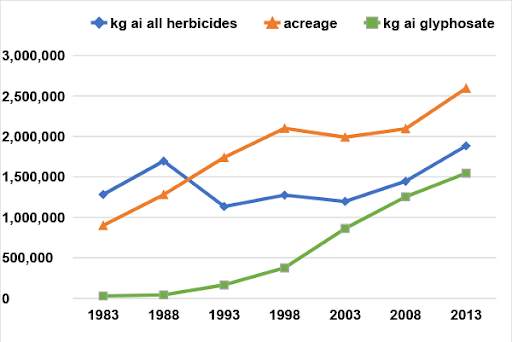
Corn Between 1983 and 2013, the total amount of herbicide used in field corn in Ontario declined by 39% (Figure 1). This reduction is primarily due to the increased use of glyphosate, which is applied at a lower rate of active ingredient (ai) per acre than the herbicides it replaced, increasing from 1% to 54% of the amount of all herbicides applied to field corn during that period. Furthermore, the decline in the total amount of herbicide applied occurred despite an 11% increase in the area grown to field corn (Figure 1).
Figure 1. Amount of herbicide applied to field corn and acreage grown in Ontario from 1983 to 2013. Drawn from OMAFRA data by Dufault & Saik.
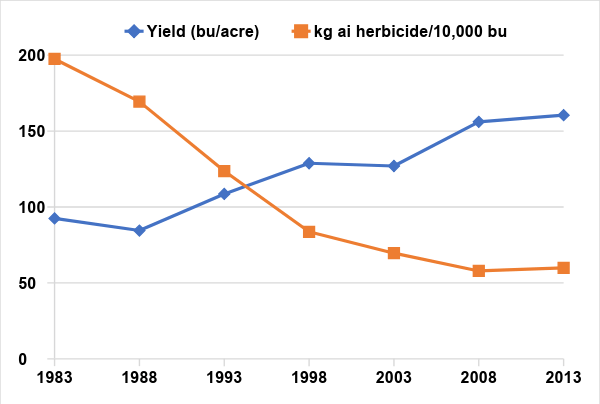
In that same 30-year period, the yield per acre of field corn increased by 74% (Figure 2). And due to a combination of the reduced amount of herbicide applied per acre and increased yield, the amount of kg ai of all herbicides applied per bushel produced declined by a whopping 70% (Figure 2).
Figure 2. Yield of field corn and amount of herbicide applied per 10,000 bushels in Ontario from 1983 to 2013. Drawn from OMAFRA data by Dufault & Saik.
Soybeans
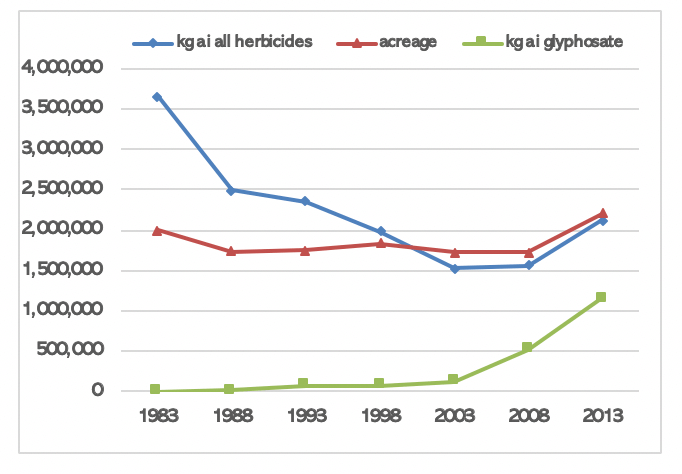
Soybeans are also a good news story. Between 1983 and 2013, despite the acreage of soybean grown in Ontario increasing by a massive 188%, the total amount of herbicide applied increased by just 47% (Figure 3). As with field corn, this is largely due to the replacement, by glyphosate, of other higher-rate herbicides; usage of glyphosate increased from 2% to 82% of all herbicides applied during that timeframe (Figure 3).
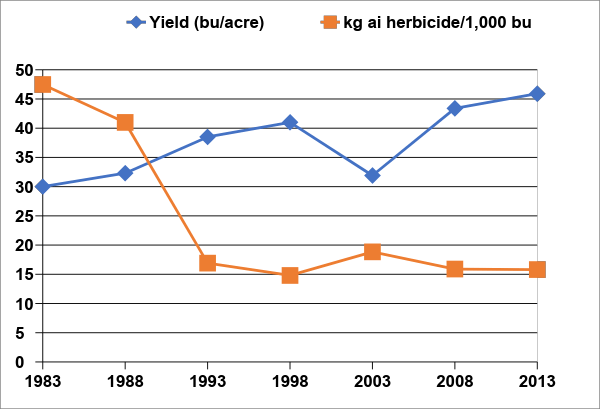
In that same 30-year period, the yield of soybean increased by 53% (Figure 4). And the amount of kg ai of all herbicides applied per bushel produced declined by an impressive 67% (Figure 4).
Figure 3. Amount of herbicide applied to soybeans and acreage grown in Ontario from 1983 to 2013. Drawn from OMAFRA data by Dufault & Saik.
Figure 4. Yield of soybean and amount of herbicide applied per 1,000 bushels in Ontario from 1983 to 2013. Drawn from OMAFRA data by Dufault & Saik.
Agronomic benefits of glyphosate
From an agronomic perspective, glyphosate has been referred to as a “once-in-a-century herbicide.” Being a broad-spectrum herbicide, it controls virtually all species of weeds and has been utilized mostly in conjunction with herbicide-tolerant crops since their first appearance in the mid-1990s. Glyphosate also largely eliminates the need for several applications of multiple limited-spectrum herbicide active ingredients that would otherwise be needed to control all the species of weeds present. Not only do these other herbicides generally have higher hazard/risk profiles (discussed below), but they are often more phytotoxic. The resultant crop damage reduces yields unlike when glyphosate is used in herbicide-tolerant crops. Economists have estimated that if the world ceased to grow genetically-modified herbicide-tolerant crops in the absence of glyphosate, the annual loss of farm income would be $6.76 billion and there would be substantial declines in the production of soybean, corn and canola.
The widespread adoption of glyphosate has also resulted in decreased tillage (or soil cultivation) as farmers have adopted minimum or zero tillage growing systems. This has profound implications because reduced tillage means lower greenhouse gas emissions from burning less fossil fuel as well as from reduced decomposition of organic matter in the soil. Additionally, the associated increase in soil tilth brings better water holding capacity and increased soil health.
EnvironmentalImpact Quotient (EIQ) and Environmental Impact (EI) of glyphosate
Based on the data just cited, it is apparent that the amount of herbicide used to produce field corn and soybeans in Ontario has declined due to glyphosate largely replacing other major herbicides that are applied at higher rates.
But, does a lower rate of application also mean reduced risk?
In conjunction with the results of the pesticide use survey, Ontario also published a report on the environmental risk associated with pesticide use in Ontario. This report used an Environmental Impact Quotient (EIQ) to estimate the hazard associated with the use of each pesticide recorded in the survey. Essentially, the EIQ is an indicator of the potential of a pesticide to cause harm. The EIQs for different pesticides can be compared and the higher the EIQ value, the greater the possible harm such as to farm workers, consumers and ecosystems.
Different ways of calculating an EIQ are found in the published literature. The particular EIQ used by Ontario in this study is calculated based on data taken from 12 different data points from safety tests conducted on pesticides in the laboratory and the field. Briefly, these include measures of short- and long-term toxicity in laboratory animals, half-life, whether systemic in plants (i.e., tendency to circulate through plant tissues), leaching and runoff potential, and toxicity to several species of non-target animals.
The reported EIQ for glyphosate was calculated to be just 15.3 which is the tenth lowest EIQ of all the pesticide active ingredients from the survey. Furthermore, glyphosate has partially replaced the use of herbicides with higher EIQs, including atrazine (EIQ = 22.9) in corn, and metolachlor/s-metolachlor
(EIQ = 22.0) in corn and soybeans, meaning it is less hazardous than these herbicides. This low EIQ for glyphosate is not surprising, considering that it is “less acutely toxic than common chemicals such as sodium chloride (salt) or aspirin.”
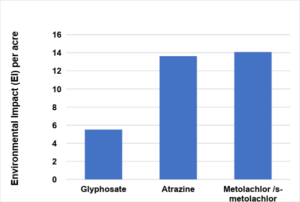
So, what about risk? This can be called environmental impact (EI) and is essentially hazard (EIQ) multiplied by exposure (i.e., amount used). Not only does glyphosate have a lower EIQ than the above-mentioned major herbicides that it replaces, but it is also recommended in Ontario for application at a lower rate per acre than the other herbicides when applied on their own. Whereas, the Ontario study calculated EIs for the use of glyphosate in the whole province, we have done so on a per acre basis. The combination of factors – lower EIQ and lower rate – means the EI for glyphosate per acre of field corn, for example, is about 60% less than for the major herbicides that it replaces (Figure 5).
Figure 5. Environmental impact (i.e., risk) per acre of glyphosate and two other herbicides in field corn in Ontario. Source data: EIQs from OMAFRA x recommended rates in Ontario of these herbicides applied on their own. Drawn by Dufault & Saik.
Health regulatory status of glyphosate
So, all the above is good news for producers and the environment. But it’s fair to say that the 12 data points used in estimating the EIQ are taken from a fraction of all the health and environmental studies done to assess the safety of pesticides. And, there’s the 2015 report from the International Agency for Research on Cancer (IARC) of the World Health Organization (WHO) that classified glyphosate as “probably carcinogenic to humans”.
This report has engendered much controversy as evidenced by the many points of view that can be found in the science community. We will simply say the following:
The IARC report took account only of published toxicity data on glyphosate.
The IARC report was a hazard assessment and did not include a health risk assessment that would take account of how glyphosate is used. Remember: hazard x exposure = risk.
The pesticide regulators in each country in which glyphosate is registered have access to much more substantial and relevant data sets than does IARC. For example, in addition to reviewing and validating published data, these organizations also review the extensive body of toxicology studies from registrants that are conducted using internationally-accepted protocols. These latter studies are also required to meet stringent Good Laboratory Practice (GLP) guidelines such as those of the Organization for Economic Co-operation and Development (OECD).
Regulatory agencies update their reviews of all registered pesticides at regular intervals; Canada and the USA do so every 15 years. And virtually all the pesticide regulatory agencies in the world, that have recently updated their reviews of glyphosate, have reconfirmed its safety and renewed its registration, in contrast to IARC’s assessment of glyphosate as being “probably carcinogenic to humans.”
Here’s a small sampling of what some of these regulatory agencies have published:
In March 2017, the European Chemicals Agency reported their determination that glyphosate is not classified as a carcinogen.
In its draft “Revised Glyphosate Issue Paper: Evaluation of Carcinogenic Potential” document for public comment dated December 12, 2017, the US Environmental Protection Agency stated that it had reviewed close to 170 epidemiological, animal carcinogenicity and genotoxicity studies, and that the available data do not support a carcinogenic process for glyphosate.
On April 28, 2017, Canada’s Pest Management Regulatory Agency (PMRA) reported in its completed re-evaluation of glyphosate that it is “unlikely to pose a human cancer risk.” In explaining why PMRA’s conclusions differed from those of IARC, PMRA stated “. . . the level of human exposure, which determines the actual risk, was not taken into account by IARC.” PMRA renewed the registration of glyphosate in Canada with only minor label changes.
Conclusion
While both corn and soybean acreage AND yield have increased in Ontario since 1983, the overall environmental impact of herbicide use per acre has declined in large part because glyphosate has displaced other more harmful major herbicide chemistries.
This reduction in risk is due to 1) glyphosate being less hazardous, based on the EIQ, compared with these other herbicides, and 2) glyphosate being applied at a lower rate. Major regulatory agencies, such as Canada’s PMRA, have recently reconfirmed the safety of glyphosate and renewed its registration.
Glyphosate has played a key role in enabling many farmers to achieve excellent weed control in herbicide-tolerant crops while adopting reduced or zero tillage. This reduction in cultivation has positive implications for the environment in terms of soil health, water holding capacity and greenhouse gas balance.
Christopher P. Dufault is a professional agrologist, and the former head of the Re-evaluation and Use Analysis Section of the Pest Management Regulatory Agency in Canada. Currently, he is a senior agri-coach with Agri-Trend and principal of Christopher P. Dufault & Associates Inc., based in Ottawa, Ontario, Canada. Email him at Christopher.dufault(at)cantab.net
Robert Saik, a professional agrologist and certified agricultural consultant, is the founder of Agri-Trend and principal of Saik Management Group Inc., based in Olds, Alberta, Canada. Email him at [email protected]. Follow him on Twitter @RSaik
For 22 years Myriad Genetics, one of the oldest genetic testing companies, has refused to make public its proprietary database of BRCA1 variants, which lists more than 17,000 known misspellings in that major “cancer risk” gene, along with the medical significance of each. The database lists which mutations increase the risk of breast and ovarian cancer, which do not, and which have an unknown health effect.
But now a blitzkrieg of biology has hacked the secret cache of life-and-death data.
By deliberately causing every possible mutation of the kind that occurs most commonly in BRCA1, and tracking how cells growing in lab dishes respond, scientists at the University of Washington determined which mutations are pathogenic and which are benign.
…
They also made that call for more than 2,000 variants whose health consequences have been unknown, a breakthrough that promises to spare thousands of women the anxiety of not knowing if their BRCA1 variant is a ticking time bomb or nothing to worry about.
…
The researchers have made their list of variant calls publicly available. They urge physicians and genetic counselors to use the results to inform patient care, including advising women who test positive for a risk-raising BRCA1 variant to consider steps such as mastectomy and oophorectomy, as Angelina Jolie famously chose, or telling those whose variant is innocuous that they can breathe easier.
If you do a Google search of “Oz superfoods” you will get more than 40,000 hits. The good doctor really likes superfoods. One small problem – there is no such thing, his self-serving proclamations notwithstanding.
A really good doctor, David Seres, the Director of Medical Nutrition at Columbia University Medical Center, and also an expert advisor for the American Council, has a few qualities that Dr. Oz lacks:
Expertise
Ethics
Credibility
In his recent piece in The Hill Seres takes apart the superfood myth, both scientifically and economically.
Now, more than ever, it’s easy to find high-price, locally grown, organic produce alongside “superfoods” like pomegranate juice, acai berries and chia seeds. Toss it all together into a sleek $400 blender and you’ve got the cure for whatever ails, except for credit card debt.
David Seres, M.D.
…
But these foods are marketed for wealthy (and gullible) people. Seres writes:
Superfoods are certainly within reach for upper middle class urbanites folks. They often live near cities and can get an antioxidant probiotic rich $12 kumquat or lemon cucumber smoothies in one of a dozen trendy bars.
The heated debate lasted all night, but the [French] National Assembly rejected all amendments to include a [glyphosate] herbicide ban in the agriculture and food law, for reasons similar to those put forward last May, during the first vote on the issue.
On September 15th, the deputies rejected a new reading of the agriculture and food bill that would codify the presidential commitment to prohibit the controversial herbicide, “at the latest in three years.”
…
In May, during the first reading of the text, deputies …. had already pleaded unsuccessfully to protect the presidential commitment to ban glyphosate. They had the support of Nicolas Hulot, then Minister of Ecology. Since the spring, the Agriculture Minister Stephane Travert has opposed the amendments ….
Editor’s note: This article was originally published in French. This summary was prepared with Google Translate and edited for clarity.
Because ALS primarily affects a person’s motor neurons, it has been assumed that the disease spares a person’s mental faculties. But the evidence behind this assumption has started to crumble, according to senior author Sharon Abrahams, a researcher at the University of Edinburgh in the United Kingdom.
…
“It was considered as a saving grace. ‘Although my body is affected, my mind is intact,’” Abrahams said. “Sadly, this is incorrect.”
…
They recruited 161 ALS patients receiving care at one of three medical centers in the UK and Ireland, interviewing them and their caretakers. As part of the interview, the patients were given tests that measured their cognition and memory.
…
Overall, 29 percent of ALS patients had some form of cognitive impairment, while around half had at least one behavioral symptom. These symptoms, such as apathy or a lack of empathy, were seen in people at every stage of ALS, but largely became more common as the disease advanced (memory problems were more common in ALS sufferers, but didn’t become more prevalent in the later stages). By the last stage, few people were completely symptomless.
…
If nothing else, they point out, taking into account a sufferer’s mental as well as physical health will allow them to live as comfortably as possible before their final days.
Opioid drugs like morphine and Oxycontin are still held as the gold standard when it comes to relieving pain. But it has become brutally obvious that opioids have dangerous side effects, including physical dependence, addiction and the impaired breathing that too often leads to death from an overdose. Researchers have long been searching for a drug that would relieve pain without such a heavy toll.
…
Now a study in monkeys published in Science Translational Medicine shows a new type of opioid drug met all the criteria on drug developers’ wish list. The findings even suggest that instead of causing addiction, the new compound might be used to curb addiction and pain all at once.
…
Opioid drugs relieve pain by acting at four types of opioid receptors found throughout the nervous system. The mu opioid receptor is primarily responsible for opioids’ pain-relieving effects.
…
Studies of [another receptor,] NOP, have shown that it too has analgesic effects in rodents—but seemingly without the side effects.
…
Even at higher doses, AT-121 did not cause the side effects that make most opioids so dangerous—suppression of breathing and heart rate, itch and physical dependence (in which stopping use leads to withdrawal symptoms). Even after several doses AT-121 retained its analgesic effect whereas most opioids require an increasing dosage over time to achieve pain relief.
Scientists are demonstrating the efficacy of plant biotechnology by taking Cornell Alliance for Science Global Leadership Fellows through the process of making genetically engineered crops.
Misinformation about biotechnology among global communities has inspired scientists to open up their workstations to the Fellows, some of whom are non-scientists, to explain how they advance indigenous breeding knowledge to produce food through the use of science.
…
People have been modifying plant genetics for over 10,000 years, first by domesticating plants that had desirable traits. Over 500 species of plants and animals have been domesticated by humans. People have further modified plant genetics through traditional plant breeding. Now scientists can also use genetic engineering and gene editing to improve plants.
…
Dr. Matthew Willmann, director of Cornell University’s Plant Transformation Facility, explained the importance of scientists …. communicating how they develop GE crops. ”I have interacted with participants who believe only GE crops have DNA, which is not true,” Willmann said. “All plants have DNA.”
…
Cornell Prof. Anthony Shelton demonstrated the safety of Bacillus thuringiensis (Bt) a gene used in the modification of maize and cotton. He tasted the Bt protein, which he said was harmless to human beings …. In order to control insects, would you would rather use Bt …. or apply pesticides, which will harm the environment? Shelton concluded
Longer lives seem attractive, but as we age we become susceptible to a host of late-life diseases that can prevent us from enjoying our later years. But science is beginning to create ways to increase our healthspan, not just our lifespan.
…
Research is starting to tease out ways of tackling the problem, according to a recent paper in Nature, from obvious fixes like increasing exercise and eating less to more exotic interventions so far only tested in animals that could eventually help rejuvenate us.
…
Obviously there’s some low-hanging fruit—not smoking, drinking less, and doing regular exercise are surefire ways to boost your lifespan.
…
There are also more radical approaches to preventing aging that are just starting to enter the mainstream. Senescent cells, which stop dividing and leak damaging inflammatory chemicals into their surroundings, have long been implicated in aging. A recent study found that using a pair of drugs to wipe them out boosted the lives of old mice by 36 percent.
…
How many of these interventions will prove effective in humans and how many people will stick to them remains to be seen, but what’s clear is that aging need not be inevitable. The elixir of eternal youth may not be as far off as we think.
When Daniel Robertson was a kid growing up in Columbia, South Carolina, he got chased off by farmers once or twice for playing in their fields. But it wasn’t until he was an adult when he realized that the fallen corn he and his friends used to hide in cost these farmers a lot of money.
As a mechanical engineering professor at the University of Idaho, Robertson now studies what’s called stalk lodging. New varieties have beefed up how much each plant can produce, but that made them top heavy.
“The grain has gotten so heavy that the wind just blows them over and knocks them down and then the grain falls to the ground and rots,” he says.
…
Robertson and his team at U of I, University of Kentucky and Clemson University will target certain plant traits that keep them upright and encourage breeders to adopt them in future varieties.
To help find these traits, he takes a CT scan of a plant and uses his mechanical engineering background to find its weakpoints and strengths. These researchers have also developed tools that farmers can use in their fields to pinpoint their weaker crops.