The European Court of Justice has ruled that organisms altered using gene editing tools should be subjected to the same rules as genetically modified organisms (GMO) …. the US Department of Agriculture held that only genetically modified organisms (GMO), and not genetically edited organisms, deserved special regulation.
However, India should create its own framework for regulating genetically edited organisms instead of following either the European or American models.
Climate change, loss of arable land and increasing human population have together strained our existing food resources, so new plant traits are needed to cater to the rising demand …. Plant breeding, gene-modification and gene-editing are all tools to achieve genetic changes that lead to better plant varieties.
…
There are risks associated with the use of any emerging technology …. However, these risks can only be alleviated through transparent governance, not through moratoria …. Examples of impactful GMOs include Bt cotton, which has made India a global leader in cotton production, golden rice, which is under trial in Philippines and Bangladesh, and Bt brinjal, which has made considerable progress in Bangladesh.
…
If India classifies genetic editing as gene modification – and so dooms GEOs to the fate of GMOs – we will be signalling our unwillingness to participate in the genetic editing race, whose winner will clearly hold the key to development in the 21st century.
Blood transfusions must match the blood type of a donor to that of the recipient; otherwise, the recipient’s immune system could attack the foreign blood, causing severe illness. [August 21], scientists at the 256th National Meeting & Exposition of the American Chemical Society report promising new steps towards hacking this system, using bacterial enzymes derived from the gut microbiome to convert restrictive blood types into more universal blood.
There are four main types of blood: AB, A, B and O blood, distinguished by the sugars red blood cells carry on their surface, called antigens.
…
As it turns out, “gut microbes are professionals at breaking down sugars,” according to Katharine Ng.
…
Sugar-laced proteins line the wall of the intestine—and some of these elaborate sugars resemble the same A and B antigens found on blood cells. What’s more, many gut microbes harvest these sugars by plucking them off the intestinal lining.
…
In the end, the team was left with 11 possible enzymes that were active against A antigen and one against B antigen—including one extraordinarily promising enzyme that was 30 times more effective against A antigen than the one discovered in 2007.
…
When the researchers next tested their powerful new enzyme against real type A human blood, the results were the same—and only a minute quantity of the protein was needed to wipe the blood clean of the offending sugars.
Over the past few years, many [DNA testing companies] have branched out into the realm of precision health, treading into ethically dangerous territories.
…
The major problems with these tests are two-fold. First, many of the tests lack scientific validity to support the genetic outcomes revealed to their customers.
…
Second, there is no professional counseling required before and after the consumer receives her results.
…
The lack of context attendant with consumer DNA testing for health reasons is a serious and potentially harmful issue. 23andMe, for example, only tests for three of the most common BRCA mutations associated with an increased risk of getting breast cancer. In fact, there are almost 1,000 BRCA mutations that need to be assayed to provide an accurate assessment.
…
In one small study, Ambry Genetics examined 49 samples sent in by physicians whose patients had been told that they had disease-causing mutations by a third-party vendor. Ambry Genetics found that 40 percent of the results were wrong.
…
The complexity of genetics and disease risks mandates an ethical directive that customers requesting such tests should also require genetic counseling and education, both prior to doing the tests and after receiving their results. DNA testing for health by clinically certified laboratories is the only logical way to proceed.
The honeybee, Apis mellifera, has been the dominant pollinator for decades but now is threatened by pesticides, pathogens, parasites and poor nutrition. Last year, beekeepers in the United States lost an estimated 40 percent of their managed honeybee colonies, according to the Bee Informed Partnership, a nonprofit that advises beekeepers.
Some years that number is even higher, according to Mark Winston, a professor of apiculture at Simon Fraser University in British Columbia and author of several books on bees. “Is there another agricultural enterprise that accepts an annual loss of 40 to 45 percent of its animals?” he asked.
…
One-third of our food …. must be pollinated in order to grow. Some scientists warn of risks to agricultural food supplies if there aren’t enough pollinators.
As honeybee prices continue to rise, farmers are turning to other types of bees — like the blue orchard bee, the bumblebee and alfalfa leafcutter — that have proven to be effective pollinators of some crops in certain settings.
[R]esearchers across the country have been studying how so-called integrated crop pollination — or combinations of varying bee species — can help growers ensure reliable pollination.
In May, [startup Beta Bionics] received Food and Drug Administration approval to start clinical trials on what it calls a “bionic pancreas system” powered by artificial intelligence, capable of “automatically and autonomously managing blood sugar levels 24/7.” An artificial pancreas powered by artificial intelligence represents a huge step forward for the treatment of diabetes—but getting it right will be hard.
…
[A]rtificial intelligence techniques involved are typically opaque. We often don’t know how the algorithm makes the eventual decision. And they may change and learn from new data—indeed, that’s a big part of the promise. But when the technology is complicated, opaque, changing, and absolutely vital to the health of a patient, how do we make sure it works as promised?
…
Diabetes software doesn’t exactly have the best track record when it comes to accuracy. A 2015 study found that among smartphone apps for calculating insulin doses, two-thirds of the apps risked giving incorrect results.
…
[C]ompanies like to keep their algorithms proprietary for a competitive advantage, which makes it hard to know how they work and what flaws might have gone unnoticed in the development process.
…. (CRISPR) technology has enabled genetic engineering feats previously considered impracticable, offering great hopes for solutions to problems facing society. We consider it timely to highlight how CRISPR can benefit public health, medicine, and agriculture in sub-Saharan Africa [SSA] ….
…
Crops and animals in SSA also face many pests and pathogens. Breeding programs attempt to tackle these but have so far achieved little. CRISPR could help breeders in SSA to produce improved farm animals or crops with pest/disease resistance or other desirable traits. Exploitation of CRISPR to modify different plants has been demonstrated and the recent genome editing in the tropical staple, cassava sets the stage for greater attempts at realizing food security in SSA.
…
Transparency and education of local people are other factors that will affect successful implementation of CRISPR in SSA. Due to societal vulnerability to rumors and conspiracy theories if knowledge of new programs or technologies is lacking, it is important to create adequate awareness and to educate local communities.
There’s a potentially huge technology risk on the horizon [for] fertilizer companies …. next-generation biotech products called microbials ….
Microbials are essentially probiotics for plants. A plant’s root system can feast on a buffet of water and a wide range of nutrients present in the soil. However …. plants are unable to break down or process all the available nutrients without help from friendly bacteria or fungi. These microbes happily colonize a plant’s root system …. to feed themselves and, in turn, feed the plant …. They can also [serve] as a natural defense against [pests]
Scientists can scour farmland for the best soil microbes, isolate them, study them in automated laboratories, select the best performers, grow them in large fermentation tanks, and coat them onto plant seeds. Farmers plant the seeds as they normally would, and reap the naturally protective qualities of biology — all while greatly reducing or eliminating the need for traditional inputs like chemical pesticides and synthetic fertilizers.
The niche industry for microbials exploded …. when Monsanto …. signed a $600 million collaboration agreement with global industrial biotech leader Novozymes. The partnership became the BioAg Alliance …. [Its] first products were capable of increasing corn yield by 4 bushels per acre …. [compared] to the average annual yield increase of 1.9 bushels per acre for American corn farmers since 1986 ….
[I]n Bavaria, the Jurassic-aged limestone deposits yielded a near-perfect fossil of Archaeopteryx. It had blade-like serrated teeth and many other features across the skeleton and skull that showed it was a carnivorous dinosaur. But the crow-sized specimen was covered in the impressions of bird-like feathers. For [Thomas] Huxley, this was the transitional form he was seeking: a dinosaur on its way to becoming a bird.
…
[I]t was feathers that provided the final incontrovertible evidence that birds evolved from dinosaurs.
…
Since then, a spectacular array of small, feathered dinosaurs have been recovered from Liaoning and a few other sites around the world, which plot every conceivable evolutionary step from small fuzz-covered, meat-eating theropods through to fully feathered and winged birds.
…
Beginning as simple downy filaments, they had probably originated to keep theropods warm – evidence supporting the theory that at least some dinosaurs were ‘warm-blooded’. They may also have served as ornaments. Festooned with arm feathers, smaller theropods’ plumage would have given them a degree of lift to chase flying insects.
This set of features – small with lightweight bones, rotated shoulder sockets with a furcula, turbocharged breathing systems and feathers – developed in theropods long before they took to the air and set the scene for protobirds.
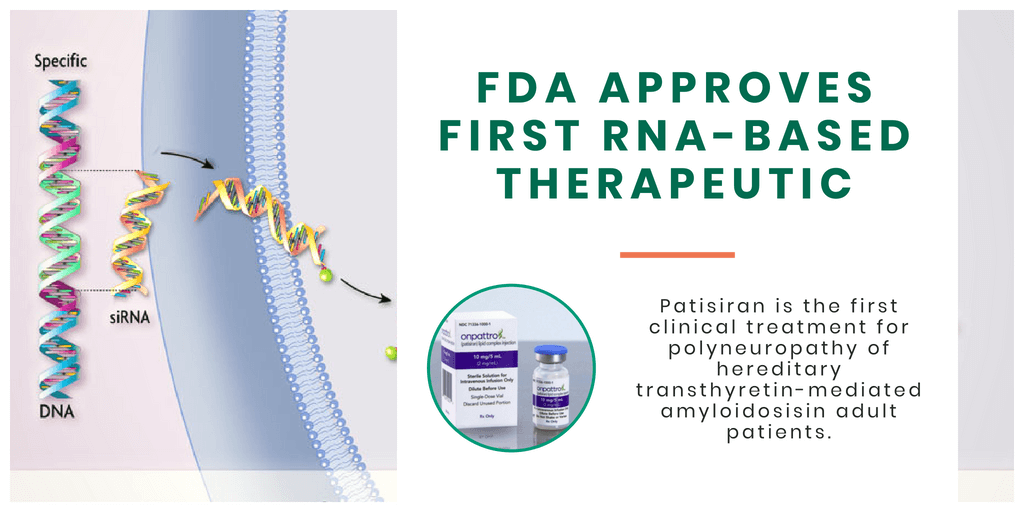
The Food and Drug Administration recently approved the first drug based on RNA interference (RNAi). Unlike media darlings gene therapy and gene editing, RNAi silences genes. The first approval is a milestone two decades in the making.
The new drug, Onpattro (patisiran), treats the tingling, tickling, and burning sensations from the rare condition hereditary transthyretin-mediated amyloidosis, aka hATTR. About 3,000 people have it in the US. Alnylam Pharmaceuticals provides this “first-of-its-kind RNA interference (RNAi) therapeutic.” Like other new nucleic-acid based treatments, it’s pricey. The cost per year for the every-third-week intravenous infusion is $450,000.
A Disease of amyloid deposition
Other symptoms of hATTR are poor balance, recurrent urinary tract infections, lightheadedness when standing, gastrointestinal effects (diarrhea, nausea, vomiting) and heart arrhythmias that can be fatal. The disease is progressive, limits mobility and patients become anxious and/or depressed. It’s ultimately life-threatening.
The protein that is abnormal in hATTR is transthyretin, aka prealbumin. Made in the liver, transthyretin molecules normally gather into quartets that carry vitamin A. But when a person has a mutation in one of the two copies of the gene, the resulting differently-shaped versions of transthyretin can’t form quartets. Instead, they become spiky fibrils that collect as sheets that are deposited as a gummy mess, called amyloid, in various tissues — the GI tract, liver, heart, and peripheral nerves.
“Amyloid” may sound familiar because of its link to Alzheimer’s disease — it’s actually a general term that refers to 25+ types of proteins that become sticky if genetic changes disrupt their normal aggregation. Amyloids plug up vital structures. Build-up of amyloid-β peptide lies behind Alzheimer’s disease, islet amyloid polypeptide is in type 2 diabetes, and prion protein buildup causes mad cow disease. The first amyloid protein was discovered in poached egg whites in 1935.
The amyloid version of transthyretin in hATTR shortens lifespan, to 2 to 5 years after onset of neuropathy if the heart is involved, and up to 15 years if not. More than 120 mutations are known in the gene. Diagnosis requires genetic testing and liver biopsy to identify excess transthyretin.
This new drug may provide a more lasting effect than current treatment, which is liver transplant or drugs that keep the protein quartets together.
Two decades in the making
RNA interference is a natural process in cells that controls expression of specific genes. Short, double-stranded RNA molecules, called small interfering RNAs (siRNAs), bind to messenger RNAs (mRNAs) that bear complementary sequences. The action blocks formation of the protein that the mRNA encodes.
Transthyretin proteins normally aggregate into quartets, which bind and carry vitamin A.
Andrew Fire and Craig Mello discovered and described RNAi in 1998, for which they received the Nobel Prize in Physiology or Medicine in 2006. Among an initial flurry of companies formed around the discovery and big pharma interest was Alnylam, founded in 2002. They stuck it out. But the long development time isn’t unusual. Two decades is a more typical timeline from discovery to regulatory approval for a drug than what’s been touted for CRISPR gene editing, first described in late 2011.
Gene silencing technologies target mRNAs, which are the go-betweens that carry a gene’s sequence information out of the nucleus and into the cytoplasm, where the encoded amino acids are strung together to form the corresponding proteins. FDA Commissioner Scott Gottlieb oversimplified when he dubbed the new treatment “targeting the root cause” of the disease, because RNAi isn’t a forever fix like gene therapy and gene editing can be. That’s why regular infusions of Onpattro are necessary — RNAs are short-lived intermediaries, compared to the permanence of genes.
Technical aside: RNAi follows a complex biochemical choreography. First an enzyme called Dicer cuts long RNA molecules into shorter ones that fold into hairpin shapes as some of its bases attract, A and U pairing and G and C pairing. Then a complex of proteins (called RISC, for “RNA-induced silencing complex”) recognizes and teases apart the hairpins and snips them down to 21 to 24 bases. These smaller pieces locate their complements among the mRNAs in the cell, bind them, and then a part of RISC called argonaute degrades the targeted RNA. Protein levels plunge.
Potential applications of RNAi are easy to envision: block a ripening enzyme and a fruit stays fresher longer. Block caffeine synthesis to create de-caf, oncogenes to prevent cancer, viral DNA to prevent infection, and single genes to treat single-gene diseases – like hATTR.
Mis- and disinformation are distorting science and public policy. Subscribe to our Daily and Weekly Digests for incisive coverage of ‘disruptive’ innovations in AI, agricultural biotechnology, food, chemicals, nuclear energy, vaccines, and other disruptive innovations.
Onpattro is a double-stranded siRNA with 21 bases on each side of the classic hairpin.
A multinational team reported phase 3 clinical trial results in the July 5, 2018 New England Journal of Medicine that led to the FDA approval. In the double-blinded study, 148 patients received the drug and 77 received placebo. When assessed for neuropathy 18 months later — motor strength, reflexes, sensation, nerve conduction and dizziness on standing — as well as walking ability, 56 percent of treated patients improved in polyneuropathy, mobility and quality of life, compared to 4 percent in the placebo group.
In aHTTR, transthyretins can’t aggregate and gummy amyloid forms.
Onpattro targets a part of the gene that’s unchanged by any mutation, so it blocks production of both normal and abnormal transthyretin in liver cells — patients make both because one copy of the gene is mutant and the other is not (the inheritance pattern is autosomal dominant). The clinical trial participants had 39 distinct mutations, but it didn’t matter because any mutation disrupts the aggregation, triggering amyloid formation. The specifics of the mutations aren’t as important as they are for a disease like cystic fibrosis, in which both copies of the gene are mutant and so no normal protein forms (the inheritance pattern is autosomal recessive). That’s why the drug Kalydeco treats only patients with certain CF mutations.
The hATTR community is thrilled. “For years I have witnessed the tragic impact of hATTR amyloidosis on generations of families. It’s extremely gratifying to see promising science translate into a treatment option that will allow patients to potentially experience an improvement in their disease and an improvement in their overall quality of life,” said Muriel Finkel, President of Amyloidosis Support Groups.
Although priced at $450,000 per year, the company will help by refunding insurance companies if the drug doesn’t work, as described in this Forbes article.
An antisense alternative
A second RNA-based drug is in development to treat hATTR, called Tegsedi. Phase 3 clinical trial results are published in the same issue of the NEJM as for Onpattro. Tegsedi hails from Ionis (formerly Isis) Pharmaceuticals’ affiliate Akcea Therapeutics and was approved in the European Union July 11. In late 2016 FDA approved a similar Ionis antisense drug, Spinraza, to treat spinal muscular atrophy.
Tegsedi uses another variation on gene silencing, a 25-base molecule similar to RNA but with a different chemical backbone. It’s an “antisense oligonucleotide.” (“Antisense” means a complementary nucleic acid sequence and “oligonucleotide” means a short DNA or RNA-like molecule.) The drug binds target mRNAs much in the way of RNAi, even using some of the same helper proteins.
In the Tegsedi clinical trial, 112 patients received the drug as a weekly injection under the skin and 60 received placebo, although only 139 participated until the end, 15 months later. Treated patients improved, but 16 had adverse effects (kidney problems and poor clotting) and five died, compared to none dying in the placebo group. Four of the deaths were due to disease progression and the fifth had a brain bleed following plummeting platelets.
Both new RNA-based drugs to treat hATTR lowered levels of the gummy protein in the blood. An editorial concludes that the investigations represent a landmark in treating this rare disease.
Perspective: progress takes time
Nucleic-acid based treatments and interventions are still in their infancy. The first FDA approval came nearly a year ago, August 30, 2017, for Kymriah, created using chimeric antigen receptor T cell (CAR-T) technology. It delivers a novel dual DNA sequence that encodes bits of an antibody and a T cell receptor, acting like an armed drone veering to targeted cells.
Although hailed by some as a form of gene therapy, Kymriah treats a form of leukemia, not a classic genetic disease, for which gene therapy was initially envisioned. The first gene therapy approval for a single-gene disease, for a type of retinal blindness, was December 18, 2017. The first regulatory approvals for treatments using CRISPR are likely years out, although approaches using older gene editing techniques, like zinc finger proteins, may come sooner because they’ve been investigated for longer.
The bigger picture is that new ways of treating disease take time to nurture and optimize. Still, a decade or so from now, physicians will be able to choose from a new type of pharmacopeia borrowed from the ways that cells naturally control their protein production.
Ricki Lewis is the GLP’s senior contributing writer focusing on gene therapy and gene editing. She has a PhD in genetics and is a genetic counselor, science writer and author of The Forever Fix: Gene Therapy and the Boy Who Saved It, the only popular book about gene therapy. BIO. Follow her at her website or Twitter @rickilewis.
CRISPR. It’s not what’s for dinner. Not yet, at least. But the hot genetic editing technology could be instrumental in reducing the multi-billion global problem of food spoilage and waste.
J.R. Simplot, the Boise, Idaho, firm that introduced two generations of potato using RNA interference (RNAi) to block gene expression that induced browning, recently announced that it has licensed CRISPR-Cas9 technology from Corteva Agriscience (a division of Dow DuPont), and the Broad Institute of MIT and Harvard University. The company plans to use the popular new technology to give its fruits and vegetables a longer shelf life.
If successful, these are the types of advances that could help prevent the sort of waste that comes from people tossing out vegetables and fruits deemed to be damaged or old. Each year, consumers throw away an estimated 400 million pounds of bruised and brown potatoes. The volume of waste grows substantially, when you consider all of the other things we eat. From National Geographic in 2014:
The Food and Agriculture Organization (FAO) of the United Nations, which keeps tabs on what’s grown and eaten around the globe, estimates that one-third of food produced for human consumption worldwide is annually lost or wasted along the chain that stretches from farms to processing plants, marketplaces, retailers, food-service operations, and our collective kitchens.
If Simplot, and its competitors, are successful in their attempts to use newer breeding techniques, including CRISPR, they will essentially be making our perishable foods less perishable. Yet, we can expect those efforts to meet resistance from anti-GMO groups and other organizations. Some, like Green America, have claimed that using genetics to address food waste is a waste of money and time. They argue that we need only be smarter with the food we have:
At the same time that there is great hunger there is also excessive food waste throughout the world. It is even worse in the western hemisphere; the US alone wastes 40 percent of its food. In western countries, grocery stores throw out a lot of food and will not purchase unattractive produce. Food is wasted simply because it is visually unappealing or goes uneaten. In developing nations food waste is a result of a lack of infrastructure, capital investment, and basic necessities. Lack of access to road ways, storage facilities, and basic refrigeration prevents food access and increases spoilage rates. With proper investment and support these problems could be remedied.
In one way, Green America is correct. There are two ways that food doesn’t make it from the farm to fork. The two vary depending on whether the food is wasting in a developing country, or an industrial one. Food loss is much more prevalent in the developing world, as crops face pests in the field, poor storage after harvest, and even more losses on the way to market. In the developed world, agricultural practices (including the use of pesticides, climate-controlled storage, and efficient transport) bypass losses, but waste occurs after the sale of food, as customers dispose of uneaten food for a variety of reasons. The difference in definitions is potentially important: a 2017 University of Minnesota study showed that estimates of Americans “wasting” $165 billion in food annually could be way off, because definitions of waste are not remotely consistent, leading to a wide range of conclusions that could affect policy.
Mis- and disinformation are distorting science and public policy. Subscribe to our Daily and Weekly Digests for incisive coverage of ‘disruptive’ innovations in AI, agricultural biotechnology, food, chemicals, nuclear energy, vaccines, and other disruptive innovations.
But the organization appears to want to sidestep genetics as a “proper investment and support.”
Simplot’s potato would not be the first time CRISPR was used to address spoilage (and therefore, waste). In 2016, a group of researchers from Pennsylvania State University developed a mushroom that was edited using CRISPR-Cas9 to prevent browning. The edits were aimed at genes that encode polyphenol oxidase (PPO), an enzyme known to cause browning in a wide range of plants. Significantly, the USDA’s Animal and Plant Health Inspection Service (APHIS), which regulates mushroom crops, decided that the new type of mushroom didn’t require regulatory approval from the agency, because the breeding process did not involve DNA from viruses, bacteria, or other “foreign” plant pests.
And so far, the USDA has indicated that it will continue to not regulate gene-edited products. However, the FDA is planning on regulating gene editing, according to Commissioner Scott Gottlieb. The agency is still in the midst of rule-making, and Gottlieb promised an “innovative and nimble” rule for CRISPR and similar technologies. And on August 22, the Japanese government announced that its agriculture regulations on genetic technologies would not apply to CRISPR and editing techiques.
Meanwhile, on July 25, the Court of Justice of the European Union ruled that gene-editing techniques are subject to existing regulations governing genetically modified crops, which are quite restrictive in Europe. The ruling limits gene-editing in Europe to research. And groups that have long been opposed to any genetic manipulation are gearing up for similar battles against CRISPR.
Andrew Porterfield is a writer and editor, and has worked with numerous academic institutions, companies and non-profits in the life sciences. BIO. Follow him on Twitter @AMPorterfield.
The Government of St Vincent and the Grenadines has placed an immediate suspension on the importation of pesticides that contain the acting ingredient glyphosate.
Acting on the advice of the Pesticides Board, the government said the chemical is found in pesticides such as Round-Up, Touchdown, and Glyphos.
According to a statement on [August 24th], the move is pending a technical review by the Ministry of Agriculture, Forestry, Fisheries, Rural Transformation, Industry, and Labor.
…
Meanwhile, the Caribbean Agriculture Research and Development Institute, the Food and Agriculture Organization of the United Nations and the Inter-American Institute for Cooperation on Agriculture have been [asked] to provide support to the Ministry of Agriculture to conduct a full chemical analysis of the products.
…
…. Agriculture Minister Saboto Caesar has called on all stakeholders to [abide] the suspension on the importation of the chemicals “in light of the nation’s quest to promote a safe working environment and good agricultural health and food safety practices.”
Are we too vulnerable to asteroid strikes and other cataclysms to stick with our single planet?
…
Frédéric Marin is among those who are doing the hard thinking. The University of Strasbourg astrophysicist has been focusing not on the engineering issues of interstellar travel (which lie beyond current technology) but on the biology side of the question: How many crew members would be needed for an interstellar voyage that might last dozens of generations? In other words, what is the minimum number of people required to deliver and successfully plant a self-sustaining population of Homo sapiens on another Earth?
…
Marin created a computer program that mimics the progress of a breeding population. Then he used the program, dubbed Heritage, to simulate the risks a spacefaring population would face, including the effects of inbreeding as well as of catastrophic events like a deadly pandemic or being hit by some celestial object.
…
The number Marin came up with is 98. Just 98 healthy people would be needed to operate the ship over many generations and to set up a healthy (non-inbred) population on another world, he estimates.
…
So even if billions of humans were wiped out by some catastrophe, as long as a suitable group of 98 survived and were able to mate, Marin says, they could carry enough genetic diversity to propagate the species and rebuild the population.
The number of U.S. lawsuits brought against Bayer’s newly acquired Monsanto has jumped to about 8,000, as the German drugmaker braces for years of legal wrangling over alleged cancer risks of glyphosate-based weedkillers.
Bayer had previously disclosed 5,200 such lawsuits against Monsanto, which it acquired in a $63 billion deal completed in June.
“The number of plaintiffs in both state and federal litigation is approximately 8,000 as of end-July. These numbers may rise or fall over time but our view is that the number is not indicative of the merits of the plaintiffs’ cases,” Bayer Chief Executive Werner Baumann told analysts in a conference call on [August 23rd].
…
CEO Baumann reiterated Bayer’s view that the jury’s verdict on Aug. 10 was inconsistent with the science-based conclusions of regulators.
Bayer said it will initially petition the judge to reverse the jury’s verdict from Aug. 10, and “if necessary” challenge the ruling with California appellate courts, which will take at least a year.
When asked whether Bayer would consider settling cases out of court, he said: “We will vigorously defend this case and all upcoming cases.”
Using dicamba as a preplant weed-management tool or abiding by state cutoff dates for postemergence applications may be a way to make dicamba-tolerant soybean systems palatable for 2019.
…
[C]omplaints about off-target applications on soybeans are down compared with 2017. Kevin Bradley, University of Missouri Extension weeds specialist, pointed out that as of July 25 [2017], 1,411 dicamba-related injury investigations were being conducted by the various state agriculture departments. University weed scientists estimated dicamba had injured approximately 2.5 million acres of soybeans.
…
Still, Bradley asks if the official dicamba-related injury investigations and/or approximately 1.1 million acres of dicamba-injured soybean constitute a problem for U.S. agriculture. He also asks if all this can be explained by some combination of physical drift, sprayer error, failure to follow guidelines, temperature inversions, generic dicamba usage, contaminated herbicides, and improper sprayer clean out, but not volatility.
…
The EPA registration for dicamba used in dicamba-tolerant systems expires on November 9 [2018] …. It’s expected EPA will soon announce its intent, as farmers are starting to select seed for 2019 …. state-specific cutoff dates are a better way to lower off-target dicamba movement than federal rules.
One possibility may be to enact dicamba application zones modeled after soybean maturity zones, with corresponding postemergence cutoff dates. This builds upon applicator training conducted last winter by universities and industry.
[Recently], more than 70 people overdosed on the synthetic marijuana known as K2 during a single 24 hour period in New Haven, Connecticut.
…
In July, the FDA issued a statement warning about the unique dangers of these synthetic drugs.
The illicit substances are all lab-made cocktails of compounds that attach to cannabinoid receptors, which are the same ones in the brain that marijuana binds to. They’re usually sprayed onto plants and smoked. But despite the name and the method of consumption, these drugs are very different than leafy green cannabis, and can cause major health problems.
These synthetic drugs are often called the same thing—K2, Spice, or Black Mamba being among the most popular—but individual batches all contain different chemicals and aren’t regulated at all. As long as the chemical compound binds to a cannabinoid receptor, it’s likely to be packaged and sold as K2 without any sort of testing.
…
Additionally, the synthetic compounds are all far more potent than the cannabinoids in marijuana plants. If the cannabinoid receptors were a dial, the plant would consistently turn it up a few notches. The synthetic compounds, on the other hand, would spin it freely.
…
“This is a constantly changing landscape,” [toxicologist Andrew] Monte says. “Until we come up with a more robust surveillance network and substance abuse education platform, we’ll continue to have these outbreaks of severe illness.”
When the robot revolution arrives, we all know the plot: Smarter machines will supersede human intelligence and outwit us, enslave us and destroy us. But what if it’s not artificial intelligence we have to fear, but artificial stupidity? What if it isn’t robot overlords that pose the greatest risk but our willingness to trust robots, even when they are clearly wrong?
…
A new study published in Science Robotics reveals how easily robots can influence the judgment of children, even when the robots are clearly in error — raising warning flags for parents and anyone thinking about the need for regulation. In the experiment, two groups of children, between 7 and 9 years old, were asked to complete a simple task: choose which two of several lines are the same length. One group did the task alone, and the other did the task while seated at a table with three autonomous robots that gazed at the same puzzle, paused and answered the question — incorrectly. The children who faced misleading robot peer pressure did less well, and three-quarters of their wrong answers were the same as the robots’ bad answers.
…
“Children are known to suspend disbelief,” said Anna-Lisa Vollmer, a researcher at Bielefeld University in Germany, who led the study. “Rather than seeing a robot as a machine consisting of electronics and plastic, they see a social character.”
[L]ook out into the future to the year 2050. Do you think our future food conversations will be more or less divisive than they are today? As much as I hope the opposite, I suspect that we’re likely to have more disagreement, not less, as we go forward.
Other’s have posited a similar phenomenon in the domain of food. For example, see Ellyn Satter in this 2007 academic article where she lays out a hierarchy of food needs ….
[W]hen people are highly income and resource constrained, people are asking questions like, “how do I get enough calories to eat?” Once that question is answered, they can then [ask]: “Is this food safe?” As a person (or country) develops and gains more income, they move from food being primarily consumed to survive to food consumption eventually serving as a form of self expression ….
…
[T]he Pew Foundation found that the widest gap between the general public and scientists was on the topic of the safety of GMOs. Clearly, something other than peer-reviewed science is driving many people’s food beliefs and consumption patterns.
…
[P]sychology research shows that we …. think others are more like us than they actually are. For those of us who have had the opportunity to “move up” the pyramid, we might forget the more foundational challenges many food consumers’ face.
[B]igger animals, which have more cells, should have greater occurrences of cancer. By that reasoning, elephants, with hundreds of times more cells than smaller mammals, should suffer from the disease at much higher rates. But that isn’t the case. Now, a study in the journal Cell Reports offers new clues as to why—and the key may be a recently revived “zombie” gene.
…
[Author Vincent] Lynch and his colleagues began searching for other genetic differences in elephants compared to small-bodied mammals, specifically, for genes with extra copies. One in particular stood out: Leukemia Inhibitory Factor or LIF.
…
Lynch thinks that LIF6 may also serve another function: slaying damaged cells. Most mammals—from the tiny pika to the massive minke whale—have just one copy of LIF. But elephants and their close relatives, including the manatee and the groundhog-like hyrax, have many.
…
LIF6 appeared in elephant genes some 59 million years ago, the study authors suggest. And initially, it was likely a useless, broken gene. But as elephants’ proboscidean ancestors evolved, so, too, did the gene. It was eventually reawakened as a working “zombie” gene—a change that may have helped elephants reach such momentous sizes unrestricted by cancer.
…
The ultimate hope is that studying animals’ cancer defenses can aid in the development of cancer treatments for humans.
With overwhelming evidence on the risks that neonicotinoids …. pose to bees, phytopharmaceutical companies look towards innovation to replace already banned or restricted insecticides. Promoted as a “safer” option and a “replacement” for other neonicotinoids, Sulfoxaflor is presented as one of the possible alternatives. This insecticide …. attacks the central nervous system of insects …. A recent study found that this alternative might not be as safe as previously promoted.
…
The study conducted at the Royal Holloway University of London used dosages consistent with post-spray field exposure …. determined that Sulfoxaflor can have a negative impact on non-targeted insects, bumblebees. After exposure to the insecticide, bumblebee colonies “produced significantly fewer workers than unexposed controls, and ultimately produced fewer reproductive offspring” …. [T]his recent study …. point towards a need for closer review of new systemic insecticides.
…
There is an opportunity to review the research on this insecticide, cautiously avoiding falling into a 20+ year discussion during which dangerous products continue to harm bees, their pollination services and their role in ecosystems (as already occurred with neonicotinoids) …. [I]t seems to be essential to remind policymakers, farmers, beekeepers and all stakeholders, that the distance between Sulfoxaflor and neonicotinoids (regarding classification and risk to bees) is not as extensive as it is portrayed to be.