Celebs from Katy Perry to Ivanka say Transcendental Meditation [TM] helps them focus. The movement’s chief promises more: quasi-magical powers and the ability to steer world events. When the David Lynch Foundation held a gala for Transcendental Meditation at the Kennedy Center in Washington, D.C., last year, it drew a star-studded crowd. Comedians Jerry Seinfeld and Margaret Cho were there. So was the singer Kesha, as well as White House advisers Jared Kushner and Ivanka Trump ….
…
[T]he combined brain activity produced during regular group practice of TM radiates out to people who are not meditating or even aware that others are; these invisible waves bring instant peace and harmony to society at large. This …. is the “Maharishi Effect.”
…
The Maharishi Effect is applicable to just about anything one can dream up …. John Fagan, a Cornell-educated molecular biologist who staunchly advocates against genetically engineered crops …. gave a presentation in which he claimed that “[T]he rapid reversal of the U.S. food system from broad acceptance to widespread rejection of GMO foods correlates [to] when a large permanent group of TM practitioners was assembled in Iowa, USA.”
…
Those higher-level meditators—known as practitioners of the “TM-Sidhis”—have even more incredible abilities. They include the practice of “yogic flying,” during which meditators attempt to levitate while sitting in the lotus position.
What lies beyond bionics? [DARPA director Justin] Sanchez described his work as trying to “understand the neural code,” which would involve putting “very fine microwire electrodes”—the diameter of a human hair—“into the brain.” When we do that, he said, we would be able to “listen in to the music of the brain” and “listen in to what somebody’s motor intent might be.”
…
He explained, “With all of this knowledge, what we’re trying to do is build new medical devices, new implantable chips for the body that can be encoded or programmed with all of these different aspects.
…
DARPA has dreamed for decades of merging human beings and machines. Some years ago, when the prospect of mind-controlled weapons became a public-relations liability for the agency, officials resorted to characteristic ingenuity. They recast the stated purpose of their neurotechnology research to focus ostensibly on the narrow goal of healing injury and curing illness. The work wasn’t about weaponry or warfare, agency officials claimed. It was about therapy and health care. Who could object? But even if this claim were true, such changes would have extensive ethical, social, and metaphysical implications. Within decades, neurotechnology could cause social disruption on a scale that would make smartphones and the internet look like gentle ripples on the pond of history.
Most unsettling, neurotechnology confounds age-old answers to this question: What is a human being?
Americans may soon be eating cotton for the first time — not just wearing it — as a new edible variety is poised to enter the market.
On [October 16], the U.S. Department of Agriculture gave the green light to commercialize a biotech version of the cotton plant whose seeds can be eaten, according to Texas A&M University, which developed it over more than two decades. U.S. Food and Drug Administration approval is still needed, which the university said it expects within months. After that, farmers will be able to grow cotton for food as well as for fiber.
Texas A&M professor Keerti Rathore started working on the project 23 years ago, and figured out how to silence a gene in the plant that produced a toxin, called gossypol. While gossypol protects the plant from insects, it made the seeds inedible to humans and most animals.
“It’ll taste like hummus,” Rathore said. “It’s not at all unpleasant.”
…
As a tree nut, its nutritional value is similar to other nuts, like almonds or walnuts. Food technologists have experimented by making cottonseed milk, crackers, cookies, nut butters and chopped-nut substitutes …. The protein could also be extracted and made into a powder that can go into energy bars or flours ….
The next time you stroll outside after the rain, thank the soil bacteria below for the sweet, earthy smell that fills the air.
…
“These bacteria are everywhere. You can dig them up in your own backyard,” notes Neil Price, a chemist with the USDA’s Agricultural Research Service (ARS). For Price, though, it’s just a matter of pulling a specimen tube from the ARS Microbial Culture Collection, a repository of nearly 100,000 strains of bacteria.
…
The collection includes the Penicillium fungus strain (found on a moldy cantaloupe) used to mass-produce penicillin, a powerful antibiotic that saved countless soldiers’ lives during World War II and civilians thereafter. Decades of use has since enabled some germs to develop resistance to penicillin. Currently, germs resistant to penicillin and other antibiotics account for 23,000 U.S. deaths annually.
One counter strategy could come from tunicamycin, a natural compound made by certain soil bacteria that repel rival microbes.
…
But those hopes were dashed with the subsequent finding that tunicamycin also blocks a key protein in human and animal cells. Price’s group has now overcome this hurdle by retooling the compound so that it poses little or no harm to human and animal cells but still kills germs.
In laboratory trials, mixing the rebuilt tunicamycin with oxacillin and other penicillin-based drugs increased their antibacterial activity by 32- to 64-fold.
Scientists have known for decades that the thalamus faithfully transmits information about the visual world from the retina to the cortex, leading to the impression that it is largely a messenger of sensory information.
…
In rodents, humans and other mammals, [neuroscientist Michael] Halassa says, the thalamus is much more than just a passive gatekeeper for sensory input. Instead, it plays an active role in orchestrating cortical activity, telling the cortex what tasks it should carry out in different contexts.
…
Knowable Magazine asked Halassa to discuss how work in his and other labs is changing the traditional view of the thalamus.
…
[Knowable:] What evidence suggests that the thalamus is doing something more interesting than previously thought?
[Halassa:] The prefrontal cortex is thought to be one of the most complicated cognitive areas of the cortex — it performs tasks that are even more complicated than face recognition. In humans, for example, it enables our ability to draw parallels, to imagine things that we’ve never seen, and to innovate. Based on our animal studies, we think that the mediodorsal thalamus is helping the brain narrow down its search for the correct behavior or response, so that it can quickly adapt as the environment or situation changes. It takes incomplete data from the cortex, then uses that information to determine which tasks the cortex should perform.
If you’ve made a grocery run at any point in the last few months, you may have noticed the proliferation of labels on your favorite products:
All natural! Non-GMO! Organic! Gluten-free! No MSG! Cruelty-free!
I’m surprised they still find room on the packaging to name the product. Many people don’t realize that all these labels aren’t actually there to inform consumers — many of them are actually misleading us and harming farmers in the process.
…
The problem has become so acute that FDA Commissioner Scott Gottlieb is asking for input from various stakeholders on how to reshape food labeling in this country. Gottlieb has been extremely receptive to the growing complaints about how the nation’s food labels serve to confuse consumers. The FDA’s development of a Nutrition Innovation Strategy gives me hope that we could finally see some changes.
Commissioner Gottlieb, as a farmer’s daughter and a consumer, here are my suggestions.
…
I want to see an end to the disparaging and slanderous comments from the organic industry. We regularly see organic marketers employ gimmicks meant to scare consumers away from conventionally produced options.
When you think of sugar, you probably think of the sweet, white, crystalline table sugar that you use to make cookies or sweeten your coffee. But did you know that within our body, simple sugar molecules can be connected together to create powerful structures that have recently been found to be linked to health problems, including cancer, aging and autoimmune diseases.
These long sugar chains that cover each of our cells are called glycans, and according to the National Academy of Sciences, creating a map of their location and structure will usher us into a new era of modern medicine. This is because the human glycome – the entire collection of sugars within our body – houses yet-to-be-discovered glycans with the potential to aid physicians in diagnosing and treating their patients.
Thanks to the worldwide attention garnered by the 2003 completion of the Human Genome Project, most people have heard about DNA, genomics and even proteomics – the study of proteins. But the study of glycans, also known as glycomics, is about 20 years behind that of other fields. One reason for this lag is that scientists have not developed the tools to rapidly identify glycan structures and their attachment sites on people’s cells. The “sugar coat” has been somewhat of a mystery.
Until now, that is.
While most laboratories focus on cellular or molecular research, our lab is dedicated to developing technology to rapidly characterize glycan structures and their attachment sites. Our ultimate goal is to catalog the hundreds of thousands of sugars and their locations on various cell types, and then to use this information to tailor medical therapies to each individual.
Why do we care about glycans?
In the future, it is likely that analysis of an individual’s glycans will be used to predict our risk for developing diseases like rheumatoid arthritis, cancer or even food allergies. This is because glycome alterations can be specifically tied to particular disease states. Also, biological processes like aging are linked to inflammation in our glycome. It remains to be tested if reversing these changes can help prevent disease, or even slow aging – an intriguing possibility.
Along with DNA, proteins, and fats, glycans are one of the four major macromolecules essential for life. Of these four, glycans are the final arbiters of how our cells behave.
DNA orchestrates what we look like, our capacity to think and behave, and even determines the diseases to which we are most susceptible. Within our DNA are short segments, genes, which often contain instructions for how to synthesize proteins. Proteins in turn are the “workhorses” of the cell, carrying out many of the functions necessary for life.
However, how a protein behaves often depends on what glycans are attached to it. In other words, these sugar molecules can greatly influence how our proteins do their work, and even how our cells will respond to stimuli. For example, if you change a few glycans on the outside of a cell, it might trigger that cell to migrate to a different location in our body.
The main job of glycans is to modify the proteins and fats that sit on the surface of our cells. Together, they create a thick sugar coat around the cell. If we consider the surface of the cell to be soil, then glycans would be the wonderfully diverse plant-life and foliage that sprout up and bring color and identity to the cell. In fact, if you were able to see a cell with your naked eye, it would look very fuzzy. Picture a peach with 10 times more fuzz.
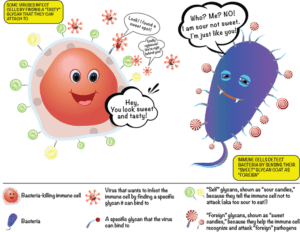
Every single cell in the human body is covered with a collection of glycans which are assembled using various simple sugars like glucose, mannose, galactose, sialic acid, glucosamine and frucose as building blocks. By sensing the type of sugar coat present, our immune cells can identify other cells as friend or foe. This is because bacteria have sugars on their surfaces that are never seen on human cells – the pathogen’s sugars are sensed by the immune system and that identifies the bacteria as ‘foreign.’ Image credit: Emanual Maverakis, CC BY-SA
Glycans label our own cells and identify them as ‘self’
The fuzz around a cell is its glycan coat. Being on the outside of our cells, glycans are the first point of contact for most cellular interactions and thus influence how our cells communicate with one another. You can also think of the glycans as a unique cellular “barcode.” Thus, a kidney cell’s fuzz will look different from an immune cell’s fuzz. But there are also similarities. In fact, the immune cells that survey our body searching for pathogens know not to attack our own “self” cells because of common features in the glycan “barcode” which are shared by all cells of our body.
In contrast, bacteria and parasites like malaria have different “sugar coats” that are not seen on human cells. When bacterial sugars are tagged as “foreign,” a person’s immune system targets the bacterium for destruction. However, some harmful bacterial pathogens like group B streptococcus, which commonly cause severe infections in babies, can avoid immune detection by impersonating human cells by carrying similar glycans as a disguise – like the wolf dressed in sheepskin.
Unfortunately some pathogens are also able to use our glycans to help them cause disease. Deadly viruses like HIV and Ebola have evolved to grab hold of specific glycans which they then “lock” onto as they infect our human cells. Therapies that either block these viruses from interacting with our glycans, or that attack virus-specific glycans may be a new avenue to treating these infections.
The sugars on our cells and on bacterial cells label them as friend or foe. Image credit: Emanual Maverakis, CC BY-SA
New research has also shown that glycans play a huge role in the development of autoimmune diseases like rheumatoid arthritis and autoimmune pancreatitis. This is not surprising since glycans directly influence the function of immune cells.
Normally, our immune cells act as our body’s “defense system,” and identify and destroy foreign invaders like harmful bacteria or viruses. But when the body mistakenly labels our own cells as the enemy and launches an internal attack on itself, autoimmunity is born. Interestingly, in such instances, it is the glycans present on the misbehaving self-attacking antibodies that will dictate the strength of the attack on the body. This abnormal immune response can even be directed against glycans. For example, the immune system can mistake “self” glycans as if they were “foreign” molecules. Our research team recently published an article that introduced the glycan theory of autoimmunity, which explains some of these relationships.
Follow the latest news and policy debates on sustainable agriculture, biomedicine, and other ‘disruptive’ innovations. Subscribe to our newsletter.
There have been many studies linking consumption of red meat with diseases like atherosclerosis and diabetes, but they have not been able to show why or how this occurs until recently. One intriguing study suggests that the culprit was a sugar with the unwieldy name, nonhuman sialic N-glycolylneuraminic acid, or Neu5Gc for short. Neu5Gc is found in all mammals except humans, because the early humans that could make Neu5Gc died from an ancient malarial parasite.
However, although we now lack the ability to produce Neu5Gc, our bodies still have the ability to incorporate it into the glycans on our cells if we obtain it by eating red meat. Once it becomes part of our cells’ glycan coat, our cells then have a “foreign” substance – Neu5Gc – surrounding them. This can trigger inflammation throughout the body because our immune system recognize Neu5Gc as “foreign” and attacks it. The chronic inflammation caused by these internal attacks can lead to heart attack, stroke and even cancer.
Our bodies synthesize tens of thousands of unique glycans, often with branching structures formed from simple sugar building blocks. Proteins or fats can also be modified by dozens of unique glycans. These countless combinations make mapping glycans a difficult task because we need a practical and efficient way to analyze hundreds of thousands of glycan patterns.
Our research team has now developed methods to rapidly and robustly monitor the human glycome. By capitalizing on engineering advancements and improvements in sample processing, our technique can monitor thousands of glycans at once, which allows us to characterize the glycans in cells from healthy controls and patients with a variety of different diseases. Our goal is to use this data to develop predictive models to help clinicians diagnose and treat all human diseases. We believe that a new wave of medical advancements will arrive as we unlock the “sugar code.”
Emmanuel Maverakis is an award-winning physician-scientist at the University of California, Davis. He has a long-standing interest in autoimmunity
Carlito Lebrilla is a distinguished Professor of Chemistry at the University of California, Davis. He is developing mass spectrometry based tools for the discovery of markers for cancer including ovarian, breast, and prostate
Jenny Wang is a medical student at Albert Einstein College of Medicine, and a clinical research fellow at UC Davis Department of Dermatology. Her research interests include autoimmune skin diseases and complex medical dermatology
In July, the US Environmental Protection Agency issued an extensive report that reviewed decades of science and declared that a very popular herbicide did not present any human health problems. As they have in reaction to previous EPA reports exonerating herbicides, anti-GMO groups howled in protest.
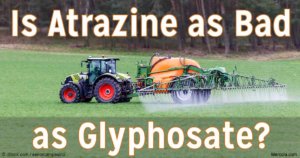
But this time, the herbicide was one that, while widely used by farmers, hasn’t yet gathered the headlines and legal focus of that ‘other’ popular herbicide, glyphosate (known in its patented version as “Roundup”). The subject of last summer’s report was the herbicide
atrazine. There are increasing signs that atrazine is the next target of groups opposed to GMOs (although atrazine is applied to conventional and GM plants) and synthetic chemicals used in modern agriculture.
According to the anti-modern agriculture Environmental Working Group, “EPA Ignores the Science, Dismisses the Risks to Children’s Health from Syngenta’s Atrazine.” EWG is now demanding a ban on the use of atrazine in the US:
In a move that echoes pesticide industry wishes, the Environmental Protection Agency chose to ignore recent science and human health studies on atrazine, a weed-killer that turns male frogs into females and may increase the risk of cancer.
Yet when the EPA published its latest review of atrazine, new research was discarded, putting the interests of pesticide manufacturers ahead of human health.
Overall, the agency:
Ignored more than 10 human epidemiological studies showing human health harm from atrazine in drinking water;
Ignored the data showing that atrazine can change brain function and behavior;
Dismissed the children’s health impacts from atrazine; and
Discounted the potential cancer risks of atrazine.
Déjà vu all over again: Atrazine’s regulatory review history foreshadowed today’s glyphosate attacks
EPA report was comprehensive, thorough and exculpatory. The agency’s conclusion was even firmer than in previous reviews. Previously, the agency had measured uncertainty, a way to determine how well animal testing translates to human exposures. In its latest study, the agency looked at 100 epidemiology studies done since 1990, as well as thousands of other reports, and found that it could reduce its uncertainty about animal-to-human results by about two-thirds. The study also found that while atrazine could be detected in water, it was levels far below safe exposures. And no risk of cancer or other serious health problems in humans was found.
Not so long ago atrazine — and not glyphosate — was the poster child for anti-pesticide activists. EPA’s recent review of atrazine, in fact, began almost a decade ago as a “special” re-review by President Obama’s then newly-appointed head of the Office of Pesticides, Stephen Owen. It was labeled “special” because EPA had just ended its regularly scheduled review of atrazine three years before and concluded that it was safe as used. Under normal circumstances, the herbicide would not have come up for another review for many years. But in this pre-glyphosate hysteria era, environmentalists had atrazine in their sights, and the Obama administration as its ally. As is now the case with glyphosate, there was enormous interest among certain trial lawyers in securing an adverse regulatory ruling on atrazine to give their class action lawsuit against the chemical a boost.
Fears were circulated around findings of micro-trace amounts of atrazine in water (similar to activist groups now hyping finding parts per billion traces of glyphosate in food). The Natural Resources Defense Council hyped the hysteria with a report called “Poisoning the Well,” claiming widespread contamination of drinking water by atrazine, and the New York Times turned it into a front-page story.
But micro-traces do not equate with danger to humans. Like glyphosate, atrazine is remarkably benign to animals and people as well. It is physically impossible to dissolve enough atrazine in water to have an adverse impact on health. At the trace amounts it is found, a human could drink thousands of gallons of water every day for 70 years and still have no effect. Claims that atrazine posed serious to frogs reviewed by regulatory agencies in the US, Australia, New Zealand and elsewhere did not hold up under scrutiny.
As in the case of glyphosate today, scientific and regulatory bodies around the world consistently have found atrazine safe to use, including those in the US, Canada, Great Britain and Australia, as well as the World Health Organization. Even as Obama’s EPA was bearing down on the chemical, the WHO was raising the maximum allowable level in drinking water from 3 parts per billion to 100 parts per billion. The herbicide had been around at that point for some 50 years and its health profile had been studied more extensively than any other agricultural chemical on the market. It’s often stated in glyphosate’s defense that there are 800 scientific studies pointing to its safety. With atrazine, there are now almost 7,000 such studies now on file at EPA.
How do these herbicides work and how are they used?
Many farmers in fact use both glyphosate and atrazine—and safely, when handled properly. Both are herbicides but act differently. In fact, before the advent of genetically modified crops that could resist glyphosate (so-called “Roundup Ready” crops), farmers used a combination of glyphosate and atrazine to combat weed growth. Even today, the combination is considered ideal for weed control with genetically modified corn.
Atrazine is often formulated with up to 45 other pesticides and can be sprayed or mixed with fertilizer. It is a pre- or post-emergence herbicide, selectively controlling grass and other leafy weeds. For at least 35 years, it’s been used on asparagus, bananas, citrus, coffee, conifers, fruits, grasslands, guavas, corn, palms, sorghum, sugar cane, roses and vines. It’s popular on roadsides, parking lots and as an anti-fungal in swimming pools.
Glyphosate, which was registered in 1974, is a non-selective systemic herbicide, blocking the activity of the enzyme enolpyruvylshikimate-3-phosphate synthase (EPSPS for short) in the shikimic acid pathway used by weeds and other plants and microorganisms (but which doesn’t exist in mammals) preventing synthesis of key amino acids. It remains the world’s most popular pesticide, and is used on fruits, vegetables, lawns, aquatic areas, forests, and roadsides and parking lots. It is also, of course, used on crops genetically modified to resist the product, including canola, corn, cotton, soybeans, and sugar beets.
The Environmental Working Group and other other advocacy groups that campaign against modern agriculture (in favor of ‘agroecology’, which they falsely claim entails the use of few chemicals) often point to findings by the WHO’s International Agency for Research on Cancer (IARC) to justify their hostility to some farm chemicals. IARC issued a 2015 monograph declaring glyphosate as a “Class 2a Probable Carcinogen.”
IARC’s finding on glyphosate has been challenged by every major oversight agency in the world, including the EPA and the European Food Safety Authority. The World Health Organization itself has rejected its sub-agency’s ‘hazard’ finding, concluding it did not adequately take into account realistic real-world exposure and did not review all the relevant studies. Moreover, much has been reported about what appears to be substantial conflicts of interest by top IARC scientists, its selective rejection of exculpatory data and its focus on hazard over risk.
As for atrazine, IARC has twice reviewed the herbicide; once in 1991 and again in 1999. The first monograph declared that atrazine was “2B; possibly a carcinogen.” The second review pushed the herbicide further down, as category “3; not classifiable as to carcinogenicity to humans.” There are reports that the organization will once again review atrazine, although its chemical profile has not changed and there are no new relevant studies that suggest any additional health dangers.
“EPA and regulatory agencies around the world have stated that atrazine is not linked to cancer,” said Tim Pastoor, scientist and former risk manager at Syngenta, which products atrazine, and who is now an independent consultant. “IARC would be unnecessarily duplicating numerous reviews done around the world, including by its parent organization, the WHO.”
In testimony to the U.S. House Science Space and Technology Committee in February, Pastoor pointed to IARC as “an antiquated review process that because of its reliance on hazard over real-world risk draws on scientific models that are half a century old. While cancer classification systems such as IARC’s may have served a useful purpose when they were created, they are as irrelevant today as the telegraph or 8—track tape player. The program fails to consider key factors such as potency and potential human exposure in its declarations of carcinogenicity.”
Follow the latest news and policy debates on sustainable agriculture, biomedicine, and other ‘disruptive’ innovations. Subscribe to our newsletter.
Another, far larger study, that groups like EWG tend not to cite is the long-term study on pesticides and fertilizers, the Agricultural Health Study. A longitudinal (25 years so far) analysis of 90,000 pesticide applicators and spouses living in Iowa and North Carolina, the study’s scope is equivalent to other hard-hitting research endeavors, like the Harvard Nurses Study, or the Framingham Heart Study, both highly regarded in scientific (in those cases, medical research) circles.
NGOs re-invigorate anti-atrazine campaigns
“This study, groups like EWG and NRDC tend to ignore,” said Pastoor. But other scientists, and the EPA, have not. Likewise, the AHS, funded by the US National Institutes of Health (NIH) and the National Institute of Occupational Safety and Health (NIOSH) has found no links between the herbicide and cancer in these workers and immediate families. Whether studies like these will temper activist attempts to target other pesticides like atrazine remains to be seen.
Some anti-pesticide activists have found unlikely allies among pro-technology scientists and science communicators. Crop biotechnology advocates have noted that a ban on glyphosate would result in farmer’s use of more hazardous pesticides. Atrazine is the most likely replacement, but some GMO supporters, bruised by the success of the glyphosate demonization campaign, lump it into a vague category of supposedly dangerous “plan B” pesticides to underscore how glyphosate is.
In September, a report by Canadians Robert Saik, founder of the Agri-Trend group of companies and retired government biologist Christopher Dufault analyzed the effects of glyphosate, and including this statement:
On the environmental front, glyphosate dramatically reduced the use of more toxic herbicides such as atrazine and metolachlor and s-metolachlor—increased crop production with fewer and lower rates of herbicide needed. Glyphosate also resulted in decreased tillage—allowed for direct and zero-till seeding practices that reduced the amount of fossil fuels needed to produced crops, which led to increased soil organic matter and carbon sequestration in the soil.
“Atrazine can be nasty stuff,” Tweeted Stephan Neidanbach, a long-time supporter of using new technology in health and agriculture, in an exchange just last week. “Changing to glyphosate and the GMOs associated helped clean up groundwater in Maryland.”
No, it’s not nasty stuff. Although atrazine is more toxic than glyphosate, it still tests out as very safe for farmers and trace amounts pose no danger to consumers. Throwing atrazine under the regulatory bus to in an attempt to defend glyphosate is just not good science.
Andrew Porterfield is a writer and editor, and has worked with numerous academic institutions, companies and non-profits in the life sciences. BIO. Follow him on Twitter @AMPorterfield
For centuries, sugarcane has supplied human societies with alcohol, biofuel, building and weaving materials, and the world’s most relied-upon source of sugar. Now, researchers have extracted a sweet scientific prize from sugarcane: its massive and complex genome sequence, which may lead to the development of hardier and more productive cultivars.
Producing the comprehensive sequence required a concerted effort by over 100 scientists from 16 institutions; the work took five years and culminated in a publication in Nature Genetics.
…
The complete genome sequence was well worth the wait and the effort because of its potential to aid the effort to improve sugarcane. The sugarcane grown by most farmers is a hybrid of two species: Saccharum officinarum, which grows large plants with high sugar content, and Saccharum spontaneum, whose lesser size and sweetness is offset by increased disease resistance and tolerance of environmental stress.
Lacking a complete genome sequence, plant breeders have made high-yielding, robust strains through generations of crossing and selection, but this is an arduous process relying on time and luck.
Brain-imaging studies have revealed that several blueberry-size regions in the temporal lobe—the area under the temple—specialize in responding to faces. Neuroscientists call these areas “face patches.” But neither brain scans nor clinical studies of patients with implanted electrodes explained exactly how the cells in these patches work.
Now, using a combination of brain imaging and single-neuron recording in macaques, biologist Doris Tsao and her colleagues at the California Institute of Technology appear to have finally cracked the neural code for primate face recognition. The researchers found the firing rate of each face patch cell corresponds to a separate facial feature. Like a set of dials, the cells can be fine-tuned to respond to bits of information, which they can then combine in various ways to create an image of every face the animal encounters. “This was mind-blowing,” Tsao says. “The values of each dial are so predictable that we can re-create the face that a monkey sees by simply tracking the electrical activity of its face cells.”
…
The findings, which were published recently in Cell, provide scientists with a comprehensive, systematic model for how the brain perceives faces. This human cerebral machinery is very similar to that of monkeys.
…
Understanding the brain’s facial code could help scientists study how face cells incorporate other identifying information, such as sex, age, race, emotional cues and names.
In 2008, the French government announced a dramatic shift in agricultural policy, calling for pesticide use to be slashed in half. And it wanted to hit that target in just a decade. No other country with as large and diverse an agricultural system had tried anything so ambitious ….
Since then, the French government has spent nearly half a billion euros on implementing the plan, called Ecophyto. It created a network of thousands of farms that test methods of reducing chemical use, improved national surveillance of pests and plant diseases, and funded research on technologies and techniques that reduce pesticide use. It has imposed taxes on farm chemicals in a bid to decrease sales, and even banned numerous pesticides, infuriating many farmers.
The effort has helped quench demand on some farms. Overall, however, Ecophyto has failed miserably. Instead of declining, national pesticide use has increased by 12%, largely mirroring a rise in farm production ….
…
The French government agrees. Officials are now finalizing a revised plan dubbed Ecophyto 2+. It will boost research, add demonstration farms, increase taxes on pesticides, and prohibit more compounds. President Emmanuel Macron has even urged a ban of glyphosate, the world’s best-selling weed killer and an important tool for many farmers.
To mark the occasion of World Food Day, farmers from around the world will convene in Iowa to share thoughts on the challenges they face and the technologies and tools that will help them meet those challenges.
As part of the World Food Prize events in Des Moines, farmers from ten countries will participate in a two-day Global Farmer Roundtable hosted by the Global Farmer Network.
Among the participants will be three alumni of Cornell Alliance for Science farmer training courses. Below is an introduction to the farmers who will be representing AfS in Iowa.
AD Alvarez is a corn (maize) farmer in the Philippines. He grows insect-resistant Bt corn on his 35-hectare farm on the Camotes Islands and is working tirelessly to improve the lives of his fellow island residents. But he does that by showing, not telling.
The original motive behind [IQ] tests was to get a diagnostic to select children at the lower ends of the intelligence scale who might need special education to keep up with the school curriculum. But then [Professor Lewis] Terman got a brilliant idea: Why not study a large sample of children who score at the top end of the scale?
…
The result was a group of 1,528 extremely bright boys and girls who averaged around 11 years old. And to say they were “bright” is a very big understatement. Their average IQ was 151, with 77 claiming IQs between 177 and 200.
…
Now comes the bad news: None of them grew up to become what many people would consider unambiguous exemplars of genius. Their extraordinary intelligence was channeled into somewhat more ordinary endeavors as professors, doctors, lawyers, scientists, engineers, and other professionals.
…
[Many] failed to become highly successful in any intellectual capacity. These comparative failures were far less likely to graduate from college or to attain professional or graduate degrees, and far more likely to enter occupations that required no higher education whatsoever.
…
[T]he IQs of the successful men did not substantially differ from the IQs of the unsuccessful men. Whatever their differences, intelligence was not a determining factor in those who made it and those who didn’t.
An internal investigation by Harvard Medical School has determined that 31 scientific publications from the laboratory of a high-profile cardiologist contain fraudulent data.
Piero Anversa and his colleagues were credited with finding a population of cells in the heart that suggested the organ has the ability to regenerate. His work, underwritten by millions of dollars in federal funding, helped lay the groundwork for clinical trials, and cardiologists continue to study ways to repair the heart with stem cells.
But the cells Anversa described, so-called “c-kit” stem cells, don’t appear to work in the way he suggested, and subsequent research has raiseddoubt that they can regenerate heart tissue.
He and other members of his laboratory left the Harvard-affiliated Brigham and Women’s Hospital in 2015 under the shadow of the ongoing internal investigation over the integrity of the work performed in his lab.
…
“This body of work has, for better or worse, been hugely influential,” said Eduardo Marbán, director of the Smidt Heart Institute at Cedars-Sinai Medical Center. “Despite the fact that several prominent laboratories failed to confirm key findings, c-kit positive heart cells were rapidly translated to clinical testing in heart failure patients. … One can only hope that no patients have been placed at risk in clinical trials based upon fraudulent data.”
The U.S., Canada and Mexico collectively addressed agricultural biotechnology like genetically modified organisms for the first time in the new NAFTA deal, agreeing to language that experts see as a major step in America’s effort to export its biotech model across the globe.
The inclusion of the chapter is designed to set a standard for future trade deals and send a message to other U.S. trading partners, like the European Union and China, which U.S. seed and pesticide manufacturers have criticized for having an unpredictable regulatory approach, said Andy LaVigne, president and CEO of the American Seed Trade Association.
…
Groups representing biotech companies and agribusiness contend the provisions in the U.S.-Mexico-Canada Agreement, or USMCA, are aimed at making trade in GE products more predictable and ensuring that disputes can be resolved more quickly, while also protecting billions of dollars in biotech industry investments in research and development.
Critics argue the language — if adopted in future trade agreements — would make it more difficult for countries to regulate GE crops and block shipments of varieties that haven’t been approved. More broadly, they say it could further entrench corporate control of new seed varieties and pesticides and limit farmers’ options in the marketplace.
Three farmers in Nebraska just plead guilty to a food fraud scheme in which they were selling conventionally grown corn and soybeans as organic. They pulled off this scheme from 2010 to 2017 and made nearly $11 million in the process. How could they get away with it for so long?
For starters, nobody can tell the difference between conventional and organic food. It’s not as if organic corn and soybeans look, smell, or taste differently compared to their conventional counterparts. So, the only way to catch food fraud is by doing a chemical analysis. In this case, the analysis would look for the presence of pesticides that are banned according to organic agriculture’s (completely arbitrary) rules.
These rules are supposedly enforced by the National Organic Program (NOP), which is part of the USDA. Obviously, it isn’t doing a particularly good job. According to the Washington Post:
“[T]he [organic food] system suffers from multiple weaknesses in enforcement: Farmers hire their own inspection companies; most inspections are announced days or weeks in advance and lack the element of surprise; and testing for pesticides is the exception rather than the rule.”
In other words, the USDA’s policy is just to trust farmers and suppliers if they say their food is organic ….
It shouldn’t hurt to put on socks, wash hands, or walk about, but for some people with damaged nerves, certain innocuous actions can be agony—a condition called mechanical allodynia. Now, researchers have discovered in mice that, regardless of whether such nondamaging activities are actually perceived as painless or painful (as in allodynia), the very same cells—those containing high levels of the protein Piezo2—transmit the tactile information to the central nervous system.
…
[Alexander] Chesler and colleagues gave four such PIEZO2-lacking patients capsaicin injections into their forearms to induce local allodynia, their sense of touch at the inflamed site remained deficient compared with that of healthy controls, who in contrast felt pain.
…
[T]hese results indicate that Piezo2 transmits the sense of touch, specifically, mechanical pressure, regardless of whether it is perceived in the brain as painful or painless. An inability to transmit this pressure sensation because of the missing transducer thus fails to produce a pain sensation in allodynia.
…
A Piezo2-inhibiting treatment could not be used systemically to treat patients with chronic allodynia because the sense of touch throughout the body would be affected. If a locally administered treatment, such as a topical cream, could be developed, says [neurologist Clifford] Woolf, a patient’s “sense of touch and tactile allodynia would be diminished,” while their normal sense of pain would remain intact.
National Biotechnology Development Agency (NABDA) has warned activists to stop campaigning against genetically modified crops, describing the act as being anti-modern technology in the country. Speaking to The Guardian, Dr. Rose Gidado of the NABDA, said some well-funded non-governmental organizations were funding the activists to raise false claims that GMOs cause cancer and infertility. She cited Home of Mother Earth Foundation, among those campaigning against GMO crops; Greenpeace, which is against golden rice that is fortified with vitamin A, and Action Aid, which is campaigning against genetically modified banana.
…
She said: “The situation is not peculiar to Nigeria alone as activists globally, have been rallying support to discredit government agencies, and institutes from introducing genetic modifications to agriculture.”
She further explained that anti-GMO campaigns were aimed at killing the development and deployment of GMOs, adding that some NGOs were lobbying to stop [Nigeria] from adopting them.
Depression is an evolutionary conundrum. On the one hand, it’s the leading cause of disability worldwide; on the other, the genes that give rise to it have been around at least as long as modern humans have walked the Earth. That means it must play a role in our survival, though scientists don’t know what. Now, bringing them closer to the answer is a new, equally perplexing study showing that depression might be linked to navigating the social world.
…
There’s no one gene that can predict depression, [researcher Xenia] Gonda explains to Inverse, but her research explains the role of one important gene — the serotonin transporter gene 5-HTTLPR— to tell a bigger story about how depression may have survived over the years. This strange single gene seems to play two roles over the course of a person’s life.
…
In youth, it appears to help people navigate and protect themselves from stressful social environments. In adulthood, it turns its back and makes financial stress even more difficult to deal with.
…
[E]volutionarily speaking this gene is useful for survival at the age when humans have babies, which is why it kept getting passed on through the generations. Its ill effects don’t kick in until people are a little older, at which point it doesn’t matter as much in an evolutionary sense.