Many people believe that a so-called “genetically modified organism” (GMO) is a term that has some significance for interpreting the safety of food. Most life scientists — geneticists, biologists, ecologists, and agronomists — are pretty sure that the opposite is true.
…
An in-depth study released by the U.S. National Academies of Sciences, Engineering, and Medicine makes clear that the process of genetic engineering is not riskier than older methods of genetic alteration. The results of that report basically confirm a similar analysis that was released more than a third of a century ago. From the 1990s to today, many position statements by scientific societies, not to mention countless papers by individual scholars, have reaffirmed that axiom.
…
While some members of the public are concerned about GMOs, the overwhelming majority of experts do not share this concern. Worse, the groups that fuel the Frankenfood fearmongering are reactionary anti-biotech groups that profit from making people afraid of their dinner. The media, which feels compelled to give “both sides” of the debate, creates false balance and a distorted picture of scientific reality.
…
Indeed, those who demand never-ending tests to “prove the safety” of GMOs are not able to put forward any science-based reason: not a single peer-reviewed paper has ever been published which even gives theoretical justification for considering DNA-tinkering to be inherently dangerous.
As consumer interest grows in probiotics and other supplements that claim to regulate gut microbes, experts are posing a critical question: Are they safe?
Probiotics are increasingly popular, from Greek yogurt and kombucha to pills chock-full of bacteria in the supplement section of the grocery store. But a new analysis published [July 16] in Annals of Internal Medicine finds that many studies of probiotics and similar products fail to adequately report on safety and adverse events. And without that information, the authors say, it’s impossible to broadly conclude whether the products are safe.
…
The study looked at how often those downsides were studied in 384 randomized, controlled trials of probiotics, prebiotics, and synbiotics.
…
The study’s authors found that 37 percent of trials didn’t report safety results and 28 percent didn’t report harms-related data.
…
Reporting of serious adverse events was even less common: 80 percent of the trials didn’t report the number of serious problems that cropped up during the study. And almost none of the studies included a definition of adverse events or serious adverse events.
“We can’t say if the probiotics are safe or not, because we don’t have the data,” said Aida Bafeta, one of the study’s authors and an epidemiologist at the Institute of Social and Preventive Medicine in Lausanne.
An emerging body of research unequivocally confirms the need to shift our diets away from a dependency on animal agriculture, and it is clear that a challenge this demanding and urgent requires a multi-pronged, innovative approach.
Many have argued that a widespread transition to a plant-based diet is required…However, in the past few years, scientists and entrepreneurs have begun to pioneer an entirely new area of biotechnology that would enable consumers to continue enjoying genuine meat products with a fraction of the environmental, public health, and ethical impacts incurred by current industrial animal agriculture practices. The production of clean meat entails growing the animal cells that comprise meat…through large-scale bioprocesses rather than breeding, rearing, and slaughtering whole animals.
…
To overcome the barriers to achieve low-cost clean meat production at scale, there is tremendous need for collaboration between scientists and industry leaders…
…
Tapping into this enormous potential for cross-disciplinary collaboration will be essential to resolve critical questions and mobilize the clean meat industry. As the search for solutions to the environmental, animal welfare, and public health problems posed by a growing population dependent on animal agriculture intensifies, the success of the of the clean meat field will be instrumental to a greener, safer, and more humane future.
Schizophrenia is considered a disorder of the mind, influencing the way a person thinks, feels and behaves. But our latest research shows that organs, other than the brain, also change at the onset of the disease.
Scientists have known for a long time that people with schizophrenia have much higher rates of physical illness compared with the general population, and this contributes to startlingly high rates of premature death. People with the disorder die 15 to 20 years earlier than the average person.
This poor physical health has often been seen as a secondary effect of illness. Antipsychotic drugs, for example, are associated with an increased risk of weight gain and type 2 diabetes. Lifestyle factors have been thought to play a part, too. A person with debilitating mental symptoms is more likely to forgo exercise and have a poor diet.
However, in recent years, scientists have observed that people who have recently been diagnosed with schizophrenia and who aren’t on any medication yet show evidence of physiological changes, such as an overactive immune system. Could it be that schizophrenia is in fact a body-wide disorder?
Mis- and disinformation are distorting science and public policy. Subscribe to our Daily and Weekly Digests for incisive coverage of ‘disruptive’ innovations in AI, agricultural biotechnology, food, chemicals, nuclear energy, vaccines, and other disruptive innovations.
My colleagues and I examined evidence of physiological changes around the body at the onset of schizophrenia and compared it with evidence of changes within the brain in the same group of people. We pooled data from multiple studies, examining markers of inflammation, hormone levels and heart disease risk factors, including glucose and cholesterol levels. We also pooled data from studies examining brain structure, levels of different chemicals within the brain, and markers of brain activity.
We showed that compared with the general population, early schizophrenia is associated with changes in brain structure and function. We also showed that early schizophrenia is associated with various changes around the body. We calculated the magnitude of these changes using a statistical measure known as the effect size. At the onset of schizophrenia, we observed that there was no difference in the effect size for changes within the brain compared with the effect size for changes around the body, suggesting that schizophrenia might indeed be a whole-body disorder, and one that should be treated as such.
Three possible explanations
There are three theories which might explain how alterations within the brain might be associated with alterations around the body in schizophrenia.
First, dysfunction around the body may cause changes in the brain, ultimately leading to schizophrenia. This process has been seen in certain rare cancers that produce antibodiesthat target the brain and trigger psychosis. If the tumour is removed, the psychotic experiences improve.
High levels of cortisol are linked to weight gain. Image credit: DONOT6_STUDIO/Shutterstock.com
Second, symptoms of schizophrenia may result in physical health disorders. An example of this is the stress of psychosis resulting in raised levels of the steroid hormone cortisol. High levels of cortisol are associated with weight gain, diabetes and raised blood pressure.
Third, symptoms of schizophrenia and physical health disorders may arise via different mechanisms but from a common risk factor. An example of this is how famine experienced by a pregnant mother increases the chances of her child developing both diabetes and schizophrenia in adult life. The increased risk of schizophrenia may be due to impaired development of the child’s brain as a result of the mother’s malnutrition. The increased risk of diabetes may be due to changes in the child’s ability to metabolise glucose, again a result of the mother’s malnutrition.
Work still to be done
We need to do more work to figure out whether changes around the body are a cause or a consequence of schizophrenia. One approach is to look at those people who are at risk of developing schizophrenia to see how changes around the body evolve in the ones who develop schizophrenia compared with those who don’t. More work is also needed to see how changes around the body respond to changes in the severity of symptoms of schizophrenia.
Finally, most premature deaths seen in schizophrenia are due to cardiovascular disease. Life expectancy in schizophrenia has failed to improve over recent decades. Studies are needed to determine if addressing physical health early on will reduce mortality in schizophrenia.
Toby Pillinger is a doctor and clinical researcher at King’s College London working in the field of treatment resistant psychosis. Follow him on Twitter @tobypill
Organisms created by methods that alter the DNA, including CRISPR gene editing, should be subject to the same EU laws as genetically modified organisms, the European Court of Justice ruled today [July 25].
The ruling is being hailed as a victory for environmentalists. However, the effect might make it so expensive to launch gene-edited crops that few organisations besides big multinationals will be able to do it. The decision will have global reverberations because the EU is such a huge market.
…Then, in the 1950s, they started deliberately inducing random mutations with radiation or toxic chemicals. Much of the food we eat today, including some strains of wheat, comes from crops created by such mutagenesis.
…
However, the ruling continues: “It is apparent from the GMO Directive that it does not apply to organisms obtained by means of certain mutagenesis techniques, namely those which have conventionally been used in a number of applications and have a long safety record…”
…
There’s confusion over the ruling’s significance, though. Some think the EU will definitely follow the ruling, which would be bad news for biologists wanting to create genome-edited products.
Others think the ruling is non-binding advice, and will not necessarily determine EU policy. Ahead of the ruling, New Scientist had asked the European Commission which is correct, but did not receive a direct answer.
A Monsanto scientist denied on [July 24th] that the company based its assertions that its Roundup weed killer doesn’t cause cancer on non-existent studies, on the tenth day of a landmark California jury trial over whether the herbicide triggered a school groundskeeper’s incurable lymphoma.
[T]he agrichemical company’s long-time toxicologist Donna Farmer explained that the U.S. Environmental Protection Agency only requires tests of Roundup’s active ingredient glyphosate and of the surfactants Monsanto adds to the product to help it spread across plant surfaces.
She said Monsanto performed those tests and found no link between either glyphosate or the surfactants and cancer in humans, allowing it to conclude that Roundup is also not carcinogenic.
…
The line of questioning by attorneys for plaintiff DeWayne Johnson stems from internal company correspondence in which Farmer told a colleague that “you cannot say that Roundup does not cause cancer. We have not done the carcinogenicity studies with Roundup.”
Johnson’s lawyers argue Roundup is more carcinogenic than pure glyphosate because surfactants boost the chemicals’ cancer-causing properties.
Establishing that Monsanto refused to test Roundup would boost Johnson’s contention that the company has known for decades that the product is carcinogenic, but didn’t warn consumers for fear of disrupting its multi-billion dollar business.
At least two EU countries continue to use emergency exemptions to sidestep a ban on pesticides that scientists believe harm bees, according to documents obtained by POLITICO.
Both Poland and Romania approved the use of neonicotinoid pesticides under emergency authorizations less than three months after the EU agreed to implement a permanent ban on the substances, produced by two of Europe’s largest chemical companies, Bayer and Syngenta.
The European Commission has written to Romania, as well as Bulgaria, Hungary and Lithuania, warning them against using such emergency derogations to spray the three banned pesticides [imidacloprid, clothianidin and thiamethoxam], according to EU officials briefed on the Commission’s stance.
EU countries opted this year to extend…a temporary ban…after the European Food Safety Authority concluded neonicotinoid pesticides “represent a risk to wild bees and honeybees.”
…
The Commission’s decision to warn Romania, Bulgaria, Hungary and Lithuania about their neonicotinoid use came after the European Food Safety Authority published seven evaluations of the emergency authorizations granted last year.
In the case of Romania, for example, EFSA evaluated six authorizations and noted that three of them where unjustifiably being applied as farmers could have used methods such as crop rotation and soil tillage, which it said are highly effective against pests.
…
But farmers continue to fight for exemptions, arguing they need the three substances…to keep insects such as flea beetles and wireworms at bay.
If there is one thorn in the side of Missouri farmer Tommy Riley, it’s pigweed.
…Riley told members of the media…he hasn’t been able to use dicamba, a product he says worked well to control weeds on his 4,000-acre farm, for a month now…
Riley was one of two farmers who gave testimonials during Monsanto’s mid-season dicamba update.
Monsanto officials reported…156 inquiries through June 28 regarding off-target drift of the chemical this season, mostly occurring from not following the label, along with other factors. That compares to similar reports last year, said Ryan Rubischko, the North America dicamba portfolio lead for Monsanto.
A week later, Monsanto updated its report, saying the company has received 381 inquiries…
Dicamba has been around for decades. However, [the herbicide] can drift in fields for miles, thus potentially damaging conventional crops of other farmers…
The Missouri Department of Agriculture implemented rules [in fall 2017] to help curb crop damage [caused by dicamba drift], which included the June 10 application deadline for [dicamba] for the Bootheel region where Riley farms.
…
In Arkansas, the application of products containing dicamba for agricultural uses is prohibited from April 16 through Oct. 31…
…
Riley said dicamba was a great solution, but he now feels like he is back to square one with the governmental limitations.
A research team from the UK and Singapore showed that a neurodegenerative condition called Gaucher disease, which can be fatal, can be prevented in mice by treating fetuses with gene therapy.
The study, published in Nature Medicine, showed mice fetuses with Gaucher disease that received an injection of the gene therapy were able to express the missing enzyme. Furthermore, animals treated with the gene therapy lived for four and a half months after birth compared to 15 days for untreated mice.
…
While the findings underscore the potential of using gene therapy to prevent and cure fetal diseases in humans in utero, the approach is still a long way from being tested in humans.
Read full, original post: Gene Therapy Could Prevent Deadly Brain Disease
The Trump administration is resisting the World Health Organization’s effort to sharply limit antibiotic use in farm animals…
…
The WHO guidelines — released in November…called for an end to giving medically important antibiotics routinely to healthy animals to promote growth or prevent disease. The United Nations agency said the drugs should be administered only to sick animals or healthy ones being raised near them, in the same flock, herd or fish population. Even then, drugs “critically important for human medicine” should not be used.
The Agriculture Department termed the effort shoddy science and one that the U.S. and other countries should have had a voice in developing. (The WHO kept country representatives out of the process to avoid potential conflicts.) U.S. policy bans antibiotics to promote growth in farm animals but still allows the drugs to be given to healthy animals to prevent disease with a veterinarian’s approval.
…
A few months earlier, at an international food-standards meeting, Mary Frances Lowe, a USDA trade official, argued that other international agencies had more expertise to provide farm advice than the WHO did.
Meghan Rodgers, the USDA’s press secretary, reiterated Lowe’s comments and said the WHO should have waited until agencies with expertise in agriculture and animal health endorsed the guidelines or should have collaborated with them in the first place.
According to [the] “predictive coding” theory, at each level of a cognitive process, the brain generates models, or beliefs, about what information it should be receiving from the level below it. These beliefs get translated into predictions about what should be experienced in a given situation, providing the best explanation of what’s out there so that the experience will make sense. The predictions then get sent down as feedback to lower-level sensory regions of the brain. The brain compares its predictions with the actual sensory input it receives, “explaining away” whatever differences, or prediction errors, it can by using its internal models to determine likely causes for the discrepancies.
…
Over the past decade, cognitive scientists, philosophers and psychologists have taken up predictive coding as a compelling idea, especially for describing how perception works, but also as a more ambitious, all-encompassing theory about what the entire brain is doing.
…
Aspects of autism, for instance, might be characterized by an inability to ignore prediction errors relating to sensory signals at the lowest levels of the brain’s processing hierarchy. That could lead to a preoccupation with sensations, a need for repetition and predictability, sensitivity to certain illusions, and other effects.
…
Predictive coding “is as important to neuroscience as evolution is to biology,” said Lars Muckli, a neurophysiologist.
Mostafa “Neo” Mohsenvand often walks around with a fisheye lens on a smartphone strapped to his chest and a black, electrode-covered neoprene EEG cap on his head. All, mind you, for science.
Mohsenvand, a graduate student in the Fluid Interfaces Group at MIT’s Media Lab, is trying to learn about what makes moments memorable by zealously gathering as much data as possible about himself and the world around him, and matching up his biometric signals with times and events.
…
So far, he’s logged over 1,500 hours of footage. Every few days he uses software to combine the videos and biometric signals, creating minutes-long films that slow down and speed up in accordance with metrics like the acceleration and deceleration of his heart rate and his level of skin conductance—things he can’t consciously control, and that he believes correspond with the noteworthiness of events in his life.
…
Heather Abercrombie, an associate professor at the University of Wisconsin—Madison who heads the school’s Mood and Memory Laboratory, says scientists tend to capture data from groups of people rather than looking at them as individuals. But since people are bound to have different physiological reactions to different situations, Mohsenvand’s one-person life logging could be useful.
“If we can capture, across time, what’s different about individuals, that’s actually great,” she says.
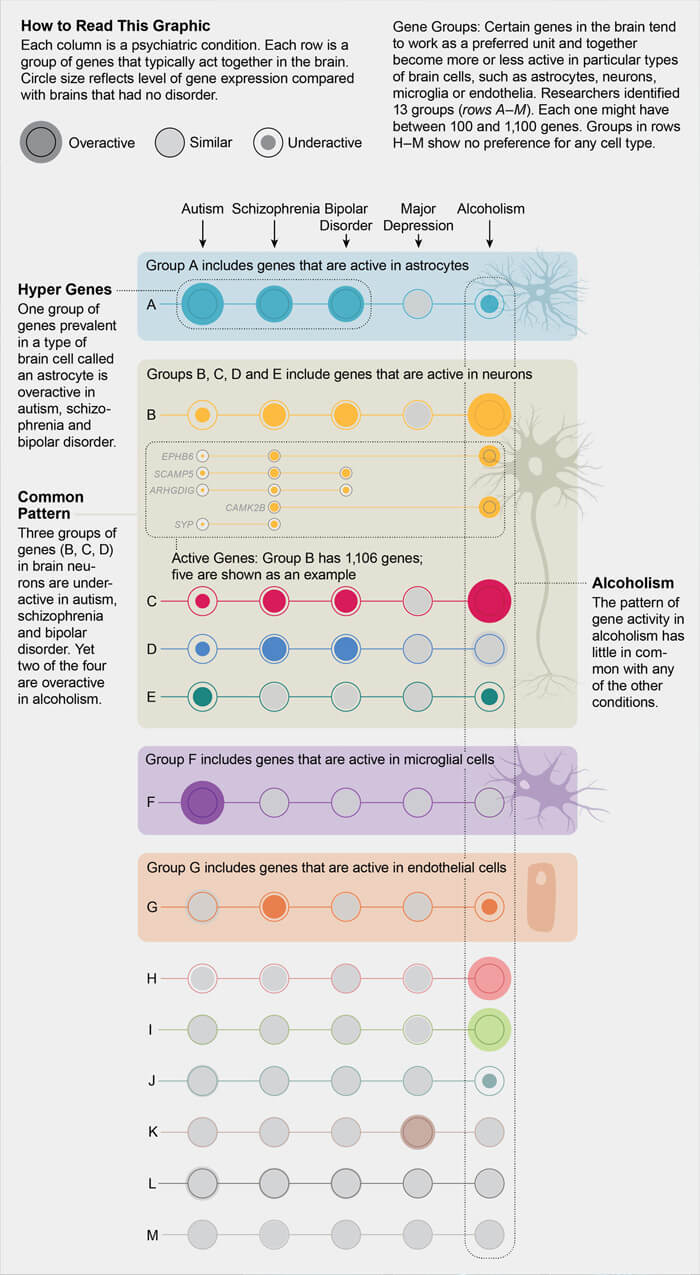
People who have autism, schizophrenia and bipolar disorder may have different challenges, but the ailments might arise from a common set of genes. Researchers compared genetic analyses of 700 human brains from deceased individuals who had one of those three disorders, major depression or alcoholism (columns) with brains of individuals who had none of the conditions. They examined 13 groups of genes thought to function together (rows). The scientists found that five groups had a pattern of overactivity or underactivity across at least three of the five conditions (blue and gray panels). Bipolar disorder, for example, was more similar to schizophrenia than to major depression even though clinicians may link bipolar disorder and depression, based on their symptoms. These insights could possibly reveal new treatments, says neurogeneticist Daniel Geschwind of the University of California, Los Angeles, one of the investigators. He adds that one path to that result, which has not yet been tested, could be to “put the different groups of genes in lab dishes and see which drugs reverse any overexpression or underexpression of the genes.”
In this era marked by Grand Canyon-sized divides among Americans, there’s one subject that seems to unite people, no matter how divergent their political persuasions. That issue is captured in three little letters: GMO.
…
We never give a second thought to the physical infrastructure, the technological capabilities, the incredible R&D that makes it all possible. It’s just part of modern life and integral to our 21st century lifestyles.
But for all our sophistication with high-tech gadgetry, a significant percentage of consumers exhibit fear and loathing of anything connected with biotech. They — we — trust implicitly that the telecom manufacturers, the Internet providers, the tech companies are all responsible actors in terms of the safety and efficacy of the devices that rule our lives.
But the idea of scientists using biotechnology to make crops hardier or more productive?
Unthinkable! Outrageous! A scourge on America that must be stopped, or at least avoided at all costs.
…
If a representative sampling of the population were asked, “Would you support a new medical treatment that triggers weight loss and could potentially ‘cure’ diabetes,” what do you suppose the answers would be? I’m guessing the responses would be overwhelmingly positive.
If you then explained that this treatment involved “gene therapy,” do you really think people would react the way they do with GMOs?
Read full, original article: Dan Murphy: Redefining GMOs
New evidence published [July 18] shows there is little or no effect of omega 3 supplements on our risk of experiencing heart disease, stroke or death.
Omega 3 is a type of fat. Small amounts of omega 3 fats are essential for good health, and they can be found in the food that we eat. The main types of omega 3 fatty acids are; alphalinolenic acid (ALA), eicosapentaenoic acid (EPA), and docosahexaenoic acid (DHA). ALA is normally found in fats from plant foods, such as nuts and seeds (walnuts and rapeseed are rich sources). EPA and DHA, collectively called long chain omega 3 fats, are naturally found in fatty fish, such as salmon and fish oils including cod liver oil.
Increased consumption of omega 3 fats is widely promoted globally because of a common belief that that it will protect against heart disease…Omega 3 fats are readily available as over-the-counter supplements and they are widely bought and used.
A new Cochrane systematic review…combines the results of seventy-nine randomised trials involving 112,059 people.
…
The researchers found that increasing long-chain omega 3 provides little if any benefit on most outcomes that they looked at. They found high certainty evidence that long-chain omega 3 fats had little or no meaningful effect on the risk of death from any cause. The risk of death from any cause was 8.8% in people who had increased their intake of omega 3 fats, compared with 9% in people in the control groups.
Read full, original post: New evidence challenges belief that omega 3 supplements reduce risk of heart disease, stroke or death
Conservative estimates place the value-added of [intellectual property] on the American economy at nearly $1 trillion annually…
…
Take, for instance, that strange-sounding acronym, CRISPR, that’s been all over the news lately. CRISPR…is a revolutionary gene-editing tool that can be used to engineer new crops, control mosquitoes, and even turn cancer cells into “turncoats” against other cancer cells, thereby shrinking tumors.
…
Scientists have known about the potential for gene-editing sequences since the late 1980s, but until this decade, scientists couldn’t test the CRISPR bacterial defense system on genetic information. Then, in 2012, researchers from the University of California (UC) Berkeley got CRISPR to work its magic on DNA contained in a test tube.
…
Unfortunately, flaws in the American patent system kept the university from capitalizing on their groundbreaking application. Broad Institute…rushed to take the technology and apply it to whole mammalian cells. They succeeded in editing these cells’ genes, and sought the lucrative CRISPR IP that UC Berkeley had already applied for. Despite UC Berkeley’s straightforward claim of “getting there first,” the Patent Trial and Appeal Board (PTAB) awarded the patent to Broad Institute…
…
Due to PTAB’s…inconsistent IP protection standards, patents deemed “too broad” often go by the wayside without regard for the original innovators behind a technology. PTAB paid no heed to UC Berkeley’s patent application…And keep in mind, every day of unnecessary litigation means a day that these potentially life-saving discoveries aren’t used.
Read full, original article: Sloppy Government IP Protection Hinders Scientific Discovery
[Recently] the Observer published an article by Mark Hertsgaard and Mark Dowie on a disturbing topic – the idea that telecoms giants might collude to suppress evidence that wireless technology causes cancer.
…
Yet as enthralling as Hertsgaard and Dowie’s narrative might be, it is strewn with rudimentary errors and dubious inferences. As a physicist working in cancer research, I found the authors’ penchant for amplifying claims far beyond that which the evidence allows troubling.
…
[A] multitude of studies have been performed to this end, and as the World Health Organisation states, there has been no evidence of detrimental health effects: “A large number of studies have been performed over the last two decades to assess whether mobile phones pose a potential health risk. To date, no adverse health effects have been established as being caused by mobile phone use.”
…
The authors conclude by stating a “lack of definitive proof that a technology is harmful does not mean the technology is safe”
…
The onus here is on the authors to prove their assertion – it is sheer logical contortion to present a lack of evidence as a superficial supporting argument.
…
[C]urrent evidence contradicts the hypothesis that mobile phones increase the risk of cancer. Scaremongering narratives may be more alluring than the less sensational, scientific findings, but they are not harmless.
At a recent event with evolutionary biologist Richard Dawkins, science writer Carl Zimmer posed the following question: “There is a gene variant in some Icelanders that protects them against Alzheimer’s disease. Do you think it is ethical to give this gene to others to keep Alzheimer’s at bay?”
“By all means,” Dawkins replied. “There is nothing wrong with improving lives.”
I definitely agree with Dawkins. However, I’d add: as long as the potential benefits outweigh the risk. And with our current understanding of human physiology and genetics, that is definitely not the case.
Human beings have always yearned to better themselves – to rise beyond nature’s lottery. We are so immersed in our modern enhancements that we are often oblivious to them. LASIK surgeries (or glasses, for that matter!), cochlear implants, plastic surgeries, and birth-control pills are all examples of things we do to overcome what we perceive as our natural limitations. But what gets people really wound up is the idea of genetic enhancement – improving traits by changing the genes inside of us.
Image credit: PressTV
Gene therapy for genetic disorders – at least, those that result from a single genetic mutation – has come a long way in the past three decades. In 2017, we witnessed several milestones, including the treatment of hemophilia and of Spinal Muscular Atrophy. But gene therapy is still complicated, with severe side effects and unforeseen consequences. For example, in early 2000s, successful gene therapy for Severe Combined Immunodeficiency was overshadowed by the development of cancer in two patients. I’d argue that for deleterious mutations, the risks are justified by the promise of treating a disease. But for enhancements, we are nowhere close to a clear justification. We know of many genetic changes that in theory should create “superhuman” traits in people, but they come with debilitating consequences.
Imagine changing a single gene so that you no longer feel pain. There are people with mutations that result in not feeling pain, a condition known as congenital analgesia. Not only is this not a superpower, but people with congenital analgesia cannot live normal lives. They burn their hands on stoves without realizing, or have severe organ malfunction without feeling any pain.
Or imagine having bones that are several times denser than the average human’s, bones so dense you could get hit by a car and walk away unscathed. In reality, people with mutations that result in unbreakable bones suffer from a condition known as Sclerosteosis. Their bones can be so dense that their brains crush under the force of their own skull. One cannot help but wonder about other genetic changes that may appear to add to our human powers, but are just terrible diseases in reality. The bottom line is that we do not know all the outcomes of creating a single mutation in an individual, and chances are we will not know enough anytime soon.
Mis- and disinformation are distorting science and public policy. Subscribe to our Daily and Weekly Digests for incisive coverage of ‘disruptive’ innovations in AI, agricultural biotechnology, food, chemicals, nuclear energy, vaccines, and other disruptive innovations.
Even if a mutation appears to have beneficial effects on the individual, we do not know all the potential side effects in the near and far future. Every now and then, based on our studies on model organisms, we come across single genes with dramatic effects on a single trait. In 1999, researchers expressed a protein that binds hippocampal receptors in the brains of mice in an attempt to improve their cognitive ability. The mice showed remarkable memory and cognitive performance, which led to the researchers naming the mice Doogie, after the genius television character Doogie Howser.
Almost 20 years later, we now know about 35 mutations in mice that improve learning and memory. We still do not know a lot about the downside to these mice, but several strains raise alarming concerns: many of the mutations that increase cognitive ability may have detrimental effects. The Doogie mice described above may be intelligent, but they have an increased sensitivity to pain. As another example, the Hras strain of mice, may excel at solving puzzles, but they have a heightened fear response. Other strains with phenomenal intelligence at complicated tasks like solving puzzles fail at simple ones like remembering where they hid their food.
The challenges are amplified when we consider that most traits are the results of tens, hundreds, or even thousands of genes, interacting in different organs. You may want to get taller, but there are about 200 genes that play a role in determining your height in your early development. Another problem is that we only move in one direction in time: we get old. Even if you could go in all your cells and change every single one of those height-altering genes for the tallest versions possible, your body is no longer in the developmental stage for those changes to manifest themselves. You can’t become super tall or super fast if you already developed with your own average genes interacting in your body.
This takes us to a whole new level of augmentation: embryo editing. Gene editing on a single-cell embryo means that the change will be passed on to the next generation(s). However, embryo editing is still in its infancy. Even the most outstanding breakthrough in embryo editing, published last year, was met with outrage and disbelief by the scientific community; a group of prominent scientists challenged the basic tenets of the paper, arguing that editing in embryos was not achieved as seamlessly as the authors had suggested.
Overall, we are nowhere close to being able to safely edit the genomes of embryos or adults. So before we start trying to turn ourselves into Usain Bolt, let’s learn more about how our genes make us who we are.
Alireza Edraki studies natural inhibitors of CRISPR-Cas9. He studies proteins from phages that can inhibit Cas9 and his research aims to use these proteins to turn Cas9 off in human cells. Follow him on Twitter @Alirezaedraki
Neuroscientist Barbara Bendlin studies the brain as Alzheimer’s disease develops. When she goes home, she tries to leave her work in the lab. But one recent research project has crossed into her personal life: She now takes sleep much more seriously.
…
Bendlin’s studies are part of a modest but growing body of research suggesting that a sleep-deprived brain might be more vulnerable to Alzheimer’s disease. In animal studies, levels of plaque-forming A-beta plummet during sleep. Other research suggests that a snoozing brain runs the “clean cycle” to remove the day’s metabolic debris — notably A-beta — an action that might protect against the disease. Even one sleepless night appears to leave behind an excess of the troublesome protein fragment.
…
[Neurologist David Holtzman] thinks Alzheimer’s disease is a kind of garbage collection problem. As nerve cells, or neurons, take care of business, they tend to leave their trash lying around. They throw away A-beta, which is a leftover remnant of a larger protein that is thought to form connections between neurons in the developing brain, but whose role in adults is still being studied. The body usually clears away A-beta.