


Featured in Weekly Newsletter

Reflex star: How our brain helps us track—and respond to—to balls, cars and other fast moving objects
New research may explain why some people—like sports stars—anticipate and react to fast-moving objects much quicker than others. When Serena ...

How food companies’ switch to non-GMO ingredients could hurt the poor
Consumers have paid significantly higher prices for non-GM foods compared with conventional counterparts in four categories, a new analysis shows ...

Delving into our complicated relationship with carbohydrates
The idea of controlling carbohydrate consumption has been bouncing around the world of diets and medicine for nearly 100 years ...
How genetics could help agroecology—the science, not the political movement
Agroecology isn’t rocket science So wrote Daniel Moss, head of the AgroEcology Fund, and Mark Bittman, former food columnist, in ...

Video: Why gene editing could change the path of human evolution
Most people think the genetics revolution is primarily about healthcare. But what's really at play is the evolutionary trajectory of ...

10 tips for better communication about pesticide science, risks
One of the biggest challenges for any risk communications professional today is to deliver positive messages on pesticides. Like any ...

Will glyphosate’s legal troubles pave the way for greater use of robots in agriculture?
Following a major blow in Californian courts recently, widely-used herbicide glyphosate has continued to take a battering, as industry professionals ...

When is it time for a scientist to call out peers over questionable research?
Sooner or later, every researcher is likely to wonder: What’s the best way to address faulty or misleading information in ...

‘White gold’: GMO cotton renews hope for Nigeria’s troubled textile industry
Nigeria's textile industry was once a thriving part of the nation's economy. The industry was once the country's second-leading employer, ...

Glioblastoma and John McCain: Why this brain cancer remains an ‘insidious enemy’
Sen. John McCain withstood beatings and torture as a prisoner of war, but he was confronted with an enemy in ...

Gene silencing through RNA interference scores first drug approval
The Food and Drug Administration recently approved the first drug based on RNA interference (RNAi). Unlike media darlings gene therapy ...

Can CRISPR help us stop wasting so much food?
CRISPR. It’s not what’s for dinner. Not yet, at least. But the hot genetic editing technology could be instrumental in ...

How John Oliver was duped by the fringe anti-science advocacy groups USRTK and the Organic Consumers Association
Sometimes it's difficult to know who is defending science and who is more concerned about identity politics and cheap laughs ...
Seeking medicine from the plants of Uganda
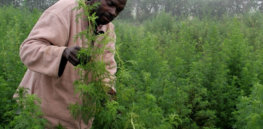
Researchers have long looked to the plants of our world to solve many of the medical problems we face. But ...

Why polio remains surprisingly hard to eradicate
Polio retains a foothold in Pakistan—and will likely continue to do so as long as basic health services are neglected ...

Why the ‘distorted memories’ of people with dementia are so important
As those with dementia lose their sense of reality, it can be helpful to validate their stories as they tell ...

USDA reveals plans to regulate GM plants based on traits, not breeding method
USDA's Sid Abel and Doug McKalip just briefed me on the new regulatory framework that is shaping up for the ...

Farmers consider a world without glyphosate—and it’s less than ideal
"More glufosinate, maybe more paraquat." "I would have to find a different burn down chemical, likely paraquat. Would use more ...

Were there two migration routes into North America? Genetics meets archaeology
Popular accounts of the peopling of North America paint a picture of a lone long-ago trek across the Bering Land ...

Europe’s decision to reject gene edited crops signals it is losing its commitment to sustainable agriculture
At the same time as Swedish agriculture is affected by the worst drought in recent memory, the European Court of ...

Does living around violence change a child’s brain?
One study suggests that young teens who witness violence exhibit differences in the structure and function of their brains in ...

Delving into our 10 million-year relationship with booze
It was conventional wisdom that the human love affair with alcohol began 10,000 years ago, with the invention of agriculture ...

Could the common cold be cured in the next decade?
Three new approaches could give us a true cure to the common cold ...

Organic Times: New satire site takes Onion-like look at crop biotechnology activists
Agriculture is a serious topic. While farmers in the developing world struggle to save their crops from pest invasions and ...

How is India’s organic-only farming experiment in Sikkim going? Peering past the propaganda, not so sustainably.
India's farm sector is in massive flux and strife right now. After a massive ten-day strike in June, Indian farmers ...

Viewpoint: There’s danger in overselling the benefits of routine DNA sequencing
For decades the potential of stem cells to cure all disease was promised. Today’s reality is that the few worthy ...

Celiac disease: What’s behind the surge in diagnoses?
A few years ago, the book “Wheat Belly” became a hit, as it pointed to new “scientifically engineered” strains of ...
