


Genetic Literacy Project

Star Trek-like transporter might solve brain disease mysteries, understand religious belief
Scientists have modeled a Star Trek-like transporter illusion to learn about how the human brain shapes our sense of spatial ...

New transplantation era beckons if we’re ok with growing organs in pigs
Some day, human organs from pigs may fill the organ gap, and the needed science and engineering is advancing rapidly, ...

Uganda’s science march reveals love, frustration of young scientists
Student scientists join global march in support of science, offer their thoughts on where things stand in Uganda ...

How Bangladesh emerged as world innovator in pest-resistant, nutritionally fortified GM crops
GMO Bt eggplant has reduced insecticide use 80-90% in Bangladesh, ushering in burgeoning era of sustainable agriculture--and more GM crops ...
Mendel meets Tinder: GenePeeks screen maps babies’ genetic risks — before conception
Genetic screening offers prospective parents new insights into the potential disease risks facing their offspring -- and maybe a chance ...

Debate heats up: Did National Academies of Science GMO report go far enough in affirming GMO safety consensus?
The debate among scientists over whether the 2016 NAS report unnecessarily muddied the debate over GMO regulations spilled over into ...

Boy or girl: Should prenatal testing be censored for fear it may become a sex-selection tool?
Some prominent ethicists push for limiting the release of prenatal testing for fear the information could be used by parents ...

Epigenetics Around the Web: IFL Science doesn’t f****** understand how humans ‘inherit’ modifications
The popular science site IFL Science whiffs at covering a major study; and can we please stop talking about 'space ...

Talking Biotech: Naturally transgenic sweet potato can be tweaked to fight plant disease, boost nutrition
Plant virologist Jan Kreuze: Disease-resistant sweet potatoes could make nutritious, naturally GMO crop key tool to fight malnutrition ...

Should the European Union continue to fund anti-science and unaccountable NGO non-profits?
Public tax money in Europe is being given with limited or no accountability to organizations actively working to undermine consensus ...
Genetic Literacy Project’s Top 6 Stories for the Week – May 1, 2017
How US NGOs are exploiting Europe’s precautionary chemophobia to ban glyphosate and GMOs | David Zaruk Can epigenetics help fuel personalized ...

Does plant patent system restrict innovation and hurt small breeders?
The one-size-fits-all approach, that imposes the patent system on the agricultural sector irrespective of the consequences, may not be in ...

Are we alone? If not, why hasn’t anyone dropped by Earth for a visit?
Scientists disagree on the probability that advanced extraterrestrials exist somewhere in the universe. Among the biggest arguments against aliens is ...

Breitbart vs. Kellogg’s: Forcing some anti-GMO progressives to choose a side
Critics of GMOs tend to align with the political left. But an ongoing feud between a right-wing news service and ...

Can epigenetics help fuel personalized medicine revolution in cancer treatment?
Already, doctors, to some degree, use personal genomics tests that integrate our unique genetic makeup into clinical decision-making. However, there ...

Costly delays: Australia’s sluggish adoption of GMO crops carries a hefty price tag
The nation lost out on $431 million in economic gains, while also missing a chance to cut greenhouse gas emissions ...

Are neonicotinoid insecticide seed treatments endangering wild bees?
Environmentalists often blame neonicotinoid insecticides for the plight of wild bee species. But the science doesn't support this hypothesis, and ...

Have patients been forgotten in the quest to build private BRCA variant databases?
Databases on life-threatening genetic mutations -- including the BRCA variants linked to breast cancer -- are maintained by corporations for ...

How US NGOs are exploiting Europe’s precautionary chemophobia to ban glyphosate and GMOs
Environmental NGOs have a harder time influencing the evidence-based US regulatory system, so they're taking the fight to Europe — ...
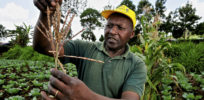
Talking Biotech: What’s blocking GMO crop adoption in Africa?
Sociologist Matthew Harsh: Poor communication between Kenyan scientists, policymakers, farmers and anti-biotech activists slows GMO adoption ...

Epigenetics Around the Web: Evolution of instincts — How ‘real’ is behavioral plasticity?
A researcher's decision to broadcast his controversial hypothesis about the evolution of instincts is irresponsible, and a study throws cold ...
Genetic Literacy Project’s Top 6 Stories for the Week – April 24, 2017
GMO corn that resists cancer-causing aflatoxin showcases biotech’s life-saving potential | Steve Savage Behold the octopus: Problem solver, tool user and now, ...

March for Science: Agony and ecstasy of a Malaysian agricultural biotechnology science communicator
In many ways, communicating science can be more difficult than scientific research. As advances in biotechnology speed up, scientists around ...

Status climb with caution: Social mobility may take a toll on our DNA
'Moving on up' is a cherished American value (and important in other societies, too). But there could be a cost ...

Behold the octopus: Problem solver, tool user and now, gene editor
The more we learn about octopuses and squids, the more mysterious they become. The ability to edit their own RNA ...

CRISPR conundrum: Is there a line between GMOs and ‘natural’ crops when genes are edited?
New gene-editing techniques like CRISPR can be detected, but can't be distinguished from "natural" genetic changes. Should regulators and the ...

Neonicotinoid fiasco: How American NGOs turn Europe against science, push EU towards insecticide ban
The current EU ban on neonics has been disastrously counterproductive, resulting in an increased use of more damaging pesticides, mainly ...

Ethiopian Jewry: Genetics of the Beta Israel muddied by historical slave ownership
Rarely mentioned by academics is the fact that Ethiopian Jews historically owned slaves. From a genetics perspective, it means this ...
